Sunday, May 20, 2012

NEW EXHIBITION SHOWCASES OLDEST ANCIENT EGYPTIAN ART

EVERYONE has looked in wonderment at the art treasures of Ancient Egypt. King Tutankhamun, Hatshepsut, Akhenaten and dynasty after dynasty of pharaonic art continue to enthrall millions around the world.

But the Egyptians were making art thousands of years before any of those pharaohs were born. And that most ancient of all Ancient Egyptian art is perhaps even more breathtakingly beautiful for its almost modernist simplicity of line and form.

New York's Metropolitan Museum of Art has put the spotlight on this pre-dynastic art dating back 6,000 years in a new exhibition entitled The Dawn of Egyptian Art.

This is art which pre-dates the pyramids by centuries. During the pre-dynastic period and the very earliest dynasties (4000–2650 B.C.), people living in the Nile Valley began recording their beliefs through paintings, sculptures, and reliefs made for their shrines and tombs. 

These works of art capture the evolving world view of these early Egyptians. Images of people, animals, and landscapes, some of which give rise to hieroglyphs, include forms and iconography that remained in use throughout the art of Pharaonic Egypt. 

This exhibition brings together some 175 objects gathered from the Metropolitan Museum's important collection of early art and from the collections of twelve other museums in the U.S. and Europe to illustrate the origins and early development of ancient Egyptian art.

The show has just opened and runs through August 5th.

Saturday, May 19, 2012

PETER WILDEBLOOD, SAINT OF ANTINOUS


ON MAY 19th, the Religion of Antinous honors our Saint Peter Wildeblood, a British journalist, novelist, playwright and gay-rights campaigner, who was born on this day in 1923.

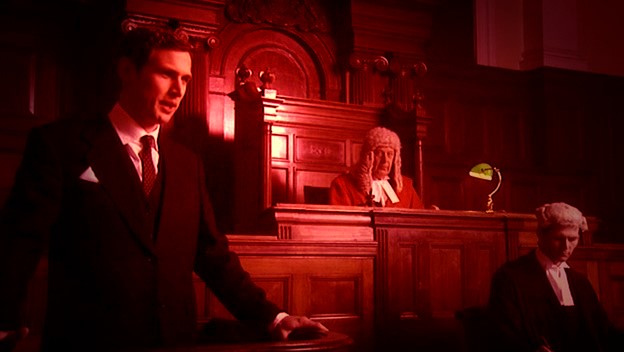
He became one of the first men in Britain to declare publicly that he was gay, when he was arrested and put on trial in a headline-making case in 1954. He was sent to prison on a conviction of "conspiring to incite acts of gross indecency and buggery" and his case created such an uproar that it helped to lead to the reform of anti-gay laws in the UK.

In the uptight post-war years of the early '50s, Wildeblood had made something of a name for himself in the theatre and as a roving reporter for a major newspaper, London's Daily Mail, when he happened to meet a 23-year-old RAF corporal named Eddie McNally in Piccadilly Circus. Although Eddie McNally was not Peter Wildeblood's type, they developed a relationship over time. 

In the summer of 1952 they arranged to go on holiday together at Edward Montagu's beach hut on the English coast. John Reynolds, who was also an airman and a friend of Eddie McNally, also joined them.

About 18 months later, on Saturday, January 9, 1954, Peter Wildeblood was arrested at his home and his house was searched. He was charged with conspiring with Edward Montagu and Michael Pitt-Rivers to incite Eddie McNally and John Reynolds to commit indecent acts.

The police tipped off the press and the story was headlined in all the Sunday newspapers the next day. Eddie McNally and John Reynolds became witnesses for the prosecution.

The media went on a feeding frenzy and his picture was plastered all over the front pages for weeks. One paper retouched his photos to make it appear that he was wearing lipstick. He was vilified in public. He later described one incident when a woman recognized him being driven past in a vehicle.

"That night, a woman spat at me," Wildeblood wrote later. "She was a respectable looking, middle-aged, tweedy person wearing a sensible felt hat. She was standing on the pavement as the car went by. I saw her suck in her cheeks, and the next moment a big blob of spit was running down the windscreen.
"This shocked me very much. The woman did not look eccentric or evil; in fact she looked very much like the country gentlewomen with whom my mother used to take coffee when she has finished her shopping on Saturday mornings. She looked thoroughly ordinary, to me. But what did I look like to her? Evidently, I was a monster."
What so troubled the decent people of the day was not that homosexual practices went on — everybody knew they always had and always would — but that anybody would openly declare himself to be "a homosexual." 

He was in the news constantly until his conviction and sentencing to 18 months in prison. Because he was (understandably) depressed, he was considered suicidal and was transferred to a dire hospital for the criminally insane where the squalid conditions affected not only his mental health but also his physical health.

He was released after 12 months and immediately launched a personal crusade to overturn anti-gay sex laws in Britain. He lobbied in Parliament and wrote articles and a book entitled Against the Law which outlined how gay people can be entrapped and harassed in their own homes for consensual activity among adults which does not affect anyone else.  

His three main points were that homosexuality between consenting adults in private ought not to be against the law, that prison only encourages homosexuality, and that in the squalor of prison hospitals there was no attempt at rehabilitation. While writing this he bought a small drinking club in Soho which attracted a mixture of types on the fringes of society. This provided material for his fictional autobiography about the club, A Way Of Life.

It was a surprise success and encouraged him to write more novels and plays which were hits on stage in London's West End in the late 1950s. In the '60s he became a well-known TV scriptwriter and producer. In the '70s he was lured by Canadian television with a lucrative contract, and emigrated to Canada, where he adopted Canadian citizenship and was responsible for numerous hit productions over the next 16 years.

When he retired in the 1980s, he went to live in a wooden Edwardian cottage in Victoria on the western coast of Canada which had a stunning view over the Juan de Fuca Straits to the Olympic Mountains above Seattle. He suffered a series of debilitating strokes in the mid-'90s which left him speechless and quadriplegic. He learned to communicate via a computer using movements of his chin. He suffered a final stroke and died November 13, 1999, at the age of 76.

In saluting Saint Peter Wildeblood, the Religion of Antinous honors the beacon of courage and hope which he represented in an age of darkness and despair for gay men everywhere. Everyone advised him to remain quiet, and yet he chose to speak out. He did not choose to be exposed but, placed at the mercy of events, he chose to become their master.

His book was a courageous act of defiance against the kind of injustice which the straight world called justice.
"Very faintly," he wrote, "as though at the end of a tunnel, I could see what I must do. I would make a statement ... I would simply tell the truth about myself ... I would be the first homosexual to tell what it felt like to be an exile in one's own country. I might destroy myself, but perhaps I could help others."


Friday, May 18, 2012

ANTONINE-ERA SHIPWRECK HINTS 

AT SMUGGLERS RING


ITALIAN archaeologists say they have found evidence of a smuggling operation aboard a shipwreck dating back to the Antonine Imperial Dynasty founded by Emperor Hadrian.

This may not seem like news, since everyone assumes smuggling was rampant in the past, just as it is now.

But archaeologists need proof before they can make such claims. Similarly, academic historians for the longest time quibbled over calling Hadrian and Antinous "gay," arguing about the semantics involved. 

That is why the curator of the British Museum shocked the academic community when he opened the exhibition "Hadrian: Empire and Conflict" in 2008 by holding a news conference and stating bluntly: "Hadrian was gay. We can say that now, but the Victorians had problems with it."

Now archaeologists are saying there were smugglers in Ancient Rome, and no one can quibble. 

 The amazingly intact wreck of an 1,800-year-old vessel in shallow waters off the coast of Sicily contains a cargo officially consisting of assorted jars once filled with walnuts, figs, olives, wine, oil and "garum" -- a tangy and exceedingly aromatic fish sauce which was something of an acquired taste. Some Patricians considered it a delicacy while others loathed it.

But archaeologists were surprised to find an undeclared consignment of ceramic tiles from North Africa, according to a report by Discovery News. The distinctive tubular tiles were apparently valuable enough for sailors to smuggle them from North Africa to Rome, where they sold for higher prices.

"They are small terracotta tubes with one pointed end. Put one into the other, they formed interlocking, snake-like tiles. Rows of these so-called fictile tubes were used by Roman builders to relieve the weight of vaulting," Sebastiano Tusa, Sicily's Superintendent of the Sea Office, told Discovery News.

Tusa will detail the wreck discovery in a forthcoming publication by the Museum of the Sea in Cesenatico, during a national meeting of underwater archaeology and naval history. 

"It was a somewhat tolerated smuggling activity, used by sailors to round their poor salaries. They bought these small tubes cheaper in Africa, hid them everywhere within the ship, and then re-sold them in Rome," Tusa was quoted by Discovery News as saying.

Dating to the 3rd Century AD, the large sunken ship was fully recovered six months ago at a depth of 7 feet near the shore of Marausa Lido, a beach resort near Trapani.

Italian archaeologists, using state-of-the-art submersible probes and sonar, have discovered numerous shipwrecks in recent years which date to the era of the Antonine Emperors, including Hadrian and his heirs. 

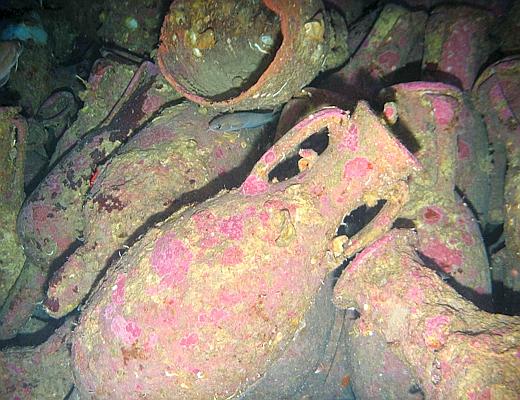
In one case, experts located five vessels largely intact, with their cargoes of wine, olive oil, fish sauce and other goods arranged in tidy rows of amphorae jars. The experts released photos showing amphorae (above left) neatly stacked just as they had been when the vessels sailed for Rome 1,800 years ago.


That shipwreck site was near the infamous banishment island of Ventotene in the Tyrrhenian Sea between Rome and Naples. Ventotene is where Augustus banished his adulterous daughter Julia the Elder.


Tiberius, Claudius and Nero also banished various of their family members and in-laws to Ventotene.

The waters around the island are noted for being treacherous which is one reason it was considered a good place to banish one's enemies, since they could not easily escape in a small boat. 

It is likely that the cargo vessels were swamped in rough seas in the 2nd or 3rd Centuries AD. They appear to have gone straight down without capsizing, landing on their keels on the seabed.

Thursday, May 17, 2012

PROTECTING ART IN AN EARTHQUAKE

YESTERDAY's blog entry about looting at the Cairo Museum proves once again how vulnerable ancient treasures are, even in the most protected settings, such as a major museum.

Besides vandalism, museum collections are also vulnerable to natural disasters such as earthquakes. At the J. Paul Getty Museum in Los Angeles, located in one of the world's most active quake zones, museum officials are taking bold new steps to protect not only their buildings but also the art treasures inside the museum. 

Their efforts coincide with tests by engineers in California to equip buildings with "seismic isolators," basically rubber bearings, such as those used commonly in Japan.

"What the bearings do is uncouple the building from the motion of the ground during an earthquake, like putting the building on roller skates," said Tara Hutchinson, an engineering professor at the University of California, San Diego. 

Rubber base isolators have already been retrofitted under the Los Angeles, Oakland and San Francisco city halls.

Wednesday, May 16, 2012

"EPIDEMIC OF LOOTING" IS SWEEPING EGYPT


EGYPTIAN lawlessness since the downfall of President Hosny Mubarak has spawned "an epidemic of looting" and tomb robbing up and down the length of the Nile, shame-faced authorities in Egypt have finally admitted.

Tales of rampant pillaging of archaeological sites have been whispered among Egyptologists and academics around the world for more than a year. The archaeological community was appalled when Egypt's most high-profile champion of ancient monuments, Dr. Zahi Hawass, resigned in protest after holding a televisised interview in which he said the Cairo Museum and innumerable tombs had been plundered during rioting over a year ago.

Now, Egyptian authorities have confessed that they are powerless to contain a situation that has reached epidemic proportions.

"Criminals have became so bold they are digging in landmark areas," including near the Great Pyramids in Giza, other nearby pyramids and the grand temples of the southern city of Luxor, said Maj. Gen. Abdel-Rahim Hassan, commander of the Tourism and Antiquities Police Department.

"It is no longer a crime motivated by poverty. It's naked greed and it involves educated people," he said.

In a country with more than 5,000 years of civilisation buried under its sands, illegal digs have long been a problem. With only slight exaggeration, Egyptians like to joke you can dig anywhere and turn up something ancient, even if its just pottery shards or a statuette.

But in the security void, the treasure hunting has mushroomed, with 5,697 cases of illegal digs since the start of the anti-Mubarak uprising in early 2011 - 100 times more than the previous year, according to figures obtained by The Associated Press from the Interior Ministry, which is in charge of police.

Related crimes have risen as well - 1,467 cases of illicit trading in antiquities and 130 attempts to smuggle antiquities abroad. At least 35 people have been killed in incidents connected to illegal digs, including 10 buried alive in the southern city of Naga Hamadi in March when the hole they dug in the ground caved in. Others were killed in disputes when thieves fell out over sharing the finds, Interior Ministry officials told AP news agency.

Even the Cairo Museum has fallen prey to looters. During rioting in Cairo in January 2011, more than 70 priceless treasures were stolen.

The most important of the missing objects include a gilded wooden statue of the 18th Dynasty King Tutankhamun being carried by a goddess and another gilded wood statue of Tutankhamun harpooning. The pillagers shattered the glass display case and broke off the harpooning sculpture at the legs, leaving the feet still stuck to the skiff-boat base.

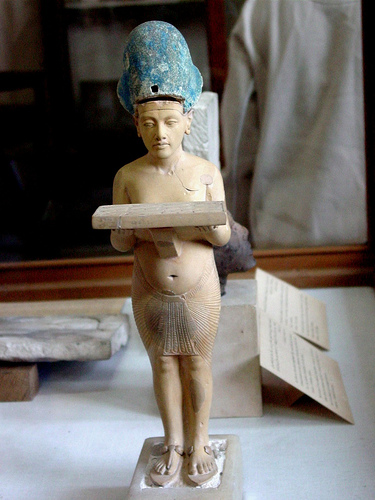
Also missing is a limestone statue of the Pharaoh Akhenaten standing and holding an offering table. The looters also took a statue of Nefertiti making offerings, a sandstone head of an Amarna princess, a stone statuette of a scribe from Amarna, eleven wooden shabti statuettes of Yuya, and a Heart Scarab of Yuya. Akhenaten is the so-called heretic king who tried to introduce monotheism to ancient Egypt.

Tuesday, May 15, 2012

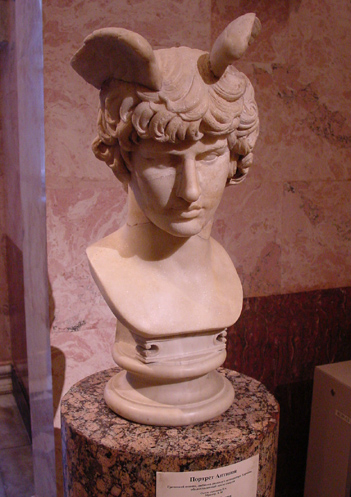
WE LIFT OUR HEARTS TO ANTINOUS/MERCURY


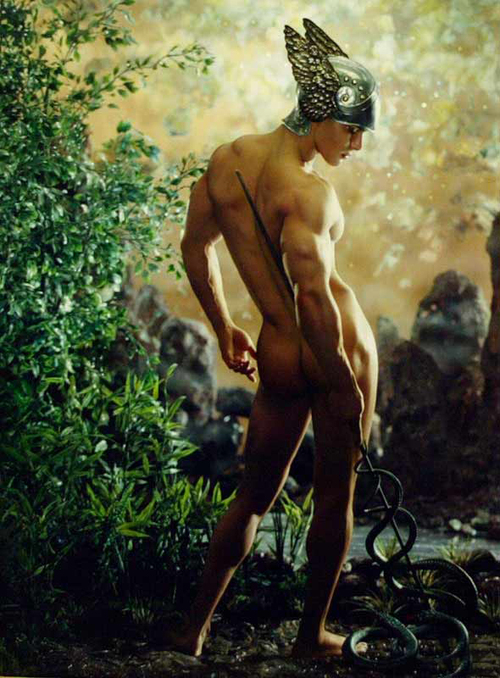
WE lift up our hearts on May 15th to the great wing-footed God Mercury father of Antinous, son of Zeus and Maia. Indeed, so close was the relationship that Antinous was often equated with Mercury in sculptural art — becoming Antinous/Mercury.

Mercury is the god of speed, the Lord of commerce, communication, and cunning. He is forever young and beautiful, the patron of skilled athletes, especially runners, and yet he possesses the infinite wisdom of extreme old age.

When Mercury was one day old, he charmed Apollo by stealing the sun god's prized cattle and crafting an ingenious story to cover his tracks.

Apollo fell in love with Mercury and from that day forward became his godfather and protector, presenting him to Olympus. Zeus was so taken by his son Mercury that he made him the messenger of the gods, and placed in his hand the sacred Caduceus, the serpent-entwined rod.

Hermes (as he was called by the Greeks) was charged with escorting the souls of the dead to the underworld, and to relay messages between heaven and hell. Thus he acquired his mystic powers, which were the inspiration of the Hermits, and of their religion known as Hermeticism.

He was known to them as Hermes Tristmegistus, the "thrice-great", and was said to have taught the secret knowledge of salvation to mankind.


As Hermes of the crossroads, he was a Phallic god, whose image was a herme, or column with a bearded head and a large penis that was placed at forks in the road to protect travelers.

Mercury made love to Venus and was father of Pan, Priapus, Hermaphroditus, and of Fortuna. He was the craftiest inventor, who created the lyre, which he gave to Apollo. And he invented written language, weights and measurement.

Mercury was the god of good business, but also of dishonesty and absolute capitalism. He invented dice and was the lord of gambling and all games of chance.

Antinous was often compared to Mercury in the statues and in the artefact fragments. His powers of youth, virility and physical fitness were central parts of the Religion of Antinous. But the hermetic sages, from whom so much of the salvation of Antinous extends, deepened this facade. He is, along with Dionysus, Apollo and Osiris, a major facet of the Spirituality of Antinous.

We acknowledge and extol Mercury, the wing-footed god, and pray to him as Antinous to run by our side and give us good fortune throughout our travels and in our communication with the divine.

Monday, May 14, 2012


MAGNUS HIRSCHFELD, SAINT OF ANTINOUS


ON MAY 14th, the Religion of Antinous honors the life of the Father of Gay Liberation, Doctor Magnus Hirschfeld, who died on this day in 1935 (which was his 67th birthday) while in exile form his native Germany in Nice, France. He died a broken and embittered man.

A life that had started out with such lofty ambitions ended in disillusionment. He was of Jewish ancestry and began his career as a medical doctor but very soon devoted his life to the study of homosexuality.

In 1897 he founded the Scientific Humanitarian Committee, an organization whose publication, called The Yearbook of Intermediate Sexual Types, was devoted to the repeal of "Paragraph 175", a law passed by the Reichstag in 1869.

The work of the committee included ongoing lobbying supported by the scientific studies of Dr. Hirschfeld into human sexuality. This study culminated in the formation of the Institute for Sexual Science in 1919.

Dr. Hirschfeld spent the majority of his career writing and lecturing around the world on the nature of homosexuality and other "intermediate" sexual types, including cross dressers. The word "transsexual" was coined by Dr. Hirschfeld to describe the phenomenon that he argued was a natural extension of human sexuality. 

His philosophy centered on the contention that there was a third sex, called the Uranian, which was neither male nor female, but a combination of both that was manifested in homosexuality, which was not to be considered an impure deviation, or even as an illness, but as a natural and phenomenal component of human nature.

For his work, the Nazis targeted Dr. Hirschfeld as an example of decadent Bolshevistic/Jewish influence infecting the purity of the German people, luring the Aryan race into impure and destructive perversity. He was ultimately driven into exile and burned in effigy as an emblem of evil. His institute was ransacked May 6th and his books were publicly burned in a bonfire on May 10th, 1933.

The slogan with which he began his speeches, "Uranians of the World, Unite!" was not to be realized until our own time. For his courage and his career of some 30 years, tirelessly devoted to the cause of Gay Liberation, we venerate SAINT MAGNUS HIRSCHFELD.