Showing posts with label museums. Show all posts

Tuesday, May 12, 2026

ΑΝΤΙΝΟΟΙ ΗΡΟΙ
(TO ANTINOUS THE HERO)


HERE IS an Antinous image rarely seen, but which I love.

Let me first call attention to the wonderful way that his name is written, combining the second two letters.

I love it...too bad it has been defaced...because I love the body and the stance.

And I would say that this is the only Antinous shown holding a spear. Historical record states that Antinous hurled an adamantine-tipped spear at a man-eating lion in Egypt ...

It was found in the ancient Roman stadium in the city of Plovdiv in Bulgaria, called Philippopolis in Roman times.

Games were held in Philippopolis like those in Greece. The games were organized by the General Assembly of the province of Thrace.

This marble slab was found during excavations at the stadium proving that there were games celebrating Antinous. Games in honor of Antinous were held 
in ANTINOOPOLIS and in numerous other cities in the Eastern Empire. 

This votive tablet dedicated to Antinous is exibited in the PLOVDIV ARCHAEOLOGICAL MUSEUM.

The inscription on the slab reads:

ΑΝΤΙΝΟΟΙ ΗΡΟΙ (to Antinous the hero)


On a number of coins of Antinous, he is honored as a hero. Syncretism of Antinous with locally relevant heroes of various types is certainly a likely thing to have occurred.

Even Hadrian himself honored Antinous as a hero in at least one location: the temple founded in Socanica, Dalmatia (modern Croatia), which was co-founded with his adopted heir, Aelius Caesar, in 136 AD.

Of the various classes of divine being that existed for the Greeks, heroes are an interesting option. Gods are gods, and demigods are often born of a god and one mortal parent. 

Many heroes seem to have started out as strictly mortal. Whatever the cultic or theological reality may be in each individual case, perhaps the main distinction is that most gods have a timeless and almost eternal quality about them, whereas heroes have a beginning and an end in death, but a very glorious afterlife.

Some heroes such as Hercules were eventually deified. The same happened in the case of "Antinous the Hero," who underwent apotheosis and became
 "Antinous the Good God."
 

There always seems to be something new to learn about Antinous.

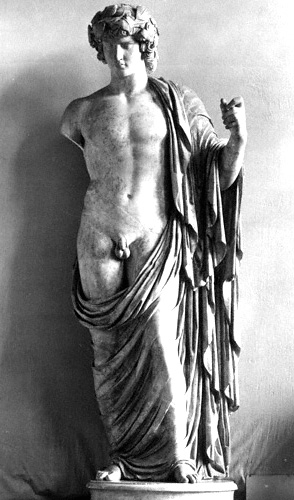
There always seems to be another image, another bust, even another statue, such as the "Dresden Antinous" shown here, which Priest Julien and I were honored to see at the GETTY VILLA MUSEUM, where it was painstakingly restored before being returned to Germany...

There could well be others hidden away in private collections ....


FLAMEN ANTINOALIS ANTONIUS SUBIA

Tuesday, April 7, 2026

YOU CAN HAVE YOUR OWN ANTINOUS
SCULPTURES THROUGH 3-D PRINTING


NOW you can own your own museum-quality Antinous sculpture, thanks to 3-D printing.

Our friend Keith MezaenAset Hoberg shares these photos of the replica of the Farnese Antinous/Adonis statue which adorns the sacred altar of Antinous in his home in Los Angeles.


The full-size original Farnese Antinous is in the National Archaeological Museum in Naples Italy. Keith ordered his 30-centimeter (12-inch) 3-D printed, bonded stone replica online.


Keith says:


"As a Companion of Antinous, having a beautiful depiction of Him to focus on during prayer, devotion, or meditation can be very helpful. 


"We are very lucky to be able to find such images of Antinous today, such as this beautiful 3-D printed statue, found in a shop on the Etsy app. 


"This reproduction of the Antinous Farnese statue has always been my favorite image of Him. Gazing upon it always calms my mind and fills my heart with love and happiness. He inspires me in so many ways."


Friday, April 3, 2026

ANTINOUS IS THE GOD OF THE GAYS
BUT WAS HE GAY IN THE MODERN SENSE?


WE are often asked whether Antinous was gay during his mortal lifetime ... truly gay, at least as we understand the complex sociological and orientation that exist today.

This stunning portrait by famed collage artist DOUG STAPLETON shows modern faces superimposed on the face of Antinous.

But was Antinous "gay" in the modern sense?

Scholars have quibbled ... especially in Victorian times ... that Hadrian and Antinous were not homosexuals in the modern sense.

Instead, they were engaged in a socially acknowledged erotic relationship between an adult male (the erastes) and a younger male (the eromenos) usually in his teens ... or so the uptight scholars argued.

These semantic nuances allowed academics to sidestep the socially loaded issue of calling some of the greatest figures in history "practicing homosexuals" ... because that might imply that homosexuality was in fact not a degenerate mental illness, but instead was perfectly normal.

Even up until the turn of the 21st Century, many academicians (mostly male) persisted in avoiding the "G" word when referring to Hadrian and Antinous.

All of that changed at a news conference in London a few years ago.

"Hadrian was gay, and we can say that now. The Victorians had a problem with it. But we can say it." Thorsten Opper, a British Museum curator of Greek and Roman sculpture shocked the stuffy world of academia when he made that statement ... at a news conference announcing the Museum's Hadrian: Empire and Conflict" exhibition in 2008.

The British Museum, that bastion of staid and conservative scholarship, signaled a paradigm shift in historical awareness of homosexuality. 

The collage portrait of Antinous by artist Doug Stapleton on this page symbolizes the many layers of perception of gayness through the ages.

Our own high priest, Flamen Antonius Subia, explains the change in attitude that has taken place ... it is not so much gayness which has changed ... but rather the cultural perception of gays has changed ... not only society's perception of gays ... but more especially the perception of gayness amongst gays.

"Gay has always been and always will be, or so I feel," Antonius says. "Antinous was gay in the way that gays were in Roman times, which is different from how gays were in the 1950's, which is different from how gays are now," he says.

"Antinous represents the divine essence that we all hold in common, so yes, I believe that in his own way and for his time, Antinous was gay just like we are now."

Sunday, December 28, 2025

EDWARD PERRY 'NED' WARREN
SAINT OF ANTINOUS


ON December 28th the Religion of Antinous celebrates the life of Saint Edward Perry "Ned" Warren, who died on this day in 1928. 

Estranged and ostracized by "decent" socialites, Saint Ned Warren was a famed gay Bostonian art collector who virtually single-handedly built up the collections of the New York Metropolitan Museum of Art and Boston Museum of Fine Arts through his passion for Classical art.

As a sissified schoolboy who suffered the taunts of bullies, he wrote a poem comparing a classmate in whom he was infatuated to Antinous.

He and his lover John Marshall travelled around Europe seeking out and buying art treasures for great museums. They were referred to snidely as "the bachelors of art" among society circles in Britain and America. 

But Warren was so fabulously rich, and museums depended on him  so much, that nobody dared say anything to his face about his blatant homosexuality. His gifts to the Boston MFA made up 90 per cent of its Classical collection, one of the finest in the world.

Even so, he found puritanical Boston deeply disagreeable, and spent most of his life in England when he was not at his apartment in Rome.

The famous Warren Cup and Rodin's statue The Kiss are just two of the most well-known objects he rounded up -- both of which were rejected by museums in Britain and America as being too raunchy. Museum curators feared museum-goers could be lured into thinking unwholesome thoughts.


Warren in fact actually commissioned the The Kiss from Rodin, explicitly saying he wanted large genitals on the man. To this day, photographs of the famous statue tend to avoid a full-frontal male view for that very reason.

The Warren Cup is a solid silver goblet which dates back to the 1st Century CE/AD and was found near Jerusalem. It is believed that it was deposited along with other valuables (some gold coins, jewellery and other precious items) in a cache by the servants of a fleeing Roman nobleman during one of several Jewish uprisings. It is even possible that it was buried during the uprising that was crushed by Hadrian's legions. 

The cup itself is considerably older, and may date to Republican times. And it is done in a retro-style which was a bit archaic even when it was new.

As the photos demonstrate, the Warren Cup shows two scenes (one on each side of the cup) of a man and a youth having sex on a couch. The silverwork is exquisitely done and the hair and draperies and facial expressions are beautifully rendered. It also reflects a bit of tongue-in-cheek wit by showing a servant boy peering curiously around a door frame at the lovers.

On one side a young man (barely more than a boy himself) is having his way with a young boy. On the other side, an older man with a beard is having anal sex with a younger man who is seated on top of him and holding onto what appears to be perhaps part of the drapes of a canopy bed. A servant looks on from the doorway off to the right side.

Saint Ned is believed to have purchased the Warren Cup from an antiquities dealer in Italy.
His efforts to sell it to museums in London and the U.S. were rebuffed.

The Warren Cup's unabashedly gay sex theme is impossible to ignore. The cup has been controversial in the art world ever since it first came to light in the 19th Century.

For many, many years, museums on both sides of the Atlantic refused to obtain it (despite its unquestionable value as a remarkably important historical piece of art) because of Victorian and Edwardian moral objections to its "immoral and beastly" theme.

At one time a curator for the British Museum was interested in acquiring the Warren Cub.

But other experts reminded him that one of the members of the board of directors of the British Museum was the Archbishop of Canterbury. The result was that museum officials were loathe to show his reverence even a photograph of the cup, let alone ask him to condone purchasing it for the collection.

So the cup languished in Warren's personal collection for many years and changed hands many times after his death, never ever being put on public display.

The British Museum finally purchased the Warren Cup for a large sum in 1999 -- and even then there was much titillation in the tabloid press.

Ned Warren wrote extensively about his views that homosexuality is a spiritual state of being, something divinely magical. Taunted as a schoolboy for being a bookworm and a sissy (he would get up at 5 a.m. to read Greek until breakfast), he nonetheless had many crushes on other schoolboys. He wrote about them all in his diary, and even wrote a poem about one especially beautiful boy whom he called a modern Antinous.

As an adult, he continued to proclaim his notion of idealized homosexual love, much to the distress of his family in Boston.

He even wrote a book entitled The Defence of Uranian Love about the same time that Oscar Wilde's The Picture of Dorian Gray was published. 

He also used his wealth to sponsor the educations of numerous boys and young men who showed promise but had no money.

He was very generous and had a big heart. For example, he heard that the daughter of a vicar in his district in England had become pregnant out of wedlock and was going to be forced to give up the child. 

Saying "this is as bad as Boston," he was so outraged that he legally adopted the little boy himself. He allowed mother and son to live upstairs in his home in England at his expense and loudly defied anyone to besmirch her honor or that of Travis, the little boy.

Ned Warren and his lover John Marshall had a stormy, on-again off-again relationship, but they were together at their flat in Rome in February of 1928. On the evening of the 15th, John went to bed early not feeling well. Ned tiptoed in later and kissed him good night and got in bed beside him. John was dead by morning.

Ned never recovered from that blow. He returned to England, where his health declined rapidly. Saying he couldn't face Christmas and New Year's without John, he died in a nursing home in England on December 28, 1928, at the age of 68.

He was cremated on January 1, 1929. But because he had always been blatant about his homosexuality, no members of his family attended the funeral and none of the museums that had benefitted so much from his largesse sent a representative to the memorial service.


His ashes were buried in the non-Catholic cemetery in Bagni di Lucca, Italy, a town known as a spa in Etruscan and Roman times.

We honor Edward Perry "Ned" Warren, 1860-1928, who wrote a poem likening a boy he loved to Antinous.

Friday, December 26, 2025

MITHRAS TEMPLE IN NORTHERN ENGLAND
WAS ALIGNED TO SUNRISE DECEMBER 25


AN ancient temple constructed by a mysterious cult in northern England may have been built to align with sunrise on December 25, to "recall the birth" of the light god Mithras.

A new analysis using satellite maps and a software that can plot the direction of sunrise and sunset revealed that the Mithraeum beside a Roman fort in Carrawburgh, England, lines up with both the winter solstice and December 25th.

Followers of the cult of Mithras often associated these two dates with the god, and were even said to celebrate the New Year on December 25th, as it marked his birth.

In a paper published to Philica, Amelia Carolina Sparavigna of Politecnico di Torino says the temple at Carrawburgh was designed for the birth of Mithras.

Sparavigna used the SunCal.net software to pinpoint the direction of sunrise and sunset at different times of the year for this location.

And, this revealed "good alignment" for the December 25 sunrise along with the winter solstice (December 21), with a difference of just 0.2 degrees.

"As we can see using software giving the sunrise and sunset directions on satellite maps, the orientation of the temple and the direction of the sunrise on winter solstice are in good agreement," Sparavigna wrote.

"It means that, probably, the orientation of the temple was chosen to recall the birth of Mithras on December 25."

Worship of Mithras spurred the rise of a mystery cult during the Roman era.

It was practiced from the 1st Century to 4th Century AD, and is linked to the sun god Sol Invictus.

"The cult of Mithras, such as that of the Sol Invictus, who was the patron of the soldiers, was very popular in the Roman army," Sparavigna wrote.

"Both Sol Invictus and Mithras, who were often identified in the same god, are linked to winter solstice.

"Actually, the followers of Mithras worshipped the New Year on December 25, to celebrate the birth of Mithras."

Monday, May 12, 2025

ΑΝΤΙΝΟΟΙ ΗΡΟΙ
(TO ANTINOUS THE HERO)


HERE IS an Antinous image rarely seen, but which I love.

Let me first call attention to the wonderful way that his name is written, combining the second two letters.

I love it...too bad it has been defaced...because I love the body and the stance.

And I would say that this is the only Antinous shown holding a spear. Historical record states that Antinous hurled an adamantine-tipped spear at a man-eating lion in Egypt ...

It was found in the ancient Roman stadium in the city of Plovdiv in Bulgaria, called Philippopolis in Roman times.

Games were held in Philippopolis like those in Greece. The games were organized by the General Assembly of the province of Thrace.

This marble slab was found during excavations at the stadium proving that there were games celebrating Antinous. Games in honor of Antinous were held 
in ANTINOOPOLIS and in numerous other cities in the Eastern Empire. 

This votive tablet dedicated to Antinous is exibited in the PLOVDIV ARCHAEOLOGICAL MUSEUM.

The inscription on the slab reads:

ΑΝΤΙΝΟΟΙ ΗΡΟΙ (to Antinous the hero)


On a number of coins of Antinous, he is honored as a hero. Syncretism of Antinous with locally relevant heroes of various types is certainly a likely thing to have occurred.

Even Hadrian himself honored Antinous as a hero in at least one location: the temple founded in Socanica, Dalmatia (modern Croatia), which was co-founded with his adopted heir, Aelius Caesar, in 136 AD.


Of the various classes of divine being that existed for the Greeks, heroes are an interesting option. Gods are gods, and demigods are often born of a god and one mortal parent. 

Many heroes seem to have started out as strictly mortal. Whatever the cultic or theological reality may be in each individual case, perhaps the main distinction is that most gods have a timeless and almost eternal quality about them, whereas heroes have a beginning and an end in death, but a very glorious afterlife.

Some heroes such as Hercules were eventually deified. The same happened in the case of "Antinous the Hero," who underwent apotheosis and became
 "Antinous the Good God."
 

There always seems to be something new to learn about Antinous.

There always seems to be another image, another bust, even another statue, such as the "Dresden Antinous" shown here, which Priest Julien and I were honored to see at the GETTY VILLA MUSEUM, where it was painstakingly restored before being returned to Germany...

There could well be others hidden away in private collections ....


FLAMEN ANTINOALIS ANTONIUS SUBIA

Monday, April 7, 2025

YOU CAN HAVE YOUR OWN ANTINOUS
SCULPTURES THROUGH 3-D PRINTING


NOW you can own your own museum-quality Antinous sculpture, thanks to 3-D printing.

Our friend Keith MezaenAset Hoberg shares these photos of the replica of the Farnese Antinous/Adonis statue which adorns the sacred altar of Antinous in his home in Los Angeles.


The full-size original Farnese Antinous is in the National Archaeological Museum in Naples Italy. Keith ordered his 30-centimeter (12-inch) 3-D printed, bonded stone replica online.


Keith says:


"As a Companion of Antinous, having a beautiful depiction of Him to focus on during prayer, devotion, or meditation can be very helpful. 


"We are very lucky to be able to find such images of Antinous today, such as this beautiful 3-D printed statue, found in a shop on the Etsy app. 


"This reproduction of the Antinous Farnese statue has always been my favorite image of Him. Gazing upon it always calms my mind and fills my heart with love and happiness. He inspires me in so many ways."


Thursday, April 3, 2025

ANTINOUS IS THE GOD OF THE GAYS
BUT WAS HE GAY IN THE MODERN SENSE?


WE are often asked whether Antinous was gay during his mortal lifetime ... truly gay, at least as we understand the complex sociological and orientation that exist today.

This stunning portrait by famed collage artist DOUG STAPLETON shows modern faces superimposed on the face of Antinous.

But was Antinous "gay" in the modern sense?

Scholars have quibbled ... especially in Victorian times ... that Hadrian and Antinous were not homosexuals in the modern sense.

Instead, they were engaged in a socially acknowledged erotic relationship between an adult male (the erastes) and a younger male (the eromenos) usually in his teens ... or so the uptight scholars argued.

These semantic nuances allowed academics to sidestep the socially loaded issue of calling some of the greatest figures in history "practicing homosexuals" ... because that might imply that homosexuality was in fact not a degenerate mental illness, but instead was perfectly normal.

Even up until the turn of the 21st Century, many academicians (mostly male) persisted in avoiding the "G" word when referring to Hadrian and Antinous.

All of that changed at a news conference in London a few years ago.

"Hadrian was gay, and we can say that now. The Victorians had a problem with it. But we can say it." Thorsten Opper, a British Museum curator of Greek and Roman sculpture shocked the stuffy world of academia when he made that statement ... at a news conference announcing the Museum's Hadrian: Empire and Conflict" exhibition in 2008.

The British Museum, that bastion of staid and conservative scholarship, signaled a paradigm shift in historical awareness of homosexuality. 

The collage portrait of Antinous by artist Doug Stapleton on this page symbolizes the many layers of perception of gayness through the ages.

Our own high priest, Flamen Antonius Subia, explains the change in attitude that has taken place ... it is not so much gayness which has changed ... but rather the cultural perception of gays has changed ... not only society's perception of gays ... but more especially the perception of gayness amongst gays.

"Gay has always been and always will be, or so I feel," Antonius says. "Antinous was gay in the way that gays were in Roman times, which is different from how gays were in the 1950's, which is different from how gays are now," he says.

"Antinous represents the divine essence that we all hold in common, so yes, I believe that in his own way and for his time, Antinous was gay just like we are now."

Thursday, March 13, 2025

WHEN YOU'RE IN BERLIN VISIT ANTINOUS
IN THIS SPLENDOROUS MUSEUM


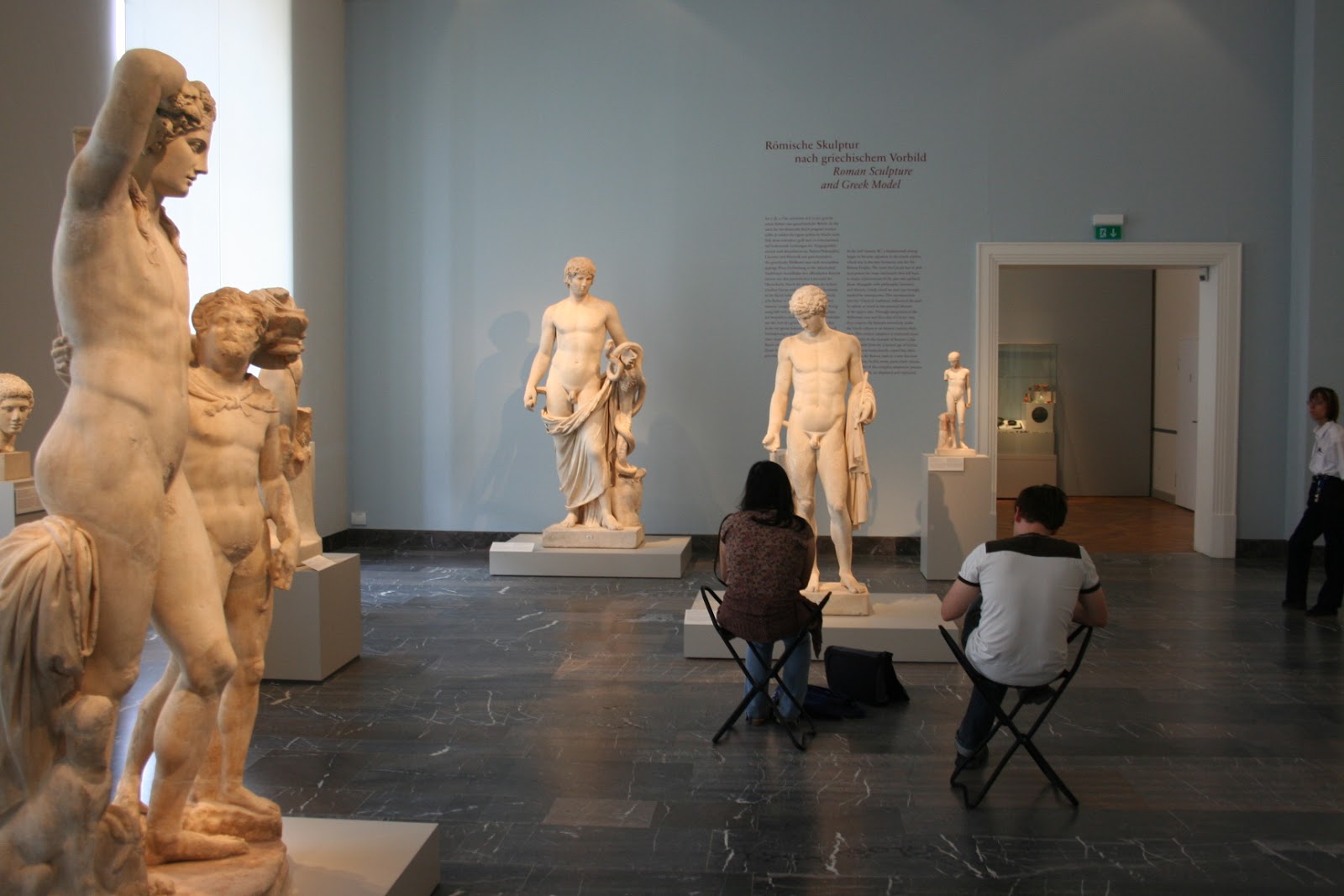
IN Berlin, Antinous lives in Greek-revival, neo-Classical splendor in the Altes Museum designed by Karl Friedrich Schinkel, who was born 13 March 1781.

When in Berlin, be sure to drop by for a visit. Antinous will receive you in grandeur ... along with Emperor Hadrian, Empress Sabina, Emperors Augustus Caesar and Caracalla ... and many others.


Saturday, December 28, 2024

EDWARD PERRY 'NED' WARREN
SAINT OF ANTINOUS


ON December 28th the Religion of Antinous celebrates the life of Saint Edward Perry "Ned" Warren, who died on this day in 1928. 

Estranged and ostracized by "decent" socialites, Saint Ned Warren was a famed gay Bostonian art collector who virtually single-handedly built up the collections of the New York Metropolitan Museum of Art and Boston Museum of Fine Arts through his passion for Classical art.

As a sissified schoolboy who suffered the taunts of bullies, he wrote a poem comparing a classmate in whom he was infatuated to Antinous.

He and his lover John Marshall travelled around Europe seeking out and buying art treasures for great museums. They were referred to snidely as "the bachelors of art" among society circles in Britain and America. 

But Warren was so fabulously rich, and museums depended on him  so much, that nobody dared say anything to his face about his blatant homosexuality. His gifts to the Boston MFA made up 90 per cent of its Classical collection, one of the finest in the world.

Even so, he found puritanical Boston deeply disagreeable, and spent most of his life in England when he was not at his apartment in Rome.

The famous Warren Cup and Rodin's statue The Kiss are just two of the most well-known objects he rounded up -- both of which were rejected by museums in Britain and America as being too raunchy. Museum curators feared museum-goers could be lured into thinking unwholesome thoughts.


Warren in fact actually commissioned the The Kiss from Rodin, explicitly saying he wanted large genitals on the man. To this day, photographs of the famous statue tend to avoid a full-frontal male view for that very reason.

The Warren Cup is a solid silver goblet which dates back to the 1st Century CE/AD and was found near Jerusalem. It is believed that it was deposited along with other valuables (some gold coins, jewellery and other precious items) in a cache by the servants of a fleeing Roman nobleman during one of several Jewish uprisings. It is even possible that it was buried during the uprising that was crushed by Hadrian's legions. 

The cup itself is considerably older, and may date to Republican times. And it is done in a retro-style which was a bit archaic even when it was new.

As the photos demonstrate, the Warren Cup shows two scenes (one on each side of the cup) of a man and a youth having sex on a couch. The silverwork is exquisitely done and the hair and draperies and facial expressions are beautifully rendered. It also reflects a bit of tongue-in-cheek wit by showing a servant boy peering curiously around a door frame at the lovers.

On one side a young man (barely more than a boy himself) is having his way with a young boy. On the other side, an older man with a beard is having anal sex with a younger man who is seated on top of him and holding onto what appears to be perhaps part of the drapes of a canopy bed. A servant looks on from the doorway off to the right side.

Saint Ned is believed to have purchased the Warren Cup from an antiquities dealer in Italy.
His efforts to sell it to museums in London and the U.S. were rebuffed.

The Warren Cup's unabashedly gay sex theme is impossible to ignore. The cup has been controversial in the art world ever since it first came to light in the 19th Century.

For many, many years, museums on both sides of the Atlantic refused to obtain it (despite its unquestionable value as a remarkably important historical piece of art) because of Victorian and Edwardian moral objections to its "immoral and beastly" theme.

At one time a curator for the British Museum was interested in acquiring the Warren Cub.

But other experts reminded him that one of the members of the board of directors of the British Museum was the Archbishop of Canterbury. The result was that museum officials were loathe to show his reverence even a photograph of the cup, let alone ask him to condone purchasing it for the collection.

So the cup languished in Warren's personal collection for many years and changed hands many times after his death, never ever being put on public display.

The British Museum finally purchased the Warren Cup for a large sum in 1999 -- and even then there was much titillation in the tabloid press.

Ned Warren wrote extensively about his views that homosexuality is a spiritual state of being, something divinely magical. Taunted as a schoolboy for being a bookworm and a sissy (he would get up at 5 a.m. to read Greek until breakfast), he nonetheless had many crushes on other schoolboys. He wrote about them all in his diary, and even wrote a poem about one especially beautiful boy whom he called a modern Antinous.

As an adult, he continued to proclaim his notion of idealized homosexual love, much to the distress of his family in Boston.

He even wrote a book entitled The Defence of Uranian Love about the same time that Oscar Wilde's The Picture of Dorian Gray was published. 

He also used his wealth to sponsor the educations of numerous boys and young men who showed promise but had no money.

He was very generous and had a big heart. For example, he heard that the daughter of a vicar in his district in England had become pregnant out of wedlock and was going to be forced to give up the child. 

Saying "this is as bad as Boston," he was so outraged that he legally adopted the little boy himself. He allowed mother and son to live upstairs in his home in England at his expense and loudly defied anyone to besmirch her honor or that of Travis, the little boy.

Ned Warren and his lover John Marshall had a stormy, on-again off-again relationship, but they were together at their flat in Rome in February of 1928. On the evening of the 15th, John went to bed early not feeling well. Ned tiptoed in later and kissed him good night and got in bed beside him. John was dead by morning.

Ned never recovered from that blow. He returned to England, where his health declined rapidly. Saying he couldn't face Christmas and New Year's without John, he died in a nursing home in England on December 28, 1928, at the age of 68.

He was cremated on January 1, 1929. But because he had always been blatant about his homosexuality, no members of his family attended the funeral and none of the museums that had benefitted so much from his largesse sent a representative to the memorial service.


His ashes were buried in the non-Catholic cemetery in Bagni di Lucca, Italy, a town known as a spa in Etruscan and Roman times.

We honor Edward Perry "Ned" Warren, 1860-1928, who wrote a poem likening a boy he loved to Antinous.

Thursday, December 26, 2024

MITHRAS TEMPLE IN NORTHERN ENGLAND
WAS ALIGNED TO SUNRISE DECEMBER 25


AN ancient temple constructed by a mysterious cult in northern England may have been built to align with sunrise on December 25, to "recall the birth" of the light god Mithras.

A new analysis using satellite maps and a software that can plot the direction of sunrise and sunset revealed that the Mithraeum beside a Roman fort in Carrawburgh, England, lines up with both the winter solstice and December 25th.

Followers of the cult of Mithras often associated these two dates with the god, and were even said to celebrate the New Year on December 25th, as it marked his birth.

In a paper published to Philica, Amelia Carolina Sparavigna of Politecnico di Torino says the temple at Carrawburgh was designed for the birth of Mithras.

Sparavigna used the SunCal.net software to pinpoint the direction of sunrise and sunset at different times of the year for this location.

And, this revealed "good alignment" for the December 25 sunrise along with the winter solstice (December 21), with a difference of just 0.2 degrees.

"As we can see using software giving the sunrise and sunset directions on satellite maps, the orientation of the temple and the direction of the sunrise on winter solstice are in good agreement," Sparavigna wrote.

"It means that, probably, the orientation of the temple was chosen to recall the birth of Mithras on December 25."

Worship of Mithras spurred the rise of a mystery cult during the Roman era.

It was practiced from the 1st Century to 4th Century AD, and is linked to the sun god Sol Invictus.

"The cult of Mithras, such as that of the Sol Invictus, who was the patron of the soldiers, was very popular in the Roman army," Sparavigna wrote.

"Both Sol Invictus and Mithras, who were often identified in the same god, are linked to winter solstice.

"Actually, the followers of Mithras worshipped the New Year on December 25, to celebrate the birth of Mithras."

Saturday, May 11, 2024

ΑΝΤΙΝΟΟΙ ΗΡΟΙ
(TO ANTINOUS THE HERO)


HERE IS an Antinous image rarely seen, but which I love.

Let me first call attention to the wonderful way that his name is written, combining the second two letters.

I love it...too bad it has been defaced...because I love the body and the stance.

And I would say that this is the only Antinous shown holding a spear. Historical record states that Antinous hurled an adamantine-tipped spear at a man-eating lion in Egypt ...

It was found in the ancient Roman stadium in the city of Plovdiv in Bulgaria, called Philippopolis in Roman times.

Games were held in Philippopolis like those in Greece. The games were organized by the General Assembly of the province of Thrace.

This marble slab was found during excavations at the stadium proving that there were games celebrating Antinous. Games in honor of Antinous were held 
in ANTINOOPOLIS and in numerous other cities in the Eastern Empire. 

This votive tablet dedicated to Antinous is exibited in the PLOVDIV ARCHAEOLOGICAL MUSEUM.

The inscription on the slab reads:

ΑΝΤΙΝΟΟΙ ΗΡΟΙ (to Antinous the hero)

On a number of coins of Antinous, he is honored as a hero. Syncretism of Antinous with locally relevant heroes of various types is certainly a likely thing to have occurred.

Even Hadrian himself honored Antinous as a hero in at least one location: the temple founded in Socanica, Dalmatia (modern Croatia), which was co-founded with his adopted heir, Aelius Caesar, in 136 AD.


Of the various classes of divine being that existed for the Greeks, heroes are an interesting option. Gods are gods, and demigods are often born of a god and one mortal parent. 

Many heroes seem to have started out as strictly mortal. Whatever the cultic or theological reality may be in each individual case, perhaps the main distinction is that most gods have a timeless and almost eternal quality about them, whereas heroes have a beginning and an end in death, but a very glorious afterlife.

Some heroes such as Hercules were eventually deified. The same happened in the case of "Antinous the Hero," who underwent apotheosis and became
 "Antinous the Good God."
 

There always seems to be something new to learn about Antinous.

There always seems to be another image, another bust, even another statue, such as the "Dresden Antinous" shown here, which Priest Julien and I were honored to see at the GETTY VILLA MUSEUM, where it was painstakingly restored before being returned to Germany...

There could well be others hidden away in private collections ....


FLAMEN ANTINOALIS ANTONIUS SUBIA

Wednesday, April 3, 2024

ANTINOUS IS THE GOD OF THE GAYS
BUT WAS HE GAY IN THE MODERN SENSE?


WE are often asked whether Antinous was gay during his mortal lifetime ... truly gay, at least as we understand the complex sociological and orientation that exist today.

This stunning portrait by famed collage artist DOUG STAPLETON shows modern faces superimposed on the face of Antinous.

But was Antinous "gay" in the modern sense?

Scholars have quibbled ... especially in Victorian times ... that Hadrian and Antinous were not homosexuals in the modern sense.

Instead, they were engaged in a socially acknowledged erotic relationship between an adult male (the erastes) and a younger male (the eromenos) usually in his teens ... or so the uptight scholars argued.

These semantic nuances allowed academics to sidestep the socially loaded issue of calling some of the greatest figures in history "practicing homosexuals" ... because that might imply that homosexuality was in fact not a degenerate mental illness, but instead was perfectly normal.

Even up until the turn of the 21st Century, many academicians (mostly male) persisted in avoiding the "G" word when referring to Hadrian and Antinous.

All of that changed at a news conference in London a few years ago.

"Hadrian was gay, and we can say that now. The Victorians had a problem with it. But we can say it." Thorsten Opper, a British Museum curator of Greek and Roman sculpture shocked the stuffy world of academia when he made that statement ... at a news conference announcing the Museum's Hadrian: Empire and Conflict" exhibition in 2008.

The British Museum, that bastion of staid and conservative scholarship, signaled a paradigm shift in historical awareness of homosexuality. 

The collage portrait of Antinous by artist Doug Stapleton on this page symbolizes the many layers of perception of gayness through the ages.

Our own high priest, Flamen Antonius Subia, explains the change in attitude that has taken place ... it is not so much gayness which has changed ... but rather the cultural perception of gays has changed ... not only society's perception of gays ... but more especially the perception of gayness amongst gays.

"Gay has always been and always will be, or so I feel," Antonius says. "Antinous was gay in the way that gays were in Roman times, which is different from how gays were in the 1950's, which is different from how gays are now," he says.

"Antinous represents the divine essence that we all hold in common, so yes, I believe that in his own way and for his time, Antinous was gay just like we are now."

Wednesday, March 13, 2024

WHEN YOU'RE IN BERLIN VISIT ANTINOUS
IN THIS SPLENDOROUS MUSEUM


IN Berlin, Antinous lives in Greek-revival, neo-Classical splendor in the Altes Museum designed by Karl Friedrich Schinkel, who was born 13 March 1781.

When in Berlin, be sure to drop by for a visit. Antinous will receive you in grandeur ... along with Emperor Hadrian, Empress Sabina, Emperors Augustus Caesar and Caracalla ... and many others.


Thursday, December 28, 2023

EDWARD PERRY 'NED' WARREN
SAINT OF ANTINOUS


ON December 28th the Religion of Antinous celebrates the life of Saint Edward Perry "Ned" Warren, who died on this day in 1928. 

Estranged and ostracized by "decent" socialites, Saint Ned Warren was a famed gay Bostonian art collector who virtually single-handedly built up the collections of the New York Metropolitan Museum of Art and Boston Museum of Fine Arts through his passion for Classical art.

As a sissified schoolboy who suffered the taunts of bullies, he wrote a poem comparing a classmate in whom he was infatuated to Antinous.

He and his lover John Marshall travelled around Europe seeking out and buying art treasures for great museums. They were referred to snidely as "the bachelors of art" among society circles in Britain and America. 

But Warren was so fabulously rich, and museums depended on him  so much, that nobody dared say anything to his face about his blatant homosexuality. His gifts to the Boston MFA made up 90 per cent of its Classical collection, one of the finest in the world.

Even so, he found puritanical Boston deeply disagreeable, and spent most of his life in England when he was not at his apartment in Rome.

The famous Warren Cup and Rodin's statue The Kiss are just two of the most well-known objects he rounded up -- both of which were rejected by museums in Britain and America as being too raunchy. Museum curators feared museum-goers could be lured into thinking unwholesome thoughts.


Warren in fact actually commissioned the The Kiss from Rodin, explicitly saying he wanted large genitals on the man. To this day, photographs of the famous statue tend to avoid a full-frontal male view for that very reason.

The Warren Cup is a solid silver goblet which dates back to the 1st Century CE/AD and was found near Jerusalem. It is believed that it was deposited along with other valuables (some gold coins, jewellery and other precious items) in a cache by the servants of a fleeing Roman nobleman during one of several Jewish uprisings. It is even possible that it was buried during the uprising that was crushed by Hadrian's legions. 

The cup itself is considerably older, and may date to Republican times. And it is done in a retro-style which was a bit archaic even when it was new.

As the photos demonstrate, the Warren Cup shows two scenes (one on each side of the cup) of a man and a youth having sex on a couch. The silverwork is exquisitely done and the hair and draperies and facial expressions are beautifully rendered. It also reflects a bit of tongue-in-cheek wit by showing a servant boy peering curiously around a door frame at the lovers.

On one side a young man (barely more than a boy himself) is having his way with a young boy. On the other side, an older man with a beard is having anal sex with a younger man who is seated on top of him and holding onto what appears to be perhaps part of the drapes of a canopy bed. A servant looks on from the doorway off to the right side.

Saint Ned is believed to have purchased the Warren Cup from an antiquities dealer in Italy.
His efforts to sell it to museums in London and the U.S. were rebuffed.

The Warren Cup's unabashedly gay sex theme is impossible to ignore. The cup has been controversial in the art world ever since it first came to light in the 19th Century.

For many, many years, museums on both sides of the Atlantic refused to obtain it (despite its unquestionable value as a remarkably important historical piece of art) because of Victorian and Edwardian moral objections to its "immoral and beastly" theme.

At one time a curator for the British Museum was interested in acquiring the Warren Cub.

But other experts reminded him that one of the members of the board of directors of the British Museum was the Archbishop of Canterbury. The result was that museum officials were loathe to show his reverence even a photograph of the cup, let alone ask him to condone purchasing it for the collection.

So the cup languished in Warren's personal collection for many years and changed hands many times after his death, never ever being put on public display.

The British Museum finally purchased the Warren Cup for a large sum in 1999 -- and even then there was much titillation in the tabloid press.

Ned Warren wrote extensively about his views that homosexuality is a spiritual state of being, something divinely magical. Taunted as a schoolboy for being a bookworm and a sissy (he would get up at 5 a.m. to read Greek until breakfast), he nonetheless had many crushes on other schoolboys. He wrote about them all in his diary, and even wrote a poem about one especially beautiful boy whom he called a modern Antinous.

As an adult, he continued to proclaim his notion of idealized homosexual love, much to the distress of his family in Boston.

He even wrote a book entitled The Defence of Uranian Love about the same time that Oscar Wilde's The Picture of Dorian Gray was published. 

He also used his wealth to sponsor the educations of numerous boys and young men who showed promise but had no money.

He was very generous and had a big heart. For example, he heard that the daughter of a vicar in his district in England had become pregnant out of wedlock and was going to be forced to give up the child. 

Saying "this is as bad as Boston," he was so outraged that he legally adopted the little boy himself. He allowed mother and son to live upstairs in his home in England at his expense and loudly defied anyone to besmirch her honor or that of Travis, the little boy.

Ned Warren and his lover John Marshall had a stormy, on-again off-again relationship, but they were together at their flat in Rome in February of 1928. On the evening of the 15th, John went to bed early not feeling well. Ned tiptoed in later and kissed him good night and got in bed beside him. John was dead by morning.

Ned never recovered from that blow. He returned to England, where his health declined rapidly. Saying he couldn't face Christmas and New Year's without John, he died in a nursing home in England on December 28, 1928, at the age of 68.

He was cremated on January 1, 1929. But because he had always been blatant about his homosexuality, no members of his family attended the funeral and none of the museums that had benefitted so much from his largesse sent a representative to the memorial service.


His ashes were buried in the non-Catholic cemetery in Bagni di Lucca, Italy, a town known as a spa in Etruscan and Roman times.

We honor Edward Perry "Ned" Warren, 1860-1928, who wrote a poem likening a boy he loved to Antinous.

Tuesday, December 26, 2023

MITHRAS TEMPLE IN NORTHERN ENGLAND
WAS ALIGNED TO SUNRISE DECEMBER 25


AN ancient temple constructed by a mysterious cult in northern England may have been built to align with sunrise on December 25, to "recall the birth" of the light god Mithras.

A new analysis using satellite maps and a software that can plot the direction of sunrise and sunset revealed that the Mithraeum beside a Roman fort in Carrawburgh, England, lines up with both the winter solstice and December 25th.

Followers of the cult of Mithras often associated these two dates with the god, and were even said to celebrate the New Year on December 25th, as it marked his birth.

In a paper published to Philica, Amelia Carolina Sparavigna of Politecnico di Torino says the temple at Carrawburgh was designed for the birth of Mithras.

Sparavigna used the SunCal.net software to pinpoint the direction of sunrise and sunset at different times of the year for this location.

And, this revealed "good alignment" for the December 25 sunrise along with the winter solstice (December 21), with a difference of just 0.2 degrees.

"As we can see using software giving the sunrise and sunset directions on satellite maps, the orientation of the temple and the direction of the sunrise on winter solstice are in good agreement," Sparavigna wrote.

"It means that, probably, the orientation of the temple was chosen to recall the birth of Mithras on December 25."

Worship of Mithras spurred the rise of a mystery cult during the Roman era.

It was practiced from the 1st Century to 4th Century AD, and is linked to the sun god Sol Invictus.

"The cult of Mithras, such as that of the Sol Invictus, who was the patron of the soldiers, was very popular in the Roman army," Sparavigna wrote.

"Both Sol Invictus and Mithras, who were often identified in the same god, are linked to winter solstice.

"Actually, the followers of Mithras worshipped the New Year on December 25, to celebrate the birth of Mithras."