Showing posts with label ancient egypt. Show all posts

Friday, September 25, 2026

ON NATIONAL COMIC BOOK DAY
WE REMEMBER JACQUES MARTIN


SEPTEMBER 25th is National Comic Book Day ... and we say Happy birthday to Jacques Martin, creator of Alix the blond Gallic-Roman boy who fights evildoers in ancient Rome. Jacques Martin was born 25 September 1921. Alix and his Egyptian orphan teen friend Enak have delighted comic book readers for more than 75 years ... In the image above, notice the Antinous Farnese statue on the balustrade as Alix and Enak frolic in the Edessa Falls in Greece.

Thursday, September 24, 2026

FEATURED ANTINOUS STATUE OF THE DAY
THE ANTINOUS OF ELEUSIS


THIS statue of Antinous from Eleusis - Ἐλευσίς - is the only one that seems to refer back to an incident in his life, his initiation into the Eleusinian Mysteries of death and resurrection in September 128 AD.

The sculpture was erected after his death in the outer courtyard of Eleusis and captures this instant of his life, though officially it depicts him as the god Dionysos Zagreus, a divinity of suffering abd resurrection associated with the Eleusinian Mysteries.

Technically it is not one of the best of the depictions of Antinous, but it evokes a mood and a moment.


The sulptor clearly envisaged the young lad draped in his himation, standing in the darkened Telesterion (the initiation hall) and confronted with the Eleusinian Mysteries of death and resurrection.

He clutches at the folds of his himation anxiously, insecure, staring wide-eyed, his mouth pursed in awe, with an expression of apprehension, intent rapture and awareness of the tremendous significance of what was being revealed to him.


Even though it is a mediocre statue in workmanship and details it is redeemed by its expressiveness and pathos.

This statue is now housed in the Archaeological Museum of Eleusis: Antinous as Dionysus Zagreus, Inv. 5092, 1.83 m, in marble of Thasos.

Wednesday, September 23, 2026

THE DAY ANTINOUS WAS INITIATED
INTO THE ELEUSINIAN MYSTERIES


ON THE EQUINOX in September the Religion of Antinous commemorates the FEAST OF THE PERSEPHONEA — the initiation of Antinous into the ELEUSINIAN MYSTERIES in Greece at the outset of Emperor Hadrian's Imperial Tour of the Eastern Provinces.

Historical records state that, in the late summer of the year 128, the Imperial Court embarked on a grand tour of the East. The Empress Sabina, Hadrian's wife, and her attendants were members of the entourage.

But on this particular journey, Antinous was the most favored of Hadrian's companions. Their love affair was openly, and gracefully displayed before the eyes of the world. This journey through the East, what we call the SACRED PEREGRINATION, is the only part of the short life of Antinous that history has conveyed to us. 

For this reason it takes on the importance of a sacred epic. Antinous  was in the very flower of his beauty and vigor, he was a shining star  held in the wings of the Imperial Eagle, and it is no coincidence that  this court of demigods should travel through the lands of Ganymede, Attis, Adonis, Jesus and Osiris, who were all beautiful souls taken from life before their time.


The court stayed in Athens for five or even six months, they arrived in time for the celebration of the MYSTERIES OF ELEUSIS, which symbolically portrayed the rape of Proserpina by Hades, the mourning of her mother Demeter, and the return of Spring. 

In the modern Religion of Antinous, we commemorate these ELEUSINIAN MYSTERIES during the September Equinox, for it is believed that Antinous underwent the secret initiations provided by the Priests of Eleusis at the Temple of Demeter/Ceres.


The painting above by Joseph Gandy in 1818 shows how the temple may have looked in the 2nd Century AD. The painting at right is "The Garden of Persephone" by Robert Hale Ives Gammell.

Through the Priests of Eleusis Antinous received the consecration of the dark goddess of the underworld Persephone/Proserpina, which prepared him for his own death and resurrection.

In the Mysteries of Eleusis, the initiates are led into the realm of death and are confronted with immediate death. 


Two years later, in 130 AD, Hadrian and Antinous would indeed be confronted by physical death. 

In the Mysteries of Eleusis (and indeed in the Underworld after Death), the initiates cannot go back the way they have come. 

And they cannot go forward without knowing the Words of Power that will allow the gatekeepers to throw open their gates.

But we face such situations not only in secret initiations, or on our deathbeds. No, we face such "mysteries" every day of our lives. 


We put off our dreams and aspirations so we can cope more effectively with the challenges of the present, ostensibly to have more time and leisure to realize our purpose in the future. 

Or we tell ourselves that we will chase our dreams someday once we have accomplished other lesser goals.

(Photo left: Antinous statue found at Eleusis.)

In truth, it is our fear that keeps us from seeking fulfillment in the here and now — because we view failure as a possibility, our reasons for delaying our inevitable success seem sound and rational. 

If we ask ourselves what we are really waiting for, however, we discover that there is no truly compelling reason why we should put off the pursuit of the dreams that sustain us.

That is what "mystery initiations" are all about. Hadrian and Antinous were forced by the Eleusinian priests to confront their fears and to find a way to go forth into life — NOW. They had no options. It was now or never. Life or Oblivion. In our own lives, we face the same question every day. And usually we try to find a way to avoid the question.

The idols, the images, the icons, the gilded statues and the gods themselves are as nothing.

YOU YOURSELF HOLD THE KEYS TO FINDING AND FULFILLING YOUR OWN DESTINY.

It is yours to find and to fulfill. No one else's. Not even the gods'.

That is what the ELEUSINIAN MYSTERIES are all about. And that is what the PERSEPHONEA is all about. And the Journey Up the Nile by Hadrian and Antinous to their Fateful Destiny with Eternity. And it is also what the symbolism of the Equinoxes is all about.

Even if the days are getting shorter, they are also getting longer — it is all a matter of perspective. The days ARE getting longer — our brothers in South America, South Africa and Australia can look out the window and see the lavender blossoms of the jacarandas in springtime bloom.

Remember Hadrian and Antinous in the Underworld (or on their Fateful Voyage Up the Nile) and understand what they understood: That the keys of fate are in your hands and you can venture forth RIGHT NOW wherever you wish to go.


FOR IT IS WRITTEN ON THE OBELISK OF ANTINOUS:  


He is able to enter any place he wishes.
The Guardians of the Gates
Of the Underworld
Say "Praise to You!" to Him...
They loosen their bolts
And throw open their Gates before Him ...
Millions of years ... daily ...
As His duration of life is as the sun,
Never in eternity elapsing!"


Tuesday, September 22, 2026

ANTINOUS ON MOUNT CASIUS
WAS NEARLY STRUCK BY LIGHTNING


IT was at the season of the Equinox in the year 129 that the imperial court ascended Mount Cassius (also called Mons Casius, Mount Kel or Mount Casius).

They climbed the mountain overlooking the sea because on top of it was a Temple of the Sun. 

A storm broke while they made their ascent, and Hadrian had the priests conduct the Equinox ceremony in the rain. 

During the sacrifice at the altar, a bolt of lightning struck with a horrific, earth-shattering clap of thunder ... killing the priest and the sacrificial animal together. 

This was taken as a very significant portent, one that perhaps Antinous alone comprehended, the darkness of the coming death and transfiguration were presaged. 

Hadrian took it as a sign that the gods of Syria had turned against him, thinking it was Baal-Zeus who struck down the priests as a warning to Hadrian of what lay ahead when the court entered Jerusalem. 

Perhaps it is all a myth and a legend, of course. There were many myths and legends about the events leading up to the deification of Antinous. 

Researching background information on the Lightning Bolt Omen on Mount Cassius, we stumbled upon an old Epistle which Antonius Subia wrote to the original members of this religion at this time of year back in 2002. There were only a handful of followers ... about five or six. 

Take a moment to read what Antonius wrote so many years ago:

"Whatever myths and mysteries were fabricated to legitimize the Religion of Antinous, we can be sure that they were only for the benefit of the vulgar populace, dependent on poetry and allegory. The Priesthood of Antinoopolis however, had to deal with the truth. I can't help but think that the pinnacle of his mysteries, revealed to only the most devoted, was the unsettling revelation that Antinous the God was no more than a boy, just as any of them were or had been."

And Antonius says that THAT fact was what makes our religion so special. He goes on to write:

"That Antinous lived a truly human life, died, and miraculously became a God is what captivates me, even more than his beauty. Unlike so many other, mythical gods, there is a definite level of certainty that all that is said about him is true. It is only when one begins to dig deeper that the mysteriousness of his story becomes manifest. There is a desperate shortage of evidence from his time, almost nothing at all, and what little is written is rare and clothed in foreign languages. Antinous, because of the peculiarity of his divinization, is not a subject of great philosophical interest as are the other, more popular gods."

And then he hints at the idea of HOMOTHEOSIS:

"The most important impression one receives from his story, which is utterly non-mythological, is that if he could become a God, with a star, and a flower, and an eternal name, then what prevents all of us from following in his trail? Antinous destroys the very concept of Godhood. For the vast majority, this is an incomprehensible concept, but Antinous is not a god of the populous, who remain simple in their acceptance of theology … then as now."

And he says Antinous is the divine spark of Sacred Homosexuality:

"Homosexuals suffer from a terrible lack of Gods and divine heroes. Heterosexuality has an overabundance. 

He adds: "I don't see the harm in claiming the truth of our one and only patron saint and god. The emphasis of our day, in which homosexuality is gaining acceptability, seems to be on bringing our sexuality into line, and in conformity to the rest of the population. But what we need most is our own identity, not as an aberration, or a peculiarity, or a mere deviation from the norm, but as a sanctification, a sacred state of blessedness. 

"For thousands of years we have been considered a degeneration, a sin, and even a disease of lust. Now people are beginning to see that we are just different, but there is almost no talk, even amongst ourselves, that we are a wonder of the human species, a divine grace, a delicate flower possible only in the most elevated levels of civilization. It is no coincidence that our sexuality has regained the prominence of respect that it knew in the age of the Antonines, and Antinous is the emblem, in my heart, of our blessedness, then as now."

Antonius then says non-pagans balk at our religion, but he also notes that traditional pagans also have problems with the concept of Antinous as the Gay God for the 21st Century, rather than remaining a reconstructed Classical deity from ancient times:

"Already I have encountered the difficulty of explaining what is so personal to an uninformed listener, and this conflict of interest, as it were, may only increase. My only hope is that Antinous has already prepared the way, as he has done with me, and a few others. However difficult and testing his message may be to bring to the world, I trust that those who are prepared to listen will need very little explanation, the truth being already ingrained within the depth of their soul.

"All I can ever do is turn the key that they alone suspected was there, but the door is for them to open. The statues, and the stark reality of his life, show that there are many sides to our Antinous, none of which is ultimately and universally true.

"However much we may delineate and formalize his religion, it must always remain founded on personal connection, and individual truth. 

"I am prepared to say that this is far more simple than it seems, if we are willing to succumb wholly to absolute freedom in ourselves, and in others."

Antonius (writing back in 2002, remember) has a final question ... a question he has posed to each new priest over the years:

"My question is this, if ever you felt yourselves to be secret priests, evangelists of beauty, and missionaries of sacred homosexuality among these barbarians of our age, what would you say to a soul in whom you could plainly see Antinous, just beneath the skin? But more importantly, why would you even mention his name?"

This weekend, as the shadow of the Super Moon Eclipse falls upon the Earth, and as we remember the story of the Lightning Omen on Mons Cassius, it is perhaps good to remember the founding tenets of our religion:

Antinous was a flesh-and-blood human being of lowly birth.


Antinous and Hadrian were male-male lovers.


Antinous died tragically, perhaps in sacrifice for his beloved Emperor.


Hadrian "wept like a woman" and issued a decree establishing the Religion of Antinous … declaring Antinous a God … the last Classical Deity.

And the question for us today is whether we would recognize a modern-day Antinous if he walked up to us on the street, or if we saw him on Netflix or on the Internet.

More importantly, can we see Antinous in the eyes of all gay men.

Because that's the first place to look for him.

Monday, September 21, 2026

WE ARE THE HUNTER AND THE HUNTED
DURING THE EQUINOX STAG HUNT


ON the Equinox ... may Antinous-Cyparissus bless us with celestial alignment and let us be in harmony with the cosmos. 

We regard the September Equinox (Autumnal in the Northern Hemisphere and Vernal in the Southern Hemisphere) as the SACRED STAG HUNT in which Antinous spiritually pursues the magic stag through the spiritual forest ... the stag representing the male god force within us. 

The stag is a symbol for gay spirituality, a graceful, beautiful animal, crowned with horns, mighty and strong, yet pursued by hunters who yearn for the taste of his tender meat.

We look to the story of Cyparissus the beautiful boy who was lover of Apollo or in another version of the forest god Silvanus. 

As a gift of love, the god gave Cyparissus a beautiful stag, but while hunting the ever jealous god of the west wind fooled Cyparissus into accidentally shooting and killing his beloved stag. (Image: "Cyparissus" by Jacopo Vignali)

The boy was so consumed by grief that Sylvanus-Apollo took pity and immortalized him by turning him into the Cypress tree, which is an emblem of death. 

So it is the the Stag Hunt brings summer to a close and prepares the way for the Death and Transfiguration of Antinous.

We pray to the Horned God to come into our lives and direct our magical forces as gay men towards fulfilling our goals and accomplishing our dreams. We are both hunter and hunted.

Antinous is both the beautiful Cyparissus and his beloved stag, and between the two is a sacred gay mystery.

Ave Antinous the Stag Hunter

~ANTONIUS SUBIA

Sunday, September 20, 2026

THE ROMAN GENERAL UNDER HADRIAN
WHO HAD A VISION OF A STAG


SEPTEMBER 20th is the saint day of Saint Eustace, patron saint of hunters, firefighters and also anyone facing adversity, a Christian saint who is linked by legend to Emperor Hadrian.

Saint Eustace, also known as Eustachius or Eustathius in Latin, purportedly was a general named Placidus, who converted to Christianity and who ... again, according to legend ... was persecuted by Hadrian.


While hunting a stag in Tivoli near Hadrian's Villa, Placidus saw a vision of a crucifix lodged between the stag's antlers. 

He was immediately converted, had himself and his family baptized, and changed his name to Eustace (Greek: Εὐστάθιος Eustathios "well standing, stable, steadfast").

A series of calamities followed to test his faith: his wealth was stolen; his servants died of a plague; when the family took a sea-voyage, the ship's captain kidnapped Eustace's wife Theopista.

And as Eustace crossed a river with his two sons Agapius and Theopistus, the children were taken away by a wolf and a lion. Like Job, Eustace lamented but did not lose his faith.

He was then quickly restored to his former prestige and reunited with his family. 


There is a tradition that when he demonstrated his new faith by refusing to make a pagan sacrifice, Emperor Hadrian condemned Eustace, his wife, and his sons to be roasted to death inside a Brazen Bull ... a bronze statue of a bull or an ox ... in the year AD 118.

However, the Catholic Church rejects this story as "completely false".

Eustace became known as a patron saint of hunters and firefighters, and also of anyone facing adversity; he was traditionally included among the Fourteen Holy Helpers. He is one of the patron saints of Madrid, Spain. The island of Sint Eustatius in the Caribbean Netherlands is named after him.

The German digestif schnapps Jägermeister (German for "Master of the Hunt") has a round logo of a shining cross between the antlers of a deer/stag referring to two persons who had seen such a vision: Saint Hubertus and Saint Eustace.

Saturday, September 19, 2026

THE BIRTH OF ANTONINUS PIUS


SEPTEMBER 19 the Religion of Antinous celebrates the birth of the Divine Emperor Antoninus Pius.

Caesar Titus Aurelius Fulvius Boionius Arrius Antoninus was born on this day 86 A.D. at Lanuvium, near Rome.

Under the Divine Hadrian he served as Proconsul of Asia minor from 130 to 135, the most crucial years in the development of the Religion of Antinous. After that he was summoned to Rome to be close to Hadrian as his health failed.

With the untimely death of the emperor's chosen heir, the blessed Lucius Aelius Verus Caesar, Hadrian chose Antoninus to be his successor. Thus Hadrian adopted him as his son and successor on the 25th of February 138, on condition that he himself adopted Hadrian's great nephew-by-marriage Marcus Aurelius, and Lucius Aelius Verus's son Lucius Verus, who was only 7 years old.

Hadrian's choice in successors proved to be infinitely wise. 

Following decades of political turmoil, civil strife and imperial excesses, Hadrian and his successors ushered one final period of peace and prosperity for Rome which would go done in history as the Sacred and Golden Age of the Antonines.

On Hadrian's death, Antoninus Pius was enthusiastically welcomed to the throne by the Roman people, whose hopes of a happy reign were not disappointed. For Antoninus came to his new office with simple tastes, kindly disposition, extensive experience, a well-trained intelligence and the sincerest desire for the welfare of his subjects.

One of his first acts was to persuade the Senate to grant divine honors to Hadrian, which they had at first refused (but later agreed to). This gained him the title of Pius (dutiful in affection). He built temples, theaters, and mausoleums, promoted the arts and sciences, and bestowed honors and salaries upon the teachers of rhetoric and philosophy.

Unlike his predecessors Trajan and Hadrian, Antoninus Pius was not a military man. His reign was comparatively peaceful. Insurrections amongst the Moors, Jews, and Brigantes in Britain were easily put down. The one military result which is of interest to us now is the building in Britain of the Wall of Antoninus (a few miles north of Hadrian's Wall), which was proclaimed in 2008 to be a UNESCO World Heritage Site.

During his reign, Antoninus issued coins celebrating the religious glory of Rome in celebration of the nine hundredth anniversary of the city in 147. The coins asserted the superiority of Romanism over the Empire.

Antoninus is said to have restored the sanctity of the ancient Roman faith, and to have reinvigorated its ceremonies, which is another possible reason why he was surnamed Pius.

The Religion of Antinous was in its infancy when Antoninus Pius came to power. The Blessed Boy's temples were under construction. The Sacred City of Antinoopolis was unfinished. It would have been easy for Antoninus Pius to pull the plug on the expense involved in the new religion. After all, Antoninus Pius was known as a penny-pincher who demanded fiscal restraint.

Instead, Antoninus Pius generously supplied the fledgling religion with imperial largess and was instrumental in the spread of the Faith of Antinous in those early years. Without him, the religion would have vanished at Hadrian's death. Instead, it flourished for centuries.

After the longest reign since Augustus (surpassing Tiberius by a couple of months), Antoninus died of fever on March 7, 161. His last public utterance was when the tribune of the night-watch came to ask the password — "aequanimit as" (equanimity). It was a fitting epitaph.

His body was placed in Hadrian's Mausoleam, a column was dedicated to him on Mars Field, and the temple he had built in the Forum in 141 to his deified wife Faustina was rededicated to the deified Faustina and the deified Antoninus. The Temple of Antoninus and Faustina still stands today in the Roman Forum (at right, now called the Church of San Lorenzo in Miranda).


We pay tribute to Antoninus Pius, who truly lived up to his title as a man of wisdom and piety.

Thursday, September 17, 2026

FRENCH EGYPTOLOGIST ALBERT GAYET
IS A SAINT OF ANTINOUS


WE are proud to consecrate French archaeologist Albert Gayet as a Messenger Saint of Antinous for his pioneering efforts to reclaim the city of Antinoopolis from the sands of oblivion.

The city that Hadrian built and dedicated to his lover Antinous flourished for hundreds of years before being looted and plundered and lost to the desert sands of Egypt.

Napoleon's French team of proto-archaeologists mapped and catalogued the remains at the turn of the 19th Century. 


But it was this rather curious and eccentric French bachelor who would make the lost city ... Antinoopolis ... famous again.

Antinoopolis became renowned around the world in 1895 when Gayet began exploring the vast necropolis burial grounds south of Antinoopolis. 


An estimated 40,000 mummies were buried in the Antinoé necropolis.

Between 1895 and 1911, Gayet worked tirelessly at Antinoé, the French name for the city which became synonymous with his own name. 


He stood out against the squalor of the wretched modern village and the moonscape of ancient ruins ... dressed impeccably in a three-piece black linen suit and tie, with a boater hat, a cane and white gloves ... more befitting a stroll on the Champs Élysée in Paris than overseeing Egyptian workers toiling in the blistering Egyptian sun as they unearthed mummies from the sands.

Gayet's crews worked day and night unearthing hundreds of mummies representing all social classes and historical epochs.

To his utter astonishment, many of the mummies were gilded, many were swathed in priceless woolen wraps and others wore Byzantine jewellery and headdresses.

He returned to Paris, where the most exquisite mummies were put on display at the Louvre, attracting throngs of visitors and spawning a "Coptic Craze" throughout Europe and America.

Antinoopolis embroidery and linens inspired Matisse, Renoir and the leading Paris fashion designers, who incorporated the rich colors and designs into their work.

But the craze soon waned. The mummies were packed away in storage, most of them to disintegrate or become lost. 


Gayet died in Paris at age 60, impoverished and embittered after having spent 20 years of his life trying to raise funds for further exploration of Antinoopolis. 

Unmarried, he bequeathed a number of Antinoopolis artefacts which he had kept for himself to his sister in Dijon, where the artefacts are in the local museum and a street is named after him.

Gayet's dream of a "Musee d'Antinoé" in Paris died with him.

Saturday, September 12, 2026

RUN LIKE PHEIDIPPIDES
JUST DON'T DIE LIKE PHEIDIPPIDES


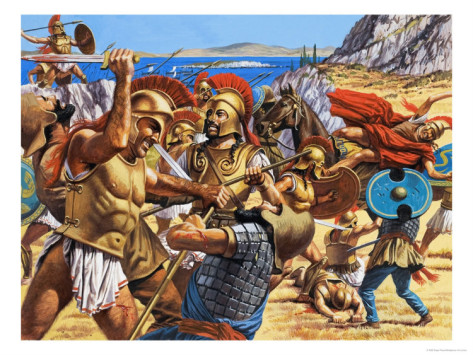
ON September 12, 490 BC, 10,000 Greeks use superior tactics to push 100,000 Persians back into the sea at the Battle of Marathon Bay ... forever changing the course of Western Civilization.

Though outnumbered 10 to 1, the Greeks won thanks to their new tactics.

Instead of individual soldiers fighting one-to-one duels, the Greeks rolled out their "phalanx" battle line of Hoplite soldiers who fought as one impenetrable unit.

The Battle of Marathon was a watershed in the Greco-Persian wars, showing the Greeks that the Persians could be beaten; the eventual Greek triumph in these wars can be seen to begin at Marathon. 

The battle also showed the Greeks that they were able to win battles without the Spartans, as they had heavily relied on Sparta previously. 

This win was largely due to the Athenians, and Marathon raised Greek esteem of them. Since the following two hundred years saw the rise of the Classical Greek civilization, which has been enduringly influential in western society, the Battle of Marathon is a pivotal moment in history.

The battle is perhaps now more famous as the inspiration for the marathon race. 

Although thought to be historically inaccurate, the legend of the Greek messenger Pheidippides running to Athens with news of the victory became the inspiration for this athletic event, introduced at the 1896 Athens Olympics, and originally run between Marathon and Athens.

Pheidippides was a professional "hemerodrome" (foot courier) who was sent to Sparta to request help when the Persians landed at Marathon, Greece. 

He ran 240 km (150 mi) in two days. Thanks to him, the Persians were defeated. 

He then ran the 40 km (26 mi) from the battlefield near Marathon to Athens to announce the Greek victory over Persia in the Battle of Marathon (490 BC) with the words "Chairete, nikomen!" ("Rejoice, we are victorious!") ... before collapsing and dying ... uttering "Cairete" (Rejoice) with his final rasping gasp of breath.

Image at top of entry: "Man Runs First Marathon To Bring News of Greek Victory Over Persia" painting by Tom Lovell (1909–97)

Wednesday, September 9, 2026

'QUINTILIE VARE, LEGIONES REDDE!'
COINS CONFIRM SITE OF TEUTOBURG BATTLE


WHERE was the Battle of Teutoburg Forest fought in the year 9 AD? That is a trick question which school teachers have loved to spring on their pupils for generations.

The answer, of course, is that the Battle of Teutoburg Forest was fought at Teutoburg Forest, changing the course of Western Civilization. But where is that?

Now, for the first time, archaeologists say they have found eight gold coins which confirm the location was at a place called Kalkriese Hill … which is a short distance from the modern-day Teutoburg Forest.

Such a find is extremely rare, the researchers say, and this recent discovery at Kalkriese Hill expands the number of gold coins collected at the site by more than double the previous amount.

The coins featured images of the Emperor Augustus, with the imperial princes Gaius and Lucius Caesar on the back, and all date back to a period before the ancient battle. Thus they were carried by the legions into the battle.

The defeat of the crack troops, who were led to their deaths by ex-Consul Publius Quinctilius Varus, effectively changed the course of Western Civilization.

Prior to 9 AD, Emperor Augustus Caesar pursued a course of military expansion across the Rhine and into central and northern Europe. After 9 AD, the Rhine became the frontier between the "civilized" Roman world and the "barbaric" lands to the east and north.


Prior to becoming emperor, Hadrian himself had served a stint of duty along the Rhine. As emperor, he consolidated the borders of the empire and his forces never ventured across the Rhine into across-the-Rhine Germania.

Historians have always referred to the Battle of Teutoburg Forest as a defining moment which affected the course of history. 


It has even been cited as a factor in both world wars, especially by the French and British, who considered themselves to have a Roman heritage, as opposed to the Germans, whom war propagandists condemned as the descendants of barbarians.

As a result, Germany was never incorporated into the Roman Empire, leaving that region a breeding ground for barbarian incursions which eventually would bring down the empire and eventually (according to Allied war-time propaganda) result in two world wars.

Arminius, known as Herrmann to the Germans, has indeed come down through German history as a heroic symbol of liberty and German national strength. Herrmann turned back the Roman occupation forces forever, according to the popular interpretation by German nationalists. 


In the late 19th and early 20th Century, unscrupulous German leaders used Hermann as a rallying figure in wars of aggression.

A monument near the site of the Teutoburg Forest battlefield celebrates Herrmann as a national hero. Thousands of German tourists visit the site annually. And the regional soccer team (in Bielefeld) is called Bielefeld Arminia. "Armin" is a popular name for German boys to this day.

Archaeologists in recent years have determined the exact location of the battle near the modern village of Engter north of the city of Osnabrueck. Bones, weapons and armour from the fleeing soldiers of the XVII, XVIII and XIX Legions are strewn along a narrow 17-km-long stretch of marshy woodlands bounded by confining hills to the north and south.


Now the coins definitely confirm that location.

Arminius had been educated in Rome and had become a trusted friend of Varus. The idea was that raising future chieftains in Rome would bond them to Rome when they returned to their families on the frontier.


Arminius was an example of how that policy could backfire and result in knowledge of Roman ways being used against the Romans. Arminius ingratiated himself with Varus, who was one of the most influential men in Rome, a friend of Augustus Caesar himself. 

It was that trust in Arminius which resulted in Varus leading a punitive expedition into an indefensible, boggy forest without sentries or reinforcements ... on advice of his trusted friend Arminius.

In the resulting massacre, Roman soldiers fled for their lives. Most were cut down in the mud. Blue markings in the graphic show where Roman bodies and armament have been found. 


Those who survived were sold into slavery or else were placed in wicker cages and burned alive as sacrifices to the Germanic deities. 

Reports of the battle are sketchy for the simple reason that almost no one survived to report what had happened.

Never before had three entire legions been wiped out in a single battle. The defeat was so devastating that the numbers of the Legions XVII, XVIII and XIX were retired forever, never again to appear in the Roman Army's order of battle. 


Augustus was so traumatized by the loss of three elite legions that he went into a prolonged state of mourning as though for a beloved son ... he tore his clothes, refused to cut his hair for months and, for years afterwards, was heard to moan from time to time, "Quintilie Vare, legiones redde!" ("Quinctilius Varus, give me back my Legions!").

This scene from the epic BBC/PBS mini-series I, Claudius dramatically recreates how Augustus received the news:


Saturday, September 5, 2026

ROMULUS SHRINE TO JUPITER LOCATED
AT BASE OF PALATINE IN ROME


IN the old Roman calendar, September was the seventh month of the year in counting March as the first. Among the festivals observed in September were several honoring Jupiter. 

He was hailed as the chief of the gods and had many epithets as a result.


As Jupiter Optimus Maximus, he occupied the temple of Jupiter Capitolinus on the Capitoline hill with the goddesses Juno and Minerva. With them, he received a Lectisternium (September 13) and the Ludi Romani  (September 5-19). 

He was honored with festivals as Jupiter Liber and Jupiter Fulminator (September 1) and as Jupiter Stator (September 5).

Jupiter Stator is the hand of Jupiter giving Roman troops their unstoppable force.

Romulus built a temple to Jupiter Stator at the foot of the Palatine Hill, Italian archaeologists say.


The ruins of the shrine to Jupiter Stator (Jupiter the Stayer), believed to date to 750 BC, were found by a Rome University team led by Andrea Carandini.

"We believe this is the temple that legend says Romulus erected to the king of the gods after the Romans held their ground against the furious Sabines fighting to get their women back after the famous Rape (abduction)," Carandini said in the Archeologia Viva (Living Archaeology) journal.


Historians have always been intrigued by ancient references to the temple, but never knew precisely where it was located or what it looked like. The lithograph above is a fanciful 19th Century idea of its possible appearance.

According to myth, Romulus founded Rome in 753 BC and the wifeless first generation of Roman men raided nearby Sabine tribes for their womenfolk, an event that has been illustrated in art down the centuries.

Carandini added: "It is also noteworthy that the temple appears to be shoring up the Palatine, as if in defence".

Rome's great and good including imperial families lived on the Palatine, overlooking the Forum.

Long after its legendary institution by Romulus, the cult of Jupiter the Stayer fueled Roman troops in battle, forging the irresistible military might that conquered most of the ancient known world.


In the article in Archeologia Viva, Carandini's team said they might also have discovered the ruins of the last Palatine house Julius Caesar lived in - the one he left on the Ides of March, 44BC, on his way to death in the Senate.

Friday, September 4, 2026

DID ANTINOUS AND HADRIAN VISIT
THIS SANCTUARY OF PAN/FAUNUS?


EXPERTS in Israel have discovered what may turn out to be a sanctuary to the god Pan/Faunus which may have been seen by Antinous and Hadrian during their trip through the Eastern Provinces.

Archaeologists unearthed a gateway in the city of Hippos where they discovered a large and rare mask of Greek God Pan. 

The mask is an extraordinary find and suggests the ancient sanctuary was dedicated to the Greek God Pan.

According to experts, bronze masks of this size are extremely rare and usually do not depict Pan or any of the other Greek or Roman mythological images.

University of Haifa archaeologist Michael Eisenberg led a team that unearthed a 1.8-meter-tall (6-foot-tall) Roman gate near a stone building where the mask was found, leading him to speculate that the gate might have led to a sanctuary dedicated to Pan. 

"The mask, and now the gate in which it was embedded, are continuing to fire our imaginations," Eisenberg says. 

"The worship of Pan sometimes included ceremonies involving drinking, sacrifices and ecstatic rituals, including nudity and sex. This worship usually took place outside the city walls, in caves and other natural settings." 

The possible sanctuary was located near the city gates and was constructed sometime during the reign of Hadrian, who was emperor from 117 AD to 138 AD. 

Hadrian and Antinous traveled through the area in 129-130 AD.

Hippos-Sussita is located about 2 km east of the Sea of Galilee in the Sussita National Park of the National Parks Authority.

In recent years, the mysteries of Hippos-Sussita have been revealing their secrets in an extraordinary way.

In 2011, scientists found an ancient sculpture of Hercules. Two years later a basalt tombstone with a sculpture of the deceased’s bust was uncovered. 

Now there is a new surprise: the only finding of a bronze mask of unnatural size, in the form of the god Pan/Faunus.

In Greek mythology, Pan was the god of the wild, hunting and companion of the nymphs. He was depicted as being half human, while having the legs and horns of a goat, just like a faun. 

His Roman counterpart was Faunus and he was in many ways similar to Herne the Hunter, the horned god and lord of the forest in British mythology.

Until now it was thought there were no temples attributed to Pan, but he was rather worshipped in natural settings such as caves.

A more thorough cleaning in the lab, revealed strands of a goat beard, long pointed ears, and other characteristics that led Dr. Eisenberg to identify the mask as depicting a Pan/Faunus/Satyr.

"Now that the whole gate has been exposed, we not only have better information for dating the mask, but also a clue to its function," Eisenberg said in a statement. "Are we looking at a gate that led to the sanctuary of the god Pan or one of the rustic gods?"

Pan is the son of Antinous .. not "our" Antinous, but "Antinous the Suitor" of Homer's Odyssey and Iliad.

At the online Temple of Antinous, our own ANTONIUS SUBIA  explains the esoteric reason for the connection between Antinous and Pan.  He notes that there are two deities named Pan ... the Great Pan who is "all things" ... and the lesser Pan who is the cloven-footed goat-horned god. 

The "Little Pan" is the son of Antinous ... not OUR Antinous, but rather the Antinous of Greek mythology who was slain by Odysseus for having hit on his wife Penelope while Odysseus was off on his Odyssey.

Two different Pans. Two different Antinouses.

It gets a little confusing.

But Antonius suggests there is a clue to the names ... he says it is because they all came from the same place. Antonius points out that it was in August of the year 128 that Hadrian and Antinous traveled through the Peloponnesus and visited the home of Antinous's ancestors in Arcadia, at the city of Mantineia. 

Here is how Antonius explains the Pan-Pan and Antinous-Antinous connection at the online TEMPLE OF ANTINOUS:

"This is an important first event for Antinous as it represents his return to the place of the origin of his blood, which is the source of his mysterious name. Mantineia was to become the fourth most sacred city of the religion of Antinous, honoring Our God with a Temple and Sacred Games. The Queen who founded the city was named Antinoea, she was led to the site of the city by a serpent or dragon. 

"While in the city, Antinous and Hadrian pay homage at the grave of Epaminondas, the great Theban general who defeated the Spartans in the battle of Mantineia, but died after shortly after the victory from his wounds. The battle was won because of the courage of the Sacred Band, also known as the Army of Lovers, a corps of 300 homosexual lovers. Mantineia is the home of the prophetess Diotima, who was the teacher of Socrates, from whom he learned his philosophy of Love, particularly the mysteries of Venus Urania, which is a metaphor for gay love. 

"And Mantineia is the birthplace of the horned god Pan, son of Penelope and 'Antinous the Suitor.' The patron deity of Mantineia, and of all Arcadia is the Great God Pan. There are two gods named Pan, the Great Pan, who is all things, and the Little Pan, who is the son of 'Antinous the Suitor.' 

"We dedicate ourselves to the dual nature of Pan, the most ancient faith of Antinous, the goat-horned god, who follows in the train of Dionysus, and is the King of Satyrs. We seek to understand that within our Antinous is the nature of the Great Cosmic Pan, and also the Little Cloven-hoofed Pan of Mantineia."

Thursday, September 3, 2026

ANCIENT PRIESTS BLESSED TREASURES
BEFORE THROWING THEM AWAY


YOU think you have trouble clearing out accumulated old things to make room for new acquisitions?

The ancient priests of Antinous ... along with priests of many other deities ... couldn't just throw out statues, offerings and other artefacts that worshipers had donated to their temples. The objects had to be ritually blessed, deconsecrated and given burials befitting their sacred nature.

Very often, these caches of "discarded" artefacts survive to the present day ... as has happened at the Temple of Ptah at Karnak in Egypt.

Ironically, treasures which remained in the temple sanctuaries often ended up being looted by invaders, which the "discarded" artefacts remained intact for thousands of years in the "rubbish heap" under the temple.

For example, the photo at left shows the only known portrait of Khufu (or Cheops), the 4th Dynasty pharaoh who (allegedly) built the Great Pyramid at Giza, is a very tiny ivory figurine only 7 centimeters (3 inches) tall.

It was discovered covered in dried feces IN AN ANCIENT CESSPIT next to the temple of Seti at Abydos in Egypt.

We can only assume that, thousands of years ago, some harried novice priest "flushed it away" during routine spring cleaning to clear out old statuary to make room for new items.

After years of being washed, perfumed and fed in ancient Egypt, the statue of the revered Egyptian deity shown at the top of this page was given a proper burial with other "dead" statues more than 2,000 years ago.

Ancient Egyptians buried the statue of the deity Ptah ... the god of craftsmen and sculptors ... with other revered statues, including those of a sphinx, baboon, cat, Osiris and Mut, in a pit next to Ptah's temple.

The statue of Ptah had likely sat in the temple for years, but it and the other sacred objects were respectfully buried after they accumulated damage and were declared useless by the ancient Egyptians, the researchers said.

"We can consider that when a new statue was erected in the temple, this one [of Ptah] was set aside in a pit," said study co-researcher Christophe Thiers, director of the French-Egyptian Center for the Study of the Temples of Karnak. 

"The other artifacts were also previously damaged during their 'lifetime' in the temple, and then they were buried with the Ptah statue."

Archaeologists discovered the pit in December 2014 at Karnak, an Egyptian temple precinct, and spent about a month excavating its rich assemblage. 

The pit held 38 objects, including:


  • Fourteen statuettes and figurines of Osiris.
  • Eleven fragments of inlay from statues. The inlay included that of an iris, a cornea, a false beard, a cap, a strand of hair and an inlay plaque.
  • Three baboon statuettes (representing the god Thoth).
  • Two statuettes of the goddess Mut (one with hieroglyphic inscriptions).
  • Two unidentified statuette bases.
  • One head and one fragmentary statuette of a cat (Bastet).
  • One small fragmentary faience stele (a stone slab) recording the name of the god Ptah.
  • One head of a statuette of a man in gilded limestone.
  • One lower part of a statue of the seated god Ptah, sawn and repaired.
  • One sphinx.
  • One unidentified metal piece.

Monday, August 31, 2026

ANTINOUS ENABLES YOU TO DISCOVER
THE INTELLIGENCE OF THE HEART


IN ancient times, Antinous was known as a miracle worker. His worshipers prayed to him for miracles, oracles, visions and answers to problems in their daily lives.

The Egyptian hieroglyphs on the OBELISK OF ANTINOUS state clearly that Antinous answers the prayers of all who call upon him through dreams and visions, for example.

The hieroglyphs also make cryptic references to his ability to work magic through his heart. This is a reference to the Ancient Egyptian concept of the "Intelligence of the Heart."

The Egyptians knew that the brain is the center of motor activity and sensory perception. But they believed the heart is the center of a form of intelligence which has baffled most mainstream Egyptologists ... who assume the Egyptians believed the heart was where cognitive thinking occurs.

But the Egyptians had a very different view of the universe from our rational, scientific view of the universe. We dissect facts and analyze them. But while the Egyptians were very good at analyzing facts, they also retained the Zen-like ability to see the whole ... which leads to contemplation ... not analysis.

The Egyptians understood that if you want to find an intelligent solution to a problem, your brain can do the work. You have all the necessary intelligence inside the bone in your skull.

However, most people use their brains the same way they use their muscles. You can strain your head just as if it were a muscle, and work very hard trying to arrive at an answer, but it doesn't really work that way.

When you really want to find an answer to something, what you need to do is contemplate the problem. Visualize your question as well as you can, and then simply wait.

If you don't, and if you instead try to find the solution through brute mental strength, you may be disappointed, because any solution that comes in that way is likely to be wrong.


But when you have waited for a while, the solution will come of itself. That is what the Egyptians called the Intelligence of the Heart ... using your heart instead of your head.

It will work for you in the same way your stomach will digest your food for you without your having to supervise it consciously. Our attempts to supervise everything consciously have all led to consequences that aren't too good for our stomach, and the reason for that is quite simple.

Conscious attention, which employs words, cannot think of very much. We are forced, therefore, to ignore almost everything while we are thinking. We think along a single track, but the world doesn't proceed along a single track.

The world is everything happening altogether everywhere, and you just can't take all that into consideration because there isn't time.

However, the Intelligence of the Heart can take it all into consideration because it is capable of handling innumerable variables at once, even though your conscious attention cannot...


The hieroglyphs on the Obelisk of Antinous promise that Antinous the Gay God enables us to discover the Intelligence of the Heart ... the Intelligence of HIM ... he opens his heart to you .... 

Sunday, August 30, 2026

ANTINOUS WORSHIPERS WORLDWIDE
TAKE PART IN LION HUNT CEREMONIES


ANTINOUS worshipers worldwide participated live online tonight in ceremonies commemorating the SACRED LION HUNT, the final recorded event in the brief life of Antinous ... when he and Hadrian slew a man-eating lion in Egypt in August of the year 130 AD.

Worshipers on both coasts of North America as well as worshipers in South America, Europe and Africa took part in the ceremonies originating at the Hollywood Temple of Antinous.


The skin art image shows Antinous subduing the man-eating Marousian lion in the Egyptian desert in the year 130 AD.

The SACRED LION HUNT was immortalized in poetry and in stone, showing Antinous brashly attacking the lion with his adamantine-tipped spear and wounding it ... so that Hadrian had to gallop to his rescue and dispatch the beast.

Hadrian added medallions to the Arch of Constantine showing him and Antinous with feet on the lion's neck and also making sacrifice to the great lion-killer Hercules.

Soon legend would have it that scarlet-red lotus blossoms had sprung forth from the pool of the lion's blood ... which we honor as the LOTUS MOON, the Pisces Third Quarter Moon in June.

Within a few short weeks after the Sacred Lion Hunt, Antinous himself would be dead. The Sacred Lion Hunt is the last recorded event in His short life.

Flamen ANTONIUS SUBIA celebrated the liturgical ritual in Hollywood.

Antonius noted that the brave may not live forever, but the cautious do not live at all. Tonight's rituals and meditations were aimed at enabling participants to traverse the road between who they think they are and who they can be. The key is to set forth on the journey ... with adamantine-tipped spear in hand ... galloping forward.

Saturday, August 29, 2026

THE ANCIENT PRIESTS OF ANTINOUS
KNEW HOW THE LEOPARD GOT ITS SPOTS


ANCIENT PRIESTS of Antinous at the Great Temple at ANTINOOPOLIS in Egypt were familiar with leopard-skin priestly robes. 

Whether they actually wore leopard skins in the Egyptian priestly manner is unknown, but it is certainly possible.

The Ancient Egyptian magical SEM priests always wore a leopard skin ... as do many African shamans even today.

Indeed, it is highly likely that the Ancient Egyptians got the idea from their southern neighbors — where else could they have got the idea, after all? 

The Egyptians were accustomed to lions and we know that lions were a menace even in the 2nd Century AD when Hadrian and Antinous conducted the SACRED LION HUNT. But it is safe to say that leopards were very rare and highly prized species even in Ancient times — which made them even more magical.

The Egyptians said the leopard started out as a variety of sacred lion, the lion being associated with the sun god Ra and of pharaoh's power and rulership as an incarnation of the sun god. 

The leopard lived in the desert like the lion and was indistinguishable from the lion because the leopard originally had no spots.

This is the cue for Anubis and Seth to enter the scene!

Anubis had a very odd love/hate relationship with Seth. Some said that Anubis was the son of Seth by Seth's consort Nephthys. Others said Anubis was the son of Osiris and Seth's consort Nephthys and that Nephthys placed the baby in the care of her sister Isis to avoid Seth's wrath. 


At any rate, little Anubis was raised by the Osiris side of the divine family, not the Seth side. Anubis and Seth had a very strained relationship, to say the least, full of doubt and suspicion on both sides.

Not surprisingly, Anubis took sides with Isis (as his foster mother) and her son Horus (perhaps his biological half-brother? ) in seeking to avenge the death of Osiris (his own true father?) after Seth murdered Osiris by drowning and mutilating his body.

The struggle between Horus and Seth continues to this day, of course. Seth has the advantage of being able to transform himself into any creature, thus eluding his pursuers. Sometimes he is a hippo. Sometimes he is a crocodile. Sometimes he is a giant serpent. Often, he is a graceful antelope. He can be deceptively beautiful and entrancing.  


The Lie takes many deceptive forms,
always posing as the Truth. 


But Anubis was able, by means of his keen canine senses, to sniff out Seth in whatever form he takes. 

Once, Seth assumed the form of a leopard and blended into the desert sand so well that Horus was unable to spot him from the air as he circled high in the sky upon his falcon wings, using his sharp falcon eyes to scan the Earth.

But Anubis sniffed out Seth and decided to brand him so that everyone would be able to see him. Anubis trotted over to the banks of the Nile and dunked his paws in rich black Nile mud. Then he leapt onto the leopard and left indelible muddy paw prints all over Seth's hide.

That is how the leopard got its spots, according to the Ancient Egyptians.

The highest caste of Egyptian magician/priests wore leopard skins to symbolize the never-ending struggle between the Truth and the Lie. The Lie persists. Seth the Deceiver was not killed by Anubis. But Anubis revealed Seth for the Lie that he is.


And that is why the Priests at the Great Temple of Antinoopolis may have worn leopard skins ... to demonstrate that it is possible to see through the Lie to uncover the Truth that lies underneath.