Tuesday, July 21, 2026

WE REMEMBER HEROSTRATUS
THE ULTIMATE NOTORIETY SEEKER


ON 21 July we remember Herostratus, whose name is synonymous with all persons who commit heinous crimes for the sole purpose of making their names notorious ... the eternally aggrieved ego ... the call for damnatio memoriae ... destroyer of beauty, youth and success perceived as insults to the entitled outsider.


Herostratus was a 4th Century BC Greek arsonist who sought notoriety by destroying one of the Seven Wonders of the Ancient World, prompting a law forbidding anyone to mention his name.

His name has become a metonym for someone who commits a criminal act in order to become famous.

On 21 July 356 BC, seeking notoriety, he burned down the Temple of Artemis at Ephesus in Asia Minor (now Turkey).

Antinous and Hadrian visited TEMPLE OF ARTEMIS in June of 129 AD.

The temple honoured a local goddess, called Artemis by the Greeks, their version of Diana goddess of the hunt, the wild, and childbirth. 

The temple was constructed of marble and was built by King Croesus of Lydia to replace an older site destroyed during a flood. Measuring 130 meters long (425 feet) and supported by columns 18 meters high (60 feet), it was one of the Seven Wonders of the Ancient World.

Far from attempting to evade responsibility for his act of arson, Herostratus proudly claimed credit in an attempt to immortalise his name. 

To dissuade those of a similar mind, the Ephesian authorities not only executed him, but attempted to condemn him to a legacy of obscurity by forbidding mention of his name under penalty of death. However, this did not stop Herostratus from achieving his goal because the ancient historian Theopompus recorded the event and its perpetrator in his Hellenics.

Herostratus' name lived on in classical literature and has passed into modern languages as a term for someone who commits a criminal act in order to bask in the resultant notoriety.

Monday, July 20, 2026

THE BIRTH OF ALEXANDER


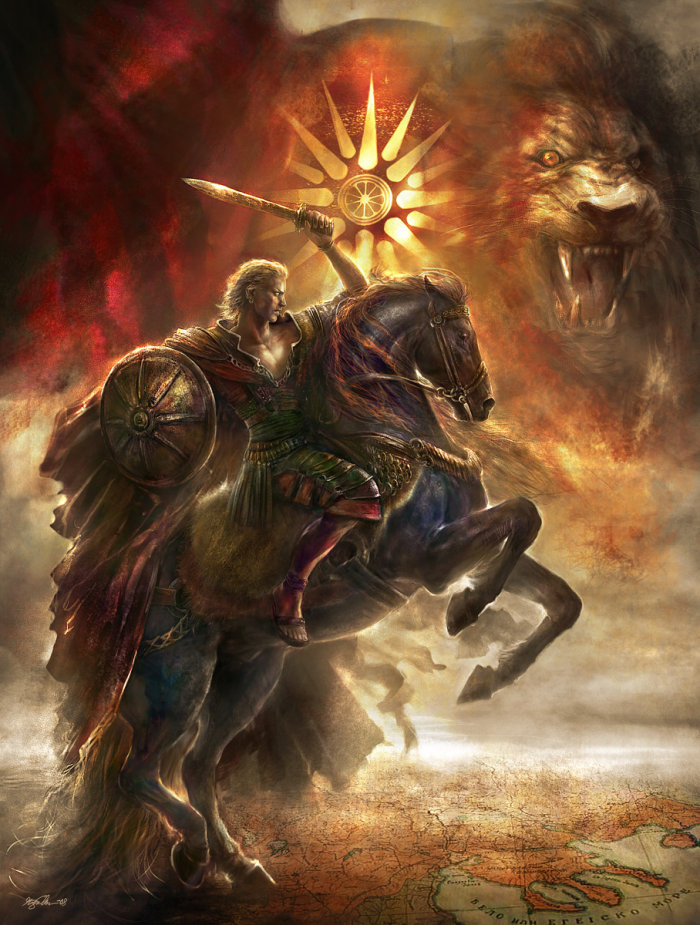
IT IS SAID that on the night before the mother of Alexander, Olympias, was to be married to King Phillip of Macedonia, she dreamt that a thunderbolt struck her body and filled it with power.

After the marriage, it is said that Phillip peeked into her chamber, and found her lying with a serpent, and that he afterward dreamt that her womb was sealed and that a lion dwelled within her. 

And on the night that he was born, 20th of July, 356 BC, the great Temple at Ephesus was burned to the ground by a vandal, because the goddess Artemis was away, assisting with the birth of Alexander the Great.

He was considered to be the son of Zeus, and this divine origin was  what was given as an explanation for the unprecedented conquests that he accomplished. In his youth Aristotle, a student of Plato, educated him along with his following of young princes, who were later serve as his generals, and the founders of great dynastic monarchies of the Hellenistic world.

Foremost of these was his ever loyal and devoted Hepheistion, whose reciprocated love for Alexander was homosexual in nature.

In one of their first battles, while Phillip was still king, the young Alexander proved himself by defeating the Sacred Band of Thebes, the army of homosexual lovers who were the most famous and courageous warriors of their time.

Alexander is said to have wept at their destruction, and buried them with honor, erecting a statue of a Lion over their graves.

He would later go one to conquer the entire Eastern world, Asia Minor, Syria, Judea, Egypt, and all of Persia, as far East as India. The Empire of Alexander spread Greek culture throughout the world, and made the communication of far-distant ideas possible so that the new Hellenistic culture that he created, was a combination of classical Greece and of the exotic cultures that were imported from every corner.


After the death of Alexander, at only 33 years of age, he was deified by his generals who divided his great Empire among themselves. We praise the glorious warrior Alexander of Macedonia, and elevate him, and worship him as a God, an example of the greatness of homosexuality, and a heroic protector of the Divine Antinous.

Sunday, July 19, 2026

ALEXANDRIA ALIGNED TO SUN
ON ALEXANDER THE GREAT'S BIRTHDAY


ALEXANDRIA, home to one of the seven wonders of the ancient world, may have been built to align with the rising sun on the day of Alexander the Great's birth.

The Macedonian king, who commanded an empire that stretched from Greece to Egypt to the Indus River in what is now India, founded the city of Alexandria in 331 B.C. 

It would later become hugely prosperous, home to Cleopatra, the magnificent Royal Library of Alexandria and the 450-foot-tall (140  meters) Lighthouse of Alexandria, one of the SEVEN WONDERS OF THE ANCIENT WORLD.

Hadrian and Antinous visited Alexandria in the summer and early autumn of 130 AD.

Ancient Alexandria was planned around a main east-west thoroughfare called the Canopic Road, points out Giulio Magli, an archaeo-astronomer at the Politecnico of Milan. 

A study of the ancient route reveals it is not laid out according to topography; for example, it doesn't run quite parallel to the coastline. 

But on July 20th, the birthday of Alexander the Great, the rising sun of the 4th Century BC rose "in almost perfect alignment with the road," Magli was quoted as saying.

July 20th, 356 BC, is the date which has always been accepted as the birthday of Alexander the Great. Whether it was his actual birthday or only the official royal observance of his birth is unknown.

It is said that on the night before the mother of Alexander, Olympias, was to be married to King Phillip of Macedonia, she dreamt that a thunderbolt struck her body and filled it with power.

After the marriage, it is said that Phillip peeked into her chamber, and found her lying with a serpent, and that he afterward dreamt that her womb was sealed and that a lion dwelled within her. 


And on the night that he was born, 20th of July, 356 BC, the great Temple at Ephesus was burned to the ground by a vandal, because the goddess Artemis was away, assisting with the birth of Alexander the Great.

He was considered to be the son of Zeus, and this divine origin was what was given as an explanation for the unprecedented conquests that he accomplished. In his youth Aristotle, a student of Plato, educated him along with his following of young princes, who were later serve as his generals, and the founders of great dynastic monarchies of the Hellenistic world.

Foremost of these was his ever loyal and devoted Hepheistion, whose reciprocated love for Alexander was homosexual in nature.

In one of their first battles, while Phillip was still king, the young Alexander proved himself by defeating the SACRED BAND OF THEBES, the army of homosexual lovers who were the most famous and courageous warriors of their time.

Alexander is said to have wept at their destruction, and buried them with honor, erecting a statue of a Lion over their graves.

He would later go one to conquer the entire Eastern world, Asia Minor, Syria, Judea, Egypt, and all of Persia, as far East as India.


The Empire of Alexander spread Greek culture throughout the world, and made the communication of far-distant ideas possible so that the new Hellenistic culture that he created, was a combination of classical Greece and of the exotic cultures that were imported from every corner.

After the death of Alexander, at only 33 years of age, he was deified by his generals who divided his great Empire among themselves. We praise the glorious warrior Alexander of Macedonia, and elevate him, and worship him as a God, an example of the greatness of homosexuality, and a heroic protector of the Divine Antinous.

Saturday, July 18, 2026

CARAVAGGIO, SAINT OF ANTINOUS


ON JULY 18th the Religion of Antinous honors Saint Caravaggio.


Michelangelo Merisi da Caravaggio, who died under suspicious circumstances on this day in 1610, was an extraordinary painter whose homoerotic images of young men have caused art historians to call him the first modern painter.

St. Caravaggio is the Patron of Gifted Bad Boys — Gay Boys who are blessed with incredible talents but who are too impatient and too rebellious to abide by the rules of society.

St. Caravaggio was always in trouble. In 1592, when he was not yet 20 years old, he fled Milan after a series of brawls and the wounding of a police officer. He went to Rome and was there, for the most part, until 1606, when he again had to flee. His life in Rome was of growing financial and professional success, but it was also punctuated with crime.

In the years 1600-1606 alone, he was brought to trial no less than eleven times. The charges covered a variety of offenses, most involved violence. It is significant that, despite his reputation for homosexuality, and his endless brushes with the police, he was never charged with sodomy, then a capital offense.

But he was charged with murder. On 29 May 1606 he killed one Tommasoni in a brawl after a disputed game of royal tennis, and had to flee to escape execution. He went first to Naples, then to Malta, where he was feted and made a Knight of St John.

Then, after "an ill considered quarrel" with a senior knight, he was on the run once more, all around Sicily, then on to Naples again.

But this time there was no hiding place. The knights, known for their relentlessness, pursued him, and Caravaggio, now 39 nine, in an attempt to seek forgiveness and refuge in Rome, tried to get there, but died at Porto Ercole, apparently of a fever, though the circumstances are highly suspicious.

Despite his hunted and, in the end, desperate life, he always managed to go on painting, often without a proper workshop of any kind. He was variously described, even by admirers, as a man of "stravaganze" as "uno cervello stravagantissimo" (exceptionally odd) and a "cervello stravolto".

His father died when he was six, his mother when he was 18, which may help to explain his anger at the world. His paintings show that he was a man of the most profound religious convictions, of a humble and contrite heart, and with a fanatical devotion to his art.

 His fundamental ideas were always absolutely clear, though he continually changed and improved his techniques. He believed in total realism, and he always painted from life, dragging poor people in from the street if need be.

He became a great realist by painting flowers and fruit, in a variety  of lights, sometimes pure still lifes, sometimes with street boys, such as the model for Bacchus (above).

To achieve realism, he liked to pull his subject out of surrounding darkness into strong lateral or overhead light, as close to the viewer  as possible.

This was a new kind of art, which was to have momentous consequences. It has led some modern writers to speculate that, born into the 20th or 21st Century, Caravaggio would have been a photographer or a filmmaker.

But that is nonsense. Caravaggio, it is clear, adored the feel and line of a brush on a slightly springy surface, prepared with grey (as a rule), and the sheer creative excitement of using the brush to bring the real world out of the darkness of the canvas.

For the first time in the history of art, Caravaggio eliminated the space between the event in the painting and the people looking at it. He created a kind of virtual reality to give you a feeling as though you are right there inside the painting.


Even we, whose vision and sense of reality has been blunted and distorted by television and the cinema, still get tremendous impressions of participating when we see his great canvases close up. What then must it have been like in the early seventeenth century, for people who had never come across anything approaching this blast of actuality, to be brought face-to-face with a reenactment of sacred events in two dimensions, such as St. Francis of Asisi in Ecstasy?

Artists were particularly struck, or perhaps shocked is a better word, but horribly stimulated too, and stirred to find out exactly how the man did it.

Caravaggio, despite all his difficulties, always finished each piece of work if he possibly could, then went directly on to another, with  fresh ideas and new experiments.

He was a Bad Boy. But he was a gifted genius. The Religion of Antinous honors this Patron of Gifted Bad Gay Boys as an exemplar and saint. Let us lift our glasses to St. Caravaggio.

Friday, July 17, 2026

SKIN ART MAKES ANTINOUS
AN INDELIBLE PART OF YOUR LIFE


ANTINOUS skin art is popular among many modern-day worshipers of the Most Great and God God.

Thousands of people want a relationship with Antinous which ... literally ... goes under the skin.

The most famous celebrity with an Antinous tattoo is ADAM LAMBERT, who has called on all of his fans to learn all they can about Antinous. 

The tattoo, which reaches from nipple to hips down the left flank of his torso, features a bust similar to ones he saw on a trip to Greece.

Adam Lambert says he is "obsessed" with Antinous.

He told an interviewer recently: "I have a tattoo of Antinous, Emperor Hadrian’s lover, on my ribs. It was a very public relationship and they travelled around together until Antinous died. They were like the early gay power couple!"

Below are several more skin art designs proudly worn by adherents of Antinous:


Thursday, July 16, 2026

ANTINOUS SHOOTS HIS ARROWS
INTO YOUR HEART


THE PERSEID meteors streak across the heavens from late July to reach their peak in mid-August. Go outside on a clear night and you will see dozens of meteors.

They appear to originate in the Constellation of Antinous right in the middle of the July and August night sky as though Antinous is shooting arrows at you.

The CONSTELLATION OF ANTINOUS is directly right overhead in mid-heaven at this time of year. Go outside about 10 p.m. when it is good and dark and look up. You will see the Milky Way bisecting the sky from north to south. Look for the "Summer Triangle" formed by the stars Vega, Deneb and Altair they seem to straddle the brightest part of the Milky Way.

Altair is the head of Aquila the Eagle and Antinous is directly under the Eagle. 

The PERSEIDS are a great opportunity for ANTINOUS STAR MAGIC. 

How you cast the wish is up to you. If you re a Druid, Wiccan or even just a lapsed Catholic, you know some simple rituals. You can write a wish on a piece of paper and then go outside and look up and, as you repeat the wish aloud while tearing up the piece of paper, a shooting star will catch your eye and you hold the palm of your hand in front of your mouth and blow away the bits of paper.


The Shooting Star does the rest.

There are many, many other ways of working ANTINOUS STAR MAGIC. As always with such things, the "magic" is within your heart and soul. So there are no firm-and-fast rules ... it all depends on you. 


If you are an ARIES, you probably don't believe in such foolishness as "wishing on a star" but you love to gamble, and so you'll make a wish. And when it comes true, you'll be all the happier.

If you are a TAURUS, you know precisely what you want to wish for, something you've wanted for a long, long time. A leatherette recliner, for example. You love the romance and beauty of a summer evening. You've brought along a lawn chair and a hamper full of food and drink. 

If you are a GEMINI, you will be out with friends and you will be talking, laughing or else texting and twittering so much that you may forget to look up and make a wish.

If you are a CANCER you will be overwhelmed by the sheer romantic beauty of it all. You love the cosy setting and being with close friends or family. When you look up, you will make a special wish upon a star in hopes of finding that certain someone. You may stop pouting about how that other special someone broke your heart.

If you are a LEO, you will be convinced that Antinous is indeed shooting these love arrows your way just for your own personal benefit, of course! And you will make a very grand wish, and you can't wait to show off and brag when it comes true.

If you are a VIRGO, you don't believe in luck, only in thankless hard work, and so you doubt that any wishes ever come true. You are wary of lying back on the grass because you are worried that a tick might bite you and you would contract Lyme Disease. It would be just your luck Besides, you know it's selfish to wish for things for yourself. And anyway, you think you don't deserve to have a wish come true. But you DO deserve it!

If you are a LIBRAN, you can't decide on just one wish. So you make two wishes (at least). You secretly know you deserve to have your wishes come true more than anybody else, but you are far too diplomatic and tactful ever to say so openly. Your wishes involve matters of love and grace and beauty. You publicly wish good luck to all the others and they all thank you and think you're so nice. Everyone thinks you're their friend and you encourage them in that. Of course, secretly you think they're all morons, and if their lame wishes come true and your lovely wish doesn't come true then there's no justice in this world.

If you are a SCORPIO, then you will also wish for love but skip the grace and beauty and get down to the hot and heavy. Something with gleaming black leather and chrome steel chains. That wish better come true, too. You demand obedience.

If you are a SAGITTARIUS, your wish comes true instantaneously or perhaps has already come true before you actually made the wish. Sagittarians have a direct hotline to the stars, so you always get your wishes -- and don't mind letting others know about it, either.

If you are a CAPRICORN, you don't believe in such frivolous nonsense as wishing on a star. But you have a list of very practical things you would like to wish for. Good dividends on investments, for example. So there's no harm in making a wish. If it comes true, it was "coincidence".

If you are an AQUARIUS, you will be counting the shooting stars ("Wow, 60 in just one hour, that's one a minute!") and you will be estimating what speed they must be traveling to reach the burn-out temperature. You're indoors, of course, watching the spectacle on NASA's streaming video website. You wrote down a wish for a new iPhone on a slip of paper, but you forgot where you put it, maybe it's stuck to the cheese under the Domino's Pizza next to your keyboard. Who cares? There are so many shooting stars to count.

If you are a PISCES, you have made elaborate plans to position yourself on a hilltop where your friends the UFO space aliens will be sure to spot you in your glow-in-the-dark jump suit. Your wish is for the aliens to abduct you ... again.

Make a wish!

HERNESTUS  

Wednesday, July 15, 2026

ANTINOUS IN PHAETHON'S CHARIOT


WE CELEBRATE July 15th as the date of the triumphal arrival of Hadrian and Antinous at Tarsus in what was the biggest "celebrity arrival" in that city since Cleopatra had landed with her barge two centuries earlier.

Passing through the Cilician Gate, the famous mountain road used by Alexander to cross the Taurus Mountains, the Imperial court arrived at the city of Tarsus, the guardian of Asia Minor.

It was outside of Tarsus that Alexander battled against the Persian Army and defeated Darius, after which he soon took control of the vast Empire of the Persians, the traditional enemies of Greece. Tarsus was the crossroad between the Hellenic west and the Persian-Phoenician East.

The people of Tarsus were rapturous and espcially adored Antinous, according to Antinous authority Royston Lambert, who writes:

"Tarsus added Adriana to its name, provided a splendid festival and seems to have taken very special note of Antinous."

It was here that Hadrian and Antinous first encountered the devotion that the Phoenicians and Canaanites held for the Sun God, whom they called El, Baal, or Elagabal.

The Greeks called the deity who was the orb, heat and light of the Sun, Helios, and he was pictured riding a chariot pulled by burning horses, who made their way across the sky.

Phaethon was the son of Helios, and he one day tried to drive his father's chariot but lost control, so that the sun moved erratically out of its course and scorched Ethiopia. Zeus struck Phaethon down before he could do further damage.

Flamen Antonius Subia explains the parallels:

"So it is that Antinous, on his journey towards Ethiopia, would find himself unable to control the mighty horses that pulled Hadrian's chariot, and would be struck down by the jealous Sun. We pray to Father Helios of Tarsus on this day."

Tuesday, July 14, 2026

KARL HEINRICH ULRICHS
SAINT OF ANTINOUS


ON JULY 14 the Religion of Antinous honors Saint Karl Heinrich Ulrichs, the world's first gay activist, who lobbied governments 100 years before Stonewall for repeal of anti-gay laws, and who was also Chief Priest of Antinous worldwide in the latter half of the 19th Century.

Even before the term "homosexuality" had been coined, Ulrichs came out to his friends and families and proclaimed in 1864 that he was a "Uranian" — or "Urning" in his native German — and thenceforth waged a one-man campaign for gay rights in Germany.

Sanctus Carolus Henricus Ulrichs, Chief Priest of Antinous in the 2nd half of the 19th Century (worldwide!) wrote incredibly long poems — nearly in epic form — about Hadrian and Antinous.

He wrote a manuscript for a mammoth scientific work on Antinous in history, art, coins and his influence on ancient and modern culture. The manuscript was confiscated and destroyed in a police raid.

As part of his gay-rights lobbying effort, he wrote dozens of pamphlets with titles such as "Researches on the Riddle of Man-Manly Love" aimed at dispelling homophobic myths about same-sex love.

Late in life Ulrichs wrote: "Until my dying day I will look back with pride that I found the courage to come face to face in battle against the spectre which for time immemorial has been injecting poison into me and into men of my nature. Many have been driven to suicide because all their happiness in life was tainted. Indeed, I am proud that I found the courage to deal the initial blow to the hydra of public contempt."

Forgotten for many years, Ulrichs is now becoming something of a cult figure in Europe. There are streets named for him in the German cities of Munich, Bremen and Hanover. His birthday (August 28th, 1825) is marked each year by a lively street party and poetry reading at Karl Heinrich Ulrichs Square in Munich.


The International Lesbian and Gay Law Association presents an annual Karl Heinrich Ulrichs Award in his memory. He died on July 14th, 1895, in L'Aquila, Italy.

Monday, July 13, 2026

PRIEST HERNESTUS UNVEILS
THE ANTINOUS MOON MAGIC BEADS


THERE are Catholic rosary beads, Eastern Orthodox beads, Swedish Lutheran Frälserkransen beads, Islamic prayer beads, Buddhist meditation beads, Hindu japa mala beads and even Wiccan prayer beads ... now several adherents of Antinous are designing prayer beads.

Earlier we unveiled the FLAMEN ANTONIUS SUBIA PRAYER BEADS.

Today we show you the beads designed by Priest Hernestus ... his "Antinous Moon Magic" beads.

They consist of 52 beads symbolizing the 52 primary annual lunar phases, each of which represents a specific archetypal spirit in Antinous Moon Magic. 

In addition, there are some 30 additional beads representing various major "Saints of Antinous," "Blessed Souls of Antinous" and also what Hernestus calls his "Sorgenkinder" (German for "special needs children") ... beads for persons or situations which require urgent spiritual attention.

The beads have a very Egyptian flavor, reflecting the mysteries of the Land of the Nile where Antinous died and was deified. The strand has beads of quartz crystal, amber, carneol, turquoise and red-green glass.

A gold filigree Egyptian ankh with six semi-precious gemstones dangles from the keystone bead at the end of the strand ... a bead which Hernestus calls the "Rekhenef" bead symbolizing the KA of the prayer beads.


Each bead represents a particular lunar phase of the year or saint or individual person/situation. 

The strand is over three feet long ... nearly one meter long. 

The length means that it variously can be worn around the neck during most hours of the day or wrapped around the wrist during intensive prayer or spell work.

"During the cycle of a lunar phase, of course, I meditate on that particular moon," says Priest Hernestus. 

"But the whole point of Antinous Moon Magic is to be able to call down the power of Antinous the Moon God at any time of the lunar year."

He explains, "So, for example, if someone consults me about asking their boss for a pay increase, I focus my attention on the 'Merchant Moon' representing the employer, and the 'Denarius Moon' for money as well as a special bead representing that person asking for a pay hike."

He says it does not matter that the Merchant Moon and Denarius Moon are lunar phases which occur at two totally different times of the year.

"Antinous Moon Magic exists beyond linear time. Antinous himself dwells in the Egyptian occult concept of SEP TEPY ... a state beyond Time and Space in which the universe is being created on a continual basis," Hernestus says. 

"The job of the magician-priest of Antinous, both in ancient times and now, has always been to enter into SEP TEPY and cast the prayer spell there."

He adds that the beads have a way of communicating special needs which require his attention.

"I wrap the beads around my wrist at random, paying no attention to the order of the beads," Hernestus. "Then during meditation, I look down and notice which bead or beads are right over my pulse on the underside of my wrist ... those beads indicate a person or situation that needs my attention."

He has found that the prayer beads can use this means to alert him to a person who is thinking of him or who is about to contact him very shortly. 

"I beads tell me a certain person is in trouble. So I consult the Antinous Oracle and go deep within myself to see what the specific situation is. Then when the person calls me, they are surprised to learn that I am already on top of their plight," he says.

"They seem to think I am psychic or something, but in fact, it is just the Antinous Moon Magic beads ... they really do work," he insists.

Sunday, July 12, 2026

THESE SEVEN ANCIENT PRIESTS
DEVOTED THEIR LIVES TO ANTINOUS


IN many religions the number seven is sacred ... Christians honor the Seven Archangels … but (typically) apocryphal texts and regional denominations can't agree on the lists of seven. The big four are certain: Michael, Gabriel, Raphael and Uriel, but after that things get a bit iffy. 


Depending on which "church" is involved the seven may include: Raguel, Sariel, Baracael, Ieadiel, Sealtiel, Peliel, Gamael, Jerahmeel, Izidkiel, Hanael or Kepharel.

Oh and at least one list includes Lucifer, the fallen angel.

In Santeria Las Siete Potencias Africanas (Seven African Powers) are the best known and most powerful Orishas of the Yoruban pantheon. There are endless variations worldwide.

Many Protestants, of course, denounce all mention of angels, potencias or even saints as idolatrous, further confusing the situation for many modern seekers.

The Religion of Antinous has no "angels" (fallen or otherwise) in the Judeo/Islamic/Christian sense.

But the Romans depicted many ascendant souls as having wings and assisting in elevating mortal humans to attain celestial realms.

By sacred synchronicity, we know the names of Seven Ancient Priests of Antinous. They are:

JULIUS FIDUS AQUILA, Epistrategos and Architect of Antinoopolis.

ARISTOTIMOS, Priest of Delphi.

HOSTILIUS MARCELLUS, Priest of Corinth.

ISIDORUS DIDYMUS, Priest of Alexandria.

NICIAS, Priest of Rome.

PUBLIUS SUFENAS LUPERCUS, Fratriarch and Eunostos, Naples.

MARCUS DOMITIUS EUPHEMUS, Mysteriarch, Bithynion-Claudiopolis

There were many other priests, of course. But alas, their names went unrecorded.

We have no portraits of any of these Seven Ancient Priests. And their mortal appearance is of little importance.

Priest Hernestus wears prayer beads and a bracelet with seven charms and beads representing the Seven Ancient Priests. He prefers to think of them transcending Time and Space ... serving as mediators in modern guise for all of us.

Rather than worshiping mythical angelic beings, we honor these seven human beings of flesh and blood who really lived and who devoted their lives to Antinous. 

They were priests of Antinous ... we honor them ... men who lived and breathed and who remind us that angels come in many guises ... angels are all around us in our everyday lives.

Saturday, July 11, 2026

THE WELL OF CASTALIA —
HOW DELPHIC ANTINOUS
CAN TEACH YOU TO TAME PEGASUS


ON JULY 11th each year, the Religion of Antinous takes a moment to ponder the esoteric reflections in the Well of Castalia at Delphi — where Antinous took a sacred bath, and where he was initiated into the Delphi Mystery Teachings.

It is also where one of the most mysterious and inspiring statues of Antinous was found.

The Well of Castalia is a fresh-water spring that flows from Mount Parnassus at Dephi, the sanctuary of Apollo. 

The Castalian Spring is located about 500 yards/meters from the Apollo Sanctuary itself. Busloads of tourists are whisked through the ruins of Delphi, but few ever stray away from their groups to wander off over to the spring site, which makes it an even more secluded and magical and mysterious place. 

It really is like stepping into the scene pictured here Tarot Trump XVII "The Star" — the trump card which was inspired by the Well of Castalia

The spring was created when Pegasus, the winged horse, struck his hoof against a rock at the base of Mount Parnassus and water gushed forth, creating a wellspring of divine inspiration for the gods of Olympus. 

The name Castalia is derived from a Nymph named Castalia, a daughter of the river Achelous, who, when pursued by Apollo, threw herself in the spring that took her name. It was the most holy spring at Delphi and was said to be the place where Apollo and the Muses bathed. 

Pilgrims washed in the sacred water before visiting the Pythoness at the Delphic Oracle. According to Euripides, washing one's hair was sufficient for the average visitor, but persons who had transgressed more seriously against the Gods (he mentions habitual murderers as an example) had to strip off and wash themselves completely in the purifying waters.

The ancients believed the name Pegasus came from an even more ancient word meaning "wellspring of magical inspiration" and it was said that Pegasus was drinking from the Castalian Pool when Bellerophontes (or in later versions Perseus) sneaked up on him to harness Pegasus to do battle against fearful monsters.

In the Delphic Mystery Teachings,  the initiates were called upon to harness the magical inspiration of Pegasus for their own quest against the inner-demons of darkness towards spiritual enlightenment.


It was also said that the water of Castalia possessed the gift of prophecy, and any man who drank there would derive prophetic vision. Castalia is also a metaphor for the Well of Knowledge, and was said to be the fountain from which wisdom and learning poured from the heart of Apollo.

We know that Hadrian and Antinous visited this spot and it seems certain that Antinous purified himself in these waters — or at least washed his luxuriant hair.

An exquisite statue of Antinous was discovered at Delphi. The forearms had been broken off, but the ancient priests had lovingly buried the statue standing upright — which was the way it was found in the 19th Century, incredibly intact except for the missing forearms.

Alas, Antinous would drown in the similarly magical waters of the River Nile only a few scant months after visiting Delphi, during what we call the imperial "Three-Year Peregrination" — the wondrous and fateful final three-year Eastern Empire travels of Hadrian and Antinous. 

Flamen Antinoalis Antonius Subia explains why this special day, July 11th, is venerated by us Antinoians:


"We venerate the wisdom-gushing Well of Castalia on this day, half a year distant from the Well of Juturna, and bathe in preparation for the transition of the Peregrination year. We pray to Castalia to sweeten our tongue, as Antinous once bathed there, exposing the pure beauty of his flesh to the cold, fresh-gushing pool that imparts inspiration of the mind. In reverence of the wisdom and poetic elegance  of Antinous, we bathe in our own Fountains of Castalia."


The imagery of this purifying plunge into the magically inspiring waters of the Castalian Well has been used throughout history — even adorning the walls of early Christian churches, as seen in the mosaic (above) found in Libya. 

The imagery lives vibrantly in the XVIIth Greater Trump in the Tarot as The Star.

Open your Mind and your Heart to the Mystery Teachings of Delphi. Permit yourself to be carried aloft upon the magical wings of Pegasus, whose name means "wellspring of magical inspiration". Become one with Antinous through the wonder of HOMOTHEOSIS and allow yourself to conquer your demons and to soar to glory amongst the stars.

Friday, July 10, 2026

THE DAY HADRIAN DIED


ON JULY 10th the Religion of Antinous commemorates the Apotheosis of Hadrian. After a prolonged illness, at Baiae, on the Bay of Naples, Hadrian died on July 10, 138. 

His ashes were placed in the mausoleum on the bank of the Tibur that is now called Castel Sant'Angelo.

After the death of the gentle Antinous, Hadrian became embittered and mistrustful, capricious and cruel. 

When Hadrian died, the Senate wished to condemn his memory for atrocities against them during his final years. 

But his successor, Antoninus Pius, persuaded them to declare Hadrian a God. 

A temple was built for him known as the Hadrianeum on the Campus Marius, the remains of which are now part of the Roman Stock Exchange.

Flamen Antinoalis Antonius Subia explains:

"Hadrian the God is venerated as the manifestation of Jupiter Optimus Maximus on Earth, the ruler and guiding force behind the Antonine Dynasty, the most sacred family of emperors, whose reign is the Golden Age of Rome, because of the peace and prosperity that it maintained, which was the result of the wisdom of Hadrian's far-sighted and divine plan stretching out over the world. We worship and adore Hadrian the God, Savior of the Cosmos."

Thursday, July 9, 2026

THE DAY HADRIAN WAS DECLARED
EMPEROR OF ROME


ON JULY 9th we commemorate the Ascension and Consecration of Hadrian — when he became master of the world after years of worrying and waiting. Hadrian was declared Emperor by the Legions when Trajan died suddenly while campaigning in Parthia on August 8th, 117 ... and nearly a year later, on July 9th, 118 AD, he formally became Emperor of Rome. 

In this illustration, you see Hadrian entering the Roman Forum at the height of his power. Standing behind him in the chariot is Antinous saying: "Respice post te! Hominem te esse memento! Memento mori!": "Look behind you! Remember that you are a man! Remember that you'll die!"

On this day in 117 AD, however, Hadrian truly had been in fear of death. Hadrian had been on tenterhooks for years wondering whether Trajan would formally adopt him as his heir. 

If Trajan died without the issue of succession being settled, it could result in civil war — or at least in the assassination of Hadrian by some other ambitious man.

It is said that the Divine Empress Plotina forged the will of her husband and gave the throne to Hadrian, who had been her protégé and friend for years.

After assuming power, Hadrian first settled the conflict with the Persian King, signing a peace treaty that was to last through the whole of his reign. As Trajan's military representative in the provinces, he had seen how the empire was beginning to over-reach its resources. So he set about consolidating things in the East, lest his Empire become embroiled in the sort of chronic blood-letting that modern superpowers now seek to extricate themselves from in that same region.

It is also said that he wanted to let the political dust settle back in Rome before returning to a city where his critics were waiting. Many thought him unfit. Hadrian was Hispanic — literally so. He was born in the province of Hispania and spoke Latin with a provincial "Hispanic accent" which was the cause of much derision by high-born Patricians when he was sent to Rome as a boy to be educated. He never liked Rome and, throughout his reign, spent as little time there as possible.

Settling other matters in the East, Hadrian waited a full year before  returning to Rome, and on July 9th, 118, he entered the Holy City and was formally and ritually installed as Emperor by the Senate. He was then consecrated as Pontifex Maximus, highest priest of the Roman Religion, and head of all foreign cults.

He inherited from the warrior-king Trajan the largest empire that the western world had ever known — Rome at her greatest size and strength — and he wisely chose not to continue to expand the frontiers, but to turn instead to the development of the interior.


He visited every province, traveling more than any other emperor before or after, dedicating his power to art, literature, legal reform and the promotion of peace, prosperity, and the united religious consciousness of Roman citizenship after his beloved Athenian model.

Flamen Antinoalis Antonius Subia says the following about this Sacred Day in our Liturgical Calendar:

"On this day, Imperator Caesar Traianus Hadrianus Augustus was to assume responsibility as the spiritual leader of the Empire, Father of the Country with a vigor unparalleled by his predecessors, and was to be one of the foremost builders of cities, temples, and public structures world-wide. For his love of Antinous and the extraordinary gesture of deifying our god, we worship and venerate Hadrian as the founder of our faith and as our immortal father, the lover of Antinous."

Wednesday, July 8, 2026

MARTIN CAMPBELL'S HISTORICAL NOVEL
'QUEEN JULIUS CAESAR' IS A TRIUMPH


LOOKING for a holiday book tip? We can most assuredly say that, if you loved THE LOVE GOD, Martin Campbell's historical novel about the life of Antinous ... now you must read his new novel about the early life of Julius Caesar entitled "Queen Julius Caesar" ... now available in Kindle and paperback. ORDER HERE

This meticulously researched book (with 40 pages of glossary and appendices) is a fast-paced page-turner with swashbuckling pirates, orgies and political intrigue. And it has already spawned pre-publication controversy with its provocative title and the tag-line "Rome's greatest ruler was bisexual." 

But far more interestingly, Campbell shows how a cocky, privileged young Patrician, accustomed to getting his way, is forced through adversity and deprivation ... and the intervention of Eastern potentates ... to develop the qualities of character that will make him a great leader.

Along the way, he parlays physical and emotional disabilities (epilepsy, obsessive-compulsive tendencies and self-injury to allay emotional pain) into strengths which will enable him to outwit and outmaneuver his adversaries.

His lessons begin at sea on a galley loaded with gold when pirates commandeer his vessel and hold him for ransom. Cunningly, he informs his captors the ransom is too low, and he finagles and entraps the pirates.

Another man in such a hopeless and helpless situation would give up. But Campbell skillfully shows how Caesar used his wits and his obsessive-compulsive discipline and determination not only to save himself and his adjutants, but also to emerge victorious and to exact cruel vengeance which would earn Caesar a place in the history books as a man not to be trifled with. 

In addition, in Campbell's brilliant historical novel, 20-year-old Caesar's education in leadership comes in the arms (literally) of Nicomedes IV, king of Bithynia, and his consort Nysa. 

Prudish Victorian historians quibbled over the three-way relationship. But Julius Caesar's own troops lustily chanted: "Gallias Caesar subegit, Caesarem Nicomedes," (Caesar laid the Gauls low, Nicomedes laid Caesar low). Hence, the title of this book!

Campbell shows how young Julius Caesar observed the way Nicomedes charmed and coaxed and coerced his courtiers and his naval and land forces into doing his will ... without having to resort to blunt force in the traditional Roman way.

By the end of this at once charming and illuminating book, the reader has accompanied Julius Caesar from bumptious adolescence to manhood as a mature leader who can meet ... and defeat ... anything or anybody who gets in his way.

Through it all, the goddess Minerva provides off-stage asides to the reader in the tradition of the chorus in a Classical stage comedy.

Campbell is working on two more novels ... and we can't wait!

Tuesday, July 7, 2026

'THE LOVE GOD' BY MARTIN CAMPBELL
IS A BRILLIANT NOVEL ABOUT ANTINOUS


THE most brilliant novel about Antinous to appear in over half a century ... THE LOVE GOD ... is authored by our own MARTINUS CAMPBELL, priest of Antinous.

While that sounds like biased praise, we Antinomaniacs are hard to please and would not hesitate to pick apart a poorly researched book or one that denigrated Antinous, even if it were written by one of our best friends ... perhaps especially if it were. 

At the same time, a sycophantic book that presented Antinous as being cloyingly sweet and angelic would be unbearable and not believable.

So we are gratified (and greatly relieved) to report that this book truly is a remarkable work of historical fiction right up there with Marguerite Yourcenar's landmark MEMOIRS OF HADRIAN 60 years ago.

Martin traces the life of Antinous from the moment his tousle-haired head emerges from his mother's womb under auspicious stars in Asia Minor to the moment his head sinks beneath the swirling waters of the Nile on a starry evening in Egypt.

Antinous comes to life as a young man of breath-taking beauty who is filled with conflicting passions and loyalties. He is a young man who at times is naive, yet at other times worldly wise with an ability to see the world as it is ... and to describe it with at times brutal honesty to the most powerful man in the world.

Above all, this is a gentle love story between Antinous and Emperor Hadrian, himself a man of contradictory passions and priorities.

Martin himself is a man shares these passions. He has rebounded from a series of debilitating strokes to resume a daunting array of political activism for LGBTIU health and rights issues ... while working on this novel.

Based in a hilltop home overlooking the sea in Brighton England, he spent the best part of a decade researching this novel, retracing the footsteps of Antinous across Greece and Italy, as far north as Hadrian's Wall and as far south as the Nile in Upper Egypt.

Historical facts are excruciatingly accurate ... even the positions of the stars and planets at the moment of the birth of Antinous have been calculated to precision.

An academic scholar can read this book with satisfaction, noting obscure and arcane references which only the experts in the field of Antinology fully appreciate.

At the same time, however, this is a fun book to read even for those who have never heard of Antinous in their lives and who have no firm grasp of Roman civilization in the 2nd Century AD.

There is intrigue, skulduggery, near-death by lightning, getting lost in a subterranean labyrinth, a storm at sea, earthquakes ... and some fairly hot man sex as well, albeit tastefully brought to the page.

The narrator is the Classical Love God himself: Eros. He shoots his amorous arrows and ensures that Antinous and Hadrian fulfill the destiny which the Fates have in store for them ... despite efforts by certain people in the Imperial Court to thwart the Fates.

But the genius of this book is that there are no black-and-white villains or heroes. Antinous is a young man with all the problems and drives of late adolescence. Hadrian is a man with a mid-life crisis of doubt and regret.

Others such as Empress Sabina and her constant companion Julia Balbilla and their coterie of fawning courtiers and freedmen are not really hateful towards Antinous so much as they are simply perplexed by him. 

They view him the way some members of the Royal Household might look at the favorite Corgi of the Queen, unable to comprehend her affection for it, her grief when it dies.

They whisper amongst themselves: What hold does Antinous have over Hadrian? 

Just who does he think he is? And is he a threat to them? 

What is so different about Antinous that Hadrian doesn't grow weary of him ... as he always has with previous toy boys? 

Because they cannot understand how he fits in the scheme of Imperial court life, some really rather wish he would just disappear ... voluntarily or otherwise. 

And through it all is the boyhood friend of Antinous who has accompanied him on this long journey with mixed feelings and with growing envy and jealousy. 

The boiling emotions all stem from Eros, who winks knowingly at the reader as he shoots one arrow after another with unerring accuracy to ensure that Antinous fulfills his destiny ... to take his place alongside Eros as a God of Love.

The result is a richly entertaining and beautifully written novel which appeals to those seeking authoritative scholarly accuracy as well as readers who just want a riveting and memorable adventure yarn.

The Love God is available as Kindle and as a paperback ... CLICK HERE to order.