Showing posts with label roman god. Show all posts

Monday, April 24, 2017

MODERN SCULPTURE 'RUINS' GREETED
2.5 MILLION TOURISTS IN POMPEII RUINS


MORE than 2.5 million people saw this amazing exhibition of modern sculptural "ruins" against the backdrop of the ancient ruins of Pompeii.

The exhibition of over-size colossal bronzes by Polish artist Igor Mitoraj closes 1 Many 2017 after a 12-month run.

The traveling exhibition arrived in Pompeii from a widely hyped stints in the Valley of the Temples in Agrigento and the Trajan's Forum in Rome.

In all, 28 bronze sculptures were placed in strategic areas of Pompeii, including the Temple of Isis, the Forum, the Stabian Baths and the portico of the amphitheater.

Mitoraj chose the location of each sculpture in Pompeii before his death three years ago.

The elegant sculptures, inspired iconology based on Classical myths and legends, exquisitely complemented the ancient ruins of ancient Pompeii. A perfect marriage between modern and ancient culture.


Saturday, August 20, 2016

THE SACRED BAND OF THEBES
THE ARMY OF LOVERS


AUG. 20 the Religion of Antinous commemorates the Sacred Band of Thebes, the Army of Gay Lovers whose courage and valour have echoed down through the ages as an inspiration that Gay Love is a magical means of Conquering Fear and  Doubt.

The Sacred Band of Thebes, also called The Theban Band, was a battalion composed entirely of homosexual friends and lovers. This military unit, consisting of 150 male couples, was based on the belief that men fighting alongside their lovers would die rather than shame one another.

According to Aristotle, the Army of Lovers were sworn into military service at the Tomb of Iolaus, one of the many male lovers of Hercules. Iolaus had helped the god in the Twelve Herculean Tasks. 

He often acted as Hercules' charioteer and companion, and the closeness of their relationship was such that he was known as Heracles' symbomos (altar-sharer), since the two could be honored at one and the same altar — a very rare occurrence in ancient Greece, where each divinity would have his or her own altar.

Iolaus was called the eromenos (beloved boy) of Hercules, and was thus a Sacred Hero of same-sex love in Thebes. Hercules, Iolaus and Eros were often depicted together.

That is probably why the army of gay lovers was called the Sacred Band, since they took their oath of allegiance at the Sacred Tomb of Iolaus, which was at the same time a shared sacred altar to Hercules. In effect, the warriors were swearing that they would fight alongside their comrades the same way Iolaus and Hercules fought together — armed with the arrows of Eros.


You can see the parallels to Hadrian and his beloved boy Antinous, and later this week the parallels become even clearer when we commemorate the SACRED LION HUNT.

After that hunt in the Libyan desert in the summer of the year 130 AD, Hadrian and Antinous made sacrifice to thGreat Lion Slayer Hercules — thus cementing the identification between Hadrian/Hercules and Antinous/Iolaus — and their affiliation with the Sacred Band of Thebes.

The great Theban gener
al and tactician Epaminondas is generally credited with establishing The Sacred Band, although some sources claim it was his "beloved friend" Pelopidas who was responsible for recruiting them. No matter — they both fought side-by-side at the head of The Sacred Band.

This corps d'elite first took to the battlefield against Sparta, which had dominated Greece since the fall of Athens in 404 BC. The Spartans were confident of victory, as they had never suffered a defeat on the battlefield — never ever.

Deploying the Sacred Band on his front left wing, "Epaminondas made his left wing fifty deep and flung it forward in the attack." 

The "extra weight" of this wing and the "fanatical bravery of the Sacred Band" broke the Sparta right wing, which contained their best warriors. In the ensuing hand-to-hand combat, the Spartan king was killed and their right gave way.

Witnessing this, the rest of the Spartan forces, who had not yet been engaged, fell back in disarray, running for their lives. Thus, Sparta suffered their first recorded defeat in more than 400 years — at the hands of an Army of Gay Lovers.

But the end came in 338 BC at the battle of Chaeronea when King Phillip II of Macedonia and his son Alexander (later called Alexander the Great) defeated the combined forces of Athens and Thebes-Boetia. Alexander confronted The Sacred Band of Thebes, the elite corps of 300 homosexual lovers who were by that time the most respected soldiers in the world.

But alas! They were no match for the Macedonians under Phillip and Alexander. It was a rout. The Athenian and Theban armies gave way and began retreating from the advancing Macedonians. Only The Sacred Band stood their ground — and died. Only a few were subdued and captured. Of those who died, it was found that not one had been wounded in the back — a sign that they had not turned away from the fight.

Alexander was so moved by their nobility and courage that he asked his father to bury them with honour and raise a monument in the form of a Sacred Lion over their mass grave. In 1881, the shattered fragments of this Lion Tomb were discovered, surrounded by the bones of 254 pairs of men with their weapons, arranged in a phalanx of seven rows, the battle formation of the Sacred Band.

In 1902 the fragments of the Sacred Lion were reconstructed and placed again over the tomb of The Sacred Band (depicted left) by the secret homosexual society known as the Order of Chaeronea, founded by gay-rights pioneer George Cecil Ives.

It reminds us once again of the Sacred Lion Hunt which we celebrate later this week.

So, what has all of this got to do with us in our daily lives? We're not soldiers. We're not brave and courageous. Like Dorothy Gale, we're meek and mild. Timid. We know that if we were on a battlefield, we would turn and run. We would hide and "play dead" and hope nobody found us.

We assume that the Army of Gay Lovers were all fearless. We think they were unafraid. We don't think of them as being scaredy-cats like us. We think they didn't mind the prospect of agonizing death. We think they were somehow above such mortal fears and doubts.

That's nonsense, of course. They were scared out of their wits. We can scarcely imagine how afraid they were. As they stood there alone against the mightiest army in the Ancient World, their emotions shifted beyond the mere terror of possibly being killed, to the actual horror of inescapable agony and death. It is one thing to be terrified — we all know the fears generated by terrorists who fly airliners into buildings. 

But the emotions experienced by those trapped in the planes or inside the burning buildings go far beyond mere terror to the actual horror of inescapable agony and death. That is the Mystery of Terror as opposed to the Mystery of Horror. We tend to forget the distinction!

The Army of Gay Lovers were not without fear. On the contrary, they were staring into the horror of impending pain and death. But they did not allow their fear to overwhelm them. 

Instead, they turned their fear "inside-out" and used it as a magical shield. The barbs of fear were no longer poking inward to themselves, but instead were pointing outward towards their foes.

And that is the Mystery Teaching of the Army of Gay Lovers. It was no doubt part of the initiation which the recruits underwent at the Tomb of Iolaus. They were schooled in magico-religious methods for handling fear. It's about learning to harness Mars energy. Mars is all about the double-edge sword of fear/bravery and how you can learn to wield that Sword of Mars.

It's not about being fearless. It's about being able to transform your fear into a mighty force which wins the battle of life. Mars Warrior Energy is not about death. It is about LIFE. It is about harnessing fear and doubt and turning them into useful energies in your daily life.

Life — from the time you are born until the time you die — life is just one constant battle. And if you give in, then you are lost. And if you give in to the fear and doubt that constantly confront you each and ever day, then you are lost. It's about using selfless love and transcendant awareness to transform fear and doubt into constructive energies which empower you to stand up and wade into the fray of daily life.


The Band of Thebes were initiated into Mystery Teachings which showed them how to transform fear and doubt into a magical force which made them invincible — capable of asserting their will and making their dreams become reality. 

And the catalyst was male-male love and devotion.

This is one of the deepest and most profound Mystery Teachings of the Religion of Antinous

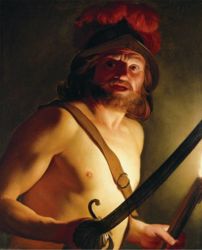
We are talking about the Mysteries of Antinous-Mars. This is why Flamen Antinoalis Antonius Subia has painted Antinous in the guise of the War God (above). 

Antinous is not just about gay male beauty. He is about gay male warrior energy.

Mars is a very important constituent aspect of Antinous. In Fixed Star Astrology, the STAR OF ANTINOUS is characterized by a mixture of Jupiter/Mars energy along with Venus energy — unique among Fixed Stars. To overlook Mars is to overlook a major component of what Antinous is all about.

Mars and his Alchemical Intelligence Graphiel and Daimon Barzabel (Deimos and Phobos) is much misunderstood by philosophers and occultists. 

The fiery Graphiel/Barzabel energies of the red planet ("terror" Deimos and "horror" Phobos) are often seen as frightful and horrific and destructive and warlike with no other qualities. This is a shallow analysis and one that should be discarded. Understanding your Martial nature — the Antinous-Mars warrior inside you — is essential to your survival and growth as a gay man. Terror and horror accompany us all our lives.

We are all afraid every day. We are all riddled with doubts every day. Look around you — most people are consumed with fear and doubt. Fear fuels their lives! But each of us can learn to turn our fears and doubts "inside-out" so that their barbs no longer point inward towards us, but instead so that these barbs of fear and doubt form a protective shield around us. 

It girds us with a constructive energy which helps us to advance through the Herculean travails which we face in our daily lives. Instead of being "fearfully" timid, we become "fearsomely" determined not to let life get us down.

Tomorrow, this transformational ability to turn fear "inside-out" will help us to understand how Antinous was able to charge the man-eater during the SACRED LION HUNT.

He must have been terrified. He was young and inexperienced and alone on his steed and armed only with an adamantine-tipped lance.

But through his loving bond with Hadrian/Hercules, Antinous/Iolaus was also magically armed with the "fearsomely strong" energies of the Sacred Band of Thebes.

Flamen Antinoalis Antonius affirms: "We consecrate and honor their memory and call upon their strength and courage in our own hearts, that we may become the New Sacred Band."

Thursday, June 2, 2016

WARREN LEE WILLIAMSON
JUNE 2, 1939 - MARCH 13, 2012


BROTHERS,
(as Warren always saluted us) 

Today we remember our dear gay wizard friend Warren Lee Williamson, born on this day in 1939, and who  succumbed to bone cancer at a hospital in Dallas on March 13, 2012, leaving behind Bob, his life's companion of 45 years. 

I want to send out a huge blessing from the bottom of my heart to the Wizard Warren on the occasion of his birthday!
I know that he is sitting there on the deck of the ANTINOUS BARQUE OF MILLIONS OF YEARS,
watching the hot young ancient Greek sailors manning the oars,
sipping champagne from an old fashioned (Marie-Antionette) glass,
on an Egyptian chaise-lounge next to Hadrian and Antinous and Lucius and all the rest of the sacred gays,
when suddenly our prayers will waft up from down below (or where ever it is that we are)
And the ship's DJ will announce over the amazing speaker system that it's Warren's Birthday!
The whole ship will freak out...a disco ball will drop from the mast...and confetti will shoot from the cannons!
He is the first of the NEW BELIEVERS IN ANTINOUS to check in with his boarding pass for the Barque of Millions of Years.
May Antinous give the Blessed Wizard Warren a special First Class seat with a window.
I love the Wizard Warren...he always had something right out of the cosmos to say,
...he gave me a tremendous boost of confidence when I was feeling out of my mind.
Warren was the holy grandfather of the Religion of Antinous...he was a magic presence among us,
We still continue to feel the ripples of his magic course through us even now.
The Blessed Wizard Warren is now the first of us to stand before ANTINOUS THE GAY GOD!
I know that the Wizard will sit down with Antinous and explain to the ancient boy-god,
what all our modern crazy madness is about (because Antinous must surely be confused)
...and then, with a wave of a divine hand, Antinous will restore the Wizard Warren to his pinnacle of eternal youth,
And in that perfect state of bliss, Antinous will reveal all the mysteries of HOMOTHEOSIS
That can only be known to those who have shed their mortal flesh forever.
I hope to join them there one day on the ship of millions of years.

The Wizard Warren was the 1st champion of the FIRST ANTINOUS GAMES,
He won with a beautiful story and a Haiku poem.
There were other great submissions, of course,
...but it was obvious to me that Warren's submission was something deeper
Than a devotional tribute to Antinous might usually be,
but it had what I can only describe as A VOICE OF MILLIONS OF YEARS
and this is why I insisted that Warren be named the winner.
In Memory of the Great Wizard, I want to share these two emails that were sent by Warren in 2006 during the First Sacred Games,
They are wonderful to read because it is only now that the uncanny VOICE OF MILLIONS OF YEARS
Is clearly obvious.

The Wizard Warren Lives Forever!

ANTONYUS SUBIA

______________________________________

April 13th 2006

Brothers:
I do not know whether I should relate this evenings occurrence, or
just keep it to myself. I choose to tell you; think of me what you will.
I went to church this evening, Thursday before Easter, not because I am a christian but because I love the music. Arriving late, I sat at the back.
I don't know when I first noticed Him, but it was with disapproval.
In the pew in front of me, but at the other side of the sanctuary,
stood a young man, probably 17 or 18 years of age. I felt that he was too casually dressed for such an occasion; he wore a rock style T-shirt, short pants and what we used to call in the old days (1970's) "Jesus boots', the roman style lace up sandals. During the service I kept feeling myself drawn to him; I purposely tried to look away.
He seemed familiar. And I loved His curly hair; He seemed Mediterranean.
As the sermon droned on I kept hoping he would look back at me, and then he did! It was as if someone had slapped me in the face. I was stunned! It was Him........It was Him. I knew....I knew it was Him.
He smiled and my heart stopped. I stood for the hymn not even aware I was doing so. It was by Bernard of Clairvaux. During the second verse his eyes never left me and I realized I was singing it to Him.

What language shall I borrow,
To thank thee, dearest friend,
For this thy dying sorrow,
Thy pity without end?
Let me be thine forever.
And, should I fainting be,
Oh, let me never, never,
Outlive my love to thee.

His eyes pierced to my soul, and his smile was more than I could bear. I kept thinking this was not happening.....it couldn't be! I have looked at his statues for years.....I know his visage well.......and it was Him.
At the moment the hymn ended he turned full front to me and I saw what rock band was emblazoned there on his T-shirt: OSIRIS RISING.
My knees went weak, and tears streamed down my cheeks. The woman next to me, thinking I had been overcome by the service, put her arm around me to comfort me.
The service over, I looked up to locate Him, to follow Him, but He was on the other side of the church and the crowd was thick. I saw Him move into the narthex and I pushed my way through the crowd to get there as quickly as possible. But of course, He was not there. He was no where to be found......and I looked for several minutes. I asked casually if anyone had seen the 'young man', but no, no one remembered seeing Him.
I left sadly, yet strangely content. Because I know deep inside it
was Him. So I know He is watching; He is more than myth, much more.
And I shall never forget that smile as long as I live. Antinous lives!
 

-----------
(Following Submission to the First Antinous Games)

April 21st 2006

Dear Brothers:

Believing that the time of Antinous has truly come, that he is no 
longer a local phenomenon only, but has taken his place with the eternal Olympians, I offer the following haiku poem to His honor and for the glory of His games throughout the world.

"Antinous Epiphanios"

Maundy Thursday's King, 

Brazen, Antinous smiling,
Osiris Rising!


Also,a sad note. I attended both Good Friday and Easter services,
searching each face, hoping that He would be there. But, of course,
He was absent, as I reckoned He would be. I will keep searching,
but I knew it was but a single epiphany. He is indeed Antinous
Epiphanios
!

I appreciated, so much, your comments. And I asked myself the same 
questions you did...........what would I have done had I met Him? I have no answer; I only felt compelled to touch His hand, to be with Him for a moment.

Glory to Antinous and peace to the Ecclesia Antinoi!
 

ANTINOUS VIVIT, AVE!

Sunday, June 21, 2015

ANTINOUS MERGES WITH APOLLO
DURING THE GLORIOUS JUNE SOLSTICE


THE JUNE SOLSTICE is one of the most sacred days in the Liturgical Calendar of the Religion of Antinous.

It is the day when Ra Herakhte, the heavenly father of Antinous, stands still for a moment. In the Northern Hemisphere it is the longest day  and from now on the days become shorter and shorter. For our brothers in the Southern Hemisphere, this is the Shortest Day and from now on the days become longer and longer.

That is an important aspect to remember about the Religion of Antinous. The Blessed Boy is beyond such constraints as Summer and Winter or even Life and Death. For Antinous, the days are ALWAYS getting longer and the they are ALWAYS getting shorter.

For HE lives in our hearts — wherever we are.

The Religion of Antinous celebrates a whole cluster of Sacred Events on this magical day, which we call The Delphinea as a collective term. The Delphinea is the celebration of the beautiful, golden-haired god of light, Apollo. 

Antinous would be associated with many deities in the generations to come. Among his many names, the Beauteous Boy was adored as Antinous-Apollo (image above).

The Delphinea is the celebration of the beautiful, golden-haired god of light, Apollo, and of his triumph over the great and monstrous Python which was wrapped around holy mount Parnassus. The Python was the creation of Juno, a creature of jealousy whose coils were meant only to stifle and constrict the grace of that which was to proceed from the Sacred Way of the holy city of Delphi.


Apollo shot the Python and destroyed it, when he was only three days old, which is like the brilliance of the Sun dispelling the covering of night. He set the black stone which had fallen from the sky, called the Omphalos, over the navel of the Earth, and charged a Sibyl, a priestess of the Great Mother to watch over the stone and to convey his wisdom to mankind.

Flamen Antinoalis Antonius Subia explains the significance for us Antinoians:
"The Oracle of Delphi, called a Pythoness, was overtaken while seated atop a golden tripod, by a fire that is the breath of the God. Apollo is the Flower Prince reborn, he is the Twin brother of Dionysus, the Twin brother of Diana. He is the Son of Zeus, and the inheritor of his Kingdom, just as Aelius Caesar was the chosen son of Hadrian.
"Apollo is the God of wisdom and art, the speaker of truth, the deliverer of radiance, reason and beauty. Apollo is the God of Socrates and Plato, and he is the God of Pythagoras who claimed to be his son, exhibiting a golden thigh as proof. Apollo is the unconquered light, the full manifested brilliance, power and wisdom of Orpheus.
"Of all the gods, Apollo is the most boy-loving, though the touch of his heart was invariably fatal. He is the genius of the dying boy-gods. We pray to Apollo, the great god of homosexuality, and seek his guidance on this day, the longest day of the year."

Wednesday, April 15, 2015

THIS BRITISH ROMAN'S LEAD CURSE
ASKED SEA GODS TO DESSICATE A FOE


A man living by the sea in Roman Britannia invoked Neptune and a British sea spirit to use their powers over fluids to drain the life's blood from a thief who stole his money.

His invocation was etched into a LEAD CURSE TABLET and buried next to a sacred river near the sea.

Found by Badnam Creek in Southampton, this curse tablet from the Roman-Greco world was created in about 350 or 400 AD by Muconius, a man angry at the mystery thief who stole his gold and silver coins.

Willing divine retribution to visit his assailant, Muconius might have paid a scribe or prepared the scornful curse himself, etched upon lead, a naturally plentiful material with a heavy, cold nature thought to possess a lifelessness which could enhance the power of the sentiments.

The text reads: “Lord Neptune, I give you the man who has stolen the solidus and six argentioli of Muconius.

“So I give the names who took them away, whether male or female, whether boy or girl. So I give you Niskus, and to Neptune, the life, health, blood, of him who has been privy to that taking away.

“The mind which stole this and has been privy to it, may you take it away. The thief who stole this, may you consume his blood and take it away, Lord Neptune.”


Curse tablets of the period are usually associated with civil and criminal court cases, as well as unsolved crimes and personal grievances. In the Roman Empire they were usually inscribed with a stylus on lead tablets, although wooden tablets, papyri and other materials were also used.

Neptune was the name of the Roman god of rivers, lakes and springs before becoming god of the sea, usually depicted as a bearded man holding a trident and a somewhat angry countenance.

He was also the god of earthquakes and storms and the patron of horses and horse races. In the Roman Pantheon he is a son of Saturn and the brother of Jupiter, the Lord of the Heavens, and Pluto (Hades - the Lord of the Underworld). The Greek equivalent is Poseidon.

River settings where tablets have been found in Britain include the Thames at London Bridge, the Little Ouse at Brandon in Norfolk and the Tas at Caister St Edmund in Suffolk.  All of them appealed to the god Neptune.

Many tablets, such as those found in Bath, were originally perforated and nailed to the fabric of temple buildings.

The identity of Niskus is uncertain. The use of the letter ‘k’ - only one other usage is known from Roman Britain - is rare.

The most plausible identification is with a male version of Niska, which is a name associated with water-nymphs, found on tablets (now lost) in 1845 at the principal hot spring at Aix-les-Bains in France.

Alternatively, Niskus may have been a native British water-god. But no evidence has yet been found of a link to Neptune similar to the one established between the British goddess Sulis and the Roman Minerva at Bath.


Saturday, April 4, 2015

THE PINK MOON OF ANTINOUS
IS A MOMENT OF AWESOME WONDER


THE Pink Moon of Antinous! Saturday's Total Lunar Eclipse or "Blood Moon" is visible … right now as these lines are being written … in most of North America, South America, the Pacific, Asia and parts of Australia. 

The moment of totality over the Hollywood Temple of Antinous is about 5:00 a.m. PST, and priests at this very moment are observing it and offering prayers.

But from beginning to end, it lasts for 3 hours and 29 mins. 

With the Sun in Aries and the Moon in Libra, this is the Libra Full Moon ... the lunar cycle we call the ORATOR MOON of diplomacy and balanced thinking. 

This is the perfect time for fulfilling dreams of finding just the right partner, the person who balances out your needs and desires perfectly. But remember that diplomacy is the key. 

The good news is that diplomacy and balance are enhanced.

The not-so-good news is that indecision and dithering are also enhanced. You lack the ability to differentiate between friend and foe, between advantage and disadvantage, between good opportunities and bad opportunities.

Speaking of which … many extremist fundamentalist Christians are calling this the "Blood Moon" which will usher in Judgement Day and the End Times.

We don't view it in such biblical apocalyptic terms. But … we feel a great change is indeed coming. The Piscean Age dominated by messianic religions is coming to an end … and the Aquarian Age of freedom and equanimity is at hand.

Sunday, January 25, 2015

WORSHIPERS ON BOTH SIDES OF ATLANTIC
CELEBRATE HADRIAN'S BIRTHDAY


WORSHIPERS on both sides of the Atlantic joined hands via Skype in ceremonies celebrating Emperor Hadrian's birthday at the Hollywood Temple of Antinous ... rites which continued into early Sunday.

Flamen Antonius Subia had issued a global invitation via social networks for participation in Saturday evening's ceremonies commemorating the 1,939th anniversary of the birth of Hadrian.

"We honor Hadrian because without him there would be no Religion of Antinous," Priest Antonius told the worshipers who had gathered in Hollywood with live participation from adherents elsewhere in the USA as well as in Mexico and Europe.


"Hadrian loved Antinous with all his heart and with all his soul. And yet, when Antinous died he could have kept Antinous in his heart to treasure alone for all eternity," Antonius said.

"But instead, he shared Antinous with the world," he added, raising his hands toward images of Hadrian and Antinous on the temple's sacred altar.

"He issued an imperial command that temples to Antinous be erected throughout the Empire," the Hollywood high priest explained, "and that statues, busts and sacred images of Antinous be created to perpetuate his memory."

Even in the darkest times after the Fall of Rome, Antinous continued to serve as a beacon for homosexuals through the centuries.

"Antinous was revered by gay people throughout the centuries, even in the Killing Times when gays were burned and persecuted, even during the Gay Holocaust at the hands of the Nazis ... and also as gay people continue to suffer today," he said.


"Instead of keeping Antinous locked in his heart, Hadrian shared a portion of Antinous with us," Antonius added, speaking in English and in Spanish for participants in Mexico City. 

"He permitted us to share in his loving relationship with Antinous, and in doing so, he forever changed the way gay people have seen themselves," he told the congregants.

Officiating at the Hollywood Temple as others took part via Skype, Antonius lighted incense and offered libations in celebration of the birth and life of Hadrian and his unprecedented step to deify his gay lover ... the ultimate Classical deity.

"He was the most powerful man in the world, who loved Antinous so much that he declared him a god," Antonius told worshipers.

"He did that as representative of Zeus on Earth, emblem of the ruler of the Cosmos, the great eagle," Antonius added. 

"Hadrian is the bringer of order out of chaos, founder of our religion," he went on. "He is the divine lover of Antinous ... our model ... and our God."

Future interactive ceremonies will be announced in advance.

Thursday, September 4, 2014

THE SEMEN OF THE FIRST GOD
TRULY IS IN HIS BODY


ANTINOUS must have heard the many wondrous creation stories which the Egyptians told him during that fateful journey up the Nile.

The Egyptians had many creation stories, ranging from dry land appearing in the midst of the primeval ocean to the "Great Cackler" laying an enormous egg.

Our own favorite (and the one with the closest bearing on Antinous) is probably the least-well known of all of them, involving as it does an act of masturbation.

If you've never heard about it, it's because Victorian and Edwardian Egyptologists were so shocked by it that they referred to it only in Greek or Latin footnotes 
— if at all.

For a hoot, read Wallis Budge's embarrassed attempts to tell the story in English using words no stronger than "onanism" and "seed".

Hernestus once knew a Harvard teaching assistant who taught Beginner's Hieroglyphs at the Cambridge Adult Education School and who delighted in titillating his students (mostly lonely-hearts straight women and a couple of gay men) by demonstrating reflexive verbs in Middle Egyptian with the sentence: "The God Loved Himself With His Hand" and assigning homework that involved copying out the text with particular attention to the glyph showing testicles attached to an erect penis with a fountain of semen gushing forth from its end.

Here's the gist of the story:


The Great Creator sits alone, having not yet created anything, when the creative urge comes upon him and his penis throbs into a massive erection, which he strokes to ecstatic climax, sending his silvery semen flying into his mouth, whereupon he speaks the magical words that create the first "neteru" (gods) and all the universe.

"In the Beginning was the Word" is the way the New Testament puts it in a somewhat more family-friendly version of the same story.

It is this "essence of magical creation," which the Egyptians call "heka," which invigorates everything we do. It is liquid heka which flows through the desert in the form of the annual inundation of the Nile, creating life from barrenness.

Budge and the others translated "heka" as "magic," which is misleading and simplistic. But then they also translated "neteru" as "gods," which is also misleading since English is such a young language (scarcely 1,600 years old) that its linguistic concept of "god" necessarily reflects Christian attitudes.

An Egyptian or a Greek or Roman of Antinous's day might have been more comfortable with Medieval infatuation with Spheres of Angels and Archangels or with the Catholic panoply of Saints. The Egyptians might have thought that more like the divine agents they called "neteru."


The "neter" associated with the annual inundation of the Nile is the transgender deity Hapi. To our mind, and we believe to the minds of the Ancient Egyptians, Hapi is one of the most wonderful and beautiful of the "neteru."

Hapi's most distinctive attribute is bluish-green skin and a towering headdress consisting of papyrus and lotus plants which seem to shoot out of the crown of Hapi's head the way those plants do from the waters of the Nile.

As a transgender deity, Hapi has a robust male physique with athletic legs, narrow waist, broad shoulders and sinewy arms. But Hapi also has the pendulous breasts of a nursing mother and the round belly of an expectant one. Sometimes Hapi has the short-cropped hair of a man, but more often Hapy is depicted with long hair cascading over both shoulders almost to the waist.

Very strikingly, Hapi effortlessly holds before him/herself a platter heaped high with incredible amounts of crops, beverages, groceries and produce, often including casks of wine, sheaves of wheat and even entire sides of beef.

Just as the Egyptians had no problems thinking that the universe and the neteru (and ultimately they themselves) were all products of primordial masturbation, they also had no problems thinking that their lives depended on a transgender deity who was, in essence, their mother/father and provider of everything they put in their mouths and clothed their bodies with.


It is a popular misconception to try to fit Isis and Osiris into the roles of Mother Earth goddess and Great Father god who bring forth riches from a bountiful Earth. That is an alien concept to the Egyptians, for whom the Earth was a desert. Our own English word "desert" comes directly from the Ancient Egyptian "desheret" — meaning the "Red Land" of sunrise and sunset.

It was only divine "heka" flowing through this barrenness that permitted life to thrive in a verdant valley called the "Black Land" or "Kemet," from which the Arabs derived "al-Chem" and our words "alchemy" and "chemistry" come.

As Herodotus said: "Egypt is the gift of the Nile," by which he meant: "Egypt is the gift of Hapi."


So when Antinous plunges into the Nile on that fateful October day, he becomes becomes one with Hapi. Antinous and the transgender source of all life merge and flow into each other.

Antinous opens his mouth and his nostrils and allows himself to be filled with heka which, after all, is the semen of the Great Creator himself.

The hieroglyphs on the OBELISK OF ANTINOUS proclaim that Antinous can assume any form his heart desires "for the Semen of the First God Truly is in His body!"

It's the ultimate seminal experience.

And it is Antinous's unique gift to us as gay men. He asks us to take the plunge with him and to explore what words like "god" and "magic" really mean.

Tuesday, July 8, 2014

THE DAY HADRIAN WAS DECLARED
EMPEROR OF ROME


ON JULY 8th-9th we commemorate the Ascension and Consecration of Hadrian — when he became master of the world after years of worrying and waiting. Hadrian was declared Emperor by the Legions when Trajan died suddenly while campaigning in Parthia on August 8th, 117. 

In this illustration, you see Hadrian entering the Roman Forum at the height of his power. Standing behind him in the chariot is Antinous saying: "Respice post te! Hominem te esse memento! Memento mori!": "Look behind you! Remember that you are a man! Remember that you'll die!"

On this day in 117 AD, however, Hadrian truly had been in fear of death. Hadrian had been on tenterhooks for years wondering whether Trajan would formally adopt him as his heir. 

If Trajan died without the issue of succession being settled, it could result in civil war — or at least in the assassination of Hadrian by some other ambitious man.

It is said that the Divine Empress Plotina forged the will of her husband and gave the throne to Hadrian, who had been her protégé and friend for years.

After assuming power, Hadrian first settled the conflict with the Persian King, signing a peace treaty that was to last through the whole of his reign. As Trajan's military representative in the provinces, he had seen how the empire was beginning to over-reach its resources. So he set about consolidating things in the East, lest his Empire become embroiled in the sort of chronic blood-letting that modern superpowers now seek to extricate themselves from in that same region.

It is also said that he wanted to let the political dust settle back in Rome before returning to a city where his critics were waiting. Many thought him unfit. Hadrian was Hispanic — literally so. He was born in the province of Hispania and spoke Latin with a provincial "Hispanic accent" which was the cause of much derision by high-born Patricians when he was sent to Rome as a boy to be educated. He never liked Rome and, throughout his reign, spent as little time there as possible.

Settling other matters in the East, Hadrian waited a full year before  returning to Rome, and on July 9th, 118, he entered the Holy City and was formally and ritually installed as Emperor by the Senate. He was then consecrated as Pontifex Maximus, highest priest of the Roman Religion, and head of all foreign cults.

He inherited from the warrior-king Trajan the largest empire that the western world had ever known — Rome at her greatest size and strength — and he wisely chose not to continue to expand the frontiers, but to turn instead to the development of the interior.


He visited every province, traveling more than any other emperor before or after, dedicating his power to art, literature, legal reform and the promotion of peace, prosperity, and the united religious consciousness of Roman citizenship after his beloved Athenian model.

Flamen Antinoalis Antonius Subia says the following about this Sacred Day in our Liturgical Calendar:

"On this day, Imperator Caesar Traianus Hadrianus Augustus was to assume responsibility as the spiritual leader of the Empire, Father of the Country with a vigor unparalleled by his predecessors, and was to be one of the foremost builders of cities, temples, and public structures world-wide. For his love of Antinous and the extraordinary gesture of deifying our god, we worship and venerate Hadrian as the founder of our faith and as our immortal father, the lover of Antinous."

Wednesday, June 18, 2014

BIG ROMAN TEMPLE FOUND IN FRANCE
DEDICATED PERHAPS TO ANTINOUS?


AN unprecedentedly large Roman temple has been unearthed in northern France which dates to the 2nd Century AD in the heyday of the Religion of Antinous.

The discovery raises new hope of an Antinous Temple being found, or at least a shrine or chapel (aedicula) to Antinous within a temple.

Experts caution, however, that they do not yet know to which deity or deities this temple was dedicated.

This is the largest provincial temple found in France. It measures 70 meters by 105 meters and has two small pavilions in the back, of which only the foundations remain. 

In the center, the "Cella," visitors could access a dramatic masonry platform via a front staircase.

Here in the heart of the temple, the ancient Romans would have erected the statue of a deity.

Archaeologists have discovered many elements of the artwork inside the sanctuary, including clashed spears and marble veneer.

The entrance to the temple was a monumental façade measuring 10 meters high and 70 meters long, which made it an exceptional structure in Roman Gaul.

This façade consists of 13 to 17 arches, above which the Romans surmounted an entablature and, exceptionally, a frieze that should include a dedication in bronze letters.

A few decades after its erection, the façade collapsed in one piece perhaps due to a defect in the foundation related to the nature and slope of the ground, which caused a mess of thousands of blocks and fragments. 

Archaeologists intend to study these fragments to gradually restore the original appearance of the sanctuary. 

The ornamentation, sometimes enhanced color reveals carved decorations: Greek meanders, foliage, animals, and images of several deities, including Venus, Apollo, and Jupiter.

Within the entablature, its most unique sequence is the frieze decorated with deities from the Greco-Roman Pantheon, such as a crouching Venus alongside the head of an old woman. 

This sculpture recalls an episode told by Homer in The Odyssey. After an affair with Mars, Vulcan’s wife retired to the woods. An old lady informed the gods, who sought the place of her retreat.

To punish her, Venus turned the old woman into a rock. At the top of the façade, one of the most remarkable features is a decoration of monumental heads, which measure three times larger than human size, with complex hair and eyes that had once consisted of colored stones.

Among them, the head of Jupiter and a series of griffins with outstretched wings sit along yet-undetermined gods … could Antinous be one of them?

Tuesday, May 6, 2014

HERE'S YOUR CHANCE TO BE A CHAMPION
IN THE SACRED GAMES OF ANTINOUS


HERE's your chance to pay tribute to Antinous with your own special artistic or athletic talents ... and to compete for prizes ... in keeping with the ancient tradition of holding Games in honor of Antinous.

The 3rd Sacred Games of Antinous in the modern era will be held August 21st, 2014. Applications for entries are being taken now.

Antonius Subia unveiled the poster for the Games and initial plans for the competition during a global phone and Skype conference call involving modern-day priests and adherents of Antinous on three continents.

The virtual-reality conclave was held in conjunction with ceremonies at the HOLLYWOOD TEMPLE OF ANTINOUS Monday evening celebrating the SACRED BOAR HUNT of Antinous and Hadrian.


"Everyone has heard of the Ancient Olympics, but there were other Games held in antiquity," Antonius told the celebrants gathered at the Hollywood Temple and via phone and Skype as far away as New Zealand.

"And among the most famous were the Games of Antinous, which were called the Megala Antinoeia ... the Great Games of Antinous," Antonius said. "These were Sacred Games which were held in Antinoopolis, Bithynia and in Mantinea."

The most famous Games were held at Antinoopolis, the city founded by Emperor Hadrian in Egypt at the spot along the Nile where Antinous had drowned in the year 130 AD.

The competitors were primarily young men called Ephebes. 

In Antinoopolis these included swimming and boat races in the Nile.

But the Antinous Games were unique in that they also included competition in the arts and music. 

The over-all winner was consecrated as the living embodiment of Antinous and given citizenship in Antinoopolis, with an all-expense-paid life of luxury and adoration. 

He was worshiped in the temple as the representative of Antinous, the emblem of youth and masculinity. He was the Divine Ephebe.

The Great Antinoeia, as the Games of Antinous were called, were held for hundreds of years. 

But little was known of the actual competitions until a fragile papyrus was deciphered recently which revealed some intriguing and somewhat shocking details about the Games of Antinous of the year 267 AD and two wrestlers named NICANTINOUS AND DEMETRIUS.

The Games of Antinous faded into obscurity ... but have been revived in the past decade by us. They are held every four years during the cycle of the blooming of the ROSY LOTUS OF ANTINOUS AFTER THE LION HUNT in August.


This is the III ANTINOEIAD of the modern era, and entry is open to everyone wishing to honor Antinous with their own artistic, academic or athletic talents.

"These Games are open to all ... regardless whether you are gay and regardless of gender," Antonius said.

"You can submit any form of artistic endeavor ... poems, paintings, videos or literary works. But you can also submit dancing, running or other physical effort ... as long as you provide documentation of your performance art," he explained.

Prizes will be awarded to winners, details of which are to be unveiled on this blog in coming days and weeks as the deadline approaches.

For enquiries and submissions, contact us here: antinouspriest@gmail.com

Monday, April 21, 2014

THE EROTICON
WHEN ANTINOUS HUNTS A BEAR


ON April 21, as the Sun moves into the Sign of Taurus the Bull, we celebrate the ancient festival of THE EROTICON.

On this day we honor the great God of Love, Eros-Cupid, in his guise as Antinous-Phanes, the "radiant being of light who emerges from the egg of night". 


We also honor the Great God Priapus the divine phallus, the column of male virility, the bestower of the fertility of fields, vineyards, orchards and gardens. Priapus is the axis of the cosmos.

On this date we also commemorate the founding of the city of Rome, Natalis Urbis, personified by the Romans as Our Lady Roma. We celebrate the consecration of her sacred border, and of her birth, and eternal life, and remember that we are her children.

And also on this date we remember the Sacred Bear Hunt. While in Mysia in Asia Minor, in the year 129, the court engaged in a Bear Hunt near the city which Hadrian had founded (on an earlier trip) called Hadrianotherae, "Hadrian's hunting ground". It is the modern-day city of Balikesir in a lovely area of wooded forests and lakes in northwestern Turkey.

Hadrian loved animals and is known to have built tombs for his dogs and horses (according to Royston Lambert) and he loved to hunt. The Bear is the sacred animal of Diana-Artemis, and symbolizes the solitary, forest-roaming character of the Virgin Huntress. In the ferocity of the bear lies the secret of Diana's power, against which Hadrian and Antinous pitted themselves, as shown on the tondo from the Arch of Constantine.

The grand themes of the Eroticon are Love and Sex and Ferocious Anger. The Beast is always lurking inside of us. The mystery teaching surrounding the Bear Hunt involves getting to know your animal instincts -- sex and lust and rage -- and to become one with them and to turn them into powerful allies for your spiritual development.

Flamen Antinoalis Antonius Subia has expressed this mystical mystery meaning as follows:

"Antinous, under Hadrian's guidance, was an accomplished hunter, indeed it is perhaps his natural skill and bravery in the chase that elevated him to the absolute love and adoration of Hadrian. The Emperor was madly in love with hunters, and Antinous was one of the best. Antinous had perhaps been silently stalking and hunting the Emperor's favor for quite some time, and now, in Asia, in the sacred Hunting Grounds of Hadrian, Antinous closed in on the heart of his prey and captured the Emperor completely. In our commemoration of the Sacred Bear Hunt we recognize that Artemis and Antinous are twin deities, and we seek the Dianic-Artemis-Bear within ourselves."

Sunday, February 23, 2014

MEET ANTINOUS IN LONDON
DURING GAY HISTORY MONTH


ONE of the world's leading authorities on Antinous will discuss the latest research discoveries and insights into the Beauteous Boy during a popular lecture as part of London Gay History Month tomorrow, February 24th.

John J Johnston will give the lecture, entitled "A Boy and His Empire: Antinous — Last God of the Ancient World", on February 24th at the TREADWELL'S esoteric and occult book shop located at  33 Store Street, Bloomsbury, London, WC1E 7BS.

Seating is exceedingly limited, so it is advisable to contact the store by CLICKING HERE.

Johnston, shown above with the famous Berlin Green Head, is well known for giving lectures which offer a very thorough and precise outline of the historical person Antinous and his elevation by the Emperor Hadrian from provincial obscurity to the dizzying heights of Imperial Rome — and upon his death, to the celestial realm of divinity. 

He has spoken on the subject of Antinous twice at the renowned Petrie Museum of Egyptian Archaeology, drawing standing-room-only crowds each time.

This lavishly illustrated lecture draws upon artistic, archaeological, and textual sources to examine the enigmatic life and death of Antinous, before going on to consider his religious and artistic legacy throughout the Roman world and his continuing influence in the modern world from his adoration by Johann Joachim Winckelmann, the father of art history, through the works of Victorian artists and writers, and into the 21st Century where Antinous and his image have provided the basis for numerous "blockbuster" exhibitions in museums and galleries throughout the world and continue to inspire artists, writers and film-makers.
 

Bringing the discussion right up-to-date, he will also be addressing our own Priesthood of Antinous and the online TEMPLE OF ANTINOUS as exemplars of Antinous' influence on modern popular culture.

Recently, he presented a conference paper focused upon the effect of Antinous upon western gay culture, entitled The Cult of Antinous: 1,882 Years and Counting?
  
John J Johnston is Vice-Chair of the Egypt Exploration Society and serves on the Committee of the Friends of the Petrie Museum. He has lectured extensively at institutions such as the British Museum, the National Museum of Scotland, the Royal College of Surgeons and the Ny Carlsberg Glyptotek in Copenhagen. 


His varied research interests encompass mortuary beliefs and practices, gender and sexuality, Hellenistic and Roman Egypt, the history of Egyptology and the reception of ancient Egypt in the modern world. 

He is co-editor of the book, Narratives of Egypt and the Ancient Near East: Literary Linguistic Approaches (Peeters, 2011). He is presently editing two further publications and sits on the Editorial Board of Egyptian Archaeology magazine.

John J Johnston read Egyptology and Classics at the University of Liverpool and Open University, respectively. He obtained an MA in  Egyptian Archaeology from University College London, where he is  currently reading for a PhD.