Showing posts with label classical god. Show all posts

Saturday, September 5, 2026

ROMULUS SHRINE TO JUPITER LOCATED
AT BASE OF PALATINE IN ROME


IN the old Roman calendar, September was the seventh month of the year in counting March as the first. Among the festivals observed in September were several honoring Jupiter. 

He was hailed as the chief of the gods and had many epithets as a result.


As Jupiter Optimus Maximus, he occupied the temple of Jupiter Capitolinus on the Capitoline hill with the goddesses Juno and Minerva. With them, he received a Lectisternium (September 13) and the Ludi Romani  (September 5-19). 

He was honored with festivals as Jupiter Liber and Jupiter Fulminator (September 1) and as Jupiter Stator (September 5).

Jupiter Stator is the hand of Jupiter giving Roman troops their unstoppable force.

Romulus built a temple to Jupiter Stator at the foot of the Palatine Hill, Italian archaeologists say.


The ruins of the shrine to Jupiter Stator (Jupiter the Stayer), believed to date to 750 BC, were found by a Rome University team led by Andrea Carandini.

"We believe this is the temple that legend says Romulus erected to the king of the gods after the Romans held their ground against the furious Sabines fighting to get their women back after the famous Rape (abduction)," Carandini said in the Archeologia Viva (Living Archaeology) journal.


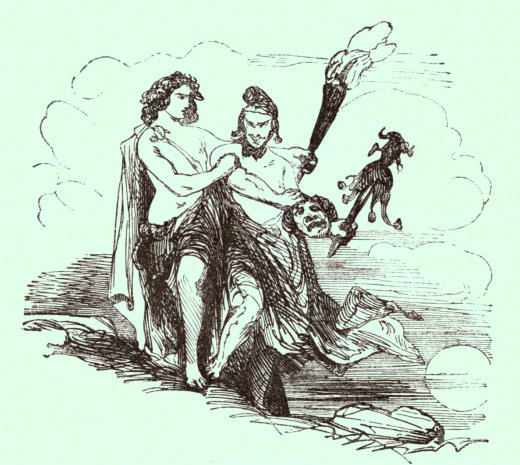
Historians have always been intrigued by ancient references to the temple, but never knew precisely where it was located or what it looked like. The lithograph above is a fanciful 19th Century idea of its possible appearance.

According to myth, Romulus founded Rome in 753 BC and the wifeless first generation of Roman men raided nearby Sabine tribes for their womenfolk, an event that has been illustrated in art down the centuries.

Carandini added: "It is also noteworthy that the temple appears to be shoring up the Palatine, as if in defence".

Rome's great and good including imperial families lived on the Palatine, overlooking the Forum.

Long after its legendary institution by Romulus, the cult of Jupiter the Stayer fueled Roman troops in battle, forging the irresistible military might that conquered most of the ancient known world.


In the article in Archeologia Viva, Carandini's team said they might also have discovered the ruins of the last Palatine house Julius Caesar lived in - the one he left on the Ides of March, 44BC, on his way to death in the Senate.

Friday, September 4, 2026

DID ANTINOUS AND HADRIAN VISIT
THIS SANCTUARY OF PAN/FAUNUS?


EXPERTS in Israel have discovered what may turn out to be a sanctuary to the god Pan/Faunus which may have been seen by Antinous and Hadrian during their trip through the Eastern Provinces.

Archaeologists unearthed a gateway in the city of Hippos where they discovered a large and rare mask of Greek God Pan. 

The mask is an extraordinary find and suggests the ancient sanctuary was dedicated to the Greek God Pan.

According to experts, bronze masks of this size are extremely rare and usually do not depict Pan or any of the other Greek or Roman mythological images.

University of Haifa archaeologist Michael Eisenberg led a team that unearthed a 1.8-meter-tall (6-foot-tall) Roman gate near a stone building where the mask was found, leading him to speculate that the gate might have led to a sanctuary dedicated to Pan. 

"The mask, and now the gate in which it was embedded, are continuing to fire our imaginations," Eisenberg says. 

"The worship of Pan sometimes included ceremonies involving drinking, sacrifices and ecstatic rituals, including nudity and sex. This worship usually took place outside the city walls, in caves and other natural settings." 

The possible sanctuary was located near the city gates and was constructed sometime during the reign of Hadrian, who was emperor from 117 AD to 138 AD. 

Hadrian and Antinous traveled through the area in 129-130 AD.

Hippos-Sussita is located about 2 km east of the Sea of Galilee in the Sussita National Park of the National Parks Authority.

In recent years, the mysteries of Hippos-Sussita have been revealing their secrets in an extraordinary way.

In 2011, scientists found an ancient sculpture of Hercules. Two years later a basalt tombstone with a sculpture of the deceased’s bust was uncovered. 

Now there is a new surprise: the only finding of a bronze mask of unnatural size, in the form of the god Pan/Faunus.

In Greek mythology, Pan was the god of the wild, hunting and companion of the nymphs. He was depicted as being half human, while having the legs and horns of a goat, just like a faun. 

His Roman counterpart was Faunus and he was in many ways similar to Herne the Hunter, the horned god and lord of the forest in British mythology.

Until now it was thought there were no temples attributed to Pan, but he was rather worshipped in natural settings such as caves.

A more thorough cleaning in the lab, revealed strands of a goat beard, long pointed ears, and other characteristics that led Dr. Eisenberg to identify the mask as depicting a Pan/Faunus/Satyr.

"Now that the whole gate has been exposed, we not only have better information for dating the mask, but also a clue to its function," Eisenberg said in a statement. "Are we looking at a gate that led to the sanctuary of the god Pan or one of the rustic gods?"

Pan is the son of Antinous .. not "our" Antinous, but "Antinous the Suitor" of Homer's Odyssey and Iliad.

At the online Temple of Antinous, our own ANTONIUS SUBIA  explains the esoteric reason for the connection between Antinous and Pan.  He notes that there are two deities named Pan ... the Great Pan who is "all things" ... and the lesser Pan who is the cloven-footed goat-horned god. 

The "Little Pan" is the son of Antinous ... not OUR Antinous, but rather the Antinous of Greek mythology who was slain by Odysseus for having hit on his wife Penelope while Odysseus was off on his Odyssey.

Two different Pans. Two different Antinouses.

It gets a little confusing.

But Antonius suggests there is a clue to the names ... he says it is because they all came from the same place. Antonius points out that it was in August of the year 128 that Hadrian and Antinous traveled through the Peloponnesus and visited the home of Antinous's ancestors in Arcadia, at the city of Mantineia. 

Here is how Antonius explains the Pan-Pan and Antinous-Antinous connection at the online TEMPLE OF ANTINOUS:

"This is an important first event for Antinous as it represents his return to the place of the origin of his blood, which is the source of his mysterious name. Mantineia was to become the fourth most sacred city of the religion of Antinous, honoring Our God with a Temple and Sacred Games. The Queen who founded the city was named Antinoea, she was led to the site of the city by a serpent or dragon. 

"While in the city, Antinous and Hadrian pay homage at the grave of Epaminondas, the great Theban general who defeated the Spartans in the battle of Mantineia, but died after shortly after the victory from his wounds. The battle was won because of the courage of the Sacred Band, also known as the Army of Lovers, a corps of 300 homosexual lovers. Mantineia is the home of the prophetess Diotima, who was the teacher of Socrates, from whom he learned his philosophy of Love, particularly the mysteries of Venus Urania, which is a metaphor for gay love. 

"And Mantineia is the birthplace of the horned god Pan, son of Penelope and 'Antinous the Suitor.' The patron deity of Mantineia, and of all Arcadia is the Great God Pan. There are two gods named Pan, the Great Pan, who is all things, and the Little Pan, who is the son of 'Antinous the Suitor.' 

"We dedicate ourselves to the dual nature of Pan, the most ancient faith of Antinous, the goat-horned god, who follows in the train of Dionysus, and is the King of Satyrs. We seek to understand that within our Antinous is the nature of the Great Cosmic Pan, and also the Little Cloven-hoofed Pan of Mantineia."

Monday, August 17, 2026

THE ANTINOUS OF RENO NEVADA


WE love it when Antinomaniacs from around the world share images of Antinous they discover during their globetrotting travels.

This statue of Antinous in the guise of Dionysus is the center of an Italian restaurant in Reno Nevada. He holds the thyrsus staff of Dionysus in one hand and a goblet of wine in the other.

He is flanked by two maenads who are totally naked ... though his private parts are hidden discreetly ... lest prudish American diners be put off their pasta.

And to top it all off ... this statue rotates slowly to give diners on all sides a 360-degree view of him ... under a twinkling starry heaven.


Friday, August 14, 2026

ANTINOUS MEETS THE REPTILE FROM HADES
BUT WILL HE KILL IT? ... OR RESCUE IT?


AUGUST 14th is World Lizard Day and here is one of the most mysterious ... and missing ... statues of Antinous, showing him as Antinous Sauroktonos, the Lizard-Slayer.

The statue once stood in Dresden's Japanische Palais. But it was lost in the firestorms which swept Dresden during Allied bombing in the final days of World War II.

There is a famous statue of by Praxiteles of Apollo Sauroktonos, showing the God of Light with a stone poised over a lizard on a tree stump. 

The Praxiteles statue was oft copied by the Romans and also by artists up to the present day.

But this statue depicts Antinous as Apollo.

There is an ambivalence which has always intrigued historians. 

Is Antinous/Apollo about to kill the lizard? Or is he consciously sparing the life of the lizard?

Forget Nietzsche and other modern "experts" who philosophize about the "light" and "dark" side of human libidos and psyches.

The answer lies ... as always ... in Greek and Roman Symbological Imagery. 

(Image: Versions of Praxiteles' Apollo-Sauroktonos)

In Greek and Roman myths, the lizard symbolizes a sneaky spy who is eavesdropping on us. 

It is keeping tabs on our every move … It is a boyish tattle-tale who says, "Nyah, nyah ... I saw what you did and I'm gonna tell on you!"

The lizard is Ascalaphus, who is mentioned variously in Ovid's Metamorphoses and also by Pseudo-Apollodorus and other writers.

There are a couple of versions of the tale of Ascalaphus being metamorphosed into a skulking lizard and/or an owl (the better to spy on you at night).

In one version, Demeter persuades Pluto to permit her daughter Proserpine (Persephone) to return to the land of the living on condition that she imbibe neither food nor drink in the Elysian Fields.

But the mischievous little Hades boy "daimon" (Greek for "spirit") Ascalaphus observers her secretly biting into a pomegranate to eat its seeds and drink its juice.

Ascalaphus goes running off to tell Jupiter what he had seen ... whereupon Proserpine is condemned to remain with Pluto forever.

Proserpine/Persephone curses Ascalaphus by hurling a few drops of pomegranate juice at him which results in red speckles on his skin -- and he is transformed into a slinking newt ("askalaxos") with red-speckled scales for skin. 

Or else he becomes a speckled owl ("Bubos askalaphos").

In yet another version, Demeter herself takes vengeance by transforming Ascalaphus into a lizard and crushing him with a huge stone at the bottom of Pluto's realm.

Then, in turn, Hercules comes along and lifts the stone ... freeing Ascalaphus. Thus, Hercules is sometimes called the "Lizard Liberator" for that reason. 

But Ascalaphus's new-found freedom was short-lived because Demeter transformed him into a spotted horned owl ... as Ovid writes: "... a loathsome bird, ill omen for mankind, a skulking screech-owl, sorrow's harbinger. That tell-tale tongue of his no doubt deserved the punishment."

Thus, throughout the ages, Ascalaphus has become a synonym for someone who is punished cruelly for telling the truth. Back in the days when cultivated people studied the Classics, the imagery of a boy with a stone poised over a lizard was very clear. 

Tennessee Williams used that Classical imagery throughout his play "Night of the Iguana"which uses a Mexican lizard tied to a tree as a metaphor for the lies and mendacity and religious hypocrisy which have restricted unpleasant truths from being set free.

Antonius Subia says: 
This story of the tatter-tale daemon boy-lizard is endearing … and I have a fondness for sneaky little spies who reveal the truth...and I admire him for not letting Proserpina get away with fooling the Lord of the Underworld … he made quite sure that she stayed in the underworld like everybody else.  
This Ascalaphus is obviously a Gay lizard-boy, not in the least charmed by Prosephone's supposed beauty … when he saw that she had broken the rules, he wasted no time reporting it to Jupiter.  Perhaps Demeter/Sabina held a grudge against the little Gay Lizard...but I'm sure Jupiter/Hadrian appreciated the loyalty of the little traitor-informant. Antinous had no secrets to hide … and even if he did … I'm sure that he could count on the loyalty of the little gay lizard … if anything … the lizard kept Antinous informed of what Hadrian was up to behind closed doors … always a dangerous game … but for the sake of truth … this little gay lizard isn't afraid to die!

Why is Apollo so often depicted as the Lizard-Slayer? There's a theory that Apollo Sauroktonos is a spoof of Apollo's first deed as a young boy-god.

(Image: Apollo Vanquishing Python by symbolist painter Gustave Moreau)

Apollo's first achievement was to rid Pytho (Delphi) of the serpent (or dragon) Python. 

This monstrous beast protected the sanctuary of Pytho from its lair beside the Castalian Spring. 

There it stood guard while the "Sibyl" gave out her prophecies as she inhaled the trance inducing vapors from an open chasm. 

Apollo killed Python with his bow and arrows (Homer wrote "he killed the fearsome dragon Python, piercing it with his darts"), and then Apollo took charge of Delphi, turning it into his own special Oracle.

So ... is Antinous about to slay the lizard like Apollo slaying Python?

Or is Antinous actually lifting the stone away from the lizard, like Hercules liberating Ascalaphus in the River of Styx? 

Either way, of course, Antinous is engaging very powerful, dark energies. 

The Python is the guardian of Divine Secrets ... and Apollo mastered and become lord of Divine Secrets by overpowering Python. And Ascalaphus is the herald of dark secrets and unpleasant truths which must be told ... even at the risk of severe penalty.

Either way, these images have nothing to do with 20st Century sensitivities about animal cruelty.

These are very powerful images of Divine Secrets.

Wednesday, August 12, 2026

HERCULES INVICTUS


ON AUGUST 12th, we honor Hercules Invictus, the champion of homosexuality.

The Great God Hercules, defender of mankind against chaos, the son of Zeus, the strongest and mightiest man that has ever lived, was one of the first of the Greek gods to be worshipped by the Romans.

The Greeks of southern Italy introduced the Cult of Hercules at such an early date that the Romans were convinced that Hercules was indigenous. Indeed, he was admitted by Romulus into the sacred Pomeria, the spiritual protective wall of the city of Rome.

The cult of Hercules was centered at Tibur, where Hadrian built his magnificent Villa, and Hadrian is often compared to Hercules for his travels, his physical strength, courage, and his sexual prowess.

Hercules was driven mad by Hera and forced to murder his wife and children. In order to atone for his sin, he visited the oracle of Delphi and was instructed to submit to twelve labors.

Hercules accomplished them all, and many others including the release of Prometheus from bondage. 


He was also a sexual champion and the number of his lovers is very long, and they include boys such as Abderus, Chonus, Haemon, Hylas, Iokastus, Iolaus, Nestor, Philoctetes, Polyphemus, Telamon, Abderus, Admetus, and Dryops.

Without question, Hercules was a champion of homosexuality, and a defender of mankind against the forces of evil. 


For his benefit to mankind, he is venerated as a God and Protector of the Religion of Antinous.

(Illustration above of Hercules battling the Hydra by gay old-school beefcake artist George Quaintance.)

Wednesday, July 29, 2026

CENTAUR MOSAIC AT HADRIAN's VILLA
OFFERS INSIGHTS INTO EMPEROR's MIND


ON International Tiger Day, July 29th, we remember that the famous Centaur Mosaic from the grand dining pavilion of Hadrian's Villa at Tibur has intrigued art historians for decades. The mosaic is on view at the Altes Museum in Berlin, along with stunning sculptures of Hadrian and Antinous. But few people have had the opportunity to view it up close with commentary by eminent art historians ... until now!

This video (below), with a running narration by Dr. Steven Zucker and Dr. Beth Harris, provides brilliant insights not only into the Roman interpretation of Greek art, but also into the subtle differences in the way that the Romans and the Greeks perceived their place in the cosmos.

One important point which Drs. Zucker and Harris do not make, however, is that Hadrian was called "The Lion Slayer" because the Emperor and Antinous killed a man-eating lion in Egypt in the summer of the year 130 AD — only weeks before the tragic death of Antinous. 

Another detail is that the centaur downed by the tiger is a female, presumably the mate of the centaur holding the boulder. It is unclear whether the downed mate is dead or only stunned and is about to be rescued — just as Hadrian rescued Antinous from the Egyptian lion in real life.

So Hadrian's dinner guests could look at the mosaic and interpret the bearded centaur as being a mythic aspect of the emperor himself — protecting the Empire from the beastly forces of chaos. Hadrian could also be equated with Chiron, with Antinous perhaps his tutor.

In Greek mythology, Chiron was one of the Titans, the greatest of the Centaurs. Chiron was the tutor to a great many gods and demigods, including Prometheus, Theseus, Achilles and Hercules, to name but a few.

Astrologically, Chiron represents a person's healing energies and, indeed, the word for "surgery" in many European languages (chirurgie in French and German, cirugya in Spanish, chirugia in Italian and Portuguese) comes directly from the Ancient Greek words for "Chiron Hands" — a healer with the skilled hands of the Titan Chiron.

Astrologically, the asteroid Chiron currently is in a highly fortuitous aspect to Pluto — an aspect of cosmic healing which will last on and off through September. Hadrian, who was obsessed with astrology himself, could hardly have looked at this mosaic without pondering cosmic implications.

Zucker and Harris, founders of Smarthistory, aptly point out that this mosaic ... only a tiny fraction of the dining pavilion's mosaic ... must have been a profound source of dinner conversation.


Thursday, July 23, 2026

WE CELEBRATE THE NEPTUNALIA
AND HONOR ANTINOUS LINKS TO NEPTUNE


THE 23rd of July is the ancient Roman Neptunalia festival, when Romans honored Neptune with feasting and frivolity.

Although identified with the Greek Poseidon, god of the sea, the Roman Neptune was originally god of fresh water and prayed to at this time of year to prevent drought.

Coins minted by a priest of Antinous in Corinth show Antinous with Neptune/Poseidon. 

More clues to the link between Antinous and Neptune come from the Black Sea coast.

Experts working at a dig on the Black Sea coast in Bulgaria say they have found a well-preserved altar to Poseidon/Neptune which suggests the surrounding ruins were once a major temple to the god of the seas.

Archaeologists found the building in front of the medieval fortified wall of the seaside town of Sozopol, according to Bozhidar Dimitrov, director of Bulgaria’s National History Museum.

It is a little-known fact that Antinous was associated in a gay context with the classical god of the seas, called Poseidon by the Greeks and Neptune by the Romans.

Coins minted by a priest of Antinous at Corinth named HOSTILIUS MARCELLUS (from whom our own Julien Hostilius Marcellus takes his priestly name) show Antinous as Neptune/Poseidon.

It is a reference to the myth that Poseidon became enthralled with another marine male deity, Nerites, who was said to be the handsomest of all males on Earth, in the Heavens or in the Seas.


The sexual union of Poseidon and Nerites produced Anteros, god of requited love.

In those days, few people could read or write, but everyone knew these myths. So anyone who held one of these Antinous/Poseidon coins could "read" the gay symbolism.


So any discovery concerning Neptune/Poseidon is of great interest to us, since the dig could ultimately reveal Antinous-related artefacts.


At the Sozopol site, Dimitrov said that the numerous pieces of marble found during excavations indicate that the temple was destroyed after the declaration of Christianity as the official religion of the Roman empire in 330 AD.

The structure was partially pulled down and partially reconfigured as a Christian house of worship dedicated to a Christian saint, whose iconography was similar to that of the ancient god Neptune.

Dimitrov said that in Sozopol, there was a simiar example of how a temple to the Thracian horseman in the centre of the old town was converted into a church dedicated to Saint George, riding a horse to slay a demon dragon.

He said, according to a report by local news agency Focus, that in the case of the temple to Neptune – the god of the sea – the time of its destruction saw the building of a Christian church a very short distance away, dedicated to Saint Nicholas, the patron saint of fishermen and sailors.

Monday, July 13, 2026

PRIEST HERNESTUS UNVEILS
THE ANTINOUS MOON MAGIC BEADS


THERE are Catholic rosary beads, Eastern Orthodox beads, Swedish Lutheran Frälserkransen beads, Islamic prayer beads, Buddhist meditation beads, Hindu japa mala beads and even Wiccan prayer beads ... now several adherents of Antinous are designing prayer beads.

Earlier we unveiled the FLAMEN ANTONIUS SUBIA PRAYER BEADS.

Today we show you the beads designed by Priest Hernestus ... his "Antinous Moon Magic" beads.

They consist of 52 beads symbolizing the 52 primary annual lunar phases, each of which represents a specific archetypal spirit in Antinous Moon Magic. 

In addition, there are some 30 additional beads representing various major "Saints of Antinous," "Blessed Souls of Antinous" and also what Hernestus calls his "Sorgenkinder" (German for "special needs children") ... beads for persons or situations which require urgent spiritual attention.

The beads have a very Egyptian flavor, reflecting the mysteries of the Land of the Nile where Antinous died and was deified. The strand has beads of quartz crystal, amber, carneol, turquoise and red-green glass.

A gold filigree Egyptian ankh with six semi-precious gemstones dangles from the keystone bead at the end of the strand ... a bead which Hernestus calls the "Rekhenef" bead symbolizing the KA of the prayer beads.


Each bead represents a particular lunar phase of the year or saint or individual person/situation. 

The strand is over three feet long ... nearly one meter long. 

The length means that it variously can be worn around the neck during most hours of the day or wrapped around the wrist during intensive prayer or spell work.

"During the cycle of a lunar phase, of course, I meditate on that particular moon," says Priest Hernestus. 

"But the whole point of Antinous Moon Magic is to be able to call down the power of Antinous the Moon God at any time of the lunar year."

He explains, "So, for example, if someone consults me about asking their boss for a pay increase, I focus my attention on the 'Merchant Moon' representing the employer, and the 'Denarius Moon' for money as well as a special bead representing that person asking for a pay hike."

He says it does not matter that the Merchant Moon and Denarius Moon are lunar phases which occur at two totally different times of the year.

"Antinous Moon Magic exists beyond linear time. Antinous himself dwells in the Egyptian occult concept of SEP TEPY ... a state beyond Time and Space in which the universe is being created on a continual basis," Hernestus says. 

"The job of the magician-priest of Antinous, both in ancient times and now, has always been to enter into SEP TEPY and cast the prayer spell there."

He adds that the beads have a way of communicating special needs which require his attention.

"I wrap the beads around my wrist at random, paying no attention to the order of the beads," Hernestus. "Then during meditation, I look down and notice which bead or beads are right over my pulse on the underside of my wrist ... those beads indicate a person or situation that needs my attention."

He has found that the prayer beads can use this means to alert him to a person who is thinking of him or who is about to contact him very shortly. 

"I beads tell me a certain person is in trouble. So I consult the Antinous Oracle and go deep within myself to see what the specific situation is. Then when the person calls me, they are surprised to learn that I am already on top of their plight," he says.

"They seem to think I am psychic or something, but in fact, it is just the Antinous Moon Magic beads ... they really do work," he insists.

Saturday, July 11, 2026

THE WELL OF CASTALIA —
HOW DELPHIC ANTINOUS
CAN TEACH YOU TO TAME PEGASUS


ON JULY 11th each year, the Religion of Antinous takes a moment to ponder the esoteric reflections in the Well of Castalia at Delphi — where Antinous took a sacred bath, and where he was initiated into the Delphi Mystery Teachings.

It is also where one of the most mysterious and inspiring statues of Antinous was found.

The Well of Castalia is a fresh-water spring that flows from Mount Parnassus at Dephi, the sanctuary of Apollo. 

The Castalian Spring is located about 500 yards/meters from the Apollo Sanctuary itself. Busloads of tourists are whisked through the ruins of Delphi, but few ever stray away from their groups to wander off over to the spring site, which makes it an even more secluded and magical and mysterious place. 

It really is like stepping into the scene pictured here Tarot Trump XVII "The Star" — the trump card which was inspired by the Well of Castalia

The spring was created when Pegasus, the winged horse, struck his hoof against a rock at the base of Mount Parnassus and water gushed forth, creating a wellspring of divine inspiration for the gods of Olympus. 

The name Castalia is derived from a Nymph named Castalia, a daughter of the river Achelous, who, when pursued by Apollo, threw herself in the spring that took her name. It was the most holy spring at Delphi and was said to be the place where Apollo and the Muses bathed. 

Pilgrims washed in the sacred water before visiting the Pythoness at the Delphic Oracle. According to Euripides, washing one's hair was sufficient for the average visitor, but persons who had transgressed more seriously against the Gods (he mentions habitual murderers as an example) had to strip off and wash themselves completely in the purifying waters.

The ancients believed the name Pegasus came from an even more ancient word meaning "wellspring of magical inspiration" and it was said that Pegasus was drinking from the Castalian Pool when Bellerophontes (or in later versions Perseus) sneaked up on him to harness Pegasus to do battle against fearful monsters.

In the Delphic Mystery Teachings,  the initiates were called upon to harness the magical inspiration of Pegasus for their own quest against the inner-demons of darkness towards spiritual enlightenment.


It was also said that the water of Castalia possessed the gift of prophecy, and any man who drank there would derive prophetic vision. Castalia is also a metaphor for the Well of Knowledge, and was said to be the fountain from which wisdom and learning poured from the heart of Apollo.

We know that Hadrian and Antinous visited this spot and it seems certain that Antinous purified himself in these waters — or at least washed his luxuriant hair.

An exquisite statue of Antinous was discovered at Delphi. The forearms had been broken off, but the ancient priests had lovingly buried the statue standing upright — which was the way it was found in the 19th Century, incredibly intact except for the missing forearms.

Alas, Antinous would drown in the similarly magical waters of the River Nile only a few scant months after visiting Delphi, during what we call the imperial "Three-Year Peregrination" — the wondrous and fateful final three-year Eastern Empire travels of Hadrian and Antinous. 

Flamen Antinoalis Antonius Subia explains why this special day, July 11th, is venerated by us Antinoians:


"We venerate the wisdom-gushing Well of Castalia on this day, half a year distant from the Well of Juturna, and bathe in preparation for the transition of the Peregrination year. We pray to Castalia to sweeten our tongue, as Antinous once bathed there, exposing the pure beauty of his flesh to the cold, fresh-gushing pool that imparts inspiration of the mind. In reverence of the wisdom and poetic elegance  of Antinous, we bathe in our own Fountains of Castalia."


The imagery of this purifying plunge into the magically inspiring waters of the Castalian Well has been used throughout history — even adorning the walls of early Christian churches, as seen in the mosaic (above) found in Libya. 

The imagery lives vibrantly in the XVIIth Greater Trump in the Tarot as The Star.

Open your Mind and your Heart to the Mystery Teachings of Delphi. Permit yourself to be carried aloft upon the magical wings of Pegasus, whose name means "wellspring of magical inspiration". Become one with Antinous through the wonder of HOMOTHEOSIS and allow yourself to conquer your demons and to soar to glory amongst the stars.

Sunday, July 5, 2026

WEAR A WREATH OF FLOWERS
DURING THE LUDI APOLLINARES


FROM the 5th to 13th of July is the Ludi Apollinares, a Roman festival in honour of Apollo. This was celebrated with horse racing and theatre plays. Livy writes: "The people took part in them wearing wreaths of flowers. The doors to the houses were opened, meals eaten in the open." So a picnic outside today would make a lovely way to celebrate. Photo art by Keith MezaenAset Hoberg.

05-13 de julho é o Ludi Apollinares , um festival romano em honra de Apollo . Este foi celebrado com corridas de cavalos e peças de teatro . Livy escreve: " As pessoas participaram neles vestindo coroas de flores As portas para as casas foram abertas , refeições consumidas no aberto. ". Assim, um piquenique fora hoje faria uma maneira bonita de comemorar . arte da foto por Keith MezaenAset Hoberg .

5-13to de julio es el Ludi Apollinares , un festival romano en honor de Apolo. Este fue celebrado con las carreras de caballos y obras de teatro . Livio escribe: " Las personas que participaron en ellos con coronas de flores Las puertas de las casas se abrieron , comidas comidas al aire libre. ". Por lo que un picnic fuera hoy haría una bonita manera de celebrar. Foto del arte de Keith MezaenAset Hoberg .

Saturday, June 20, 2026

ANTINOUS MERGES WITH APOLLO
DURING THE GLORIOUS JUNE SOLSTICE


THE JUNE SOLSTICE is one of the most sacred days in the Liturgical Calendar of the Religion of Antinous.


It is the day when Ra Herakhte, the heavenly father of Antinous, stands still for a moment. In the Northern Hemisphere it is the longest day  and from now on the days become shorter and shorter. For our brothers in the Southern Hemisphere, this is the Shortest Day and from now on the days become longer and longer.

That is an important aspect to remember about the Religion of Antinous. The Blessed Boy is beyond such constraints as Summer and Winter or even Life and Death. For Antinous, the days are ALWAYS getting longer and the they are ALWAYS getting shorter.

For HE lives in our hearts — wherever we are.

The Religion of Antinous celebrates a whole cluster of Sacred Events on this magical day, which we call The Delphinea as a collective term. The Delphinea is the celebration of the beautiful, golden-haired god of light, Apollo. 

Antinous would be associated with many deities in the generations to come. Among his many names, the Beauteous Boy was adored as Antinous-Apollo (image above).

The Delphinea is the celebration of the beautiful, golden-haired god of light, Apollo, and of his triumph over the great and monstrous Python which was wrapped around holy mount Parnassus. The Python was the creation of Juno, a creature of jealousy whose coils were meant only to stifle and constrict the grace of that which was to proceed from the Sacred Way of the holy city of Delphi.


Apollo shot the Python and destroyed it, when he was only three days old, which is like the brilliance of the Sun dispelling the covering of night. He set the black stone which had fallen from the sky, called the Omphalos, over the navel of the Earth, and charged a Sibyl, a priestess of the Great Mother to watch over the stone and to convey his wisdom to mankind.

Flamen Antinoalis Antonius Subia explains the significance for us Antinoians:
"The Oracle of Delphi, called a Pythoness, was overtaken while seated atop a golden tripod, by a fire that is the breath of the God. Apollo is the Flower Prince reborn, he is the Twin brother of Dionysus, the Twin brother of Diana. He is the Son of Zeus, and the inheritor of his Kingdom, just as Aelius Caesar was the chosen son of Hadrian.
"Apollo is the God of wisdom and art, the speaker of truth, the deliverer of radiance, reason and beauty. Apollo is the God of Socrates and Plato, and he is the God of Pythagoras who claimed to be his son, exhibiting a golden thigh as proof. Apollo is the unconquered light, the full manifested brilliance, power and wisdom of Orpheus.
"Of all the gods, Apollo is the most boy-loving, though the touch of his heart was invariably fatal. He is the genius of the dying boy-gods. We pray to Apollo, the great god of homosexuality, and seek his guidance on this day, the longest day of the year."

Thursday, June 18, 2026

THE HYACINTHIA FESTIVAL HONORS
ANTINOUS AS APOLLO-HYACINTHUS


AT THE height of summer, during the cycle of the June Solstice, the Ancient Spartans noticed that the hyacinth flower began to wilt in the intense heat ... which reminded them of the untimely death of Hyacinthus, lover of Apollo.

The Ancient Spartans celebrated a three-day festival called the Hyacinthia, which began with mourning for Hyacinthus and ended with rejoicing for the majesty of Apollo.

This solar cycle is sacred to Antinous in the form of Apollo-Hyacinthus. ... Antinous being the beautiful flower boy Hyacinthus who dies, just as the sun begins to die, but who was raised from the dead and deified by the love of the God of Light, who forbade Dis Pater from taking his beloved boy to the place of Death.... 

Hyacinthus arose as Apollo, to live forever within the rays of the Unconquered Sun, an allegory of ourselves awakening to the light of reason, truth and sacred Homotheosis.

The beautiful boy from Sparta known as Hyacinthus, whose astonishing beauty and long, flowing blonde hair, was first noticed by Zephyrus, the God of the West Wind.

The moisture laden Zephyrus fell madly in love with the boy, and attempted many times to seduce Hyacinth, but every time the boy rejected the wind god whose breeze is the most lovely and most arousing.

It was then that Apollo noticed Hyacinthus and fell completely in love with him also, however when Apollo revealed his love to Hyacinth, he was not rejected, but his shining love was returned many fold. 


The two, who were like twins, whose long, blonde curls, rustled together in the jealous wind of Zephyrus, enjoined a passionate love affair, until one day, the sight of their happiness proved too much for Zephyrus to endure.

While Apollo and Hyacinthus were throwing the discus together, the wind god sent a gust of air, when Apollo threw the golden disk, causing it to fall directly on the perfect head of Hyacinthus who died instantly from the blow. 

It was all an accident, and a tragedy, but Apollo was beside himself with grief, like Hadrian holding the body of his beloved Antinous.

The Sun God turned the blood that flowed through the soft curls into the flower that we call the Hyacinth. 


The Death of Hyacinthus is the divine metaphor for the beauty and tragedy of life taken from the young in their full vigor, falling victim to the accidents of youth.

It is also a warning to those who would approach the majesty of the great god Apollo, who is rightfully called the Far-Shooter, and the falling of the golden discus is a sign that the powers of the sun at this time of the year, though at their greatest, are slowly fading. The disk strikes Hyacinth on the head and the days grow shorter.

Wednesday, June 17, 2026

DISCOVER THE MYSTERIES OF ANTINOUS
IN YOUR DAILY LIFE NOW


JUNE 17th is the traditional anniversary of the wedding of Orpheus and Eurydice. Antinous was initiated into the Orphic Mysteries of the power of love transcending death. Discover the Orphic Mysteries in your daily life. 

The Orphic Mysteries teach you to remember that you are the musician. You are the dancer. You are that which dies and enters the Underworld. You are also that which rises re-born bright and shining like the dawn sunrise ... today ... every day ... forever ... Homotheosis, Man-Godliness-Becoming-the-Same. 

For a clue to the Antinous Mystery Teachings, just check out French director Marcel Camus' unforgettable film Orfeu Negro, which is a rendition of the Orphic Mysteries in the setting of 1950s Rio de Janeiro during Mardi Gras, or Carnival. 

It is based on the Greek myth of Orpheus and Eurydice. Orfeu is a trolley-car motorman and gifted guitarist. Amid the joyous frenzy of Rio's Carnival, he becomes enthralled with the beautiful, doomed Eurydice. 

Against a backdrop of Rio's favelas (shanty-town ghettos on the hills), the lovers sway in a never-ending rhythmic samba among the crowds. But Eurydice is stalked by a man in a skeleton costume. 

Eventually, Orfeu finds her body in the morgue. In the house of the dead, voodoo rites are performed to bring her back to life. But impatient Orfeu looks upon her too soon ... and the spell is broken. 

In the end, bearing her body in his arms, he falls to his death from a cliff. His guitar, standing in for the lyre of Orpheus, is taken up by one of the street urchins who follow him as a sort of Greek chorus.

The movie is the stuff of pure myth. The movie shows a Rio which no longer exists. In fact, it shows a Rio that never existed. The movie was based on a highly political stage play which satirically condemned the poverty of the favelas. 


When the movie came out, Brazilians criticized it for portraying a Frenchman's romanticized TechniColor tourist vision of Rio.

So what?

That's what myths are about. Myths don't tell the plain old every-day truth that we see on the streets. Myths tell Sacred Truths that exist within our hearts and our souls.

Hadrian and Antinous had both been initiated into the Orphic Mysteries. That is the darker aspect ... the Antinous Mystery Teaching ... which was brought to the screen in Orfeu Negro. Mardi Gras (Carnival) ultimately is a Masque of Love and Death. 


The frivolities are fleeting. Death will catch up with each of us. But a few mortals are privileged ... like Hadrian and Antinous ... to have been initiated into the Mysteries which enable a mortal to cheat death. And that is why we put on gay costumes and dance until we drop.

Most mortals are dancing just because it's party time. But a few mortals are dancing because they have been initiated into the Mysteries of Life and Death. Initiation into the Orphic Mysteries promised advantages in the afterlife. Hadrian and Antinous were well-versed in both Mystery Schools.

But, like Orpheus in the Underworld, poor grieving Hadrian must have known as we wept over his lost boy that the Mysteries not only offer a promise of advantages in the afterlife. The Mysteries of Antinous are lived on a daily basis.


We face a dark demon every day, if not several dark and deathly demons. Physical death is only one of those demons. There are many other forms of death, and the Mysteries of Antinous help us to overcome them on a daily basis.

Bringing Light out of Darkness is a spiritual miracle each of us faces every day. Rejuvenating our spiritual life out of the setbacks and trials of mortality is a task we face every day of our lives, and not just at the hour of our death.

The Afterlife is Now! And THAT is the ultimate Mystery Teaching. The Mysteries of Antinous are not about the Afterlife. They are about your Spiritual Life on an everyday basis.

That's why we dance and sing till we drop ... and never look back! When we dance the Masque of Love and Death, then our lives become imbued with the stuff Sacred Myths are made of ....


Saturday, June 6, 2026

IS THIS A MOSAIC OF ANTINOUS?


IS this a mosaic depiction of Antinous? Archaeologists in Italy theorize that this mosaic north of Naples in the volcanic area known as "Campi Flegrei" could depict Antinous.


The mosaic represents what they indicate to be a bust of Antinous as god or genie of the vegetation.


Below that depiction is the image of Amor/Eros carrying a hare, surrounded by a sash with two heart-shaped ends.


In Classical art symbolism, a hare or rabbit was given by a man to another male as a symbol of amorous intent.  Amor/Eros/Cupic served as bunny courier.


The hypothesis of the Italian experts is that this mosaic also represents Antinous sacrificing himself (the hare) for love (Eros and the hearts) for the longevity and good fortune of Hadrian. If so, it would be the absolutely first image of a heart in the "modern" shape we all know.


Wednesday, May 27, 2026

WE CELEBRATE THE FEAST OF COMUS
GREEK GOD OF DRAG QUEENS


MAY 27th is the Greek festival of Comus ... the god of drag queens! 

Comus is the son of Dionysus which means that he is the son of Antinous, because Antinous is often depicted as Dionysus.

During his festival, the worshipers of Comus would dress in clothes of the opposite sex and have fun dancing all night. He is the god of cross-dressing, partying, comedy and comedians. 

Art above by Edmund Dulac shows Comus in red wig and green frock leading his followers in a wild dance in his role as the god of festivity, revels and nocturnal dalliances. 

He is a son and a cup-bearer of the god Bacchus. Comus represents anarchy and chaos. His mythology occurs in the later times of antiquity. During his festivals in Ancient Greece, men and women exchanged clothes. 

He had a wreath of flowers on his head and carried a torch that was in the process of being dropped. 

Comus was often depicted with Momus (illustration left), who was the deity of satire and mockery and who later became the familiar court jester.

Unlike the purely carnal Pan or purely intoxicated Bacchus, Comus was a god of excess. 

He is the god of drunken revelry, merrymaking, the source of jokes and comedy, especially anything which provokes a huge belly laugh. He is the god who makes a party go with a swing. 

His festival was a time of fun and frolics, with men dressed in drag and women sauntering about in male garb.

27 de maio é o festival grego de Comus ... o deus dos travestis! Comus é o filho de Dionísio. Durante seu festival, os adoradores de Comus vestir-se-iam nas roupas do sexo oposto e dariam o divertimento dançar toda a noite. Ele é o deus do travestismo, da festa, da comédia e dos comediantes. A arte por Edmund Dulac mostra Comus na peruca vermelha e no vestido verde que conduz seus seguidores em uma dança selvagem.

27 de mayo es el festival griego de Comus ... el dios de los travestis! Comus es el hijo de Dionisio. Durante su fiesta, los adoradores de Comus se vestirían con ropas del sexo opuesto y se divertirían bailando toda la noche. Él es el dios del travestismo, fiesta, comedia y comediantes. El arte de Edmund Dulac muestra a Comus en la peluca roja y el vestido verde que lleva a sus seguidores en una danza salvaje.