Showing posts with label egyptian god. Show all posts

Sunday, September 6, 2026

PORTAL TO ANOTHER DIMENSION
IN THE MIDDLE OF MODERN-DAY ROME


IN a quiet corner of a shady plaza in the middle of Rome stands an ages old portal to another dimension.

The "Magical Doorway" (Porta Alchemica) is all that remains of a 17th Century alchemical laboratory which drew scientists from across Europe ... and which drew the wrath of the Inquisition.

The Alchemy Gate or Magic Portal is a landmark from the Villa Palombara built in 1680 by Massimiliano Palombara marquis of Pietraforte on the Esquiline Hill.

The Porta Alchemica is the only survivor of the five gates of the villa Palombara. 

There was a lost door on the opposite side dating from 1680 and four other lost inscriptions on the walls of the mansion inside the villa. 

The marquis was fascinated by occult and esoteric sciences. His wealth and social position enabled him to act as a patron to a number of  alchemists. 

In his villa he also held meetings, attended by other important personages who shared his interests, such as the Swedish Queen Christina, who lived in Rome after having abdicated, the distinguished astronomer Domenico Cassini, the renowned scholar Father Athanasius Kircher, and others.

Villa Palombara had a small detached outbuilding, probably a laboratory, where the occult meetings and the alchemic experiments were secretly held, and occult rituals were performed.

A young doctor and alchemist from Milan named Giuseppe Borri, who had been expelled from the Jesuit college for delving into the occult, came to Rome and joined the circle of Villa Palombara.

A legend says that Borri, sponsored by the marquis, was successful in transforming lead into gold ... creating the Philosopher's Stone of transformational magic. 

But one night he suddenly fled - this really happened, after being stalked by the pope's Inquisition - and left behind a number of papers inscribed with complicated formulae which nobody was able to decipher. 

So Massimiliano Palombara had them inscribed on the doorways of his laboratory.

Another version of the legend says that an occultist calling himself Antimony (an alchemical element whose symbol adorns the portal lentil) conducted experiments at the villa ... and vanished through the doorway one night ... disappearing into a magical dimension ... leaving behind only a solid-gold apple as proof that he could transform matter into gold.


Unfortunately Villa Palombara was completely demolished in the second half of the 1800s, when the new district was built. 

The other doorways were lost ... along with their alchemical formulae.

On both sides of the surviving portal stand two bearded and bandied-legged  statues ... they are statues of the Egyptian deity BES which once stood at a Temple of Isis and Serapis in Ancient Rome.

Knowledge of the Egyptian hieroglyphs had long since been lost when the portal was built. 

The marquis could not have known that BES was a worshiped by the Egyptians not only as a protective deity ... but also as a protector of Egyptian SEM magician-priests.

Or perhaps the marquis was very well aware of this ....

Thursday, September 3, 2026

ANCIENT PRIESTS BLESSED TREASURES
BEFORE THROWING THEM AWAY


YOU think you have trouble clearing out accumulated old things to make room for new acquisitions?

The ancient priests of Antinous ... along with priests of many other deities ... couldn't just throw out statues, offerings and other artefacts that worshipers had donated to their temples. The objects had to be ritually blessed, deconsecrated and given burials befitting their sacred nature.

Very often, these caches of "discarded" artefacts survive to the present day ... as has happened at the Temple of Ptah at Karnak in Egypt.

Ironically, treasures which remained in the temple sanctuaries often ended up being looted by invaders, which the "discarded" artefacts remained intact for thousands of years in the "rubbish heap" under the temple.

For example, the photo at left shows the only known portrait of Khufu (or Cheops), the 4th Dynasty pharaoh who (allegedly) built the Great Pyramid at Giza, is a very tiny ivory figurine only 7 centimeters (3 inches) tall.

It was discovered covered in dried feces IN AN ANCIENT CESSPIT next to the temple of Seti at Abydos in Egypt.

We can only assume that, thousands of years ago, some harried novice priest "flushed it away" during routine spring cleaning to clear out old statuary to make room for new items.

After years of being washed, perfumed and fed in ancient Egypt, the statue of the revered Egyptian deity shown at the top of this page was given a proper burial with other "dead" statues more than 2,000 years ago.

Ancient Egyptians buried the statue of the deity Ptah ... the god of craftsmen and sculptors ... with other revered statues, including those of a sphinx, baboon, cat, Osiris and Mut, in a pit next to Ptah's temple.

The statue of Ptah had likely sat in the temple for years, but it and the other sacred objects were respectfully buried after they accumulated damage and were declared useless by the ancient Egyptians, the researchers said.

"We can consider that when a new statue was erected in the temple, this one [of Ptah] was set aside in a pit," said study co-researcher Christophe Thiers, director of the French-Egyptian Center for the Study of the Temples of Karnak. 

"The other artifacts were also previously damaged during their 'lifetime' in the temple, and then they were buried with the Ptah statue."

Archaeologists discovered the pit in December 2014 at Karnak, an Egyptian temple precinct, and spent about a month excavating its rich assemblage. 

The pit held 38 objects, including:


  • Fourteen statuettes and figurines of Osiris.
  • Eleven fragments of inlay from statues. The inlay included that of an iris, a cornea, a false beard, a cap, a strand of hair and an inlay plaque.
  • Three baboon statuettes (representing the god Thoth).
  • Two statuettes of the goddess Mut (one with hieroglyphic inscriptions).
  • Two unidentified statuette bases.
  • One head and one fragmentary statuette of a cat (Bastet).
  • One small fragmentary faience stele (a stone slab) recording the name of the god Ptah.
  • One head of a statuette of a man in gilded limestone.
  • One lower part of a statue of the seated god Ptah, sawn and repaired.
  • One sphinx.
  • One unidentified metal piece.

Monday, August 31, 2026

ANTINOUS ENABLES YOU TO DISCOVER
THE INTELLIGENCE OF THE HEART


IN ancient times, Antinous was known as a miracle worker. His worshipers prayed to him for miracles, oracles, visions and answers to problems in their daily lives.

The Egyptian hieroglyphs on the OBELISK OF ANTINOUS state clearly that Antinous answers the prayers of all who call upon him through dreams and visions, for example.

The hieroglyphs also make cryptic references to his ability to work magic through his heart. This is a reference to the Ancient Egyptian concept of the "Intelligence of the Heart."

The Egyptians knew that the brain is the center of motor activity and sensory perception. But they believed the heart is the center of a form of intelligence which has baffled most mainstream Egyptologists ... who assume the Egyptians believed the heart was where cognitive thinking occurs.

But the Egyptians had a very different view of the universe from our rational, scientific view of the universe. We dissect facts and analyze them. But while the Egyptians were very good at analyzing facts, they also retained the Zen-like ability to see the whole ... which leads to contemplation ... not analysis.

The Egyptians understood that if you want to find an intelligent solution to a problem, your brain can do the work. You have all the necessary intelligence inside the bone in your skull.

However, most people use their brains the same way they use their muscles. You can strain your head just as if it were a muscle, and work very hard trying to arrive at an answer, but it doesn't really work that way.

When you really want to find an answer to something, what you need to do is contemplate the problem. Visualize your question as well as you can, and then simply wait.

If you don't, and if you instead try to find the solution through brute mental strength, you may be disappointed, because any solution that comes in that way is likely to be wrong.


But when you have waited for a while, the solution will come of itself. That is what the Egyptians called the Intelligence of the Heart ... using your heart instead of your head.

It will work for you in the same way your stomach will digest your food for you without your having to supervise it consciously. Our attempts to supervise everything consciously have all led to consequences that aren't too good for our stomach, and the reason for that is quite simple.

Conscious attention, which employs words, cannot think of very much. We are forced, therefore, to ignore almost everything while we are thinking. We think along a single track, but the world doesn't proceed along a single track.

The world is everything happening altogether everywhere, and you just can't take all that into consideration because there isn't time.

However, the Intelligence of the Heart can take it all into consideration because it is capable of handling innumerable variables at once, even though your conscious attention cannot...


The hieroglyphs on the Obelisk of Antinous promise that Antinous the Gay God enables us to discover the Intelligence of the Heart ... the Intelligence of HIM ... he opens his heart to you .... 

Saturday, August 29, 2026

THE ANCIENT PRIESTS OF ANTINOUS
KNEW HOW THE LEOPARD GOT ITS SPOTS


ANCIENT PRIESTS of Antinous at the Great Temple at ANTINOOPOLIS in Egypt were familiar with leopard-skin priestly robes. 

Whether they actually wore leopard skins in the Egyptian priestly manner is unknown, but it is certainly possible.

The Ancient Egyptian magical SEM priests always wore a leopard skin ... as do many African shamans even today.

Indeed, it is highly likely that the Ancient Egyptians got the idea from their southern neighbors — where else could they have got the idea, after all? 

The Egyptians were accustomed to lions and we know that lions were a menace even in the 2nd Century AD when Hadrian and Antinous conducted the SACRED LION HUNT. But it is safe to say that leopards were very rare and highly prized species even in Ancient times — which made them even more magical.

The Egyptians said the leopard started out as a variety of sacred lion, the lion being associated with the sun god Ra and of pharaoh's power and rulership as an incarnation of the sun god. 

The leopard lived in the desert like the lion and was indistinguishable from the lion because the leopard originally had no spots.

This is the cue for Anubis and Seth to enter the scene!

Anubis had a very odd love/hate relationship with Seth. Some said that Anubis was the son of Seth by Seth's consort Nephthys. Others said Anubis was the son of Osiris and Seth's consort Nephthys and that Nephthys placed the baby in the care of her sister Isis to avoid Seth's wrath. 


At any rate, little Anubis was raised by the Osiris side of the divine family, not the Seth side. Anubis and Seth had a very strained relationship, to say the least, full of doubt and suspicion on both sides.

Not surprisingly, Anubis took sides with Isis (as his foster mother) and her son Horus (perhaps his biological half-brother? ) in seeking to avenge the death of Osiris (his own true father?) after Seth murdered Osiris by drowning and mutilating his body.

The struggle between Horus and Seth continues to this day, of course. Seth has the advantage of being able to transform himself into any creature, thus eluding his pursuers. Sometimes he is a hippo. Sometimes he is a crocodile. Sometimes he is a giant serpent. Often, he is a graceful antelope. He can be deceptively beautiful and entrancing.  


The Lie takes many deceptive forms,
always posing as the Truth. 


But Anubis was able, by means of his keen canine senses, to sniff out Seth in whatever form he takes. 

Once, Seth assumed the form of a leopard and blended into the desert sand so well that Horus was unable to spot him from the air as he circled high in the sky upon his falcon wings, using his sharp falcon eyes to scan the Earth.

But Anubis sniffed out Seth and decided to brand him so that everyone would be able to see him. Anubis trotted over to the banks of the Nile and dunked his paws in rich black Nile mud. Then he leapt onto the leopard and left indelible muddy paw prints all over Seth's hide.

That is how the leopard got its spots, according to the Ancient Egyptians.

The highest caste of Egyptian magician/priests wore leopard skins to symbolize the never-ending struggle between the Truth and the Lie. The Lie persists. Seth the Deceiver was not killed by Anubis. But Anubis revealed Seth for the Lie that he is.


And that is why the Priests at the Great Temple of Antinoopolis may have worn leopard skins ... to demonstrate that it is possible to see through the Lie to uncover the Truth that lies underneath.

Wednesday, August 26, 2026

NINE MILLION MUMMIFIED DOGS
FOUND AT EGYPTIAN TEMPLE OF ANUBIS


AS Antinous and Hadrian journeyed up the Nile in August and September of 130 AD, they must have seen the mighty monuments at Memphis ... and the sprawling cliffside ANUBIEION, the mystery-shrouded Temple of the jackal-headed Egyptian deity Anubis at Saqqara south of modern Cairo.

But was Antinous aware that nine million dog mummies were entombed there?

The unique, terraced temple compound was built into the face of the cliffs overlooking the ancient Egyptian capital city of Memphis-Mennefer. Beyond the Anubieion lay the necropolis city of the dead. In front of it lay the teeming city nestled in the Nile Valley.

For decades, experts were unsure what purpose the Anubieion served. No where else in Egypt is there a temple dedicated solely to Anubis. Some temples to other deities had niche shrines to the jackal-headed deity who conveyed the souls of the dead to everlasting life.

But the discovery of myriads of mummified dogs in the Anubieion's catacombs makes it clear that the Anubieion was indeed a temple whose goal was to assist people in making the transition from earthly life to eternal life.

The dog mummies were sold to serve as "guide dogs" for souls of the departed.

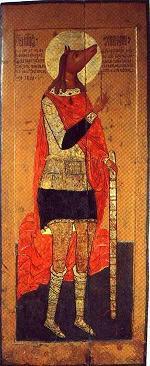
As Christianity spread in Egypt, Anubis morphed into St. Christopher ... and many early Coptic images of Saint Christopher depict him with the head of a dog (image at left).

The discovery came during routine excavations at the dog catacomb in Saqqara necropolis by an excavation team led by Salima Ikram, professor of Egyptology at The American University in Cairo (AUC), and an international team of researchers led by Paul Nicholson of Cardiff University.

Initial inspection reveals that dogs of all breeds and ages were mummified, from newborn puppies to decrepit old dogs.

“We are recording the animal bones and the mummification techniques used to prepare the animals,” Ikram said.

Ikram also told National Geographic, which is financing the project, that "in some churches people light a candle, and their prayer is taken directly up to God in that smoke. In the same way, a mummified dog's spirit would carry a person's prayer to the afterlife".

Saqqara dog catacomb was first discovered in 1897 when well-known French Egyptologist Jacques De Morgan published his Carte of Memphite necropolis, with his map showing that there are two dog catacombs in the area.

However, mystery has overshadowed such mapping as it was not clear who was the first to discover the catacombs nor who carried out the mapping, and whether they were really for dogs.

"The proximity of the catacombs to the nearby temple of Anubis, the so called jackal or dog-headed deity associated with cemeteries and embalming, makes it likely that these catacombs are indeed for canines and their presence at Saqqara is to be explained by the concentration of other animal cuts at the site," Nicholson wrote on his website.

"These other cults include the burials of, and temples for, bulls, cows, baboons, ibises, hawks and cats all of which were thought to act as intermediaries between humans and their gods."


Despite the great quantity of animals buried in these catacombs and the immense size of the underground burial places, Egyptologists have focused on the temples and on inscriptional evidence rather than on the animals themselves.

The mysteries behind De Morgan's mapping were unsolved until 2009 when this team started concrete excavations at the cemetery in an attempt to learn more about the archaeological and history of the site.

"Results at the first season showed that De Morgan map has substantial inaccuracies and a new survey is under way," Nicholson said.


"The animal bones themselves have been sampled and preliminary results suggest that as well as actual dogs there may be other canids present. Furthermore the age profile of the animals is being examined so that patterns of mortality can be ascertained."

Friday, August 7, 2026

HAPPY WORLD CAT DAY
IS YOUR HOME A CAT TEMPLE TOO?


AUGUST 8th is World Cat Day ... so it's the purrr-fect day to look over the shoulders of archaeologists who have unearthed what appears to have been a major temple to the cat goddess Bastet in the royal quarter of ancient Alexandria.

The discovery represents the first trace of the true location of Alexandria's royal quarter, where the Ptolemies resided and which served as the home base for Roman visitors, such as Julius Caesar and Marcus Antonius, and later Emperor Hadrian and his lover Antinous in 130 AD.

The temple was in use for centuries. Presumably it was still in use when Hadrian and Antinous arrived in Alexandria. In later centuries Christians and Moslems used it as a "quarry" for stone to build new structures.

Its ruins remained buried until an archaeological team, doing routine excavations near the Roman theatre in Alexandria, stumbled onto the temple foundations and a cache of 600 Ptolemaic statues, primarily of cats and the goddess Bastet.

The temple was built by Queen Berenike, wife of Ptolemy III (246-222 BC). The temple compound is believed to measure 60 metres by 15 metres and extends underneath the present Ismail Fahmi Street in the heart of Alexandria.

The team, which comprises 18 skilled excavators and restorers, unearthed a large collection of statues depicting the cat goddess Bastet, the goddess of protection and motherhood, which confirms that the temple was dedicated to this popular Delta goddess.

The Bastet statues were unearthed in three different areas of the site  together with other limestone statues of unidentified women and children, according to Al Ahram newspaper. Clay pots as well as bronze and faience statues of various ancient Egyptian deities have also been uncovered, along with terracotta statues of the gods Harpocrates and Ptah.

The temple foundations definitely can be dated to the reign of Queen Berenike, making this the first Ptolemaic temple discovered in Alexandria to be dedicated to the goddess Bastet. It also indicates that the worship of the goddess Bastet continued in Egypt after the decline of the ancient Egyptian dynasties.

An inscribed base of a granite statue from the reign of Ptolemy IV was also unearthed. It bears an Ancient Greek inscription written in nine lines stating that the statue was commissioned by an official of high standing at the Ptolemaic court. Abdel-Maqsoud believes the inscription celebrates Egypt's victory over the Greeks during the Battle of Raphia in 217 BC.

Archaeologists also found a cluster of other ancient structures, including a Roman water cistern, a group of 14-metre-deep water wells, stone water channels, and the remains of a bath area, as well as a large number of clay pots and shards that can be dated as far back as the founding days of Alexandria in the 4th Century BC.


"This find is the first trace of the real location of Alexandria's royal quarter," the newspaper reported.

Friday, July 31, 2026

HADRIAN ALIGNED TEMPLE OF ANTINOUS
TO CATCH DAWN RAYS ON THIS DATE


HADRIAN designed the Antinous Mortuary Temple at his Villa outside Rome so that the rays of the rising sun would illuminate the inner sanctum on the Egyptian festival of the Nile Inundation, according to a US research team.

The new findings come on the heels of studies by other researchers showing that Emperor Hadrian, a skilled architect and astronomer/astrologer in his own right, aligned the Pantheon and the observatory at his Villa to the Solstices.

The new findings are the first indicating a celestial configuration for the Mortuary Temple of Antinous at Hadrian's Villa.

Archaeo-astronomers at Ball State University in the United States say the mystery-shrouded temple, called the ANTINOEION, was aligned so that the first rays of the rising sun would illuminate the East Face of the OBELISK OF ANTINOUS, which would then cast a shadow across a monolithic statue of Antinous-Osiris deep in the inner sanctum of the temple.

Using "solar tracking" technology and highly sophisticated 3-D computer imaging, the Ball State experts say that this sunrise configuration only occurs on July 20th each year.

July 20th was when the Egyptians, at that point in their long history, celebrated the annual Inundation of the Nile, the flood waters which brought nutrient-rich sediment down the river to Egypt to ensure bountiful crops for the coming year.

At other points in Egyptian history, that "Egyptian New Year" festival was celebrated on other dates, owing to vagaries of ancient calendars. But according to Roman writer Censorinus, the Egyptian New Year's Day fell on July 20th in the Julian Calendar in 139 AD, which was a heliacal rising of Sirius in Egypt.

The Ball State University findings are all the more interesting because the First Miracle of Antinous, the July after his death in October 130 AD, was the NILE INUNDATION MIRACLEwhich  ended a years-long drought which had threatened the entire empire with famine since Egypt was Rome's "breadbasket" for grain and produce.


The Obelisk is now located atop the Pincian Hill in Rome, but it almost certainly originally stood at the Antinoeion within the Hadrian's Villa compound. The plinth for the obelisk is still visible.

The Obelisk is covered in Egyptian hieroglyphs which constitute a prayer of praise for Antinous the God, describing his blessings.

The Egyptian hieroglyphs on the East Face of the Obelisk quote Antinous the God as asking Ra-Herakhte the sun god for blessings on Hadrian, and also asking Hapy, the Nile Inundation deity, to bring about a bountiful inundation on his behalf.

In effect, the rays (or "hands") of the sun god "activate" the Egyptian hieroglyphs, bringing this divine prayer to religio-magical life, as the shadow of the Obelisk covers the statue of Antinous-Osiris, master of death and transfiguration.

The Ball State University findings have yet to be verified independently, and the researchers said further studies are underway.


It is possible, of course, that the date July 20th had another significance of a more personal nature involving Hadrian and Antinous. 

On the final leg of a three-year tour of the Eastern Empire, Hadrian and his Imperial entourage arrived in Egypt in the summer of the year 130 AD. 

It is known that Hadrian and Antinous spent time in Alexandria, as well as in the coastal resort of Canopus. And they also slew a man-eating lion in Egypt in the summer of 130 AD.

So July 20th could refer to one of those events. It could, of course, also refer to something of a more intimate nature between the two men which transpired on that date.


Perhaps Hadrian and Antinous took part in celebrations for the Nile Inundation on July 20th of 130 AD in Egypt at which drought-weary Egyptians looked to Emperor Hadrian, as their pharaoh, to provide a miracle. 

Ancient writers speculated that Antinous may have been eager to find a religio-magical way to help his beloved Hadrian, possibly sacrificing his life in return for blessings on the Emperor.

Whatever the date may signify, we know that, barely three months later, Antinous drowned in the Nile, and that grief-stricken Hadrian proclaimed him a God, the last Classical Deity before the Fall of Rome.

He died under mysterious circumstances, with Hadrian saying only that he "fell into the Nile." The Inundation Deity Hapy ensured that the Nile overflowed its banks generously the following July 20th.


Monday, July 27, 2026

SACRED ART OF THE NILE INUNDATION
THE FIRST MIRACLE OF ANTINOUS THE GOD


ANTINOUS
worked his first recorded miracle in July of the year 130 AD by ensuring a bountiful Nile Inundation which ended a famine.


Artist Andreja Izta Jurečič has created this sacred art showing the deified Antinous wading into the Nile flood waters hand-in-hand with Anubis as a bounty of food and vegetation swirls around them both.


The artist says:


ANTINOUS DEUS - The God Who Made the Nile Give Birth 


The legend says the Nile flooded and bore fruit again only after Antinous died. His sacrifice was a gift to Hapi, god of the inundation.


I created a series that tells exactly that, in Egyptian:


Anubis leads Antinous, holding the Ankh - the symbol of life, through the flooded Nile full of lotus, wheat, fish and offerings. Above them, enthroned, sits golden Osiris, who has received him. And above it all shines the golden moon, the constellation of Antinous in the sky, and a shooting star - his descent back to earth to work the miracle.


The image above is how it looked on the day of its dedication, when the painters of Emperor Hadrian had just finished it. Vivid Egyptian blue, fresh gold letters: ANTINOUS HEROES EVERGETES / FILIUS OSIRIDIS ANTINMORTALIS AETERNUS


The image below  is as if we had just discovered it yesterday in the temple of Antinoopolis, cracked, 1900 years old.


From a drowned youth, to a god who makes the Nile give birth, to a star in the sky. An eternal story of transformation.


Andreja Izta Jurečič


Sunday, July 26, 2026

WE CELEBRATE THE NILE INUNDATION
THE FIRST MIRACLE OF ANTINOUS THE GOD


ANTINOUS worshipers around the world convened via Zoom tonight for ceremonies originating from the Hollywood Temple of Antinous celebrating the First Miracle of Antinous ... the Bountiful Inundation of the Nile which ended a drought which had caused food shortages throughout the Empire.

The famine had overshadowed the tour of Egypt by the Imperial entourage in the year 130. The half-starved Egyptians looked to Hadrian, whom they worshipped as pharaoh, to perform a miracle which would end their misery.

But as Hadrian and Antinous traveled up the Nile during the summer and autumn of 130, the Nile once again failed to rise sufficiently to water the fields of Egypt — Rome's "Bread Basket" and chief source of grain and other staple foodstuffs.

It was a humiliating disappointment for the Emperor following the jubilant welcome by peoples during the earlier part of his tour through the Eastern Empire. In Ephesus and other cities he had been welcomed as a living god.

But the Egyptians had given him and his coterie what little they had in the way of food and wine — and he had failed to convince the Inundation Deity Hapi to bless them with bounty. Hapi is one of the most extraordinary deities in the history of religion.

Hapi is special to us especially because Hapi is hermaphroditic. With many other such deities, the gender division is down the middle of the body (like some Hindu deities) or the top half is one gender and the bottom half is the other.

But Hapi is very complex and the genders are mixed throughout his/her body. Male deities invariably have reddish-orange skin in Egyptian Art and female deities have yellowish skin. Hapi has bluish-green skin. Hapi has long hair like a female deity but has a square jaw and a           beard. Hapi has broad shoulders yet has pendulous breasts like a nursing mother. Hapi has narrow hips and masculine thighs, but has a pregnant belly. Nobody knows what sort of genitals Hapi has, since they are covered by a strange garment reminiscent of a sumo wrestler's belt.

Hapi is both father and mother to the Egyptians. Hapi provides them with everything necessary for life. As Herodotus wrote, "Egypt is the gift of the Nile". Hapi wears a fabulous headdress of towering water plants and she/he carries enormous offering trays laden with foodstuffs.

The Ancient Egyptians had no problem worshipping a mixed-gender deity. I think it is very important to draw the connection between Hapi and Antinous, especially since the First Miracle that Antinous performed as a god involved Hapi. The Egyptians accepted Antinous into their own belief system immediately and were among the most ardent followers of Antinous.

They had no problem worshipping a gay deity who had united himself with a hermaphroditic deity. It must have seemed very logical and credible to them.

It made sense to them and enriched their belief system, made it more personal since they could identify more easily with a handsome young man than with a hermaphrodite wearing a sumo belt (Hapi forgive me!).

Herodotus also said he once asked a very learned religious man in Egypt what the true source of the Nile was.

The learned man (speaking through an interpreter, since most Greeks never bothered to learn Egyptian) paused and finally told him the true source of the Nile is the thigh of Osiris.

We think of it as a strange answer. We think of the Nile as an "it" and the source as a "geographical location". But the Egyptians thought of the Nile as "us" and its true source as "heka" — the magical semen of the creator.

So, a learned Egyptian would have assumed that a learned Greek would understand what was meant: That Hapi is the equivalent of Dionysus, who was "incubated" in the inner thigh of Zeus after his pregnant mortal mother Semele perished when she could not bear the searing sight of her lover Zeus in all his divine panoply.

It's a very poetic way (a very Egyptian way) of saying that the "true source" of the Nile, which is to say Egypt itself, is the magical heka/semen from the loins of the original creator.

We will never know what happened during that journey up the Nile along the drought-parched fields with anxious Egyptian farmers looking to Hadrian for a miracle. All we know is that Antinous "plunged into the Nile" and into the arms of Hapi in late October of the year           130.

And then the following summer, Hapi the Inundation Deity provided a bountiful Nile flood which replenished the food stocks of Egypt — and the Roman Empire.

Our own Flamen Antinoalis Antonius Subia explains the more esoteric aspects of this special Religious Holy Day:

"The Dog Star Sirius appears, and the sacred Star of Antinous begins to approach its zenith in the night sky of the northern hemisphere. The appearance of the Dog Star once announced the rise of the Inundation of the Nile, though it no longer does due to the precession of the Equinox, which is the slight alteration of the position of the stars.
"After the Death and Deification of Antinous, the Nile responded by rising miraculously after two successive years of severe drought. It was on this day, July 25th, in the year 131 that the ancient Egyptians recognized that Antinous was a god, nine months after his death, following their custom of deifying those who drowned in the Nile, whose sacrifice insured the life-giving flood.

"Sirius is the brightest star in the sky, it is part of the constellation Canis Major, or the big dog, which is the hunting dog of Orion. Mystically, Sirius and the constellation Canis Major is Antinous Master of Hounds and Orion is Hadrian the Hunter.

"The position of Orion, along the banks of the Milky Way, our galaxy in relation to Sirius is a mirror image of Pyramids along the bank of the Nile, which is the same relationship as Antinoopolis to the Nile, with the Via Hadriani, the road which Hadrian built across the desert to the East, linking the Nile with the Red Sea — Rome to India.

"We consecrate the beginning of the Dog Days of Summer to the advent of the Egyptian deification of Antinous and the miracle of the Inundation of the Nile."


The First Miracle of Antinous the Gay God is enshrined in the hieroglyphic inscription on the 

The East Face of the Obelisk, which is aligned to the rising sun Ra-Herakhte, speaks of the joy that fills the heart of Antinous since         having been summoned to meet his heavenly father Ra-Herakhte and to become a god himself.

Then the inscription tells how Antinous intercedes with Ra-Herakhte to shower blessings upon Hadrian and the Empress Sabina Augusta.

And Antinous immediately calls upon Hapi ...

Hapi, progenitor of the gods,
On behalf of Hadrian and Sabina,
Arrange the inundation in fortuitous time
To make fertile and bountiful, the fields
Of Both Upper and Lower Egypt!

We joyfully celebrate this, the First Miracle of Antinous!

Saturday, July 25, 2026

THE INUNDATION OF THE NILE
WAS SEEN AS THE FIRST MIRACLE
OF ANTINOUS THE GOD


ON JULY 25 the Religion of Antinous joyfully commemorates the First Miracle of Antinous — the Bountiful Inundation of the Nile which ended a drought which had caused food shortages throughout the Empire.

The famine had overshadowed the tour of Egypt by the Imperial entourage in the year 130. The half-starved Egyptians looked to Hadrian, whom they worshipped as pharaoh, to perform a miracle which would end their misery.

But as Hadrian and Antinous traveled up the Nile during the summer and autumn of 130, the Nile once again failed to rise sufficiently to water the fields of Egypt — Rome's "Bread Basket" and chief source of grain and other staple foodstuffs.

It was a humiliating disappointment for the Emperor following the jubilant welcome by peoples during the earlier part of his tour through the Eastern Empire. In Ephesus and other cities he had been welcomed as a living god.

But the Egyptians had given him and his coterie what little they had in the way of food and wine — and he had failed to convince the Inundation Deity Hapi to bless them with bounty. Hapi is one of the most extraordinary deities in the history of religion.

Hapi is special to us especially because Hapi is hermaphroditic. With many other such deities, the gender division is down the middle of the body (like some Hindu deities) or the top half is one gender and the bottom half is the other.

But Hapi is very complex and the genders are mixed throughout his/her body. Male deities invariably have reddish-orange skin in Egyptian Art and female deities have yellowish skin. Hapi has bluish-green skin. Hapi has long hair like a female deity but has a square jaw and a beard. Hapi has broad shoulders yet has pendulous breasts like a nursing mother. Hapi has narrow hips and masculine thighs, but has a pregnant belly. Nobody knows what sort of genitals Hapi has, since they are covered by a strange garment reminiscent of a sumo wrestler's belt.

Hapi is both father and mother to the Egyptians. Hapi provides them with everything necessary for life. As Herodotus wrote, "Egypt is the gift of the Nile". Hapi wears a fabulous headdress of towering water plants and she/he carries enormous offering trays laden with foodstuffs.

The Ancient Egyptians had no problem worshipping a mixed-gender deity. I think it is very important to draw the connection between Hapi and Antinous, especially since the First Miracle that Antinous performed as a god involved Hapi. The Egyptians accepted Antinous into their own belief system immediately and were among the most ardent followers of Antinous.

They had no problem worshipping a gay deity who had united himself with a hermaphroditic deity. It must have seemed very logical and credible to them.

It made sense to them and enriched their belief system, made it more personal since they could identify more easily with a handsome young man than with a hermaphrodite wearing a sumo belt (Hapi forgive me!).

Herodotus also said he once asked a very learned religious man in Egypt what the true source of the Nile was.

The learned man (speaking through an interpreter, since most Greeks never bothered to learn Egyptian) paused and finally told him the true source of the Nile is the thigh of Osiris.

We think of it as a strange answer. We think of the Nile as an "it" and the source as a "geographical location". But the Egyptians thought of the Nile as "us" and its true source as "heka" — the magical semen of the creator.

So, a learned Egyptian would have assumed that a learned Greek would understand what was meant: That Hapi is the equivalent of Dionysus, who was "incubated" in the inner thigh of Zeus after his pregnant mortal mother Semele perished when she could not bear the searing sight of her lover Zeus in all his divine panoply.

It's a very poetic way (a very Egyptian way) of saying that the "true  source" of the Nile, which is to say Egypt itself, is the magical heka/semen from the loins of the original creator.

We will never know what happened during that journey up the Nile along the drought-parched fields with anxious Egyptian farmers looking to Hadrian for a miracle. All we know is that Antinous "plunged into the Nile" and into the arms of Hapi in late October of the year 130.

And then the following summer, Hapi the Inundation Deity provided a bountiful Nile flood which replenished the food stocks of Egypt — and the Roman Empire.

Our own Flamen Antinoalis Antonius Subia explains the more esoteric aspects of this special Religious Holy Day:

"The Dog Star Sirius appears, and the sacred Star of Antinous begins to approach its zenith in the night sky of the northern hemisphere. The appearance of the Dog Star once announced the rise of the Inundation of the Nile, though it no longer does due to the precession of the Equinox, which is the slight alteration of the position of the stars.
"After the Death and Deification of Antinous, the Nile responded by rising miraculously after two successive years of severe drought. It was on this day, July 25th, in the year 131 that the ancient Egyptians recognized that Antinous was a god, nine months after his death, following their custom of deifying those who drowned in the Nile, whose sacrifice insured the life-giving flood.

"Sirius is the brightest star in the sky, it is part of the constellation Canis Major, or the big dog, which is the hunting dog of Orion. Mystically, Sirius and the constellation Canis Major is Antinous Master of Hounds and Orion is Hadrian the Hunter.

"The position of Orion, along the banks of the Milky Way, our galaxy in relation to Sirius is a mirror image of Pyramids along the bank of the Nile, which is the same relationship as Antinoopolis to the Nile, with the Via Hadriani, the road which Hadrian built across the desert to the East, linking the Nile with the Red Sea — Rome to India.

"We consecrate the beginning of the Dog Days of Summer to the advent of the Egyptian deification of Antinous and the miracle of the Inundation of the Nile."


The First Miracle of Antinous the Gay God is enshrined in the hieroglyphic inscription on the OBELISK OF ANTINOUS which stands in Rome.

The East Face of the Obelisk, which is aligned to the rising sun Ra-Herakhte, speaks of the joy that fills the heart of Antinous since having been summoned to meet his heavenly father Ra-Herakhte and to become a god himself.

Then the inscription tells how Antinous intercedes with Ra-Herakhte to shower blessings upon Hadrian and the Empress Sabina Augusta.

And Antinous immediately calls upon Hapi ...

Hapi, progenitor of the gods,
On behalf of Hadrian and Sabina,
Arrange the inundation in fortuitous time
To make fertile and bountiful, the fields
Of Both Upper and Lower Egypt!

We joyfully celebrate this, the First Miracle of Antinous!

Wednesday, July 22, 2026

THE HELIACAL RISING OF THE DOG STAR


THE "Dog Days" are here! In Ancient Egypt, the "Heliacal Rising of Sirius" occurred in mid-July ... but over the course of many centuries it now occurs in late July or early August (in the Northern Hemisphere). 

But depending on where you live on our planet, you may see Sirius/Sothis rising just before dawn any day now ... as nighttime turns to daytime.

During the daytime, look to the sun and you see Antinous conjoined with Ra-Herakhte, Apollo, Invictus, Horus, Mithras, Belenus, Balder, Huitzilopochtli and countless other solar deities. ANTONIUS SUBIA offers this prayer: 

Arise in Me…Sothis,

Let me be cleansed

Let me be renewed

Let the Inundation flood

Across the heart

Dog Star Returns

A New Antinous coming forth

To set the soul in order

To purify with clear water

That we may be whole again


~FLAMEN ANTONIUS SUBIA

Sunday, July 19, 2026

ALEXANDRIA ALIGNED TO SUN
ON ALEXANDER THE GREAT'S BIRTHDAY


ALEXANDRIA, home to one of the seven wonders of the ancient world, may have been built to align with the rising sun on the day of Alexander the Great's birth.

The Macedonian king, who commanded an empire that stretched from Greece to Egypt to the Indus River in what is now India, founded the city of Alexandria in 331 B.C. 

It would later become hugely prosperous, home to Cleopatra, the magnificent Royal Library of Alexandria and the 450-foot-tall (140  meters) Lighthouse of Alexandria, one of the SEVEN WONDERS OF THE ANCIENT WORLD.

Hadrian and Antinous visited Alexandria in the summer and early autumn of 130 AD.

Ancient Alexandria was planned around a main east-west thoroughfare called the Canopic Road, points out Giulio Magli, an archaeo-astronomer at the Politecnico of Milan. 

A study of the ancient route reveals it is not laid out according to topography; for example, it doesn't run quite parallel to the coastline. 

But on July 20th, the birthday of Alexander the Great, the rising sun of the 4th Century BC rose "in almost perfect alignment with the road," Magli was quoted as saying.

July 20th, 356 BC, is the date which has always been accepted as the birthday of Alexander the Great. Whether it was his actual birthday or only the official royal observance of his birth is unknown.

It is said that on the night before the mother of Alexander, Olympias, was to be married to King Phillip of Macedonia, she dreamt that a thunderbolt struck her body and filled it with power.

After the marriage, it is said that Phillip peeked into her chamber, and found her lying with a serpent, and that he afterward dreamt that her womb was sealed and that a lion dwelled within her. 


And on the night that he was born, 20th of July, 356 BC, the great Temple at Ephesus was burned to the ground by a vandal, because the goddess Artemis was away, assisting with the birth of Alexander the Great.

He was considered to be the son of Zeus, and this divine origin was what was given as an explanation for the unprecedented conquests that he accomplished. In his youth Aristotle, a student of Plato, educated him along with his following of young princes, who were later serve as his generals, and the founders of great dynastic monarchies of the Hellenistic world.

Foremost of these was his ever loyal and devoted Hepheistion, whose reciprocated love for Alexander was homosexual in nature.

In one of their first battles, while Phillip was still king, the young Alexander proved himself by defeating the SACRED BAND OF THEBES, the army of homosexual lovers who were the most famous and courageous warriors of their time.

Alexander is said to have wept at their destruction, and buried them with honor, erecting a statue of a Lion over their graves.

He would later go one to conquer the entire Eastern world, Asia Minor, Syria, Judea, Egypt, and all of Persia, as far East as India.


The Empire of Alexander spread Greek culture throughout the world, and made the communication of far-distant ideas possible so that the new Hellenistic culture that he created, was a combination of classical Greece and of the exotic cultures that were imported from every corner.

After the death of Alexander, at only 33 years of age, he was deified by his generals who divided his great Empire among themselves. We praise the glorious warrior Alexander of Macedonia, and elevate him, and worship him as a God, an example of the greatness of homosexuality, and a heroic protector of the Divine Antinous.

Tuesday, June 16, 2026

WE REMEMBER THE NIGHT OF THE TEARDROP
WHEN WEEPING ISIS WORKED A MIRACLE


THE 16th of June is the Egyptian "Night of the Teardrop" festival. 

On this night, when the moon rises into the sky, Isis sheds one blessed and mournful tear for her beloved, Osiris, as the breeze from her wings fans the breath of life into him ... so that he is reborn to eternal life. 

That precious tear is then collected by intersex Nile inundation deity HAPI, signalling the start of the build up to the inundation in July. 

Similarly, Hadrian wept for Antinous after he died in the Nile in late 130 AD, and subsequently proclaimed Antinous a god. 

Divine Antinous called upon HAPI to bring forth a bountiful flood in the summer of 131 AD to end a famine. 

It was the first miracle of Antinous! 

The mystery teaching: Even in tears of grief, the divine miracle of life comes forth.

Monday, June 15, 2026

THE FESTIVAL OF MAAT
AS ALL DEITIES INCLUDING ANTINOUS


THE 15th of June is the Egyptian festival when Ma'at unites as one with all the deities of the heavens. This is when all the gods take on the principle of Ma'at ... including Antinous as the final god of Egypt and ultimate Classical deity. Ma'at is often thought of as representing justice, but her true function is balance. If something has been pushed off kilter, then Ma'at embodies the power that restores equilibrium. This means that she can be appealed to if you are the victim of an injustice, and she will ensure that harmony is restored. However be very sure that you are the victim, because Ma'at is impartial, and will restore balance whoever has been at fault - this is the reason that justice is often shown as blindfolded.

Friday, May 15, 2026

IN PRAISE OF MERCURY


WE lift up our hearts to the great wing-footed God Mercury on this day in mid-May when Mercury traditionally leaves stodgy Taurus and wings his way into Gemini, his astrological home.

The Ancient Romans celebrated this cosmic event on May 15th each year with the Mercuralia festival.

Father of Antinous, son of Zeus and Maia, Mercury is the god of speed, the Lord of commerce, communication, and cunning. 


He is forever young and beautiful, the patron of skilled athletes, especially runners, and yet he possesses the infinite wisdom of extreme old age.

When Mercury was one day old, he charmed Apollo by stealing the sun god's prized cattle and crafting an ingenious story to cover his tracks.

Apollo fell in love with Mercury and from that day forward became his godfather and protector, presenting him to Olympus. Zeus was so taken by his son Mercury that he made him the messenger of the gods, and placed in his hand the sacred Caduceus, the serpent-entwined rod.

Hermes (as he was called by the Greeks) was charged with escorting the souls of the dead to the underworld, and to relay messages between heaven and hell. Thus he acquired his mystic powers, which were the inspiration of the Hermits, and of their religion known as Hermeticism.

He was known to them as Hermes Tristmegistus, the "thrice-great", and was said to have taught the secret knowledge of salvation to mankind.

As Hermes of the crossroads, he was a Phallic god, whose image was a herme, or column with a bearded head and a large penis that was placed at forks in the road to protect travelers.

Mercury made love to Venus and was father of Pan, Priapus, Hermaphroditus, and of Fortuna. He was the craftiest inventor, who created the lyre, which he gave to Apollo. And he invented written language, weights and measurement.

Mercury was the god of good business, but also of dishonesty and absolute capitalism. He invented dice and was the lord of gambling and all games of chance.

Antinous was often compared to Mercury in the statues and in the artefact fragments (bust above). His powers of youth, virility and physical fitness were central parts of the Religion of Antinous. But the hermetic sages, from whom so much of the salvation of Antinous extends, deepened this fascade. He is, along with Dionysus, Apollo and Osiris, a major facet of the Spirituality of Antinous.


We acknowledge and extol Mercury, the wing-footed god, and pray to him as Antinous to run by our side and give us good fortune throughout our travels and in our communication with the divine.

Wednesday, April 29, 2026

THE MYSTERIOUS EGYPTIAN MUU
AND THE DANCE THAT THEY DO


APRIL 29th is International Dance Day so let us muse on the mysterious MUU and that high-stepping dance that they do. 


The MUU were professional male dancers who showed up at funerals to cavort and frolic amongst the bereaved whilst wearing tall conical headdresses constructed of papyrus stalks. 


Were they comic relief? Were they personifications of afterlife spirits? 


The best analysis of the mysterious MUU dancers comes from Gregory Reeder, who writes: 


"One gets the feeling that the muu ... based on their surviving representations ... were likable characters in the ancient Egyptian funerary drama.Their high-stepping 'dance' and accompanying gestures evoke a smile in the present-day viewer. Clearly they were characters patterned after the common folk on the Nile Delta, people who lived along and worked on the canals of the north, surrounded by lush flora and diverse fauna. Marsh life and people were favorite themes of tomb decoration of the pharaonic period, and their treatment by the tomb artisans often show an affection and humorous sympathy. Who better to call upon to lead one through the winding waterways of Paradise than the boatmen of the Nile Delta?" 


Read Gregory Reeder's full article HERE.