Showing posts with label archaeology. Show all posts

Saturday, September 5, 2026

ROMULUS SHRINE TO JUPITER LOCATED
AT BASE OF PALATINE IN ROME


IN the old Roman calendar, September was the seventh month of the year in counting March as the first. Among the festivals observed in September were several honoring Jupiter. 

He was hailed as the chief of the gods and had many epithets as a result.


As Jupiter Optimus Maximus, he occupied the temple of Jupiter Capitolinus on the Capitoline hill with the goddesses Juno and Minerva. With them, he received a Lectisternium (September 13) and the Ludi Romani  (September 5-19). 

He was honored with festivals as Jupiter Liber and Jupiter Fulminator (September 1) and as Jupiter Stator (September 5).

Jupiter Stator is the hand of Jupiter giving Roman troops their unstoppable force.

Romulus built a temple to Jupiter Stator at the foot of the Palatine Hill, Italian archaeologists say.


The ruins of the shrine to Jupiter Stator (Jupiter the Stayer), believed to date to 750 BC, were found by a Rome University team led by Andrea Carandini.

"We believe this is the temple that legend says Romulus erected to the king of the gods after the Romans held their ground against the furious Sabines fighting to get their women back after the famous Rape (abduction)," Carandini said in the Archeologia Viva (Living Archaeology) journal.


Historians have always been intrigued by ancient references to the temple, but never knew precisely where it was located or what it looked like. The lithograph above is a fanciful 19th Century idea of its possible appearance.

According to myth, Romulus founded Rome in 753 BC and the wifeless first generation of Roman men raided nearby Sabine tribes for their womenfolk, an event that has been illustrated in art down the centuries.

Carandini added: "It is also noteworthy that the temple appears to be shoring up the Palatine, as if in defence".

Rome's great and good including imperial families lived on the Palatine, overlooking the Forum.

Long after its legendary institution by Romulus, the cult of Jupiter the Stayer fueled Roman troops in battle, forging the irresistible military might that conquered most of the ancient known world.


In the article in Archeologia Viva, Carandini's team said they might also have discovered the ruins of the last Palatine house Julius Caesar lived in - the one he left on the Ides of March, 44BC, on his way to death in the Senate.

Friday, September 4, 2026

DID ANTINOUS AND HADRIAN VISIT
THIS SANCTUARY OF PAN/FAUNUS?


EXPERTS in Israel have discovered what may turn out to be a sanctuary to the god Pan/Faunus which may have been seen by Antinous and Hadrian during their trip through the Eastern Provinces.

Archaeologists unearthed a gateway in the city of Hippos where they discovered a large and rare mask of Greek God Pan. 

The mask is an extraordinary find and suggests the ancient sanctuary was dedicated to the Greek God Pan.

According to experts, bronze masks of this size are extremely rare and usually do not depict Pan or any of the other Greek or Roman mythological images.

University of Haifa archaeologist Michael Eisenberg led a team that unearthed a 1.8-meter-tall (6-foot-tall) Roman gate near a stone building where the mask was found, leading him to speculate that the gate might have led to a sanctuary dedicated to Pan. 

"The mask, and now the gate in which it was embedded, are continuing to fire our imaginations," Eisenberg says. 

"The worship of Pan sometimes included ceremonies involving drinking, sacrifices and ecstatic rituals, including nudity and sex. This worship usually took place outside the city walls, in caves and other natural settings." 

The possible sanctuary was located near the city gates and was constructed sometime during the reign of Hadrian, who was emperor from 117 AD to 138 AD. 

Hadrian and Antinous traveled through the area in 129-130 AD.

Hippos-Sussita is located about 2 km east of the Sea of Galilee in the Sussita National Park of the National Parks Authority.

In recent years, the mysteries of Hippos-Sussita have been revealing their secrets in an extraordinary way.

In 2011, scientists found an ancient sculpture of Hercules. Two years later a basalt tombstone with a sculpture of the deceased’s bust was uncovered. 

Now there is a new surprise: the only finding of a bronze mask of unnatural size, in the form of the god Pan/Faunus.

In Greek mythology, Pan was the god of the wild, hunting and companion of the nymphs. He was depicted as being half human, while having the legs and horns of a goat, just like a faun. 

His Roman counterpart was Faunus and he was in many ways similar to Herne the Hunter, the horned god and lord of the forest in British mythology.

Until now it was thought there were no temples attributed to Pan, but he was rather worshipped in natural settings such as caves.

A more thorough cleaning in the lab, revealed strands of a goat beard, long pointed ears, and other characteristics that led Dr. Eisenberg to identify the mask as depicting a Pan/Faunus/Satyr.

"Now that the whole gate has been exposed, we not only have better information for dating the mask, but also a clue to its function," Eisenberg said in a statement. "Are we looking at a gate that led to the sanctuary of the god Pan or one of the rustic gods?"

Pan is the son of Antinous .. not "our" Antinous, but "Antinous the Suitor" of Homer's Odyssey and Iliad.

At the online Temple of Antinous, our own ANTONIUS SUBIA  explains the esoteric reason for the connection between Antinous and Pan.  He notes that there are two deities named Pan ... the Great Pan who is "all things" ... and the lesser Pan who is the cloven-footed goat-horned god. 

The "Little Pan" is the son of Antinous ... not OUR Antinous, but rather the Antinous of Greek mythology who was slain by Odysseus for having hit on his wife Penelope while Odysseus was off on his Odyssey.

Two different Pans. Two different Antinouses.

It gets a little confusing.

But Antonius suggests there is a clue to the names ... he says it is because they all came from the same place. Antonius points out that it was in August of the year 128 that Hadrian and Antinous traveled through the Peloponnesus and visited the home of Antinous's ancestors in Arcadia, at the city of Mantineia. 

Here is how Antonius explains the Pan-Pan and Antinous-Antinous connection at the online TEMPLE OF ANTINOUS:

"This is an important first event for Antinous as it represents his return to the place of the origin of his blood, which is the source of his mysterious name. Mantineia was to become the fourth most sacred city of the religion of Antinous, honoring Our God with a Temple and Sacred Games. The Queen who founded the city was named Antinoea, she was led to the site of the city by a serpent or dragon. 

"While in the city, Antinous and Hadrian pay homage at the grave of Epaminondas, the great Theban general who defeated the Spartans in the battle of Mantineia, but died after shortly after the victory from his wounds. The battle was won because of the courage of the Sacred Band, also known as the Army of Lovers, a corps of 300 homosexual lovers. Mantineia is the home of the prophetess Diotima, who was the teacher of Socrates, from whom he learned his philosophy of Love, particularly the mysteries of Venus Urania, which is a metaphor for gay love. 

"And Mantineia is the birthplace of the horned god Pan, son of Penelope and 'Antinous the Suitor.' The patron deity of Mantineia, and of all Arcadia is the Great God Pan. There are two gods named Pan, the Great Pan, who is all things, and the Little Pan, who is the son of 'Antinous the Suitor.' 

"We dedicate ourselves to the dual nature of Pan, the most ancient faith of Antinous, the goat-horned god, who follows in the train of Dionysus, and is the King of Satyrs. We seek to understand that within our Antinous is the nature of the Great Cosmic Pan, and also the Little Cloven-hoofed Pan of Mantineia."

Thursday, September 3, 2026

ANCIENT PRIESTS BLESSED TREASURES
BEFORE THROWING THEM AWAY


YOU think you have trouble clearing out accumulated old things to make room for new acquisitions?

The ancient priests of Antinous ... along with priests of many other deities ... couldn't just throw out statues, offerings and other artefacts that worshipers had donated to their temples. The objects had to be ritually blessed, deconsecrated and given burials befitting their sacred nature.

Very often, these caches of "discarded" artefacts survive to the present day ... as has happened at the Temple of Ptah at Karnak in Egypt.

Ironically, treasures which remained in the temple sanctuaries often ended up being looted by invaders, which the "discarded" artefacts remained intact for thousands of years in the "rubbish heap" under the temple.

For example, the photo at left shows the only known portrait of Khufu (or Cheops), the 4th Dynasty pharaoh who (allegedly) built the Great Pyramid at Giza, is a very tiny ivory figurine only 7 centimeters (3 inches) tall.

It was discovered covered in dried feces IN AN ANCIENT CESSPIT next to the temple of Seti at Abydos in Egypt.

We can only assume that, thousands of years ago, some harried novice priest "flushed it away" during routine spring cleaning to clear out old statuary to make room for new items.

After years of being washed, perfumed and fed in ancient Egypt, the statue of the revered Egyptian deity shown at the top of this page was given a proper burial with other "dead" statues more than 2,000 years ago.

Ancient Egyptians buried the statue of the deity Ptah ... the god of craftsmen and sculptors ... with other revered statues, including those of a sphinx, baboon, cat, Osiris and Mut, in a pit next to Ptah's temple.

The statue of Ptah had likely sat in the temple for years, but it and the other sacred objects were respectfully buried after they accumulated damage and were declared useless by the ancient Egyptians, the researchers said.

"We can consider that when a new statue was erected in the temple, this one [of Ptah] was set aside in a pit," said study co-researcher Christophe Thiers, director of the French-Egyptian Center for the Study of the Temples of Karnak. 

"The other artifacts were also previously damaged during their 'lifetime' in the temple, and then they were buried with the Ptah statue."

Archaeologists discovered the pit in December 2014 at Karnak, an Egyptian temple precinct, and spent about a month excavating its rich assemblage. 

The pit held 38 objects, including:


  • Fourteen statuettes and figurines of Osiris.
  • Eleven fragments of inlay from statues. The inlay included that of an iris, a cornea, a false beard, a cap, a strand of hair and an inlay plaque.
  • Three baboon statuettes (representing the god Thoth).
  • Two statuettes of the goddess Mut (one with hieroglyphic inscriptions).
  • Two unidentified statuette bases.
  • One head and one fragmentary statuette of a cat (Bastet).
  • One small fragmentary faience stele (a stone slab) recording the name of the god Ptah.
  • One head of a statuette of a man in gilded limestone.
  • One lower part of a statue of the seated god Ptah, sawn and repaired.
  • One sphinx.
  • One unidentified metal piece.

Monday, August 31, 2026

ANTINOUS ENABLES YOU TO DISCOVER
THE INTELLIGENCE OF THE HEART


IN ancient times, Antinous was known as a miracle worker. His worshipers prayed to him for miracles, oracles, visions and answers to problems in their daily lives.

The Egyptian hieroglyphs on the OBELISK OF ANTINOUS state clearly that Antinous answers the prayers of all who call upon him through dreams and visions, for example.

The hieroglyphs also make cryptic references to his ability to work magic through his heart. This is a reference to the Ancient Egyptian concept of the "Intelligence of the Heart."

The Egyptians knew that the brain is the center of motor activity and sensory perception. But they believed the heart is the center of a form of intelligence which has baffled most mainstream Egyptologists ... who assume the Egyptians believed the heart was where cognitive thinking occurs.

But the Egyptians had a very different view of the universe from our rational, scientific view of the universe. We dissect facts and analyze them. But while the Egyptians were very good at analyzing facts, they also retained the Zen-like ability to see the whole ... which leads to contemplation ... not analysis.

The Egyptians understood that if you want to find an intelligent solution to a problem, your brain can do the work. You have all the necessary intelligence inside the bone in your skull.

However, most people use their brains the same way they use their muscles. You can strain your head just as if it were a muscle, and work very hard trying to arrive at an answer, but it doesn't really work that way.

When you really want to find an answer to something, what you need to do is contemplate the problem. Visualize your question as well as you can, and then simply wait.

If you don't, and if you instead try to find the solution through brute mental strength, you may be disappointed, because any solution that comes in that way is likely to be wrong.


But when you have waited for a while, the solution will come of itself. That is what the Egyptians called the Intelligence of the Heart ... using your heart instead of your head.

It will work for you in the same way your stomach will digest your food for you without your having to supervise it consciously. Our attempts to supervise everything consciously have all led to consequences that aren't too good for our stomach, and the reason for that is quite simple.

Conscious attention, which employs words, cannot think of very much. We are forced, therefore, to ignore almost everything while we are thinking. We think along a single track, but the world doesn't proceed along a single track.

The world is everything happening altogether everywhere, and you just can't take all that into consideration because there isn't time.

However, the Intelligence of the Heart can take it all into consideration because it is capable of handling innumerable variables at once, even though your conscious attention cannot...


The hieroglyphs on the Obelisk of Antinous promise that Antinous the Gay God enables us to discover the Intelligence of the Heart ... the Intelligence of HIM ... he opens his heart to you .... 

Saturday, August 29, 2026

THE ANCIENT PRIESTS OF ANTINOUS
KNEW HOW THE LEOPARD GOT ITS SPOTS


ANCIENT PRIESTS of Antinous at the Great Temple at ANTINOOPOLIS in Egypt were familiar with leopard-skin priestly robes. 

Whether they actually wore leopard skins in the Egyptian priestly manner is unknown, but it is certainly possible.

The Ancient Egyptian magical SEM priests always wore a leopard skin ... as do many African shamans even today.

Indeed, it is highly likely that the Ancient Egyptians got the idea from their southern neighbors — where else could they have got the idea, after all? 

The Egyptians were accustomed to lions and we know that lions were a menace even in the 2nd Century AD when Hadrian and Antinous conducted the SACRED LION HUNT. But it is safe to say that leopards were very rare and highly prized species even in Ancient times — which made them even more magical.

The Egyptians said the leopard started out as a variety of sacred lion, the lion being associated with the sun god Ra and of pharaoh's power and rulership as an incarnation of the sun god. 

The leopard lived in the desert like the lion and was indistinguishable from the lion because the leopard originally had no spots.

This is the cue for Anubis and Seth to enter the scene!

Anubis had a very odd love/hate relationship with Seth. Some said that Anubis was the son of Seth by Seth's consort Nephthys. Others said Anubis was the son of Osiris and Seth's consort Nephthys and that Nephthys placed the baby in the care of her sister Isis to avoid Seth's wrath. 


At any rate, little Anubis was raised by the Osiris side of the divine family, not the Seth side. Anubis and Seth had a very strained relationship, to say the least, full of doubt and suspicion on both sides.

Not surprisingly, Anubis took sides with Isis (as his foster mother) and her son Horus (perhaps his biological half-brother? ) in seeking to avenge the death of Osiris (his own true father?) after Seth murdered Osiris by drowning and mutilating his body.

The struggle between Horus and Seth continues to this day, of course. Seth has the advantage of being able to transform himself into any creature, thus eluding his pursuers. Sometimes he is a hippo. Sometimes he is a crocodile. Sometimes he is a giant serpent. Often, he is a graceful antelope. He can be deceptively beautiful and entrancing.  


The Lie takes many deceptive forms,
always posing as the Truth. 


But Anubis was able, by means of his keen canine senses, to sniff out Seth in whatever form he takes. 

Once, Seth assumed the form of a leopard and blended into the desert sand so well that Horus was unable to spot him from the air as he circled high in the sky upon his falcon wings, using his sharp falcon eyes to scan the Earth.

But Anubis sniffed out Seth and decided to brand him so that everyone would be able to see him. Anubis trotted over to the banks of the Nile and dunked his paws in rich black Nile mud. Then he leapt onto the leopard and left indelible muddy paw prints all over Seth's hide.

That is how the leopard got its spots, according to the Ancient Egyptians.

The highest caste of Egyptian magician/priests wore leopard skins to symbolize the never-ending struggle between the Truth and the Lie. The Lie persists. Seth the Deceiver was not killed by Anubis. But Anubis revealed Seth for the Lie that he is.


And that is why the Priests at the Great Temple of Antinoopolis may have worn leopard skins ... to demonstrate that it is possible to see through the Lie to uncover the Truth that lies underneath.

Wednesday, August 26, 2026

NINE MILLION MUMMIFIED DOGS
FOUND AT EGYPTIAN TEMPLE OF ANUBIS


AS Antinous and Hadrian journeyed up the Nile in August and September of 130 AD, they must have seen the mighty monuments at Memphis ... and the sprawling cliffside ANUBIEION, the mystery-shrouded Temple of the jackal-headed Egyptian deity Anubis at Saqqara south of modern Cairo.

But was Antinous aware that nine million dog mummies were entombed there?

The unique, terraced temple compound was built into the face of the cliffs overlooking the ancient Egyptian capital city of Memphis-Mennefer. Beyond the Anubieion lay the necropolis city of the dead. In front of it lay the teeming city nestled in the Nile Valley.

For decades, experts were unsure what purpose the Anubieion served. No where else in Egypt is there a temple dedicated solely to Anubis. Some temples to other deities had niche shrines to the jackal-headed deity who conveyed the souls of the dead to everlasting life.

But the discovery of myriads of mummified dogs in the Anubieion's catacombs makes it clear that the Anubieion was indeed a temple whose goal was to assist people in making the transition from earthly life to eternal life.

The dog mummies were sold to serve as "guide dogs" for souls of the departed.

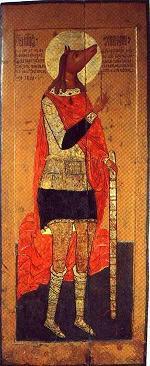
As Christianity spread in Egypt, Anubis morphed into St. Christopher ... and many early Coptic images of Saint Christopher depict him with the head of a dog (image at left).

The discovery came during routine excavations at the dog catacomb in Saqqara necropolis by an excavation team led by Salima Ikram, professor of Egyptology at The American University in Cairo (AUC), and an international team of researchers led by Paul Nicholson of Cardiff University.

Initial inspection reveals that dogs of all breeds and ages were mummified, from newborn puppies to decrepit old dogs.

“We are recording the animal bones and the mummification techniques used to prepare the animals,” Ikram said.

Ikram also told National Geographic, which is financing the project, that "in some churches people light a candle, and their prayer is taken directly up to God in that smoke. In the same way, a mummified dog's spirit would carry a person's prayer to the afterlife".

Saqqara dog catacomb was first discovered in 1897 when well-known French Egyptologist Jacques De Morgan published his Carte of Memphite necropolis, with his map showing that there are two dog catacombs in the area.

However, mystery has overshadowed such mapping as it was not clear who was the first to discover the catacombs nor who carried out the mapping, and whether they were really for dogs.

"The proximity of the catacombs to the nearby temple of Anubis, the so called jackal or dog-headed deity associated with cemeteries and embalming, makes it likely that these catacombs are indeed for canines and their presence at Saqqara is to be explained by the concentration of other animal cuts at the site," Nicholson wrote on his website.

"These other cults include the burials of, and temples for, bulls, cows, baboons, ibises, hawks and cats all of which were thought to act as intermediaries between humans and their gods."


Despite the great quantity of animals buried in these catacombs and the immense size of the underground burial places, Egyptologists have focused on the temples and on inscriptional evidence rather than on the animals themselves.

The mysteries behind De Morgan's mapping were unsolved until 2009 when this team started concrete excavations at the cemetery in an attempt to learn more about the archaeological and history of the site.

"Results at the first season showed that De Morgan map has substantial inaccuracies and a new survey is under way," Nicholson said.


"The animal bones themselves have been sampled and preliminary results suggest that as well as actual dogs there may be other canids present. Furthermore the age profile of the animals is being examined so that patterns of mortality can be ascertained."

Monday, August 17, 2026

THE ANTINOUS OF RENO NEVADA


WE love it when Antinomaniacs from around the world share images of Antinous they discover during their globetrotting travels.

This statue of Antinous in the guise of Dionysus is the center of an Italian restaurant in Reno Nevada. He holds the thyrsus staff of Dionysus in one hand and a goblet of wine in the other.

He is flanked by two maenads who are totally naked ... though his private parts are hidden discreetly ... lest prudish American diners be put off their pasta.

And to top it all off ... this statue rotates slowly to give diners on all sides a 360-degree view of him ... under a twinkling starry heaven.


Saturday, August 15, 2026

THE BIRTHPLACE OF ANTINOUS
IS THE HOME OF 'MAD HONEY'


TURKEY's hallucinogenic "Mad Honey" is produced when bees pollinate rhododendron flowers in the remote mountainside towns of the Black Sea region ... where Antinous was born and spent his childhood.

After his death and deification, Antinous was identified with ARISTAEUS (below right), the inventor of beekeeping, so it is likely that he knew about the effects of Bithynian "Mad Honey."

He must have seen beekeepers hauling their hives up the slopes of the mountains of his homeland until they reach vast fields of cream and magenta rhododendron flowers. 

Here, they unleashed their bees, which pollinated the blossoms and made a kind of honey from them so potent, it has been used as a weapon of war.

The dark, reddish "Mad Honey," known as "deli bal" in Turkey, contains an ingredient from rhododendron nectar called grayanotoxin ... a natural neurotoxin that, even in small quantities, brings on light-headedness and sometimes, hallucinations. 

Throughout the ages, Bithynia has traded this potent produce with Greece and Rome and (in later centuries) Western Europe, where the honey was infused with drinks to give boozers a greater high than alcohol could deliver.

When over-imbibed, however, the honey can cause low blood pressure and irregularities in the heartbeat that bring on nausea, numbness, blurred vision, fainting, potent hallucinations, seizures, and even death, in rare cases. 

Nowadays, cases of mad honey poisoning crop up every few years ... oftentimes in travelers who have visited Turkey.

Rhododendron flowers occur all over the world, and yet mad honey is most common in the Bithynia region ... the biggest honey-producing region in Turkey.

"There are more than 700 different species (of rhododendron) in the world, but according to our knowledge just two or three include grayanotoxin in their nectars," says Süleyman Turedi, a doctor at the Karadeniz Technical University School of Medicine in Trabzon, Turkey, who studies deli bal's effects and has witnessed more than 200 cases of mad honey poisoning.

In Turkey, not only do the poisonous rhododendrons abound, but the humid, mountainous slopes where Antinous grew up provide the perfect habitat for these flowers to grow in monocrop-like swaths. 

When bees make honey in these fields, no other nectars get mixed in ... and the result is deli bal, potent and pure.

Although the product makes up only a tiny percentage of Bithynia's honey production, it has long held a strong Turkish following.

"People believe that this honey is a kind of medicine," Turedi says. “They use it to treat hypertension, diabetes mellitus and some different stomach diseases. And also, some people use deli bal to improve their sexual performance."

The honey is taken in small amounts, sometimes boiled in milk, and consumed typically just before breakfast, he adds ... not slathered on toast or stirred generously into tea the way normal honey would be.

Its value to customers has given beekeepers an incentive to keep visiting those rhododendron fields and producing it alongside their normal honey products.

Johnny Morris, a travel journalist from the United Kingdom, puts its Turkish predominance partly down to history, too. In 2003, for his popular travel column called "Grail Trail," he went to taste mad honey in Trabzon, a Turkish city that’s backed by mountains and faces the Black Sea.

"It’s got a long history in Turkey," he says. "It was used as a weapon of mass destruction for invading armies."

Indeed, in 67 B.C. Roman soldiers invaded the Black Sea region under General Pompey's command, and those loyal to the reigning King Mithridates secretly lined the Romans' path with enticing chunks of mad honeycomb. 

The unwitting army ate these with gusto, as the story goes.

Driven into an intoxicated stupor by the hallucinogenic honey, many of the flailing soldiers became easy prey, and were slain.

Mad Honey is still sold under the counter at shops in the area today. Turedi explains that Turks in the region have the know-how to consume it responsibly.

"Local people are able to distinguish mad honey from other honeys. It causes a sharp burning sensation in the throat and thus it’s also referred to as bitter honey," he says.

People who have tried is say that even a drop or two of it on the tongue has a numbing effect. Experts say deli bal retains its numbing, head-spinning traits because it is untreated, unprocessed, and essentially pure.

"We know that if you eat more than one spoonful of honey including grayanotoxin, you are at risk of Mad-Honey poisoning," Turedi says.

"In spring and summer, the honeys are fresh and may include more grayanotoxin than in other seasons." 

If that doesn’t dissuade the adventurous foodie, then Turedi says to limit intake to less than a teaspoon, "and if you feel some symptoms associated with mad honey, you should get medical care as soon as possible."

For adherents of Antinous on pilgrimages to the land of his birth, the dangerously sweet syrup retains its ancient mystery, tucked away in shops that are difficult to find.

Friday, August 14, 2026

ANTINOUS MEETS THE REPTILE FROM HADES
BUT WILL HE KILL IT? ... OR RESCUE IT?


AUGUST 14th is World Lizard Day and here is one of the most mysterious ... and missing ... statues of Antinous, showing him as Antinous Sauroktonos, the Lizard-Slayer.

The statue once stood in Dresden's Japanische Palais. But it was lost in the firestorms which swept Dresden during Allied bombing in the final days of World War II.

There is a famous statue of by Praxiteles of Apollo Sauroktonos, showing the God of Light with a stone poised over a lizard on a tree stump. 

The Praxiteles statue was oft copied by the Romans and also by artists up to the present day.

But this statue depicts Antinous as Apollo.

There is an ambivalence which has always intrigued historians. 

Is Antinous/Apollo about to kill the lizard? Or is he consciously sparing the life of the lizard?

Forget Nietzsche and other modern "experts" who philosophize about the "light" and "dark" side of human libidos and psyches.

The answer lies ... as always ... in Greek and Roman Symbological Imagery. 

(Image: Versions of Praxiteles' Apollo-Sauroktonos)

In Greek and Roman myths, the lizard symbolizes a sneaky spy who is eavesdropping on us. 

It is keeping tabs on our every move … It is a boyish tattle-tale who says, "Nyah, nyah ... I saw what you did and I'm gonna tell on you!"

The lizard is Ascalaphus, who is mentioned variously in Ovid's Metamorphoses and also by Pseudo-Apollodorus and other writers.

There are a couple of versions of the tale of Ascalaphus being metamorphosed into a skulking lizard and/or an owl (the better to spy on you at night).

In one version, Demeter persuades Pluto to permit her daughter Proserpine (Persephone) to return to the land of the living on condition that she imbibe neither food nor drink in the Elysian Fields.

But the mischievous little Hades boy "daimon" (Greek for "spirit") Ascalaphus observers her secretly biting into a pomegranate to eat its seeds and drink its juice.

Ascalaphus goes running off to tell Jupiter what he had seen ... whereupon Proserpine is condemned to remain with Pluto forever.

Proserpine/Persephone curses Ascalaphus by hurling a few drops of pomegranate juice at him which results in red speckles on his skin -- and he is transformed into a slinking newt ("askalaxos") with red-speckled scales for skin. 

Or else he becomes a speckled owl ("Bubos askalaphos").

In yet another version, Demeter herself takes vengeance by transforming Ascalaphus into a lizard and crushing him with a huge stone at the bottom of Pluto's realm.

Then, in turn, Hercules comes along and lifts the stone ... freeing Ascalaphus. Thus, Hercules is sometimes called the "Lizard Liberator" for that reason. 

But Ascalaphus's new-found freedom was short-lived because Demeter transformed him into a spotted horned owl ... as Ovid writes: "... a loathsome bird, ill omen for mankind, a skulking screech-owl, sorrow's harbinger. That tell-tale tongue of his no doubt deserved the punishment."

Thus, throughout the ages, Ascalaphus has become a synonym for someone who is punished cruelly for telling the truth. Back in the days when cultivated people studied the Classics, the imagery of a boy with a stone poised over a lizard was very clear. 

Tennessee Williams used that Classical imagery throughout his play "Night of the Iguana"which uses a Mexican lizard tied to a tree as a metaphor for the lies and mendacity and religious hypocrisy which have restricted unpleasant truths from being set free.

Antonius Subia says: 
This story of the tatter-tale daemon boy-lizard is endearing … and I have a fondness for sneaky little spies who reveal the truth...and I admire him for not letting Proserpina get away with fooling the Lord of the Underworld … he made quite sure that she stayed in the underworld like everybody else.  
This Ascalaphus is obviously a Gay lizard-boy, not in the least charmed by Prosephone's supposed beauty … when he saw that she had broken the rules, he wasted no time reporting it to Jupiter.  Perhaps Demeter/Sabina held a grudge against the little Gay Lizard...but I'm sure Jupiter/Hadrian appreciated the loyalty of the little traitor-informant. Antinous had no secrets to hide … and even if he did … I'm sure that he could count on the loyalty of the little gay lizard … if anything … the lizard kept Antinous informed of what Hadrian was up to behind closed doors … always a dangerous game … but for the sake of truth … this little gay lizard isn't afraid to die!

Why is Apollo so often depicted as the Lizard-Slayer? There's a theory that Apollo Sauroktonos is a spoof of Apollo's first deed as a young boy-god.

(Image: Apollo Vanquishing Python by symbolist painter Gustave Moreau)

Apollo's first achievement was to rid Pytho (Delphi) of the serpent (or dragon) Python. 

This monstrous beast protected the sanctuary of Pytho from its lair beside the Castalian Spring. 

There it stood guard while the "Sibyl" gave out her prophecies as she inhaled the trance inducing vapors from an open chasm. 

Apollo killed Python with his bow and arrows (Homer wrote "he killed the fearsome dragon Python, piercing it with his darts"), and then Apollo took charge of Delphi, turning it into his own special Oracle.

So ... is Antinous about to slay the lizard like Apollo slaying Python?

Or is Antinous actually lifting the stone away from the lizard, like Hercules liberating Ascalaphus in the River of Styx? 

Either way, of course, Antinous is engaging very powerful, dark energies. 

The Python is the guardian of Divine Secrets ... and Apollo mastered and become lord of Divine Secrets by overpowering Python. And Ascalaphus is the herald of dark secrets and unpleasant truths which must be told ... even at the risk of severe penalty.

Either way, these images have nothing to do with 20st Century sensitivities about animal cruelty.

These are very powerful images of Divine Secrets.

Monday, August 3, 2026

ANTINOUS MAY HAVE SEEN THIS MOSAIC
OF A DRUNK SKELETON IN ANTIOCH


A 2,400-year-old mosaic in Antioch shows a drunken skeleton admonishing the living to eat, drink and be merry … for one day they shall join him in death.

It is possible that Antinous and Hadrian saw the remarkably intact mosaic, because it was found in the ruins of the dining room of a wealthy person's home in Antioch ... and they spent several months in that city on their tour of the Eastern Provinces in 129-130 AD.

It was found by accident during excavation construction work for a cable-car route in the modern city of Antakya … built partly over the suburbs of ancient Antioch in what is now Turkey's Hatay Province.

Excavations were then launched to search the area for more remains.

The mosaic shows a skeleton reclining on a cushion with a kylix drinking bowl in his left hand and its right arm thrown drunkenly over his head, with legs crossed.

Next to the skeleton, two loaves of bread are strewn on the floor and a large amphora of wine waits to refill his drinking bowl.

A Greek inscription says: "Be merry ... enjoy being alive," according to archeologist Demet Kara at Hatay Archeology Museum.

Kara further noted that professors have referred to the mosaic as the 'skeleton mosaic' and have concluded that the mosaic belonged to the dining room of a house belonging to the upper class back then.

She noted that there is a similar mosaic in Italy, but this one is more comprehensive, making it a unique piece.

The ancient city of Antioch was established by Seleucus I Nicator … who is one of Alexander the Great's generals ... in the 4th Century BC.

Hadrian and Antinous visited Antioch, so it is possible that they saw this mosaic at some point in their extended stay over a period of several months.

Hatay is known for its Roman-era mosaics dating back to the 2nd and 3rd Centuries BC.

Sunday, August 2, 2026

THE ANTINOUS COLORING BOOK
(YES, THERE REALLY IS SUCH A THING)


WE have seen every sort of Antinous collectible ... jewelry, coffee mugs, T-shirts, amulets, posters ... but even the most avid collectors were surprised (and envious) to learn of the existence of an Antinous coloring book.

Thirty years ago there was a spate of paper-doll cutout books and coloring books for adults. Paper dolls of Joan Crawford and Mae West, for example.

These "children's" books were targeted at adult specialty genre collectors. 

Some were published as refrigerator magnets ... the most famous being Michelangelo's "David" with a wardrobe of magnetic fashion accessories.

By and large, these books were gimmicky and often campy. But some took on serious highlights from art history ... offering coloring books which gave collectors a tongue-in-cheek gallery of famous works of art. There were coloring books of all sorts of things, including ancient civilizations. 

But we had never heard of a coloring book featuring Antinous ... until now ....

One of our far-flung correspondents literally stumbled upon it ... here is what he says:

"I am always on the look out for Antinous finds. You know that feeling when you come face to face with our Beloved. You blink once, twice. Is that him? Then in your heart you know. 

"Sharing my first find is a coloring book titled: 'Liber Romanus Pingendus A Coloring Book of Rome'. I found this in a used book store. You know the kind. The books are stacked floor to ceiling. They all have dust and that smell of old. I know it's weird but, I like that smell, the smell of history. Here are some pages that I know you will like."

Yes indeed ... we certainly like them. And we know you will too. The coloring book includes detailed plates showing Emperor Hadrian, his hand-picked heir Lucius Verus (hand-picked by Hadrian to be co-emperor with Marcus Aurelius), as well as a depiction of the Assumption of Antoninus Pius (Hadrian's immediate successor) ... and two pages devoted to Antinous himself.

Above is Antinous as Phanes encircled by astrological signs and enwrapped by a serpent. 

At right is a line drawing of the famous Lanuvium bas-relief showing Antinous as the rustic deity Sylvanus/Aristaeus harvesting grapes with a dog looking up at him adoringly.

Get out your crayons!

Wednesday, July 29, 2026

CENTAUR MOSAIC AT HADRIAN's VILLA
OFFERS INSIGHTS INTO EMPEROR's MIND


ON International Tiger Day, July 29th, we remember that the famous Centaur Mosaic from the grand dining pavilion of Hadrian's Villa at Tibur has intrigued art historians for decades. The mosaic is on view at the Altes Museum in Berlin, along with stunning sculptures of Hadrian and Antinous. But few people have had the opportunity to view it up close with commentary by eminent art historians ... until now!

This video (below), with a running narration by Dr. Steven Zucker and Dr. Beth Harris, provides brilliant insights not only into the Roman interpretation of Greek art, but also into the subtle differences in the way that the Romans and the Greeks perceived their place in the cosmos.

One important point which Drs. Zucker and Harris do not make, however, is that Hadrian was called "The Lion Slayer" because the Emperor and Antinous killed a man-eating lion in Egypt in the summer of the year 130 AD — only weeks before the tragic death of Antinous. 

Another detail is that the centaur downed by the tiger is a female, presumably the mate of the centaur holding the boulder. It is unclear whether the downed mate is dead or only stunned and is about to be rescued — just as Hadrian rescued Antinous from the Egyptian lion in real life.

So Hadrian's dinner guests could look at the mosaic and interpret the bearded centaur as being a mythic aspect of the emperor himself — protecting the Empire from the beastly forces of chaos. Hadrian could also be equated with Chiron, with Antinous perhaps his tutor.

In Greek mythology, Chiron was one of the Titans, the greatest of the Centaurs. Chiron was the tutor to a great many gods and demigods, including Prometheus, Theseus, Achilles and Hercules, to name but a few.

Astrologically, Chiron represents a person's healing energies and, indeed, the word for "surgery" in many European languages (chirurgie in French and German, cirugya in Spanish, chirugia in Italian and Portuguese) comes directly from the Ancient Greek words for "Chiron Hands" — a healer with the skilled hands of the Titan Chiron.

Astrologically, the asteroid Chiron currently is in a highly fortuitous aspect to Pluto — an aspect of cosmic healing which will last on and off through September. Hadrian, who was obsessed with astrology himself, could hardly have looked at this mosaic without pondering cosmic implications.

Zucker and Harris, founders of Smarthistory, aptly point out that this mosaic ... only a tiny fraction of the dining pavilion's mosaic ... must have been a profound source of dinner conversation.


WORLD'S OLDEST TEMPLE
ALIGNED WITH THE DOG STAR


THESE are the "Dog Days" when the Dog Star Sirius rises above the horizon ... and now an expert has determined that the world's oldest temple, Göbekli Tepe in southern Turkey, may have been built to worship Sirius.

The 11,000-year-old site consists of a series of at least 20 circular enclosures, although only a few have been uncovered since excavations began in the mid-1990s.

Each one is surrounded by a ring of huge, T-shaped stone pillars, some of which are decorated with carvings of fierce animals. Two more megaliths stand parallel to each other at the centre of each ring.

Giulio Magli, an archaeo-astronomer at the Polytechnic University of Milan in Italy, looked to the night sky for clues. After all, the arrangement of the pillars at Stonehenge in the UK suggests it could have been built as an astronomical observatory, maybe even to worship the moon.

Magli simulated what the sky would have looked like from Turkey when Göbekli Tepe was built. Over millennia, the positions of the stars change due to Earth wobbling as it spins on its axis. Stars that are near the horizon will rise and set at different points, and they can even disappear completely, only to reappear thousands of years later.

Today, Sirius can be seen almost worldwide as the brightest star in the sky – excluding the sun – and the fourth brightest night-sky object after the moon, Venus and Jupiter. Sirius is so noticeable that its rising and setting was used as the basis for the ancient Egyptian calendar, says Magli.

At the latitude of Göbekli Tepe, Sirius would have been below the horizon until around 9300 BC, when it would have suddenly popped into view.


"I propose that the temple was built to follow the 'birth' of this star," says Magli. "You can imagine that the appearance of a new object in the sky could even have triggered a new religion."

Magli used existing maps of Göbekli Tepe and satellite images of the region.


Magli drew an imaginary line running between and parallel to the two megaliths inside each enclosure. Three of the excavated rings seem to be aligned with the points on the horizon where Sirius would have risen in 9100 BC, 8750 BC and 8300 BC, respectively (arxiv.org/abs/1307.8397).

The results are preliminary, Magli stresses. More accurate calculations will need a full survey using instruments such as a theodolite, a device for measuring horizontal and vertical angles.


Also, the sequence in which the structures were built is unclear, so it is hard to say if rings were built to follow Sirius as it rose at different points along the horizon.

Thursday, July 23, 2026

WE CELEBRATE THE NEPTUNALIA
AND HONOR ANTINOUS LINKS TO NEPTUNE


THE 23rd of July is the ancient Roman Neptunalia festival, when Romans honored Neptune with feasting and frivolity.

Although identified with the Greek Poseidon, god of the sea, the Roman Neptune was originally god of fresh water and prayed to at this time of year to prevent drought.

Coins minted by a priest of Antinous in Corinth show Antinous with Neptune/Poseidon. 

More clues to the link between Antinous and Neptune come from the Black Sea coast.

Experts working at a dig on the Black Sea coast in Bulgaria say they have found a well-preserved altar to Poseidon/Neptune which suggests the surrounding ruins were once a major temple to the god of the seas.

Archaeologists found the building in front of the medieval fortified wall of the seaside town of Sozopol, according to Bozhidar Dimitrov, director of Bulgaria’s National History Museum.

It is a little-known fact that Antinous was associated in a gay context with the classical god of the seas, called Poseidon by the Greeks and Neptune by the Romans.

Coins minted by a priest of Antinous at Corinth named HOSTILIUS MARCELLUS (from whom our own Julien Hostilius Marcellus takes his priestly name) show Antinous as Neptune/Poseidon.

It is a reference to the myth that Poseidon became enthralled with another marine male deity, Nerites, who was said to be the handsomest of all males on Earth, in the Heavens or in the Seas.


The sexual union of Poseidon and Nerites produced Anteros, god of requited love.

In those days, few people could read or write, but everyone knew these myths. So anyone who held one of these Antinous/Poseidon coins could "read" the gay symbolism.


So any discovery concerning Neptune/Poseidon is of great interest to us, since the dig could ultimately reveal Antinous-related artefacts.


At the Sozopol site, Dimitrov said that the numerous pieces of marble found during excavations indicate that the temple was destroyed after the declaration of Christianity as the official religion of the Roman empire in 330 AD.

The structure was partially pulled down and partially reconfigured as a Christian house of worship dedicated to a Christian saint, whose iconography was similar to that of the ancient god Neptune.

Dimitrov said that in Sozopol, there was a simiar example of how a temple to the Thracian horseman in the centre of the old town was converted into a church dedicated to Saint George, riding a horse to slay a demon dragon.

He said, according to a report by local news agency Focus, that in the case of the temple to Neptune – the god of the sea – the time of its destruction saw the building of a Christian church a very short distance away, dedicated to Saint Nicholas, the patron saint of fishermen and sailors.