Showing posts with label saint of antinous. Show all posts

Tuesday, November 24, 2026

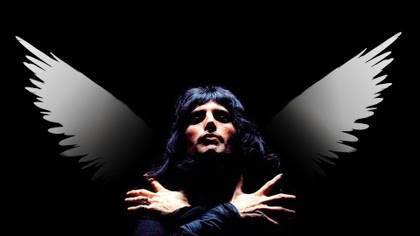
FREDDIE MERCURY
SAINT OF ANTINOUS


ON November 24th the Religion of Antinous celebrates the outrageous life of St. Freddie Mercury.

St. Freddie Mercury whose death from AIDS on this date in 1991 shocked the world, was a courageous performer whose gayness, while not always stated, was a visible part of his persona. He served as an inspiration for millions of gay men, particularly those who, like him, fight ethnic prejudice every day of their lives.

St. Freddie, who was of Indian Parsi descent, and who was born on the island of Zanzibar and grew up in India, has been referred to as "Britain's first Asian rock star."

Like all great showbiz artists, St. Freddie was acutely aware of his public image and went to great lengths to cultivate the persona of Freddie Mercury -- and to hide any trace of the little Parsi boy named Farrokh Bulsara. Freddie Mercury -- or rather the showbiz image called Freddie Mercury -- was beyond all definitions of ethnic origin, or sexual orientation or political affiliation. Not surprisingly, many people were confused and sometimes irritated by the image.

People criticized him for "hiding" his ethnic background. But as a friend told an interviewer after Freddie's death, "[Farrokh] Bulsara was a name he had buried. 

He never wanted to talk about any period in his life before he became Freddie Mercury, and everything about Freddie Mercury was a self-constructed thing."

People also criticized him for not "coming out" publicly. But again, Freddie Mercury (the showbiz image) was beyond gender limitations. 

In fact, Mercury referred to himself as "gay" in a 1974 interview with NME magazine. He was frequently spotted at the cruisiest gay bars across Europe, the UK and America. On the other hand, he would often distance himself from partner Jim Hutton during public events in the 1980s.

Freddie Mercury (the rock icon) was too big to be contained in one gender mold.

He was diagnosed with HIV in 1987. Everyone knew he was sick and everyone surmised the reason. But Freddie Mercury (the image) could never die.

And so it was, that Freddie Mercury never acknowledged his illness until November 23, 1991, when a tersely worded statement was issued announcing that he had AIDS.

A few hours later, he was dead. At the age of 45.

Although he cultivated a very flamboyant stage personality, several sources (including people of my own acquaintance who knew him "intimately") refer to Mercury as having been very shy in person. He also granted very few interviews. Mercury once said of himself: "When I'm performing I'm an extrovert, yet inside I'm a completely different man."

One man was an Indian Parsi kid called Farrokh Bulsara who had been born in Zanzibar.

The other man was FREDDIE MERCURY:

Farrokh Bulsara died on November 24, 1991.

Freddie Mercury will live forever.

The Religion of Antinous honors Freddie Mercury as a Saint of Antinous because he embodies the artistic genius and the flamboyant courage that inspires each of us to strive to be a "star". St. Freddie Mercury admonishes us to strip off the guise of conventionality and the put on our "star" outfits and to take the stage of life. He teaches us to live each day as if it is forever.

Saturday, November 21, 2026

QUENTIN CRISP
SAINT OF ANTINOUS


ON November 21st the Religion of Antinous honors Saint Quentin Crisp, who died on this day in 1999. He was born on Christmas Day in 1908. 

He became a gay icon in the 1970s after publication of his memoir, The Naked Civil Servant, his true-life account of his defiant exhibitionism and longstanding refusal to conceal his homosexuality.

John Hurt helped to make Quentin Crisp a media star in the movie adaptation of The Naked Civil Servant in the 1970s. In a sequel 30 years later Hurt made him a screen legend, very much in keeping with the lifelong ambition of Quentin Crisp.

In the second film, An Englishman In New York, Hurt portrayed the elderly Quentin Crisp as the New York gay icon based in Manhattan's funky-gritty Lower East Side in the 1980s and '90s.


At an age when most people would retire to a nursing home, Quentin Crisp left his native England and moved to New York City, where he pursued a career as a bon vivant and raconteur.

Asked by a BBC interview if he intended to die in New York, Saint Quentin emphatically said: "Oh no, I didn't come to New York to die. I came to New York to LIVE."

Arriving in New York in his 70s, he lived in his accustomed artistic squalor in a Lower East Side walk-up with a view through a grimy window pane of the next door neighbor's grimy bedroom window.


Every bit the considerate Englishman, he turned off his bare-bulb light at 11 p.m. and sat in the dark, lest the neighbor complain the glare from the 60-watt bulb (through two filthy window panes) kept him awake.

Saint Quentin experienced a meteoric rise after his cunning agent launched him into a career as a raconteur in an off-Broadway one-man show and he became a movie reviewer for a Christopher Street magazine.

But he experienced a meteoric fall from grace when, during one of his frequent TV talk-show appearances, he flippantly remarked that AIDS was "just a fad" which would soon be out of fashion, and the gay community viciously turned on him. Quentin, who had never apologized for anything in his life (and was not about to start apologizing), was perplexed when he was dropped by his agent and editor until his eyes were opened when he got to know young artist Patrick Angus, who later died of AIDS.

But in a Hollywood happy ending, Quentin was rescued by performance artist Penny Arcade, who put him back on stage, and Christopher Street re-hired him, paving the way for a glorious comeback and reconciliation with the gay community when he was in his 90s.


It is fitting that most people know Saint Quentin only through these two films. As might be expected, the best recommendation for the films comes from Quentin Crisp himself, who once famously said: "Any film, even the worst, is better than real life."

Friday, November 20, 2026

KLAUS WITZELING
A "BLESSED" OF ANTINOUS


ON November 20th we honor a modern-day mortal whose loving support has been instrumental in establishing the Religion of Antinous in the 21st Century.

Klaus Witzeling, born on this day in 1944, spearheaded the effort to expand our religion from North America back to its roots in Europe.

Born in Graz, Austria, he was trained as an actor at the famed Max Reinhardt Institute in Vienna before moving to Hamburg, Germany, where he become a well-known drama and dance critic.

His open gayness and his tireless efforts to promote new talent were instrumental in the resurgence of modern dance and independent theatrical groups in the German-speaking world over the past 30 years.

He was known for his fair and unbiased critiques. And he was especially noted for promoting obscure dance troupes and unknown actors. His insistent emphasis on furthering new talent helped to make stars out of actors and dancers who otherwise might never have become well known.

Modest to the point of introversion, he wanted no funeral services or wake. But following his death on September 29th, 2013, scores of theatrical directors, actors, dancers, agents and fellow journalists spontaneously organized a gala evening at a theatre in Hamburg in his honor.

As a Blessed of Antinous, Klaus intercedes on behalf of those in the performing arts who know the angst of standing in the wings ... waiting for their cue to go out on stage. We offer this prayer to Antinous for Klaus to intercede on their behalf:


May Klaus Witzeling have the gift of unlimited 
Antinous heka magic ...

May he have the gift of unlimited Semen of the First God ...

That he intercedes for those who dedicate their lives 

To the performing arts

That they stride onto the stage of life

With confidence and audacity

That they generously open their hearts

To the Homotheosis of Antinous

Living it in the midst of the challenges

And demands of their calling

As a spotlight on the dark stage of mortal existence

Shining as a beacon for those sitting in the darkness

That they might also fulfill their gay spiritual potential

Through Antinous the Gay God

Monday, November 16, 2026

LOZEN, APACHE WARRIORESS
SAINT OF ANTINOUS


WE honor Lozen, the two-spirit Apache warrioress and holy woman who fought with Geronimo, and who was with his final band of warriors when they surrendered.

She is a blessed Saint of Antinous.

A contemporary observer said:


"Lozen had no concern for her appearance and, even though she is seen in several famous photos of Geronimo with his warriors, there is nothing to indicate that she is a woman. You would never spot her. She was very manly in her appearance, dressed like a man, lived and fought like a man. She never married, and devoted her life to the service of her people, to the very end."

Wednesday, November 11, 2026

NIANKHKHNUM and KHNUMHOTEP
SAINTS OF ANTINOUS


ON November 11th the Religion of Antinous honors two men whose love for each other has survived the fall of all ancient civilizations.

We honor Niankhkhnum and Khnumhotep, Blessed Saints of Antinous.They lived in Egypt 2,000 years before the siege of Troy. 

They had been dead and forgotten for 2,650 years when Hadrian and Antinous visited Mennefer (Memphis) Egypt in 130 AD. 

Most likely Hadrian and Antinous stood directly on top of (or very nearly on top of) the lost tomb of these two men — two men who were buried together at the Memphis necropolis some 4,500 years ago.

When the tomb was discovered in 1964 it sent shock waves through the dusty world of Egyptology. The vividly painted reliefs on the walls of the tomb showed an intimate embrace between two male Royal Manicurists — the first recorded depiction of an openly homosexual couple.
Prudish Egyptologists have argued ever since that the two men were "just good friends" or perhaps that they were possibly "twin brothers".

But recent research by more open-minded archaeologists, such as California-based EGYPTOLOGIST GREG REEDER, has offered compelling evidence that the two men were more than "just good friends" or "close brothers."

Greg Reeder has written and lectured extensively on this extraordinary tomb, which was uncovered in 1964 in the necropolis of Saqqara at Memphis, on the west bank of the Nile. The site atop a cliff overlooking the Nile has drawn tourists since ancient times. Julius Caesar and Cleopatra stood atop this cliff and gazed in awe at its ancient tomb structures.

Hadrian and Antinous almost certainly stood on this very same spot in October of the year 130 AD, only weeks before Antinous drowned in the Nile. Beneath their feet was the Lost Tomb of Niankhkhnum and Khnumhotep. The sand has been removed and now that long-lost tomb is no longer lost.

And what a tomb it is! It has a splendid entrance and charming layout befitting a pleasant gay holiday retreat cottage — for an eternal, never-ending holiday vacation.

While grave robbers stripped the tomb of relics in antiquity, the wall paintings reveal tantalizing hints about its original occupants. The men are repeatedly depicted together, sometimes holding hands, sometimes with their arms around each other.

In two instances they are shown with their noses touching — the most intimate embrace permitted in Egyptian art of the time — tantamount to kissing. Their bodies are pressed so closely together that their groins rub against each other in a decidedly intimate sort of way. 

In Ancient Egypt, such male-male depictions were reserved for kings who merged with gods, not for two mortal men.

They are so close together that some Egyptologists have theorized that they may have been Siamese twins joined at the hips.

Other figures, identified as wives and children, are relegated to the background. In one scene, in which the two men share a final banquet before their journey into the afterlife, Niankhkhnum' s "wife" has been plastered over by the craftsmen who decorated the tomb. Khnumhotep's spouse fails to make an appearance at all — highly unusual in Egyptian tomb art, if not totally unprecedented.

Throughout the tomb, the two men are depicted in joyous pursuits, such as this relief vignette (right) showing one of them playing flute accompaniment as the other sings.

The magnificent reliefs show a variety of scenes involving nude or semi-nude males involved in all sorts of artistic and manly activities, such as one scene (below left) of a sort of "Egyptian Rodeo" bull-roping tournament with accompanying scenes of a raucous "beef barbecue" feast.

Or the scene (below right) of athletic youths — so sparingly attired you can see they are circumcised — engaged in a playful mock battle using reed skiffs on the Nile.

Throughout the tomb, the reliefs show men, men, men (and a few token females) engaged in service to the tomb's two male occupants who are — unprecedented in Egyptian Sacred Art — wholly committed to each other. Other tombs invariably show man-and-wife. Not this one.

Hieroglyphs describe the men as "Overseers of the Royal Manicurists" to pharaoh. 
Ostensibly, they were responsible for the care of the pharaoh's hands and were among the select few permitted to touch the ruler. 

However, it is also possible that the title "Royal Manicurist" could be a ceremonial honor similar to the "Order of the Garter".

Though the hieroglyphs say nothing of the two men's relationship, Greg Reeder, an Egyptologist based in San Francisco, believes the wall paintings suggest homosexuality is the answer. Reeder points out that Niankhkhnum and Khnumhotep clearly chose to depict themselves in poses usually restricted to husbands and wives in other tombs. 

"Same-sex desire must be considered as a probable explanation," Reeder said at a lecture in Britain which made headlines a couple of years ago.

"We can only say for certain that the carvings show a profound intimacy between the two men, and the people who built the tomb were possibly unsure how to portray this," the US archaeologist noted.

The tomb was restored by German archaeologists in the late 1970s and opened to the public in the 1990s.

While gay tour operators have not targeted the site, in large part because Egypt outlaws homosexual activity, Greg Reeder's articles and lectures have created gay interest in this long-lost tomb.

"It has now become famous and lots of gay tourists go there," he says with scholarly pride.

Reeder notes that, regardless of whether the two men were sexual lovers, they were definitely two men who loved each other so much that they wanted to spend all eternity in an intimate embrace.

Even their two names are intertwined. Over the entrance to one chamber their names are mingled together so that Niankhkhnum and Khnumhotep become "NiankhKHNUMhotep" — Peace and Life joined in the ram-headed Source-of-the-Nile Deity Khnum, clearly their mutual sacred patron.

Thus, their names blend together, forming a single name: "Joined in Life and Joined in Peace at the Source of All That Lives and Dies and is Born Again for All Eternity". Such is the subtlety of the Egyptian language, which turns a name into a commitment.
Our Flamen Antinoalis Antonius Subia says:

"Niankhkhnum and Khnumhotep is one of the earliest and most vivid portrayals of homosexual love, crossing all boundaries, binding two men and two families for all time, and demonstrating the profound antiquity and sacredness of our form of love." 

Thanks largely to the bold and candid research of Greg Reeder, the names of Niankhkhnum and Khnumhotep have been rescued from oblivion, so that their KAs might live forever — together! 

Tuesday, November 10, 2026

SAINT ARTHUR RIMBAUD


ON November 10th the Religion of Antinous honors St. Arthur Rimbaud, the free-spirited French poet whose openly gay lifestyle shocked even the most avant garde artists of London and Paris in the late 19th Century.

On this day, in 1891, the poet Arthur Rimbaud, Saint of Antinous, died of cancer just three months short of his 37th birthday. Despite his early death, he was already an acclaimed and highly controversial literary figure.

In his youth, Rimbaud had been what we would nowadays call a twink. A schoolboy friend said he was prettier than any of the girls and that he had "the most beautiful pale blue eyes" he had ever seen.

Raised by a staunchly Catholic single mother in isolation in the country, Rimbaud ran away to Paris at age 16 with no money but with a prodigious talent for poetry — he had already published a couple of highly praised poems.

In Paris, Rimbaud's behavior became outwardly provocative. The mild-mannered country boy started drinking, speaking rudely and writing scatological poems, stealing books from local shops, and instead of his previous neat appearance and in defiance of short-hair fashions, he began to wear his hair rebelliously long.

At the same time he wrote to an old school teacher of his who had encouraged his poetic talents, telling him about his method for attaining poetical transcendence or visionary power through a "long, intimidating, immense and rational derangement of all the senses. The sufferings are enormous, but one must be strong, be born a poet, and I have recognized myself as a poet."

Still a teenager, he was friends with radical Communists in Paris known as the Communards (hence the name of the '80s pop group) and he even wrote a poem about being sodomized by drunken Communard paramilitary men entitled "Le Coeur Supplicié" (The Tortured Heart).

He solicited the friendship of the established poet Paul Verlaine by audaciously writing a love letter to him and enclosing two hotly sexy poems, including the hypnotic, gradually shocking "Le Dormeur du Val" (The Sleeper of the Vale), in which the forces of Nature more or less rape a sleeping soldier.
  
Verlaine, who was intrigued by Rimbaud, sent a reply that stated, "Come, dear great soul. We await you; we desire you," along with a one-way ticket to Paris.

Verlaine was so smitten with the 17-year-old Rimbaud, that he abandoned his heavily pregnant 17-year-old wife and took up living with Rimbaud instead. Verlaine quit his job to become what he called "a full-time professional drunk" At left is a caricature of Rimbaud that Verlaine lovingly sketched about that time.

All of Paris was shocked by their behavior which, even among avant-garde artists, was considered scandalous.

The two of them fled to London, where they lived the life of starving artists. Rimbaud spent most of his time in the Reading Room of the British Museum for the simple reason that "heating, lighting, pens and ink were free", he later said. 

Verlaine and Rimbaud had a volatile on-again, off-again relationship punctuated by drunken bitch fights and which climaxed with Verlaine firing a gunshot at Rimbaud which resulted in a wrist wound.

In his 20s and early 30s, Rimbaud was a vagabond poet who traveled the world, mostly on foot, doing odd jobs and writing poems. There is a marble plaque on the island of Java commemorating his short visit there as a soldier in the Dutch Colonial Army — he decided the military life was not for him and deserted almost immediately upon arrival there and returned to Europe.
He was living on the Horn of Africa with an Ethiopian mistress (he had had several lovers of both sexes, basically one in every port) when his health began to deteriorate due to what would later be diagnosed as cancer — alas, the diagnosis would be made too late to save his life.

He was 17 years old when he wrote the poem The Drunken Boat: 


"..Lighter than a cork, I danced on the waves which men call eternal rollers of victims, for ten nights, without once missing the foolish eye of the harbor lights! Sweeter than the flesh of sour apples to children, the green water penetrated my pinewood hull and washed me clean of the bluish wine-stains and the splashes of vomit, carrying away both rudder and anchor. And from that time on I bathed in the Poem of the Sea, star-infused and churned into milk, devouring the green azures; where, entranced and pallid, a dreaming drowned man sometimes goes down; where, suddenly dyeing the bluenesses- deliriums and slow rhythms under the gleams of the daylight, stronger than alcohol, vaster than music-ferment the bitter redness of love."

 We dedicate this poem and the course of the free and disordered life  of St. Arthur Rimbaud to the period of 72 Archons, and our difficult passage towards godliness.

Monday, November 2, 2026

MEXICO'S FIRST SAINT OF ANTINOUS
IS VICTIM OF HOMOPHOBIC VIOLENCE


ON November 2nd, Día de los Muertos (All Souls Day), worshippers of Antinous in Mexico City solemnly honour the first martyr saint of Antinous in Mexico: Jorge Fernandez Martínez, a victim of homophobic violence.

Our sister group Epithimia Antinous at the TEMPLO DE ANTÍNOO MÉXÍCO hold a Día de lost Muertos vigil for him during ceremonies at the sanctuary of Santa Muerte in Tultitlán near Mexico City.

This tradition began in 2016 with the first funeral ceremony in the name of Antinous to be held since ancient times.

Jorge Fernandez Martinez was brutally murdered by unknown assailants near his home in the Mexico City suburb of Tultitlán.

Forensic tests showed he had been tortured, raped and asphyxiated. His broken body lay undiscovered for days.

Grieving neighbors who had known and loved him for nearly 20 years held a wake and asked for dignified funeral services conducted under the auspices of Epithimia Antinous with Pride Tultitlán Committee and Estamos Contigo.

The rites were held at the famous Shrine of Santa Muerte (Our Lady of Sacred Death) in Tultítlan led by Enriqueta Vargas.


Our brothers and sisters at Foundation Epithimia of Antinous Mexico says: 


"We were honored to officiate in the funeral ceremony for the repose of the soul of this beloved person in our community, Señor Jorge Fernandez Martinez, an active member member of our because Antinous abhors hate crimes.

"We share these images of the temple, the funeral and texts shared by Adolfo Voorduin Frappe and White White Fernandez , whom graciously thank for attending the rites. We thank Santa Muerte International and the godmother Enriqueta Vargas, for their loving support," the statement says.

In Hollywood California FLAMEN ANTONIUS SUBIA announced that Jorge Fernandez Martinez became a Martyr Saint of Antinous during ceremonies on Foundation Day in October 2016.

Friday, October 30, 2026

NEW SAINTS OF ANTINOUS FOR 2026


NEW saints of Antinous were announced by the Hollywood Temple of Antinous tonight during Foundation Day ceremonies shared globally with worshipers from around the world via Zoom.

Foundation Day commemorates the founding of the city of Antinoopolis by Emperor Hadrian on 30 October 130 AD on the shores of the Nile where Antinous had died a few days earlier.

That was 1,896 years ago, and Foundation Day marks the beginning of our liturgical calendar ... Happy New Year 1896!


After weeks of deliberations, FLAMEN ANTONIUS SUBIA announced the following New Year's List of SAINTS OF ANTINOUS for the new liturgical year.

SAINTS OF ANTINOUS

LESLIE FEINBERG was an American butch lesbian, LGBTQ+ rights activist, and the author of Stone Butch Blues, frequently considered an essential work for the LGBTQ+ community and labor organizers. She died on November 15, 2014.

GUY HOCQUENGHEM was a French writer, philosopher, and gay liberation theorist. Hocquenghem's 1972 book "Homosexual Desire" is today considered the founding text of queer theory. Hocquenghem also wrote works including "The Wrath of the Lamb," an experiment in millenarian and apocalyptic narrative; "The Atomic Heart," written in response to his deteriorating health and espousing a philosophy of dandyism, gnosticism, and Epicureanism; and Eve, a narrative combining the story of Genesis with a description of changes to his body from AIDS-related symptoms. He died from AIDS-related complications on August 28, 1988.

DAAYIEE ABDULLAH was an American Imam, scholar, and activist. Daayiee Abdullah was, after the murder of Saint Muhsin Hendricks and until his own death on August 3, 2025, one of only five openly gay Imams in the world and the first openly gay Imam in America. In 1979, he was a coordinator for the National March on Washington for Lesbian and Gay Rights. In 2011, Abdullah created an LGBTQ-friendly mosque in Washington D.C, called Masjid Nur Al-Isslaah ("Mosque for Enlightenment and Reformation"), and, in 2015, he founded the Mecca Institute, a self-described "inclusive and progressive" Islamic seminary.

ABU NUWAS was a gay classical Arabic poet, a Muslim mystic, and the foremost representative of the muhdath poetry that developed during the Abbasid Caliphate. His lyric poetry, which is mostly homoerotic, ridiculed heterosexual propriety and the condemnation of homosexuality. He earned the favour of the Abbasid caliphs Harun al-Rashid, who allegedly had a homosexual relationship with Jaʿfar the Barmakid, and his successor, Al-Amin, who fell madly in love with a male slave named Kauthar. Abu Nuwas died in 814 in Baghdad. He (like Harun) also features as a character in a number of stories in One Thousand and One Nights. In 2007, the Abu Nawas Association, which aims to decriminalise homosexuality in Algeria, was founded.

DAVID McREYNOLDS was a prominent American peace activist. Called a hero of the anti-war movement, David McReynolds was a staff member with the War Resisters League for 40 years and was twice a candidate for President of the United States, running on the Socialist Party USA ticket in 1980 and 2000. He was America's first openly gay presidential candidate and, in 1958, one of the first gay candidates to run for Congress. McReynolds died on August 17, 2018.

JOSÉ PÉREZ OCAÑA was a Spanish gay performing artist, painter, and LGBTQ+ rights activist. A central figure in Barcelona's counterculture during the Spanish transition to democracy and standing out as an icon of opposition to Francoism and its social conventions, his artistic endeavors are considered pioneering sexual and gender disobedience practices. He died on September 18, 1983.

AMELIO ROBLES ÁVILA was colonel during the Mexican Revolution who lived openly as queer and a transgender man from the age of 24 until his death at age 95 on December 9, 1984. He insisted on being treated as a man, sticking his gun in the face of individuals who misgendered him until they acknowledged him as such. In 1970, he became the first person assigned female at birth to be recognized as a male veteran by the Mexican government.

MARIE EQUI was an American lesbian, anti-war activist, and medical doctor who devoted herself to treating working-class and poor patients and regularly provided birth control and abortions at a time when both were illegal. She became a political activist and advocated for women's suffrage, an eight-hour workday, and the right to free speech. She died on July 13, 1952. In August 2019, Equi was inducted into the Rainbow Honor Walk in San Francisco’s Castro neighborhood which notes LGBTQ+ people who have "made significant contributions in their fields."

JUNIPER BLESSING (September 22, 2006 - May 10th, 2026) was a talented 19-year-old transgender woman, artist, and atmospheric science student whose life was cut tragically short. Born in Princeton, New Jersey, and raised in Santa Fe, New Mexico, she graduated from the New Mexico School for the Arts as a gifted vocalist with a magnificent five-octave range before attending the University of Washington in Seattle. Remembered by her loved ones as a uniquely compassionate, brilliant, and fiercely loyal individual who was "pure love." On the evening of May 10th 2026 she was stabbed to death more than 40 times in the basement laundry room of her student housing building. While police determined there was no evidence of a hate crime, and believe the murderer, who turned himself in three days later, to have schizophrenia and mental psychosis, the extreme violence of her death suggests that hatred was involved. Her sudden and violent death sparked profound grief and community memorials across the country.

ALEXANDER VON HUMBOLDT (14 September 1769 - 6 May 1859 ) was a visionary Prussian polymath, naturalist, and explorer whose monumental work laid the foundations for modern geography, ecology, and meteorology. Traveling extensively through the Americas and Central Asia, he pioneered a holistic view of nature as a single, interconnected global force ... an insight that profoundly shaped the development of environmental science. Humboldt was also a deeply empathetic humanitarian who fiercely condemned colonialism and slavery wherever he traveled. While his public life was defined by scientific triumph, his private letters and lifelong, deeply affectionate partnerships with men, including the soldier Reinhard von Haeften, reveal that he was gay, living out his intense emotional and romantic attachments entirely within a close-knit circle of male companions.

PETER GEORGE DOYLE (June 3, 1843 - April 19, 1907 ) was an Irish-born American transit worker best remembered as the longtime romantic companion, muse, and lover of poet Walt Whitman. Born in Limerick, Ireland, Doyle emigrated to the United States as a child and later served in the Confederate Army during the American Civil War, during which he was wounded at Antietam and briefly imprisoned. In 1865, while working as a 21-year-old streetcar conductor in Washington, D.C., he met the 45-year-old Whitman on a stormy winter night, sparking an immediate, profound intimacy that spanned nearly thirty years. Doyle’s working-class background and youthful energy deeply inspired Whitman’s poetry, positioning him as the primary muse for the homoerotic "Calamus" poems in Leaves of Grass. He faithfully nursed Whitman after the poet suffered a debilitating stroke in 1873, and though Whitman's subsequent relocation to New Jersey restricted their daily contact, the two maintained an impassioned correspondence until Whitman's death in 1892. Doyle spent his later years working for the Pennsylvania Railroad, and his preservation of Whitman's affection-filled letters ... later published as Calamus in 1897 ... provided invaluable, historic insight into the true emotional and sexual nature of America's foundational poet.

ERISHKEGAL GIANNA (GIA) BATHORY-VON ECSED (Born: December 30, 1980 - Died: December 22, 2023) was a civil rights, LGBTQ rights and Pagan rights activist who championed Gay, lesbian and trans rights for 30+ years and was one of the founding forces behind the Human Rights Campaign, the Kentucky Fairness Alliance and who spent her life supporting local LGBTQ communities until her death in 2023. She was the founder and Archpriestess of the Temple of Great Mother, America's first and only traditional pagan Temple. Trained in the Pythian Oracular tradition, as well as various forms of occult practices, she moved through the circles of the Ordo Templi Orientis, the Ordo Hermetica and was a devoted Maenad of Dionysus who reinstated the seasonal Bacchanalias, staged the Wild Hunts and Dionesuke celebrations in America, through her tireless campaigning to undo hundreds of years of misinformation and propaganda around the worship of Dionysus. She was a fierce defender of the Dionysian path, dedicating her life to the study, practice and worship of the God of transformation, liberation and ecstasy. She engaged in the walk of Elusis, entered the Mysteries of both Demeter and Persephone, as well as spending her life in the Mysteries of Dionysus. Her legacy is carried on by her Sister Christine and her Brother Cesare. She was much loved and adored by those closest to her. Her spirit now rests in the lap of the God she so beloved in life. We hope in her death she will receive the peace, love and comfort she was so often not afforded in life. Thank you for your consideration in placing her among those who devoted their lives to Antinuous-Dionysus-Bacchus. We truly feel this is a fitting final role for her.

T.E. LAWRENCE (August 16, 1888 - May 19, 1935), widely known as Lawrence of Arabia, was a British Army officer, archaeologist, diplomat, and writer. During his pre-WWI archaeological work in Carchemish, Lawrence formed an intense, close bond with an adolescent Arab water boy named Dahoum, to whom he dedicated his autobiographical book "Seven Pillars of Wisdom," which includes vivid, emotionally charged, and homoerotic passages about male bonding in the desert, contributing to long-standing speculation about his inner life.

DOLLY PARTON (January 19, 1946 - August 25, 2026) was an iconic American singer-songwriter, actress, philanthropist, and businesswoman known as the "Queen of Country."  was a longtime, vocal ally and icon for the LGBTQ+ community, consistently championing acceptance, kindness, and equal rights throughout her career.

WILLEM ARONDEUS (22 August 1894 – 1 July 1943) a Dutch gay non-Jewish artist and writer who led a group in bombing the Amsterdam Public Records Office in order to hinder the Nazi round-up of Jews, was executed with 12 others by firing squad. "Let it be known that homosexuals are not cowards," were his final words. 

FRIEDRICH ALFRED KRUPP  (July 17, 1787 - October 8, 1826) was the wealthiest industrialist in Germany. He died at his castle outside Essen. The official cause was a cerebral hemorrhage. The cause everyone in Berlin understood was something else.  For four years, Krupp had spent his winters at the Hotel Quisisana on the Italian island of Capri, where he hosted long elaborate parties for local Italian fishermen and boys at a private grotto on the cliff below the hotel. Italian socialist newspapers had begun naming him that fall.  His wife Margarethe had already gone to the Kaiser in October, asking him to intervene. The Kaiser had her committed to an asylum instead. Then on November 15, the German Social Democratic paper Vorwärts ran the full story. Krupp was the sole heir to the largest armaments fortune in Europe. He was dead within a week. Rumors began immediately and have never gone away.  Kaiser Wilhelm II attended the funeral personally and denounced "the lying press."

AGENOR DE MIRANDA ARAÚJO NETO, known as Cazuza (April 4, 1958 - July 7, 1990) was a Brazilian singer, songwriter, and poet whose rebellious spirit and emotional honesty made him one of the defining voices of Brazilian rock. Through songs such as Exagerado and O Tempo Não Para, he challenged social conventions and expressed a fierce commitment to personal freedom. His openness about his sexuality and his decision to speak publicly as a major celebrity living with HIV helped confront prejudice during the AIDS crisis. He died at 32, leaving a lasting legacy of artistic freedom and LGBTQIA+ visibility. 

RENATO MANFREDINI JÚNIOR, known as Renato Russo (March 27, 1960 - October 11, 1996) was lead singer and principal songwriter of Legião Urbana, one of Brazil’s most influential rock bands. An openly gay artist, he gave voice to love, loneliness, identity, and social alienation, reaching millions of listeners across generations. Songs such as Meninos e Meninas offered an important point of recognition for young LGBTQIA+ people growing up in a society where homosexuality remained heavily stigmatized. He died at 36, leaving a musical legacy that continues to affirm the dignity of those who live and love outside conventional expectations.

CÁSSIA REJANE ELLER, known as Cássia Eller (December 10, 1962 - December 29, 2001) was a celebrated Brazilian singer whose powerful voice and unconventional stage presence made her one of the country’s most distinctive musical artists. She lived openly with her female partner, Maria Eugênia Vieira Martins, and their family became a landmark in public discussions about same-sex parenting and legal recognition of LGBTQIA+ families. After Cássia’s death, Maria Eugênia’s fight to retain custody of Cássia’s son brought national attention to the rights of same-sex partners and families. Cássia remains an enduring symbol of authenticity, lesbian visibility, and the right to love and build a family openly.

Monday, October 19, 2026

SAINT DIVINE
HARRIS GLENN MILSTEAD


ON October 19th we honor Saint Divine (October 19, 1945 — March 7, 1988), born Harris Glenn Milstead. 

Divine was an openly gay American actor, singer and drag queen.

Described by People magazine as the "Drag Queen of the Century," Divine often performed female roles in both cinema and theater and also appeared in women's wear in musical performances.

Even so, he considered himself to be a character actor and performed male roles in a number of his later films.

He was most often associated with independent filmmaker John Waters and starred in ten of Waters's films, usually in a leading role.

Concurrent with his acting career, he also had a successful career as  a disco singer during the 1980s, at one point being described as "the  most successful and in-demand disco performer in the world."

Divine, the seventh-of-a-ton transvestite star of Mr. Waters's early movies, helped set a new standard for drag that endured long after Divine's death of heart failure in 1988, Mr. Waters said.

"When we started in those days, drag queens were square," Mr. Waters explained. "They hated Divine: they wanted to be Bess Myerson. And Divine would show up in a see-through miniskirt with a chainsaw instead of a pocketbook."

The Divine look, which stylist Van Smith first created in 1972 for Pink Flamingos, had three components. First was the hair, shaved back to the crown to allow more room for eye makeup.

Second was the makeup, acres of eye shadow topped by McDonald's-arch eyebrows; lashes so long they preceded the wearer; and a huge scarlet mouth. Third were the clothes: shimmering, skintight numbers that gave Divine a larger-than-life female sensuality.

The net effect, as Mr. Smith ordained it, was a cross between Jayne Mansfield and Clarabell the Clown.

"If you look at anything that Divine wore, you sure couldn't find that off the rack," Mr. Waters said.

All of Divine's costumes were constructed by a Baltimore woman who made outfits for strippers. Subtle they were not. There was the red fishtail dress from Pink Flamingos, in which Divine looks equal parts mermaid, Valkyrie and firetruck. And there was the sheer wedding gown she wears in Female Trouble (1974), underwear not included.

Divine once famously said that if anybody was shocked by a 300-pound drag queen in a slinky cocktail dress "then maybe they need to be shocked." He himself would describe his stage performances as "just good, dirty fun, and if you find it offensive, honey, don't join in."

As a part of his performance, he would constantly swear at the audience, often using his signature line of "fuck you very much", and at times would get audience members to come onstage, where he would fondle their buttocks, groins and breasts.

He became increasingly known for outlandish stunts onstage, each time trying to outdo what he had done before. At one performance, held in the Hippodrome in London, that coincided with American Independence Day, Divine rose up from the floor on a hydraulic lift, draped in the American flag, and declared that "I'm here representing Freedom, Liberty, Family Values and the fucking American Way of Life."

When he performed at London Gay Pride parade, he sang on the roof of a hired pleasure boat that floated down the Thames passed Jubilee Gardens, whilst at a performance he gave at the Hippodrome in the last year of his life, he appeared onstage riding an infant elephant, known as Bully the Elephant, who had been hired for the occasion.

Divine and his stage act proved particularly popular amongst gay audiences, and he appeared at some of the world's biggest gay clubs, such as Heaven in London. According to Divine's manager, Bernard Jay, this was "not because Divine happened to be a gay person himself... but because it was the gay community that openly and proudly identified with the determination of the female character Divine."

He was also described as "one of the few truly radical and essential artists of the century ... who was an audacious symbol of man's quest for liberty and freedom."

On the evening of March 7, 1988, a week after his starring role in "Hairspray" was released, Divine was staying at the Regency Hotel in Los Angeles. The next day, he auditioned for a part in the Fox network's television series "Married ... With Children". After dining with friends and returning to the hotel, he died in his sleep of an enlarged heart at age 42.

Sunday, October 18, 2026

EL SANTO NIÑO FIDENCIO


ON October 18th  we honor a gay man who is adored as a saint by millions of people in Mexico.

El Niño Fidencio, Saint of Antinous, was a Mexican "curandero" (male witch healer or shaman) in the 1920s and '30s who is regarded as a saint by his modern-day followers (although he is not recognized by the Catholic Church) and who depicted himself in drag as the Virgin Mary.

His millions of believers point to the fact that he has been credited with innumerable healings and other miracles. He is credited with saving countless lives and with curing incrable ailments.

His millions of believers also point to the numerological phenomenon that he was born on October 18, 1898, and he died on October 19, 1938.

The story of El Niño Fidencio also has many parallels to the story of the Magnificent Religion of Antinous.

Like ANTINOUS THE GAY GOD after deification on the banks of the Nile, El Niño Fidencio was a winsome young man beloved by all who worked miracles along the banks of a great river (Rio Grande) flowing through the barren wasteland of a desert between two lands, the US and Mexico.

The Nile divided the Land of the Living from the Land of the Dead,  the Rio Grande divides (or joins) two culturally merging societies.

The Ancients believed Antinous worked miracles in the lives of his faithful followers. Antinous healed the sick, he granted people love and prosperity, he shielded them from peril.

Historian Royston Lambert's book Beloved and God: The Story of Hadrian and Antinous devotes a full chapter to the Religion of Antinous and mentions the miracles he was able to bring forth.

The oracle priests of Antinous could intercede with the God, or followers could appeal directly to Antinous:

"There is evidence of oracles at Tarsos and perhaps at Rome itself," Lambert writes. "No doubt it was through these pronouncements and visitations that he wrought miracles and healing for which he evidently became famous in the east."


In many areas, people named their children Antinous in the fervent belief that he would watch over and protect their offspring all their lives.

There is the well-documented case of a man named Serapamon who lived in Antinoopolis in the 3rd Century and who called on the priests of Antinous for a love spell to attract a certain woman named Ptolemais. Clearly, his followers truly believed he could work miracles for those who believed in him.

Lambert points out: "The frequent use of his medals as talismans or amulets demonstrates demonstrates a widespread faith in his powers in Greece, Asia Minor and Egypt."

Lambert makes it clear that, for early followers of Antinous, there was no doubt in their hearts or minds that he could work miracles — and did so on an everyday basis.

"Indeed," Lambert goes on to state, "the popular vigour and genuine conviction of the 'belief' in Antinous were widespread and persistent enough to provoke the scorn of some sophisticated pagans and the anxious and unremitting indignation of most Christian apologists for two and a half centuries to come."

We should remember the heart-felt faith of the early followers of Antinous, who knew Him to be their salvation. We should remember their undying faith when we honor El Niño Fidencio in the face of the "anxious and unremitting indignation" of Catholic clerics to this day.

Friday, October 16, 2026

OSCAR WILDE
SAINT OF ANTINOUS


ON October 16th, the Religion of Antinous honors SAINT OSCAR WILDE who was born on this day in 1854. He died in ignominy and poverty on November 30th, 1900.

Ostensibly, Saint Oscar Wilde was an Irish playwright, poet and author of numerous short stories and one novel.

Known for his biting wit, he became the most successful playwright of the late Victorian era in London, and the greatest "celebrity" of his day.

His plays are still widely performed, especially The Importance of Being Earnest.

As the result of a widely covered series of trials, Wilde experienced  a dramatic downfall and was imprisoned for two years' hard labour after being convicted of homosexual relationships, described as "gross indecency" with other men.

After Wilde was released from prison he set sail for Dieppe by the night ferry and he never returned to Ireland or Britain.


That is the truth, pure and simple, of his life. But as Saint Oscar himself once famously said: "The pure and simple truth is rarely pure and never simple."

For that reason (and for many others) we remember him not only because he was notorious (something for which he might claim to be quite proud) but because he remembered Antinous.

He kept the name of Antinous alive through his poetry: 

"—A moment more, the trees had stooped to kiss
Pale Daphne just awakening from the swoon
Of tremulous laurels, lonely Salmacis
Had bared his barren beauty to the moon,
And through the vale with sad voluptuous smile
ANTINOUS had wandered, the red lotus of the Nile.

"Down leaning from his black and clustering hair
To shade those slumberous eyelids — caverned bliss,
Or else on yonder grassy slope with bare
High-tuniced limbs unravished Artemis
Had bade her hounds give tongue, and roused the deer
From his green ambuscade with shrill hallo and pricking spear.
FROM "THE BURDEN OF ITYS" BY OSCAR WILDE.


"—Lift up your large black satin eyes which are like cushions where one sinks!
Fawn at my feet fantastic Sphinx! and sing me all your memories!

Sing to me of that odorous green eve when couching by the marge
You heard from Adrian's gilded barge the laughter of
ANTINOUS
And lapped the stream and fed your drouth and watched with hot and hungry stare
The ivory body of that rare young slave with his pomegranate mouth!


FROM "THE SPHINX" BY OSCAR WILDE.

Here are some quotations from Oscar Wilde:

We are all in the gutter, but some of us are looking at the stars.

Ordinary riches can be stolen, real riches cannot.
In your soul are infinitely precious things that cannot be taken from you.

I have the simplest tastes. I am always satisfied with the best.

Man can believe the impossible, but can never believe the improbable

The critic has to educate the public; the artist has to educate the critic.

Whenever a man does a thoroughly stupid thing, it is always from the noblest motives.

It is absurd to divide people into good and bad. People are either charming or tedious.

I am so clever that sometimes I don't understand a single word of what I am saying.

I love talking about nothing. It is the only thing I know anything about.

Always forgive your enemies — nothing annoys them so much.

A true friend stabs you in the front.

I don't want to earn my living — I want to live.

Every saint has a past and every sinner has a future.

Nothing that is worth knowing can be taught.

The only thing worse than being talked about is NOT being talked about.

A gentleman is one who never hurts anyone's feelings unintentionally.

What is a cynic? A man who knows the price of everything and the value of nothing.

To live is the rarest thing in the world. Most people exist, that is all.

Be yourself; everyone else is already taken.

Tuesday, October 13, 2026

THE KNIGHTS TEMPLAR
MARTYR SAINTS OF MALE-MALE LOVE


ON this day, the origin of the folk belief that "Friday the 13th" is an unlucky day, the Religion of Antinous remembers the Knights Templar.

The proud and courageous brotherhood known as the Order of Knights Templar, who were sworn to protect pilgrims traveling to the Holy Land, were accused of Heresy, Idolatry and Sodomy, and were arrested on Friday the 13th of October in the year 1310 in France.

Although they had fought valiantly during the Crusades, and even stayed behind, sacrificing themselves to guard the retreat of Christian refugees during the fall of Acre in 1291, the order was condemned by the Pope and handed over to the envious King Philip the "Fair" of France, who coveted their land and immense wealth.

The Knights had adopted the heresy of Catharism which was basically a form of Gnosticism with Manichean influence, that had perhaps been introduced to them in the Holy Land where it flourished under the Moslems.

The Cathars believed that Jesus had descended to the material plane to undo the rule of the God of Israel, and that he had liberated mankind from the law of Moses and the natural order, through salvation in his name.

The Cathars believed that the body, and life itself, was the creation of the Evil One, who claimed to be the "Creator of the Universe."

They did not recognize the authority of the Church and believed that homosexuality was sacred because it was a form of love which did not result in procreation (locking humans in a cycle of earthly incarnations).

Following the Platonic ideal of Venus Urania, the Cathars believed that Brotherly Love was more in keeping Christ's teaching than the love between husband and wife.


The Knights Templar, whose seal depicted two knights riding on one horse, quite openly advocated this philosophy. But the Papal accusation claimed that they took this to the extreme of sodomy, requiring new initiates to perform the Kiss of Shame, by which they kissed the buttocks and phallus of the Grand Master of the Order.

They were also accused of abandoning Christianity and worshipping a demon called Baphomet, a hermaphroditic, goat-headed idol whose name implied secret knowledge. 
 

Other accusations were leveled against the Knights. But Heresy, Satanism, and Sodomy were the crimes which essentially led to their downfall.
 

Of course most of this information was obtained through torture. But one can only wonder at the consistency that characterizes their confessions.
 

On this night, the Grand Master Jacques de Molay and thousands of  Templars were arrested, tortured, condemned and subsequently Burned at the Stake. From then on, Heresy, Devil worship, and Homosexuality were indistinguishable in the eyes of the Inquisition, perhaps because they were indeed interconnected.
 

Homosexuality, however, had not been a significant threat to Christendom until it was connected with a diabolical plot to overthrow the order of society and of the Church. This was the beginning of Our Burning Times, and over the course of the next 400 years, thousands of homosexuals were officially and publicly condemned and burned or otherwise executed as an act of faith that, through our extermination, the Church was protecting the world from the Forces of Evil which we embodied.


For their courage and sacrifice, we praise the Order of the Knights Templar as Heroic Martyr Saints of the Religion of Antinous, as the Sacred Band of the Middle Ages, and we recognize their secret god Baphomet as an incarnation of our beloved Dionysus, a manifestation of Homo Deus, and of Our Beautiful God Antinous.

Monday, October 12, 2026

MATTHEW SHEPARD
SAINT OF ANTINOUS


ON this sad day we honor a young gay man who was brutally murdered: Matthew Shepard, who died at 12:53 am on Monday, October 12th, 1998.

He was brutally assaulted because he was gay, on the night of October 7, by two men who had lured him to a secluded place outside of Laramie Wyoming. 

His attackers tied him to a fence, beat him and left him for dead in the freezing cold. 

He was found the following evening by a cyclist. 

By the time help arrived, he had slipped into unconsciousness.

The death of Matthew Shepard awakened the world to the persecution that homosexuals have endured for centuries. His beauty, youth and innocence affected everyone, and spoke for the hundreds of others who in recent years have died similar deaths without being noticed.

Matthew Shepard is a Sacred and Holy Martyr of Homosexuality, he died an innocent because he was gay. He died a death that so many others have suffered, but his death changed the world.

He was 22 years old, very near the age of Antinous and, like Antinous, his beautiful face, humble origin, and tragic death have had a great impact on the future of homosexuality in our society.


We consecrate his memory and pray for him, that he will guide and protect us in our hour of danger, and bring an end to the violence and hatred that he suffered.

Saturday, October 10, 2026

THE ANTINOUS 'CAR MASCOT' ORNAMENT


IT has taken 100 years, but this elegant frosted glass "car mascot" has finally found its way ... despite many detours in the road ... to a place of honor in the Hollywood Temple of Antinous.

Perhaps a René Lalique original, this frosted glass car grill radiator ornament would have been illuminated by a tiny light bulb. Standing proudly 15 centimeters (6 inches) tall, it was a very elegant way to personalize a car and to give "The Finishing Touch" to a very elegant motor car.

Glass car mascots came in many forms ... birds, leopards/jaguars, deities ... but an Antinous car mascot gave a subtle hint as to which way the car's bachelor gentleman liked to steer.

This particular car mascot was the subject of fierce bidding on eBay in March 2012 ... with number Antinous followers on both sides of the Atlantic bidding frantically to get it.

In the end, PETER FISKE of Palm Springs California won it for "a couple of hundred dollars," as Peter announced when he formally presented the car mascot to ANTONIUS SUBIA during ceremonies consecrating Peter as a Priest of Antinous in September 2026.

Now the frosted glass Antinous car mascot is a sacred relic in the Hollywood Temple of Antinous. 


Wednesday, October 7, 2026

SAINT SERGIUS AND SAINT BACCHUS


OCTOBER 7th the Religion of Antinous honors St. Sergius and St. Bacchus, Christian patron saints of male-male love.

They were inseparable officers in the Roman army stationed in Syria during the reign of Emperor Maximian, who was fond of them and honored them repeatedly, which gave rise to jealousy in the court. 

A rival denounced Sergius and Bacchus, accusing them of not venerating the ancient gods of Rome, and of being Christians. When summoned to sacrifice to the genius of the Emperor, as was the Roman custom, Sergius and Bacchus refused.

They were imprisoned and subjected to a long series of tortures aimed at forcing them to sacrifice to the gods. They were stripped of their uniforms and made to walk through the streets wearing the clothing of women, a strange form of humiliation not usually inflicted on Christians, but a sign that their sexuality was being used to mock the saints.

Bacchus was beaten to death, but Sergius proved to be considerably  stronger than any torture that the Pagans could subject him to. When he was on the verge of surrender, and in despair, the spirit of Bacchus appeared to him and said: 

"Why do you grieve and mourn, brother? If I have been taken from you in body, I am still with you in the bond of union — Hurry then, yourself, through beautiful and perfect confession to pursue and obtain me."


Sergius was so strengthened that he could not be compelled to betray his faith, and the pagans chopped off his head.

For their strength and for the valor of their love for one another, and because for so many centuries they have remained the champions of homosexual love and devotion, we honor the Christian Saints Sergius and Bacchus as saints of the Religion of Antinous.

Tuesday, October 6, 2026

NOMINATIONS FOR SAINTHOOD 2026
NOW BEING ACCEPTED BY OUR PRIESTS


THE time has come to Nominate Gay Saints of Antinous for 2026.

Before making a nomination, please check the current LIST OF SAINTS to be sure that your suggestion is not listed already.

All nominations will be considered, but as a reminder, our traditional criteria is as follows:

I. A Nominee for Sainthood must be:

    1. A person who is no longer alive.

    2. A person who was known to be Gay or reasonably suspected to have been Gay or bisexual to a significant degree.

    3. A person who made a notable contribution to gay society or human society in general.


II. A Nominee for the category of Martyr Saint should be:

    1. Any gay person who committed suicide or was the victim of gay violence.


III. A Nominee for the category of Venerable Saint can be:

    1. Any person who was not gay, or whose homosexuality is uncertain, but who made a significant contribution to gay society or gay spirituality that we feel deserves to be recognized in an official capacity.

IV. Members of Ecclesia Antinoi, and those they love may be nominated for passage on the Barque of Millions of Years.

The deadline for nominations is October 25th, any nominations made after that date will have to be added to the nomination list for 2027.  Discussion is open to all considering the qualifications of any nomination.  The Priesthood of Antinous will make the final decision...an announcement will be made on October 30th, and a ceremony of consecration will proceed that evening.

May the Saints of Antinous be with us,
Watch over us,
And guide us to Antinous Consciousness.

Antonivs N. Svbia


Flamen Antinoalis