Monday, November 6, 2017

ANTINOUS WORSHIPERS IN BRAZIL
HONOR GAY TEEN MURDERED BY MOTHER


WE honor Itaberlly Lozano as a martyr saint of Antinous ... a 17-year-old gay youth who was murdered at the hands of his homophobic mother ... a crime which galvanized worshipers of Antinous in Brazil.

Priest DECUS RIBEIRO says: "Itaberlly Lozano was stabbed to death by his own mother and then his body was burned in a field … solely because his mother said he "brought boys home" with him."

Decus notes that hundreds of homophobic murders are reported annually in Brazil … and the number is rising as Evangelical fundamentalists make hate-speeches against homosexuality.

"It is with solemn grief but also with righteous pride that we, the São Paulo Temple of Brazil, nominated Itaberlly Lozano as a martyr saint," Priest Decus said in a statement to his fellow priests in North America, Britain and Europe.

The horrific murder occurred on 29 December 2016. The body of the adolescent was found days later, charred, in a sugar cane field near Cravinhos, in the interior of São Paul. The mother and stepfather were arrested by the Civil Police.

In a statement to the police, Itaberlly's mother, Tatiana Ferreira Lozano Pereira, 32, confessed to the murder and declared that she "could not take it anymore".

He was killed with three stab wounds in the neck and his stepfather helped to get rid of the body by burning it in a field. 

Tatiana's lawyer claimed that the boy was a drug user and had a police record, however, so far there has been no confirmation of that conduct.

According to Itaberlly's uncle, Dario Rosa, he was a hard-working boy, who had frequent quarrels at home because Tatiana did not accept that he was homosexual. 

The uncle on the father's side also says that on December 27, the young man decided to move in with him and his paternal grandmother, but after receiving a call from his mother he decided to go home on December 29 … and disappeared.

As if the whole case and its nuances were not shocking enough, Priest Decus said there were appalling comments on the news reports by people who defended Tatiana's attitude and justified the crime based on the sexual orientation and "depravity" of Itaberlly.

"The discourse of these people who blame the victim and regard homosexuality as behavior that needs to be punished is symptomatic of how much homophobia and hatred are trivialized by society in Brazil," says Decus.

In a statement from the Hollywood Temple of Antinous, Flamen ANTONIUS SUBIA condemned the martyrdom of Itaberlly and says: "May Antinous hold him in his arms as the barque of a million years gently rocks him sleep. Antinous and Hadrian are his loving parents now. Blessed be to him."

Sunday, November 5, 2017

MARY RENAULT, SAINT OF ANTINOUS


MARY RENAULT 4 September 1905 – 13 December 1983) is a saint of Antinous!

She was a British lesbian writer best known for her wonderful historical novels that recreated in Ancient Greece in magnificent detail (The King Must Die and The Persian Boy).

Renault met her life partner Julie Mullard in 1933 while they were training as nurses and they were together for 50 years, until Renault's death in 1983.

She has inspired millions of people with her historical fiction which portrays homosexuals as strong and courageous leaders.

Saturday, November 4, 2017

HADRIAN's VILLA COMES TO LIFE
FOR ANTONIUS SUBIA


HADRIAN must have delighted in forcing Patrician Romans to make the 20-mile (30 km) trek to his Tibur Villa in the rugged hill country east of Rome.

Perhaps the surroundings reminded him of his native Hispania. Perhaps he just despised Rome and its snooty residents because he had been taunted as a youth for his "Hispanic" accent and provincial manners. 

Whatever the reason, he spent most of his reign as emperor far away from Rome, traveling to the far-flung corners of his realm.

And when he wasn't traveling, he resided at his Villa, far removed from the city he abhorred. Anyone who wanted to see him was forced to make the journey over hill and dale out to Tibur. In the days of the "letica" or litter chair, it was an uncomfortable and wearying ordeal.

And it still is, even in these days of rapid transit and buses.

"He must have enjoyed making them come all the way out here," Flamen ANTONIUS SUBIA told Priest Hernestus as they waited for one of the notorious overcrowded and unairconditioned "Blue Buses" that ferry passengers from a suburban commuter rail station out to Tivoli ... and then walking a couple of miles along dusty roads to the imperial compound.

Arriving hot and weary, you then ascend a steepish incline to the walls of the Villa itself before finally arriving, out of breath, at the top of a small hill surrounded by magnificent pines, cypress and olive trees.

It is then that you realize what Hadrian loved about this place. A cool breeze wafts across the hilltop, carrying with it the scent of pine, cedar and wild roses and other flowering plants.

Antonius had never been to Hadrian's Villa until his Sacred Pilgrimage, but he knows the layout of the compound by heart, having studied its floor plans and schematic drawings for years.

"So people would arrive here," Antonius said, pointing to the entry portals only a few meters from the enormous bath complex. 

"And they would immediately be invited into the baths to freshen up before being admitted into the presence of the Emperor."

Even in a ruinous state, the baths are breathtakingly enormous, towering the equivalent of six stories overhead.

The private quarters are less easily discerned today, though Antonyus marched through them as if he had always been at home there.

"Just imagine, this is where Hadrian slept," he said in awe.

"And where do you suppose Antinous had his quarters? He must have had separate quarters of his own," Hernestus wondered.

"Somewhere with a nice view, no doubt," Antonius speculated.

The Canopus area of the compound is still stunning even today. At the end of a long pool flanked by Greco-Egyptian style statuary is a seashell motif alcove.

"This is where they dined," Antonius said with a sweep of his hand around the curved base of the alcove, "on dining couches all along here."

Very few tourists were there the day Antonius visited the Villa, just one group from a charter bus and a few hardy souls who had made the rather harrowing trip on a careening and over-crowded public bus and the trek on foot from the bus stop.

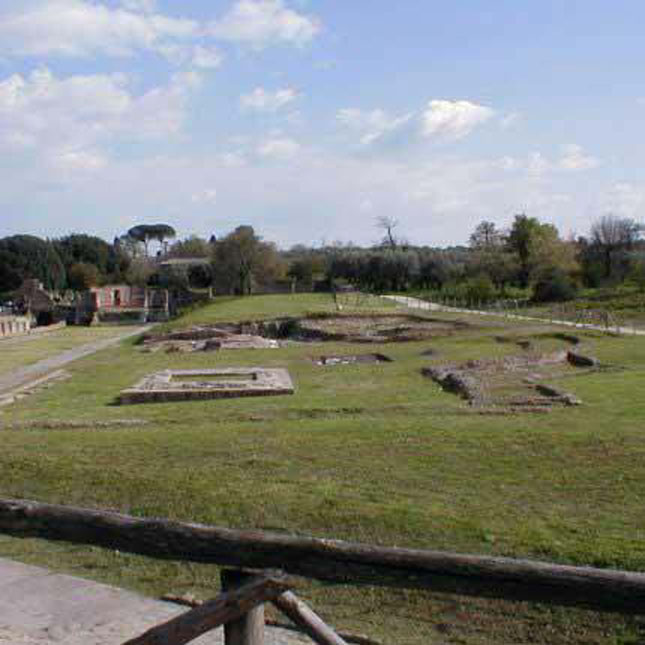
No one was paying any attention to what appeared to be a barren field between the baths and the Canopus. There was no sign indicating that this was the very heart of Hadrian's Villa, the most sacred part of the complex.

The ANTINOEION the Temple of Antinous.

This was where the OBELISK OF ANTINOUS originally stood. This is possibly where the Lost Tomb of Antinous is located.

The Antinoeion is adjacent to the curving entry pathway. It is the spiritual cornerstone of Hadrian's Villa.

"It was the first thing that anyone saw as they approached," Antonius said with a smile reflecting the satisfaction that Hadrian must have felt. "He made them acknowledge Antinous as a God."

Despite repeated promises by curators of the Villa to erect a sign, there is nothing to mark the sprawling temple complex which may yet conceal the Lost Tomb of Antinous.

Antonyus stood for a long time at the low fence which cordons off the area. To the other tourists, it was just a barren field with a few remnants of marble marking foundations of a few buildings and a plinth where an obelisk may have stood.

But for Antonius, this was Sacred Ground. This was where the Ancient Priests of Antinous had laid down the precepts of a beautiful new religion based on tolerance, love and beauty. This was where Hadrian himself came to commune with his Beloved.

A cool breeze wafted across the field, bringing with it the scent of late summer roses, pine and cedar and the sound of cicadas in the olive trees beyond the field, only a portion of which has been excavated in very recent years.

The rest of the weed-overgrown field is a ripple of mounds of earth. Or are these mounds actually the remains of still more structures, possible the Lost Tomb itself?

"There has to be much more buried under there," Antonius said. "There just has to be."

Click here to take your own tour of Hadrian's Villa:


Thursday, November 2, 2017

MYSTERIOUS CHAMBER-LIKE 'VOID'
DETECTED DEEP IN THE GREAT PYRAMID


SCIENTISTS using an imaging method based on cosmic rays have detected a mysterious and very large chamber-like "void" in the Great Pyramid of Khufu.

Researchers announced the discovery on today but said they did not know the purpose, contents or precise dimensions of what they are calling a "void" or "cavity" inside the pyramid.

To peer inside the pyramid, the scientists used an imaging technique called muon tomography that tracks particles that bombard Earth at close to the speed of light and penetrate deeply into solid objects.

They said the newly discovered "internal structure" was at least 100 feet (30 meters) long, and located above a hallway measuring about 155 feet long (47 meters) called the Grand Gallery, one of a series of passageways and chambers inside the immense pyramid.

The researchers said it constitutes the first major inner structure found in the Great Pyramid since the 19th century.

"What we are sure about is that this big void is there, that it is impressive, that it was not expected by, as far as I know, any kind of theory," said Mehdi Tayoubi, president and co-founder of the HIP Institute in France, one of the leaders of the study published in the journal Nature.

"We open the question to Egyptologists and archaeologists: what could it be?" added Hany Helal of Cairo University.

The findings come from a project called Scan Pyramids that relies on non-invasive scanning methods to probe the internal structure of the pyramids of ancient Egypt's glorious Old Kingdom period and understand how they were built.

"We are not doing this mission in order to find hidden cavities," Helal said.

Muon particles originate from interactions between cosmic rays from space and atoms of Earth's upper atmosphere. The particles can penetrate hundreds of yards (meters) into stone before being absorbed. Placing detectors inside a pyramid can discern cavities within a solid structure.


ANTINOUS EMBRACES GEORGE MICHAEL
(25 June 1963 - 25 December 2016)


George Michael (25 June 1963 - 25 December 2016) now is with Antinous among  the glittering stars. He has found his Freedom and his Faith. It was his Last Christmas, and we shall miss him. He is a saint of Antinous.

George Michael (25 de junho de 1963 - 25 de dezembro de 2016) é com Antinous agora entre as estrelas brilhantes. Ele encontrou sua liberdade e sua fé. Foi seu último Natal, e vamos sentir falta dele.

George Michael (25 de junio de 1963 - 25 de diciembre de 2016) está con Antinous ahora entre las estrellas brillantes. Ha encontrado su libertad y su fe. Fue su última navidad, y lo extrañaremos.

Wednesday, November 1, 2017

ARCHAEOLOGISTS AT ANTINOOPOLIS
FIND CLUES TO A HUGE STRUCTURE


Archaeologists have found yet another tantalizing corner cornice stone ... much larger than the one found last spring ... which indicates they may have stumbled onto the largest building yet found at the sacred city of Antinous.

After a spectacular 2016-17 dig season, archaeologists have returned to ANTINOOPOLIS in Egypt for the 2017-18 season in October 2017, and found the cornice stone.

The archaeologists will be studying it further when they return in January and February 2018.

Of course, they are also looking forward to exploring an "intentionally buried stone structure" in the heart of the city founded by Hadrian at the spot where Antinous died in the Nile.

Writing in his first 2017-18 report, James B. Heidel, president of the Antinoupolis Foundation, says: "We are very excited to be back at the site." More work will follow.
"In the first week of work we have focused on removing layers above what we believe to be the other half of the rectangular temple we were uncovering last season (in February)," he wrote.

"This is necessary to determine if it is a free-standing rectangular temple in the middle of the much larger court, or if it is connected in some way architecturally with the surrounding peristyle," he added. See the peristyle court illustration below.

"This is the temple we now are able to say with some certainly is part of the complex dedicated to Osiris-Antinous, the titular deity of Antinoupolis, due to an inscribed cornice block (pictured above left) we discovered in February," he pointed out.

The highlight of the 2016-17 season came when archaeologists detected a "deliberately buried" structure with ground-penetrating radar in February and suggested it could be an OSIREION ... symbolic Tomb of Osiris ... raising hopes that this could be the Lost Tomb of Antinous.

But initial excavation failed to yield results ... results which the archaeologists hope to find during the 2017-18 season.


Other spectacular discoveries include column capitals and a cornice stone with the name of Antinous inscribed in hieroglyphs.

The stones apparently come from a shrine to the Egyptian goddess Hathor ... not however the Great Temple of Antinous, as had been suggested initially.

The stones from the shrine are a mixture of Egyptian and Classical styles which enable the archaeologists to come up with an architectural rendering showing what the shrine and its adjacent peristyle colonnade might have looked like.

Work now resumes on these dig sites in October.

The great fear, however, is that local villagers might build houses on top of the site when archaeologists are away ... since law-enforcement is lax in the region.

It is within what possibly was the Great Temple of Antinous and is a rectangular chamber which is subdivided into three sub-chambers ... apparently an antechamber, a middle chamber and an inner sanctum.

Writing in his first 2017 report, James B. Heidel, president of the Antinoupolis Foundation, says: "The clearest part of the results show a large stone structure which is about 12 x 22 meters in the form of a tripartite shrine."

He adds: "This simply means three rooms of the same size lined up at the end of an axis, and it is a common feature of Egyptian temples for thousands of years."

The ground-penetrating radar shows that the structure is covered by soil which was placed on top of it all at one time, not in layers which accumulated over time.

"This indicates that the structure was intentionally buried.  This is intriguing," the report continues, "because in ancient Egypt buildings known as Osireons were sometimes constructed (the most famous of which is the Osireion constructed by Seti I as part of his temple at Abydos) and were seen as model tombs of the god Osiris.  As model tombs these structures seem to have been intentionally buried," the archaeologists add.

"Since Antinoupolis is the cult city of the new Osiris, Osir-Antinous,  an Osireion would make sense as part of the urban ensemble," the archaeologists state. The structure, whatever it may be, is still covered by two meters of intentional fill.

As a final exciting detail, the stone tripartite structure and the arrangement of the surrounding walls indicate an axis which would not only correspond to the grid of the Ramses II temple, but an axis which would enter that temple in the middle of the side of the "hypostyle hall," which is the hall of columns between the back shrines of the temple and the court at the temple's entry.

"This axis is a normal place for the main side entrance into an Egyptian temple precinct," the report goes on. 

"And it appears that this structure, if built by Hadrian, was intended by his designers to be an extension of the Ramses II temple complex."

The team also found what appears to be a grand stairway in the center of a large temple dedicated to Antinous-Osiris and a large harborside peristyle court ... waterfront structures which were found in the previous season.
Finding the exact location of the ancient waterfront is important since it may indicate the site at which Antinous died.


We know that Emperor Hadrian commanded that a sacred city be founded at the location where Antinous drowned in the Nile.

We also know from an ancient papyrus that an impressive quayside port facility was constructed at or near that site.

Using ground-penetrating radar (GPR), archaeologists found a large  square compound of paving stones bordered by columns ... which could mark the site where Antinous drowned.

Heidel, president of the Antinoupolis Foundation, says the discoveries in the past two years at the site have exceeded all expectations.

Finds include ornate capitals which once adorned colossal columns.

Heidel also says LOOTING has abated somewhat following a return to a semblance of stability in Egypt.

Since the revolution in Egypt, which resulted in runaway lawlessness, the site has been subject t"SYSTEMATIC LOOTING" for three years. 


The scope of looting diminished in recent months, although local villagers still search for "trinkets" to sell on the black market, he writes.

Heidel says his archaeologists working at Antinoopolis (also known as Antinoe) say local villagers continue to encroach on the dig site ... ostensibly to create new space for housing and graves.

However, it is an ages-old practice in Egypt for villagers to build houses over places where they can "accidentally" unearth ancient treasures by digging tunnels under their homes. And excavation of new graves can "accidentally" reveal more ancient treasures.

RIVER PHOENIX
SAINT OF ANTINOUS


IN the early morning hours of Halloween day in 1993, River Phoenix died outside the Viper Room on Sunset Blvd.

He had ingested a fatal combination of alcohol, marijuana, cold medicine, a component of speed, heroin and valium. He was 23 years old.

His Dionysian indulgence caused him to collapse, convulse and then suffer cardiac arrest within a matter of moments. 

He was dead when he arrived at Cedars Sinai Hospital only some 45 minutes after taking his heroin.

He was one of the most beautiful people that the world has ever known, an Adonis of our time, an amazing actor and musician, whose films will forever immortalize his memory. 

One of his last roles was as a gay, drug-addict, prostitute in My Own Private Idaho, and it is said that his work on this film had such a profound effect on his soul that he was never again free from it.

He had not only turned to the use of heavy drugs, which he had before scorned, but he is also rumored to have taken up homosexuality, which he did not deny. 

Indeed the sensitivity and depth that he brought to the tortured prostitute, searching for love, is an intimation of the inner beauty and darkness of understanding that River Phoenix possessed. 

He had only just been chosen to play the role of the poet Arthur Rimbaud, another Saint of Antinous.

For his achievements in the cinema, for the abandonment of letting the dark god take over his life, and for the sorrowful tragedy of his death, which he embraced fully, almost prophetically, we name the spirit of River Phoenix among the blessed Saints of Antinous, because he was a living Dionysus, and because his final day on earth was the day that the Holy City of Antinoopolis was founded.


It is fitting that such a beautiful creature as St. River Phoenix is the first Saint of the Ecclesiastical Year.