Showing posts with label yourcenar. Show all posts

Tuesday, December 16, 2025

MARGUERITE YOURCENAR
IS A SAINT OF ANTINOUS


ON this day in 1987, Marguerite Yourcenar died.

She wrote the landmark Mémoires d'Hadrien (Hadrian's Memoirs), which is considered by many to be the finest historical novel of the last century.

It is through her literary genius that millions of people around the world have been drawn to the modern-day Religion of Antinous.

She truly is a saint of Antinous.

Friday, November 7, 2025

MARGUERITE YOURCENAR SHOWS YOU
HOW TO PRONOUNCE THE NAME 'ANTINOUS'


IN a rare interview with our beloved Marguerite Yourcenar, author of the landmark classic historical novel MÉMOIRES D'HADRIEN (Memoirs of Hadrian), notice how she pronounces the name "Antinous."

CLICK HERE for the interview that was done for French television in 1979.

You will hear his name spoken correctly in the VIDEO when she says that "Hadrian was the only man to raise a cult for a male lover for a boyfriend for whom he was preoccupied with creating the greatest multitude of portraits in antiquity of any other person than of ANTINOOS!"

She pronounces it "On-Dthee-Noh-Oows" which is the Greco-Latin way. And according to the glyphs on the Obelisk of Antinous, it is the correct pronunciation. 

In English it is usually pronounced "an-TINN-oh-us" which cannot be how he called himself.


Flamen Antonius Subia, who is from El Paso, explains:

"Latin is only straight-forward for Latinos...and by that I do not mean only for Hispanics, but for all Latinos...Anglo-Saxons pronounce everything in their Germanic accent...all the vowels and some of the consonants are usually wrong.

"I feel sweetly vindicated and comforted by hearing that the Grand Lady herself says his name the same way that I say it...the way I knew that it should be pronounced...

"We should speak his Most Holy Name the way that He himself said it, the way that his his mother said it the day he was born, and the way that Hadrian said it...when he spoke to him directly...and the way the ancient priests said it when they prayed to HIM."

Monday, December 16, 2024

MARGUERITE YOURCENAR
IS A SAINT OF ANTINOUS


ON this day in 1987, Marguerite Yourcenar died.

She wrote the landmark Mémoires d'Hadrien (Hadrian's Memoirs), which is considered by many to be the finest historical novel of the last century.

It is through her literary genius that millions of people around the world have been drawn to the modern-day Religion of Antinous.

She truly is a saint of Antinous.

Saturday, December 16, 2023

MARGUERITE YOURCENAR
IS A SAINT OF ANTINOUS


ON this day in 1987, Marguerite Yourcenar died.

She wrote the landmark Mémoires d'Hadrien (Hadrian's Memoirs), which is considered by many to be the finest historical novel of the last century.

It is through her literary genius that millions of people around the world have been drawn to the modern-day Religion of Antinous.

She truly is a saint of Antinous.

Friday, December 16, 2022

MARGUERITE YOURCENAR
IS A SAINT OF ANTINOUS


ON this day in 1987, Marguerite Yourcenar died.

She wrote the landmark Mémoires d'Hadrien (Hadrian's Memoirs), which is considered by many to be the finest historical novel of the last century.

It is through her literary genius that millions of people around the world have been drawn to the modern-day Religion of Antinous.

She truly is a saint of Antinous.

Monday, November 7, 2022

MARGUERITE YOURCENAR SHOWS YOU
HOW TO PRONOUNCE THE NAME 'ANTINOUS'


IN a rare interview with our beloved Marguerite Yourcenar, author of the landmark classic historical novel MÉMOIRES D'HADRIEN (Memoirs of Hadrian), notice how she pronounces the name "Antinous."

CLICK HERE for the interview that was done for French television in 1979.

You will hear his name spoken correctly in the VIDEO when she says that "Hadrian was the only man to raise a cult for a male lover for a boyfriend for whom he was preoccupied with creating the greatest multitude of portraits in antiquity of any other person than of ANTINOOS!"

She pronounces it "On-Dthee-Noh-Oows" which is the Greco-Latin way. And according to the glyphs on the Obelisk of Antinous, it is the correct pronunciation. 

In English it is usually pronounced "an-TINN-oh-us" which cannot be how he called himself.


Flamen Antonius Subia, who is from El Paso, explains:

"Latin is only straight-forward for Latinos...and by that I do not mean only for Hispanics, but for all Latinos...Anglo-Saxons pronounce everything in their Germanic accent...all the vowels and some of the consonants are usually wrong.

"I feel sweetly vindicated and comforted by hearing that the Grand Lady herself says his name the same way that I say it...the way I knew that it should be pronounced...

"We should speak his Most Holy Name the way that He himself said it, the way that his his mother said it the day he was born, and the way that Hadrian said it...when he spoke to him directly...and the way the ancient priests said it when they prayed to HIM."

Friday, December 17, 2021

MARGUERITE YOURCENAR
IS A SAINT OF ANTINOUS


ON this day in 1987, Marguerite Yourcenar died.

She wrote the landmark Mémoires d'Hadrien (Hadrian's Memoirs), which is considered by many to be the finest historical novel of the last century.

It is through her literary genius that millions of people around the world have been drawn to the modern-day Religion of Antinous.

She truly is a saint of Antinous.

Thursday, November 18, 2021

MARGUERITE YOURCENAR SHOWS YOU
HOW TO PRONOUNCE THE NAME 'ANTINOUS'


IN a rare interview with our beloved Marguerite Yourcenar, author of the landmark classic historical novel MÉMOIRES D'HADRIEN (Memoirs of Hadrian), notice how she pronounces the name "Antinous."

CLICK HERE for the interview that was done for French television in 1979.

You will hear his name spoken correctly in the VIDEO when she says that "Hadrian was the only man to raise a cult for a male lover for a boyfriend for whom he was preoccupied with creating the greatest multitude of portraits in antiquity of any other person than of ANTINOOS!"

She pronounces it "On-Dthee-Noh-Oows" which is the Greco-Latin way. And according to the glyphs on the Obelisk of Antinous, it is the correct pronunciation. 

In English it is usually pronounced "an-TINN-oh-us" which cannot be how he called himself.


Flamen Antonius Subia, who is from El Paso, explains:

"Latin is only straight-forward for Latinos...and by that I do not mean only for Hispanics, but for all Latinos...Anglo-Saxons pronounce everything in their Germanic accent...all the vowels and some of the consonants are usually wrong.

"I feel sweetly vindicated and comforted by hearing that the Grand Lady herself says his name the same way that I say it...the way I knew that it should be pronounced...

"We should speak his Most Holy Name the way that He himself said it, the way that his his mother said it the day he was born, and the way that Hadrian said it...when he spoke to him directly...and the way the ancient priests said it when they prayed to HIM."

Thursday, December 17, 2020

MARGUERITE YOURCENAR
IS A SAINT OF ANTINOUS


ON this day in 1987, Marguerite Yourcenar died.

She wrote the landmark Mémoires d'Hadrien (Hadrian's Memoirs), which is considered by many to be the finest historical novel of the last century.

It is through her literary genius that millions of people around the world have been drawn to the modern-day Religion of Antinous.

She truly is a saint of Antinous.

Tuesday, December 17, 2019

MARGUERITE YOURCENAR
IS A SAINT OF ANTINOUS


ON this day in 1987, Marguerite Yourcenar died.

She wrote the landmark Mémoires d'Hadrien (Hadrian's Memoirs), which is considered by many to be the finest historical novel of the last century.

It is through her literary genius that millions of people around the world have been drawn to the modern-day Religion of Antinous.

She truly is a saint of Antinous.

Monday, December 17, 2018

MARGUERITE YOURCENAR
IS A SAINT OF ANTINOUS


ON this day in 1987, Marguerite Yourcenar died.

She wrote the landmark Mémoires d'Hadrien (Hadrian's Memoirs), which is considered by many to be the finest historical novel of the last century.

It is through her literary genius that millions of people around the world have been drawn to the modern-day Religion of Antinous.

She truly is a saint of Antinous.

Sunday, December 17, 2017

MARGUERITE YOURCENAR
IS A SAINT OF ANTINOUS


THIRTY years ago today in 1987, Marguerite Yourcenar died.

She wrote the landmark Mémoires d'Hadrien (Hadrian's Memoirs), which is considered by many to be the finest historical novel of the last century.

It is through her literary genius that millions of people around the world have been drawn to the modern-day Religion of Antinous.

She truly is a saint of Antinous.

Saturday, October 14, 2017

THE ANTINOUS MARLBOROUGH GEM
By Our Flamen Antonius Subia


Just acquired at auction!!!
My own glass copy by James Tassie
Of the Antinous Marlborough Gem!!!
And the best thing about it is that it is
This transitional color between Blue and Purple
Laid flat it looks like Lapis Lazuli,
Held under bright light it looks like sapphire
But mostly it looks like deep grape purple
(See photos at bottom of entry)
Its so wonderful, crisp and heavy like a stone!

The Marlborough Sardonix is a black stone jewel intaglio with the image of Antinous that was signed by Antoninianus of Aphrodisia, who also sculpted the Lanuvium relief now kept in Rome, the only artist known to have signed his name on his work and we have two of his pieces. 

It was proposed by Marguerite Yourcenar that what is known now as the Marlborough Sardonix after the British house of Marlborough who still owns the original, was once worn as a ring by Hadrian himself, which would make it one of the most sacred and precious items of our religion.

Even copies such as this glass cast if a Tassie copy are precious because they capture the spirit of the original...and in our religion...the true image of Antinous is the basis upon which everything is based.

We have brought this gem and many other treasures into the safe keeping of the Antinous Religion, we hope to gather many more precious images of our god together and pass them on as a valuable treasury of Sacred Antinous items to our successors.

May Antinous bless this image of the Marlborough sardonix and bless all those who venerate it as his true image.

~ANTONIUS SUBIA


Friday, February 5, 2016

EXHIBITION IN FRANCE FOCUSES ON HADRIAN
AND HIS PASSION FOR ANTINOUS


IN France this year? Be sure to visit the Archaeological Museum Nord, in the French town of Bavay on the Belgian border, which is hosting an exhibition devoted to the book "Memoirs of Hadrian" from 4 February to 30 August 2016. 

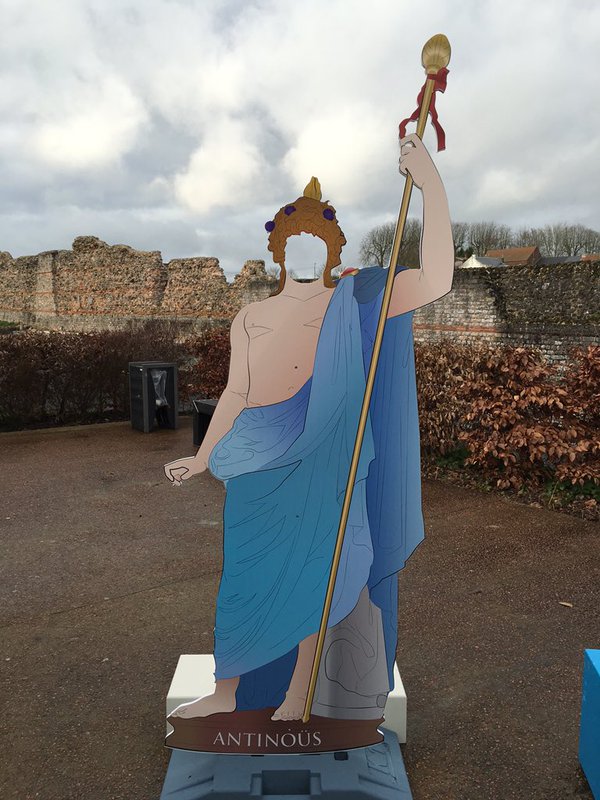
You can see busts and statuary of Antinous on loan from major world museums ... and there is even an Antinous cut-out which allows you to pose as Antinous!

The exhibition focuses on the lives of two people who never met ... but who are inextricably intertwined: Emperor Hadrian and Marguerite Yourcenar Bavay, whose landmark Mémoires d'Hadrien (Hadrian's Memoirs) is considered by many to be the finest historical novel of the last century.

This exhibition reflects both literature and archeology, fact and fiction, by showing archaeological objects from the time of Hadrian, objects that belonged to Marguerite Yourcenar and showing parallels to Hadrian's enquiring mind and the author's.

The exhibition MARGUERITE YOURCENAR ET L’EMPEREUR HADRIEN, UNE RÉÉCRITURE DE L’ANTIQUITÉ (Marguerite Yourcenar and the Emperor Hadrian, Rewriting Antiquity) is thus dedicated to both Marguerite Yourcenar and to Hadrian.

It is the first exhibition in France about Memoirs of Hadrian and traces the author's life and parallels to the life of Hadrian.

The exhibition in Bavay is divided into five thematic sections underpinned by the literary frame Memoirs of Hadrian.

Starting with a section devoted to the research of Marguerite Yourcenar, the exhibition covers various life themes of Emperor Hadrian ... the man conscious of his roots and those of his family, the politician, the emperor, builder and the esthete, friend of the arts and of Hellenic culture ... culminating with his passion and his establishment of the religion of Antinous.

Thus, the exhibition explores the place of Antique in the literary work and touches the question of the border between archaeological data and literary imagination. 

The genius of Yourcenar's book is that generations of readers have believed it to be the true, actual memoirs of Hadrian ... and this exhibition encourages visitors to believe ... at least for a short time ... that it is indeed the authentic, historical memoir of the Roman Emperor.

On view are books, manuscripts, original editions of Marguerite Yourcenar along with statuary, busts, coins, inkwells and lamps from the time of Emperor Hadrian. 

Fifty works are on loan from the Louvre, the British Museum, Petite Plaisance, the Museum Ingres (Montauban), the Gallo-Roman museum in Lyon Fourvière museum of Fenaille (Rodez).

Also on view are objects from Hadrian's Villa (Tivoli), the Musée Saint-Raymond (Toulouse), the Picardie museum and the North France Archives.

Saturday, August 23, 2014

'THE LOVE GOD' BY MARTIN CAMPBELL
IS A BRILLIANT NOVEL ABOUT ANTINOUS


THE most brilliant novel about Antinous to appear in over half a century has just been published ... THE LOVE GOD ... by our own MARTIN CAMPBELL, novice priest of Antinous.

While that sounds like biased praise, we Antinomaniacs are hard to please and would not hesitate to pick apart a poorly researched book or one that denigrated Antinous, even if it were written by one of our best friends ... perhaps especially if it were. 

At the same time, a sycophantic book that presented Antinous as being cloyingly sweet and angelic would be unbearable and not believable.

So we are gratified (and greatly relieved) to report that this book truly is a remarkable work of historical fiction right up there with Marguerite Yourcenar's landmark MEMOIRS OF HADRIAN 60 years ago.

Martin traces the life of Antinous from the moment his tousle-haired head emerges from his mother's womb under auspicious stars in Asia Minor to the moment his head sinks beneath the swirling waters of the Nile on a starry evening in Egypt.

Antinous comes to life as a young man of breath-taking beauty who is filled with conflicting passions and loyalties. He is a young man who at times is naive, yet at other times worldly wise with an ability to see the world as it is ... and to describe it with at times brutal honesty to the most powerful man in the world.

Above all, this is a gentle love story between Antinous and Emperor Hadrian, himself a man of contradictory passions and priorities.

Martin himself is a man shares these passions. He has rebounded from a series of debilitating strokes to resume a daunting array of political activism for LGBTIU health and rights issues ... while working on this novel.

Based in a hilltop home overlooking the sea in Brighton England, he spent the best part of a decade researching this novel, retracing the footsteps of Antinous across Greece and Italy, as far north as Hadrian's Wall and as far south as the Nile in Upper Egypt.

Historical facts are excruciatingly accurate ... even the positions of the stars and planets at the moment of the birth of Antinous have been calculated to precision.

An academic scholar can read this book with satisfaction, noting obscure and arcane references which only the experts in the field of Antinology fully appreciate.

At the same time, however, this is a fun book to read even for those who have never heard of Antinous in their lives and who have no firm grasp of Roman civilization in the 2nd Century AD.

There is intrigue, skulduggery, near-death by lightning, getting lost in a subterranean labyrinth, a storm at sea, earthquakes ... and some fairly hot man sex as well, albeit tastefully brought to the page.

The narrator is the Classical Love God himself: Eros. He shoots his amorous arrows and ensures that Antinous and Hadrian fulfill the destiny which the Fates have in store for them ... despite efforts by certain people in the Imperial Court to thwart the Fates.


But the genius of this book is that there are no black-and-white villains or heroes.

Antinous is a young man with all the problems and drives of late adolescence, and Hadrian is a man with a mid-life crisis of doubt and regret.

Others such as Empress Sabina and her constant companion Julia Balbilla and their coterie of fawning courtiers and freedmen are not really hateful towards Antinous so much as they are simply perplexed by him. 

They view him the way some members of the Royal Household might look at the favorite Corgi of the Queen, unable to comprehend her affection for it, her grief when it dies.


They whisper amongst themselves: What hold does Antinous have over Hadrian? 

Just who does he think he is? And is he a threat to them? 

What is so different about Antinous that Hadrian doesn't grow weary of him ... as he always has with previous toy boys? 

Because they cannot understand how he fits in the scheme of Imperial court life, some really rather wish he would just disappear ... voluntarily or otherwise. 

And through it all is the boyhood friend of Antinous who has accompanied him on this long journey with mixed feelings and with growing envy and jealousy. 

The boiling emotions all stem from Eros, who winks knowingly at the reader as he shoots one arrow after another with unerring accuracy to ensure that Antinous fulfills his destiny ... to take his place alongside Eros as a God of Love.

The result is a richly entertaining and beautifully written novel which appeals to those seeking authoritative scholarly accuracy as well as readers who just want a riveting and memorable adventure yarn.

The Love God is available as Kindle and as a paperback ... CLICK HERE to order.

Friday, November 15, 2013

MARGUERITE YOURCENAR SHOWS YOU
HOW TO PRONOUNCE THE NAME 'ANTINOUS'


IN a rare interview with our beloved Marguerite Yourcenar, author of the landmark classic historical novel MÉMOIRES D'HADRIEN (Memoirs of Hadrian), notice how she pronounces the name "Antinous."

CLICK HERE for the interview that was done for French television in 1979.

You will hear his name spoken correctly at exactly 5:45 minutes into the VIDEO where she says that "Hadrian was the only man to raise a cult for a male lover for a boyfriend for whom he was preoccupied with creating the greatest multitude of portraits in antiquity of any other person than of ANTINOOS!"

She pronounces it "On-Dthee-Noh-Oows" which is the Greco-Latin way. And according to the glyphs on the Obelisk of Antinous, it is the correct pronunciation. 

In English it is usually pronounced "an-TINN-oh-us" which cannot be how he called himself.

Flamen Antonyus Subia, who is from El Paso, explains:

"Latin is only straight-forward for Latinos...and by that I do not mean only for Hispanics, but for all Latinos...Anglo-Saxons pronounce everything in their Germanic accent...all the vowels and some of the consonants are usually wrong.

"I feel sweetly vindicated and comforted by hearing that the Grand Lady herself says his name the same way that I say it...the way I knew that it should be pronounced...

"We should speak his Most Holy Name the way that He himself said it, the way that his his mother said it the day he was born, and the way that Hadrian said it...when he spoke to him directly...and the way the ancient priests said it when they prayed to HIM."

Thursday, December 20, 2012


MARGUERITE YOURCENAR SHOWS YOU

HOW TO PRONOUNCE THE NAME 'ANTINOUS'


IN a rare interview with our beloved Marguerite Yourcenar, author of the landmark classic historical novel MÉMOIRES D'HADRIEN (Memoirs of Hadrian), notice how she pronounces the name "Antinous."

The INTERVIEW was done for French television in 1979.

You will hear his name spoken correctly at exactly 5:45 minutes into the VIDEO where she says that "Hadrian was the only man to raise a cult for a male lover for a boyfriend for whom he was preoccupied with creating the greatest multitude of portraits in antiquity of any other person than of ANTINOOS!"

She pronounces it "On-Dthee-Noh-Oows" which is the Greco-Latin way. And according to the glyphs on the Obelisk of Antinous, it is the correct pronunciation. 

In English it is usually pronounced "an-TINN-oh-us" which cannot be how he called himself.

Flamen Antonyus Subia, who is from El Paso, explains:


"Latin is only straight-forward for Latinos...and by that I do not mean only for Hispanics, but for all Latinos...Anglo-Saxons pronounce everything in their Germanic accent...all the vowels and some of the consonants are usually wrong.

"I feel sweetly vindicated and comforted by hearing that the Grand Lady herself says his name the same way that I say it...the way I knew that it should be pronounced...

"We should speak his Most Holy Name the way that He himself said it, the way that his his mother said it the day he was born, and the way that Hadrian said it...when he spoke to him directly...and the way the ancient priests said it when they prayed to HIM."