Saturday, September 14, 2024

ROMAN SKELETONS BURIED HOLDING HANDS
NOW HAVE BEEN IDENTIFIED AS TWO MALES


TWO ancient Roman skeletons, who mysteriously were buried holding hands, now have been identified as two males, researchers have revealed.

In 2009, archaeologists discovered the remains in the Italian city of Modena. The pair were dubbed the "Lovers of Modena" by the media, the assumption being that they were a heterosexual couple.

The researchers at that time could not determine the gender of the skeletons when they were found in Italy in 2009 because they were badly preserved.

But a new technique, using the protein on tooth enamel, revealed their sex.

The actual relationship between the skeletons from the 4-6th Century AD remains a mystery.

The researchers say the two adult males were intentionally buried hand-in-hand.

Some of the suggestions for the link between the two skeletons are that they are siblings, cousins or soldiers who died together in battle, study author Federico Lugli told Italy's Rai news site (in Italian).

Researchers suggest that their burial site could have been a war cemetery.
The researchers from Italy's University of Bologna said in Scientific Reports that the findings had profound implications for understanding funeral practices at that time in Italy.

Friday, September 13, 2024

ROME'S GREAT TEMPLE OF JUPITER
DEDICATED ON THIS DAY IN 509 BC


ON the 13th of September the Temple of Jupiter Optimus Maximus atop the Capitoline Hill was dedicated in 509 BC. The ascent of Rome began! 

In the old Roman calendar, September was the seventh month of the year in counting March as the first. Among the festivals observed in September were several honoring Jupiter. 

He was hailed as the chief of the gods and had many epithets as a result.


As Jupiter Optimus Maximus, he occupied the temple of Jupiter Capitolinus on the Capitoline hill with the goddesses Juno and Minerva. With them, he received a Lectisternium (September 13) and the Ludi Romani  (September 5-19). 

Thursday, September 12, 2024

RUN LIKE PHEIDIPPIDES
JUST DON'T DIE LIKE PHEIDIPPIDES


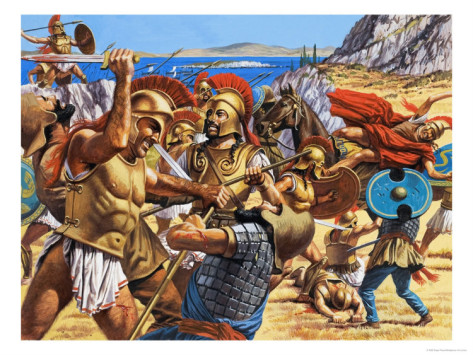
ON September 12, 490 BC, 10,000 Greeks use superior tactics to push 100,000 Persians back into the sea at the Battle of Marathon Bay ... forever changing the course of Western Civilization.

Though outnumbered 10 to 1, the Greeks won thanks to their new tactics.

Instead of individual soldiers fighting one-to-one duels, the Greeks rolled out their "phalanx" battle line of Hoplite soldiers who fought as one impenetrable unit.

The Battle of Marathon was a watershed in the Greco-Persian wars, showing the Greeks that the Persians could be beaten; the eventual Greek triumph in these wars can be seen to begin at Marathon. 

The battle also showed the Greeks that they were able to win battles without the Spartans, as they had heavily relied on Sparta previously. 

This win was largely due to the Athenians, and Marathon raised Greek esteem of them. Since the following two hundred years saw the rise of the Classical Greek civilization, which has been enduringly influential in western society, the Battle of Marathon is a pivotal moment in history.

The battle is perhaps now more famous as the inspiration for the marathon race. 

Although thought to be historically inaccurate, the legend of the Greek messenger Pheidippides running to Athens with news of the victory became the inspiration for this athletic event, introduced at the 1896 Athens Olympics, and originally run between Marathon and Athens.

Pheidippides was a professional "hemerodrome" (foot courier) who was sent to Sparta to request help when the Persians landed at Marathon, Greece. 

He ran 240 km (150 mi) in two days. Thanks to him, the Persians were defeated. 

He then ran the 40 km (26 mi) from the battlefield near Marathon to Athens to announce the Greek victory over Persia in the Battle of Marathon (490 BC) with the words "Chairete, nikomen!" ("Rejoice, we are victorious!") ... before collapsing and dying ... uttering "Cairete" (Rejoice) with his final rasping gasp of breath.

Image at top of entry: "Man Runs First Marathon To Bring News of Greek Victory Over Persia" painting by Tom Lovell (1909–97)

Wednesday, September 11, 2024

GAY MARTYRS OF TERRORISM


ON September 11th we remember those gay and lesbian men and women who have died in terrorist attacks.

The magnificent Religion of Antinous is not just about beauty and male-on-male sex and it's not just one continuous gay cocktail party. Alas!

The word "alas," by the way is a Latin corruption of the Greek name "Hylas" ... the beloved young companion of Herakles/Hercules. In Mysia, handsome young Hylas was abducted by water nymphs and vanished below the waters of a stream.

Heartbroken Herakles went mad with grief, bellowing "Hylas! Hylas!" and ripping out trees as he frantically searched for his beloved. He never abandoned his search, and his cries of "Hylas! Hylas!" continue to echo through the ages every time we say the word "alas!"

Hadrian and his beloved drowned Antinous have always been associated with Herakles and his beloved drowned Hylas. And so ... alas! ... the Religion of Antinous is profoundly and irrevocably associated with tragedy and with grief. That is the reason why the sculptures of the Beauteous Boy never show him smiling and boyish. He always gazes off to one side, his head tilted slightly downward, with a wistful and slightly melancholy expression on his face.

It's as if he is always whispering, "Alas!"

And so it is fitting that the Ecclesia Antinoi Annals of Saints and Martyrs and Exemplars includes the names of many, many people who have died under tragic circumstances.

Some died of overdoses or suicide. Others, such as the gay college student Matthew Shepard who was bludgeoned to death in Wyoming, were murdered simply because they were gay. 


In Iran, coming out is tantamount to a death sentence. 

Many, many others have been taken by the scourge of AIDS.

And still others on our list, Aula Sancti Ecclesiae Antinoi, have suffered and died because they just happened to be at the wrong place at the wrong time.

On September 11th we remember those gay and lesbian men and women who  have died in terrorist attacks.


They include the gay waiters and pastry chefs in the Windows on the World restaurant on the 110th floor of the World Trade Center, and also the gay and lesbian office workers in the Twin Towers, and the gay passengers and crew aboard the hijacked planes.

They also include the gay victims of the subsequent bombings and atrocities in London, Madrid, Orlando and many other cities.

We don't know the names of most of those people. But one name stands out: Mark "Bear Trap" Bingham.

Mark, 31, was a passenger aboard United Airlines Flight 93 and was flying home to see his mother. 

He made a phone call to his mother. He was so distracted by the chaos on  board the plane that he identified himself by his full name, saying, "Hi, Mom, this is Mark Bingham." 

He just had time to tell her he loved her and that his plane was being hijacked before the phone call abruptly ended.

Mark was a big man at 6 ft 4 in (1.93 m) and 225 pounds (102 kg) and was a rugged rugby athlete. He is believed to have been among the passengers who attempted to storm the cockpit to try to prevent the hijackers from using the plane to kill hundreds or thousands of additional victims.

That assumption is based on the fact that his lover of six years said he had repeatedly fought back against muggers and gay bashers and that Mark definitely would not have surrendered to his fate without first putting up a fight. "Mark was a fighter. He hated to lose ... at anything!"

Mark Bingham may never have even heard of Antinous, and the Ecclesia Antinoi had not been founded yet before he died. He most definitely never expected to be remembered as a gay martyr. And he scarcely could have imagined being memorialized in movies and on websites and in books and TV docu-dramas.

He surely never expected to become a symbol and an icon. But that is what he has become.

And so, on September 11th, we remember Mark "Bear Trap" Bingham as a symbol for all those gay people who happen to be at the wrong place at the wrong time when terrorists strike — as can happen to any of us.

Like Mark (and like Herakles, for that matter), we fight and struggle to do the best we can in our day-to-day lives, but sometimes things just turn out far differently from anything we could ever imagine. Sometimes tragically so ... Alas!

Tuesday, September 10, 2024

GAY TEEN MARTYR JOÃO ANTÔNIO DONATI
FIRST BRAZILIAN SAINT OF ANTINOUS


ON September 10th we remember the brutal mutilation murder of a gay teenager on this date in 2014 in Brazil ... the first official saint of Antinous in Brazil.

The death of 18-year-old JOÃO ANTÔNIO DONATI galvanized worshipers of Antinous into proclaiming him the first martyr saint of Antinous in Brazil.

His severely beaten body was found in the city of Inhumas in the state of Goiás with his neck fractured and both legs broken and with his mouth and trachea stuffed with a plastic bag and a paper note, on which had been scrawled an anti-gay hate message saying that this is what should happen to all queers.

His horrific bruises, lacerations and contusions showed that he had put up a desperate struggle against his attackers.

On the same day that João was killed, two other gays were beaten and a transvestite was murdered in the same state. But the images of João's smiling Facebook selfies instantly touched the hearts of millions.


Outrage swept the nation, with protest marches and vigils held in numerous cities.

Brazil has the largest Antinous faith community in the non-English speaking world, and adherents of Antinous have taken the unprecedented move of proclaiming João the first Saint of Antinous in Brazil. 

Brazilian Novitiate Priest DECO RIBEIRO says more than 300 LGBTIU victims of homophobic murders were reported in Brazil in 2015 alone, though the true figure is unknown.

"Hundreds more have died since then," says Deco. "Each and every one of these is a martyr who is symbolized by João Antônio Donati. He was a vibrant young man filled with all the hopes and dreams of so many his age, and who became yet another victim of homophobia in Brazil, and who so deeply touched us that we have been moved to initiate something in our country that has long been in the offing: the Declaration of Apotheosis and canonization of the martyrs of homophobia in Brazil."

Noting that anti-gay hate crimes and murders are frequent in Brazil, Deco says: "This is the first statement and official nomination amid many others that will follow continuously over time honoring the names of many victims who have died in the past and who inevitably will be murdered in the future."


He adds, "We are setting out upon a long and arduous road which will entail hard battles for criminalization of homophobia in a country that has become increasingly Christo-Fascistic, homophobic and intolerant in a grotesque throwback of catastrophic and irreparable proportions. This is a turning point in history."

At the Hollywood Temple of Antinous, the founder of the modern religion of Antinous, ANTONIUS SUBIA, says:

"My prayer goes out to Antinous to take João Donati into his embrace, to give him a place of glory and bliss and show him that the world is not merely a place of hatred and violence, but that love still exists here.  

"May his short beautiful life prove to be a changing point for Brazil, may his violent death awaken his country to the darkness and hatred that has infiltrated their society.  May he be a martyr whose violent death brings an end to such things in the future," Antonius said in the statement issued moments ago.

After João's death, his FACEBOOK page was filled with messages of condolence. 

A month before his murder, he updated his profile image with the accompanying message: "Determination, courage and self-confidence are decisive factors for success.

"No matter what obstacles and difficulties. If we are possessed of an unwavering determination, we will be able to overcome them."

Though Brazil passed same-sex marriage into law in May 2014, homophobic attacks and transphobic attacks are still common.

Monday, September 9, 2024

'QUINTILIE VARE, LEGIONES REDDE!'
COINS CONFIRM SITE OF TEUTOBURG BATTLE


WHERE was the Battle of Teutoburg Forest fought in the year 9 AD? That is a trick question which school teachers have loved to spring on their pupils for generations.

The answer, of course, is that the Battle of Teutoburg Forest was fought at Teutoburg Forest, changing the course of Western Civilization. But where is that?

Now, for the first time, archaeologists say they have found eight gold coins which confirm the location was at a place called Kalkriese Hill … which is a short distance from the modern-day Teutoburg Forest.

Such a find is extremely rare, the researchers say, and this recent discovery at Kalkriese Hill expands the number of gold coins collected at the site by more than double the previous amount.

The coins featured images of the Emperor Augustus, with the imperial princes Gaius and Lucius Caesar on the back, and all date back to a period before the ancient battle. Thus they were carried by the legions into the battle.

The defeat of the crack troops, who were led to their deaths by ex-Consul Publius Quinctilius Varus, effectively changed the course of Western Civilization.

Prior to 9 AD, Emperor Augustus Caesar pursued a course of military expansion across the Rhine and into central and northern Europe. After 9 AD, the Rhine became the frontier between the "civilized" Roman world and the "barbaric" lands to the east and north.


Prior to becoming emperor, Hadrian himself had served a stint of duty along the Rhine. As emperor, he consolidated the borders of the empire and his forces never ventured across the Rhine into across-the-Rhine Germania.

Historians have always referred to the Battle of Teutoburg Forest as a defining moment which affected the course of history. 


It has even been cited as a factor in both world wars, especially by the French and British, who considered themselves to have a Roman heritage, as opposed to the Germans, whom war propagandists condemned as the descendants of barbarians.

As a result, Germany was never incorporated into the Roman Empire, leaving that region a breeding ground for barbarian incursions which eventually would bring down the empire and eventually (according to Allied war-time propaganda) result in two world wars.

Arminius, known as Herrmann to the Germans, has indeed come down through German history as a heroic symbol of liberty and German national strength. Herrmann turned back the Roman occupation forces forever, according to the popular interpretation by German nationalists. 


In the late 19th and early 20th Century, unscrupulous German leaders used Hermann as a rallying figure in wars of aggression.

A monument near the site of the Teutoburg Forest battlefield celebrates Herrmann as a national hero. Thousands of German tourists visit the site annually. And the regional soccer team (in Bielefeld) is called Bielefeld Arminia. "Armin" is a popular name for German boys to this day.

Archaeologists in recent years have determined the exact location of the battle near the modern village of Engter north of the city of Osnabrueck. Bones, weapons and armour from the fleeing soldiers of the XVII, XVIII and XIX Legions are strewn along a narrow 17-km-long stretch of marshy woodlands bounded by confining hills to the north and south.


Now the coins definitely confirm that location.

Arminius had been educated in Rome and had become a trusted friend of Varus. The idea was that raising future chieftains in Rome would bond them to Rome when they returned to their families on the frontier.


Arminius was an example of how that policy could backfire and result in knowledge of Roman ways being used against the Romans. Arminius ingratiated himself with Varus, who was one of the most influential men in Rome, a friend of Augustus Caesar himself. 

It was that trust in Arminius which resulted in Varus leading a punitive expedition into an indefensible, boggy forest without sentries or reinforcements ... on advice of his trusted friend Arminius.

In the resulting massacre, Roman soldiers fled for their lives. Most were cut down in the mud. Blue markings in the graphic show where Roman bodies and armament have been found. 


Those who survived were sold into slavery or else were placed in wicker cages and burned alive as sacrifices to the Germanic deities. 

Reports of the battle are sketchy for the simple reason that almost no one survived to report what had happened.

Never before had three entire legions been wiped out in a single battle. The defeat was so devastating that the numbers of the Legions XVII, XVIII and XIX were retired forever, never again to appear in the Roman Army's order of battle. 


Augustus was so traumatized by the loss of three elite legions that he went into a prolonged state of mourning as though for a beloved son ... he tore his clothes, refused to cut his hair for months and, for years afterwards, was heard to moan from time to time, "Quintilie Vare, legiones redde!" ("Quinctilius Varus, give me back my Legions!").

This scene from the epic BBC/PBS mini-series I, Claudius dramatically recreates how Augustus received the news:


Sunday, September 8, 2024

THE SEMEN OF THE FIRST GOD
TRULY IS IN HIS BODY


ANTINOUS must have heard the many wondrous creation stories which the Egyptians told him during that fateful journey up the Nile.

The Egyptians had many creation stories, ranging from dry land appearing in the midst of the primeval ocean to the "Great Cackler" laying an enormous egg.

Our own favorite (and the one with the closest bearing on Antinous) is probably the least-well known of all of them, involving as it does an act of masturbation.

If you've never heard about it, it's because Victorian and Edwardian Egyptologists were so shocked by it that they referred to it only in Greek or Latin footnotes 
— if at all.

For a hoot, read Wallis Budge's embarrassed attempts to tell the story in English using words no stronger than "onanism" and "seed".

Hernestus once knew a Harvard teaching assistant who taught Beginner's Hieroglyphs at the Cambridge Adult Education School and who delighted in titillating his students (mostly lonely-hearts straight women and a couple of gay men) by demonstrating reflexive verbs in Middle Egyptian with the sentence: "The God Loved Himself With His Hand" and assigning homework that involved copying out the text with particular attention to the glyph showing testicles attached to an erect penis with a fountain of semen gushing forth from its end.

Here's the gist of the story:


The Great Creator sits alone, having not yet created anything, when the creative urge comes upon him and his penis throbs into a massive erection, which he strokes to ecstatic climax, sending his silvery semen flying into his mouth, whereupon he speaks the magical words that create the first "neteru" (gods) and all the universe.

"In the Beginning was the Word" is the way the New Testament puts it in a somewhat more family-friendly version of the same story.

It is this "essence of magical creation," which the Egyptians call "heka," which invigorates everything we do. It is liquid heka which flows through the desert in the form of the annual inundation of the Nile, creating life from barrenness.

Budge and the others translated "heka" as "magic," which is misleading and simplistic. But then they also translated "neteru" as "gods," which is also misleading since English is such a young language (scarcely 1,600 years old) that its linguistic concept of "god" necessarily reflects Christian attitudes.

An Egyptian or a Greek or Roman of Antinous's day might have been more comfortable with Medieval infatuation with Spheres of Angels and Archangels or with the Catholic panoply of Saints. The Egyptians might have thought that more like the divine agents they called "neteru."


The "neter" associated with the annual inundation of the Nile is the transgender deity Hapi. To our mind, and we believe to the minds of the Ancient Egyptians, Hapi is one of the most wonderful and beautiful of the "neteru."

Hapi's most distinctive attribute is bluish-green skin and a towering headdress consisting of papyrus and lotus plants which seem to shoot out of the crown of Hapi's head the way those plants do from the waters of the Nile.

As a transgender deity, Hapi has a robust male physique with athletic legs, narrow waist, broad shoulders and sinewy arms. 


But Hapi also has the pendulous breasts of a nursing mother and the round belly of an expectant one. Sometimes Hapi has the short-cropped hair of a man, but more often Hapy is depicted with long hair cascading over both shoulders almost to the waist.

Very strikingly, Hapi effortlessly holds before him/herself a platter heaped high with incredible amounts of crops, beverages, groceries and produce, often including casks of wine, sheaves of wheat and even entire sides of beef.

Just as the Egyptians had no problems thinking that the universe and the neteru (and ultimately they themselves) were all products of primordial masturbation, they also had no problems thinking that their lives depended on a transgender deity who was, in essence, their mother/father and provider of everything they put in their mouths and clothed their bodies with.


It is a popular misconception to try to fit Isis and Osiris into the roles of Mother Earth goddess and Great Father god who bring forth riches from a bountiful Earth. That is an alien concept to the Egyptians, for whom the Earth was a desert. Our own English word "desert" comes directly from the Ancient Egyptian "desheret" — meaning the "Red Land" of sunrise and sunset.

It was only divine "heka" flowing through this barrenness that permitted life to thrive in a verdant valley called the "Black Land" or "Kemet," from which the Arabs derived "al-Chem" and our words "alchemy" and "chemistry" come.

As Herodotus said: "Egypt is the gift of the Nile," by which he meant: "Egypt is the gift of Hapi."


So when Antinous plunges into the Nile on that fateful October day, he becomes becomes one with Hapi. Antinous and the transgender source of all life merge and flow into each other.

Antinous opens his mouth and his nostrils and allows himself to be filled with heka which, after all, is the semen of the Great Creator himself.

The hieroglyphs on the OBELISK OF ANTINOUS proclaim that Antinous can assume any form his heart desires "for the Semen of the First God Truly is in His body!"

It's the ultimate seminal experience.

And it is Antinous's unique gift to us as gay men. He asks us to take the plunge with him and to explore what words like "god" and "magic" really mean.