Wednesday, March 6, 2019

ARCHAEOLOGISTS 'MAY HAVE FOUND'
LOST TOMB OF ALEXANDER THE GREAT


ANTINOUS and Hadrian must have seen the Tomb of Alexander the Great during their visit to Alexandria in August and September of the year 130 AD.

The fabled tomb was the biggest tourist attraction in the city ... attracting Julius Caesar and Octavian (Augustus Caesar) and every other notable person in antiquity.

But the question facing us today is: Where is the location of Alexander's tomb?


Now Greek archaeologist Calliope Limneos-Papakosta has become the latest of a long series of experts ... 140 at last count ... who claim possibly to have found the Macedonian king's resting place ... beneath the royal enclosure of Alexandria.


In a new report published in the National Geographic, Papakosta explains how, after 14 years of work, she has found an early Hellenistic statue bearing every hallmark of Alexander the Great and the ruins of the ancient city's royal quarter.

"This is the first time the original foundations of Alexandria have been found," says Fredrik Hiebert, archaeologist in residence at the National Geographic Society. "It gave me goosebumps to see it."

And the site may yield one of archaeology’s biggest prizes ... the lost tomb of Alexander the Great.Over the years, Papakosta has become increasingly convinced that she’s closing in on Alexander’s lost tomb.

"For sure, it’s not easy to find it," she says. "But for sure, I am in the center of Alexandria in the royal quarter, and all these possibilities are in my favor." (Read the full article, which appeared in the National Geographic here.)

It was on 10 June 323 BC that Alexander the Great died at the palace of Nebuchadnezzar II in Babylon, according to the Babylonian astrological calendar.

His subjects wept and shaved their heads in mourning, some killed themselves, unable to imagine a world without their golden-haired leader.

Many theories have been put forth about the cause of death … poisoning … a decayed liver from alcohol excess … typhoid fever … malaria.

Egyptian and Chaldean embalmers who arrived on June 16 are said to have attested to Alexander's lifelike appearance. This was interpreted as a complication of typhoid fever, which causes a person to appear dead prior to death.

It was said to have taken two years to build an enormous funerary catafalque to convey the body from Babylon.

On its way back to Macedonia, the funerary cart with Alexander's body was met in Syria by one of Alexander's generals, the future ruler Ptolemy I Soter

In late 322 or early 321 BC Ptolemy diverted the body to Egypt where it was interred in Memphis, Egypt

In the late 4th or early 3rd Century BC Alexander's body was transferred from the Memphis tomb to Alexandria for reburial.

It was seen there by Julius Caesar and Cleopatra, Augustus and possibly Hadrian and Antinous.

At some point, however, the whereabouts of Alexander's body became unknown. 

In May 2014 Polish archaeologists claimed they found the LOST TOMB OF ALEXANDER in Alexandria. 

Later in 2014 Greek archaeologists made a similar claim to have found the Tomb of Alexander at AMPHIPOLIS, but they eventually said they had been wrong.

We, the modern priests of Antinous, praise the glorious warrior Alexander of Macedonia, and elevate him, and worship him as a God, an example of the greatness of homosexuality, and a heroic protector of the Divine Antinous.

Tuesday, March 5, 2019

HADRIAN VILLA'S SECRET SERAPEUM
OPEN TO THE PUBLIC FOR THE FIRST TIME


A secret labyrinth of chambers at the end of the Canopus pool at Hadrian's Villa are now open to the public for the first time in decades.

The chambers within the Serapeum pavilion structure had been off-limits for security reasons. No doubt they were also off-limits to visitor in ancient times and accessible only to Emperor Hadrian and perhaps his closest coterie of hangers-on.

The colossal exedra pavilion's labyrinth of rooms (even the imperial lavatory latrine of Hadrian) lead off from the Cyclopean hall of Hadrian's triclinium dining area at the end of the Canopus pool. 

Now, for the first time, tourists can follow in the Emperor's footsteps along mosaic flooring and walls still displaying traces of plaster frescoes and holes in the walls where fittings once held marble cladding in brilliant colors from all parts of the Empire. 

Visitors pass by niches decorated to look like grottoes framed by statues. 

And everywhere there is water ... befitting the Egyptian river-seaside resort of Canopus where Hadrian and Antinous spent many hours in late 130 AD.

That was during their fateful tour of Egypt. They escaped the heat and political turmoil of Alexandria with its rival groups of Jews, Christians and political rabble-rousers, and sought peace and quiet at Canopus.

It was their last pleasurable time before Antinous mysteriously drowned in the Nile in October 130 AD.

When Hadrian returned to Rome in 131 AD ... alone and grieving ... he designed the Canopus pool at his Villa to remind himself of those happy times.

The Villa's Serapeum is crisscrossed with canals ... just as irrigation canals crisscrossed Canopus in Egypt. 

The same canals that re-emerged in the area of ​​the triclinium for distinguished guests, visible on the concave facade. Slaves no doubt drew water from them to wash the feet of the guests who settled onto the curvilinear beds.

Meanwhile, spectacular dishes floated their was on miniature ships loaded with every gastronomic delight. 

Water becomes an ideal symbol of aesthetic magnificence, but also of refined hydraulic engineering that all ennobles and makes divine. 

"Entering the Serapeum means having an experience of light and sound," commented art historian Andrea Bruciati. "Water in profusion maximized the color and luminosity of the Serapeum."

"The Serapeum was the five-star restaurant par excellence, the absolute best from the point of view of the culinary landscape, which had to be shown, exposed, lived as an experience."

The scene must be imagined: Hadrian under his canopy of stars, approachable only by guests of higher rank, while the other aristocrats took their places at a distance along the Canopus perimeter.

"The Serapeum becomes the symbolic representation of the emperor as a divine being, according to the cults of ancient Egypt, land known to Hadrian and reverberating throughout the complex of the Serapeum and the Canopus," the art historian points out.

And it is in the waters of the Nile that Antinous died mysteriously. But sadly, Antinous probably never set foot here, and Hadrian gazed into the waters seeing the reflection only of those happy last days he spent with Antinous in Canopus Egypt.

The new tour route offers new scenarios. From the original stairs of the monument, between mosaics and plasters, you can climb to the Belvedere look-out with a splendid view out across the Canopus pool.

"In history a parallel can be grasped with the palace of Versailles of the Sun King Louis XIV," says Bruciati.

Entering the labyrinth of rooms, tunnels, stairwells, is basically like entering the rooms of a god.

"Until now, the Serapeum has always only shown its façade, offering itself a two-dimensional effect," reflects Bruciati. "Now we can see all the depth, its organic nature and complexity."

Hadrian traveled the length and breadth of his Empire, for a few years with Antinous at his side. His Villa is a microcosm of his travels ... and the Canopus Serapeum is the place where he spent his happiest hours with Antinous.

Check out these photos:


Monday, March 4, 2019

ANTINOUS SAILS THE SOLAR BOAT BY NIGHT
THANKS TO THE MYSTERIES OF HELIOPOLIS


MARCH 4th is the festival of Re at Heliopolis ... a city which Antinous visited during his fateful trip up the Nile.

After leaving Alexandria, the first important stop for Antinous on the Nile journey in late 130 AD was at Heliopolis, the ancient center of the worship of Re, the sun god.

The Heliopolitan cosmology states that the universe is created when the Atum (first principle) masturbates and creates himself as the sun god Re, the visible manifestation of the Atum, and then rises up from the primordial waters in the form of a mound.

Re then gives birth to the Enneads, the Nine beings who create the cosmos: Shu (air) and Tefnut (fire), Geb (Earth), Nut (Sky), Osiris and Isis, Seth and Nepthys who together are the principles of life. 

The creator, Re-Harakhte, travels across the sky on his Boat of Millions of Years every day, and then as it submerges beneath the horizon, Re-Harakhte battles against death and evil, and is greeted triumphantly each morning by the priests of Heliopolis. 

Antinous was admitted into these mysteries, and gained a place by the side of Re-Harakhte on his sacred boat, according to the hieroglyphs on the Obelisk of Antinous.

The glyphs state that Antinous can "assume any form his heart desires, because the semen of the First God TRULY is in his body."

When Hadrian and Antinous visited Heliopolis, they were no doubt shown the sacred shrine of the Bennu bird, who was said to have burst forth in a shower of radiant light from the heart of the First God.

This is the same First God who ejaculated into his own mouth to utter the words of creation at the moment of Sep Tepy, the Creation Moment. Other versions say he ejaculated in great arcs which created all the other deities and the entire universe.

Then on October 11th, a few days after visiting the Sacred Shrine of the Phoenix in Heliopolis (and acquiring that virulent bit of spellwork), Hadrian and Antinous visited Oxyrhynchus and heard of the fabled phallus of Osiris.

And a couple of weeks later, Hadrian cradled the limp body of Antinous on the shores of the Nile. The body was limp like a marionette whose strings had been cut.

Hadrian "wept like a woman" and refused to accept oblivion for his Beloved Boy. Instead, he proclaimed Antinous a god and set about making sure that the Religion of Antinous took root and blossomed.

The Obelisk of Antinous speaks of Antinous being full of the "Semen of the First God" which is the creative force of the universe.

That means Antinous can assume "any form his heart desires" since he (like Osiris) is one with the First God — and one with the Bennu Bird.

Antinous IS the Phoenix.

Sunday, March 3, 2019

MEXICO'S FIRST SAINT OF ANTINOUS
IS VICTIM OF HOMOPHOBIC VIOLENCE


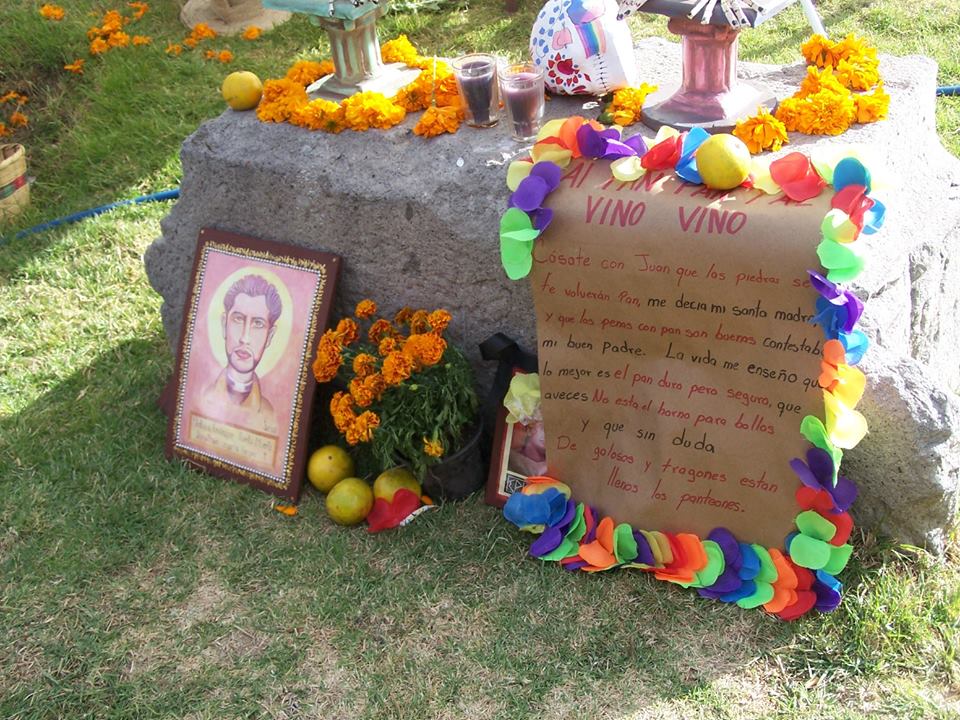
WORSHIPERS of Antinous in Mexico City today solemnly commemorate the anniversary of the horrific murder of the first martyr saint of Antinous in Mexico: Jorge Fernandez Martínez, a victim of homophobic violence.

He was brutally murdered by unknown assailants near his home in the Mexico City suburb of Tultitlán on 3 March 2016.

Forensic tests showed he had been tortured, raped and asphyxiated. His broken body lay undiscovered for days.

Grieving neighbors who had known and loved him for nearly 20 years held a wake and asked for dignified funeral services conducted under the auspices of Epithimia Antinous with Pride Tultitlán Committee and Estamos Contigo.

The rites were held at the famous Shrine of Santa Muerte (Our Lady of Sacred Death) in Tultítlan led by Enriqueta Vargas.

Our sister group Epithimia Antinous at the TEMPLO DE ANTÍNOO MÉXÍCO holds an annual vigil for him during ceremonies at the sanctuary of Santa Muerte in Tultitlán near Mexico City.

Carlos Oseguera Loraca, head of the Templo, says:

Today we commemorate the anniversary of the death of our brother in Antínoo Jorge Fernández Martínez, First Saint of Antínoo in Mexico, victim of homophobic violence in the Municipality of Tultitlán, State of Mexico. 

We also thank the Eclesiae Antinoi for having remember him on this date through the International Blog of Antinous the Gay God.

And we thank our brothers throughout the world who have raised their prayers for their eternal rest at the side of Antinous the God Gay. 

Praised be the gods because there will be justice in this life or in the other, for the crimes of hatred against our community! And let's say together with FLAMEN ANTONIUS SUBIA:

"When Antinous died, he passed into the realm of the dead where he met with our Lord Osiris and they became one God. A single God to rule the Underworld, travel through the chambers of darkness, cross the rivers of blood, cross the lakes of fire, where the light of his beautiful heart shines like a beacon. All the souls of gays, lesbians and trans will be reunited to give them a safe exit from the kingdom of shadows. He will welcome you all in his Million Year Barque. Not a single soul will be left behind forgotten and without love. Everyone will find a place of love and peace by their side. Let us raise our voices of praise, always in this way, from now on, until the end of time ... "!

Ave Antinoo!

Saturday, March 2, 2019

DANIEL ZAMUDIO
SAINT OF ANTINOUS


WE honor Daniel Zamudio as a blessed and beloved Saint of Antinous.

Through his horrific death in Santiago de Chile at the hands of Nazi thugs, Daniel Zamudio spawned outrage throughout the Spanish-speaking world which forced politicians in Chile to enact anti-discrimation laws.

On the morning of March 3, 2012, 24-year-old Daniel Zamudio was admitted to Santiago's Posta Central Hospital with severe cranio-cerebral trauma, cranial haemorrhage, multiple cuts and contusions on the face, thorax and limbs, aspiration pneumonia and a compound fracture of tibia and fibula of his right leg.

Daniel Zamudio had been tortured for nearly six hours by four youths allegedly belonging to neo-Nazi groups, who assaulted him simply because he is gay.


In his statement, one of the suspects, Raúl López, said they "kicked and punched (Zamudio) in the head, on the face, in the testicles, on his legs, all over his body." Then they carved three swastikas on him with the jagged glass of a pisco bottle that, minutes earlier, they had broken on his head.

Zamudio, a clothing store salesman, was attacked in a park in Santiago by thugs who singled him out because he was gay.

The second of four brothers, he had hoped to study theater, his brother Diego said. "He was very loving, an excellent person and that's why it's so hard to believe that they attacked him with such hate," he said.

Antinous is the God of ALL people who have suffered and been martyred for being gay. Daniel Zamudio is in the embrace of Antinous the Gay God.

Friday, March 1, 2019

RACY ROMAN SOLDIERS' GRAFFITI
TO BE IMMORTALIZED IN 3-D


RACY graffiti found at an ancient quarry near Hadrian's Wall in northern England is going to be immortalized in 3-D for future generations.

Archaeologists from the Britain's Newcastle University and Historic England are working to record the unique inscriptions carved into the walls of the quarry, which provided stone for Hadrian's Wall.


The sandstone inscriptions include a caricature of an officer and a "fascinus" phallus, which denoted good luck in Roman culture.

Other carvings at the quarry in Gelt Forest have helped experts date the rare inscriptions.

One inscription, for example, describes 'APRO ET MAXIMO CONSVLIBVS OFICINA MERCATI,' a reference to the consulate of Aper and Maximus. 

This dates the inscription to 207 AD, a time when Hadrian’s Wall was undergoing a major renovation, according to Historic England.

"These inscriptions at Gelt Forest are probably the most important on the Hadrian’s Wall frontier," said Mike Collins, Historic England's inspector of ancient monuments for Hadrian's Wall.


"They provide insight into the organization of the vast construction project that Hadrian's Wall was, as well as some very human and personal touches, such as the caricature of their commanding officer inscribed by one group of soldiers."

While continued erosion has made it so you still can’t visit the area in person, a joint campaign between Historic England and Newcastle University is opening up a new way for ancient graffiti fans to take in the heritage landmark, dubbed the Written Rock of Gelt

Archaeologists are in the process of rendering an ambitious 3-D record of the rare marks that will preserve the site like never before.
After carefully scaling the quarry walls with the help of ropes and pulleys, the plan is to give the surface of the quarry a cleaning.

Then experts will use structure-from-motion photogrammetry to record the etchings, which will be made publicly available via the 3-D modeling platform Sketchfab.
The current project involves a collaboration between Historic England and Newcastle University, with help from Natural England and the landowner, Brampton Parish Council.

Archaeologists will be using ropes from above the quarry to gain access to the Roman inscriptions and will then use laser scanning to get detailed recordings. From this record, the latest computer technology will allow a three-dimensional digital model of the rock surface to be prepared, safeguarding the inscriptions for study into the future.

Once the data is recorded, the public will be able to see the inscriptions up close for the first time in nearly 40 years.

THE LEAPING PRIESTS OF MARS
DANCED THROUGH THE STREETS IN MARCH


MARCH is the month dedicated to Mars, god of war and fertility. In Rome 24 young patrician men would be chosen to act as "Salii" dancers to get March off to a martial start. 

We wonder if Antinous was allowed to be one of the Salii. But at any rate, he would have watched in awe as this ancient Roman spectacle unfolded before his eyes on March 1.

The Salii were the "leaping priests" of Mars in Ancient Rome introduced by King Numa Pompilius: twelve pairs of patrician youths, dressed in outfits worn by archaic warriors. 

They wore an embroidered tunic, a breastplate, a red cloak (paludamentum), a sword, and a spiked headdress called an apex.

They carried the 12 bronze ancilia (shields).

These shields resembled a figure-of-eight, like Mycenaean shields.

One of the shields was said to have fallen from heaven in the reign of King Numa, and eleven copies were made to protect the identity of the sacred shield, on the advice of the nymph Egeria, 'consort' of Numa, who prophesied that wherever that shield was preserved the people would be the dominant people of the earth.

On March 1 they would lead a procession through the city, singing, dancing and leaping high in the air as they clashed their swords or spears against their shields.

At night the Salii would congregate in the temple and feast in honour of Mars. Emperor Claudius is said to have left his own banquet and gone to join them as their food and wine was better than his own.