Showing posts with label oxyrhynchus. Show all posts

Friday, December 27, 2024

HADRIAN AT THE CITY NAMED FOR THE FISH
THAT DEVOURED THE PHALLUS OF OSIRIS


AFTER the death of Antinous in October 130 AD, grief-stricken Hadrian continued his journey up the Nile to Upper Egypt.


Hadrian returned downstream a few weeks later, stopping at Antinoopolis to review the progress of the new city. During a nocturnal ceremony the mummified body of Antinous was brought into the new temple called the Antinoeon still under construction and the ceremony known as the Opening of the Mouth was performed.


The immortal spirit of Antinous was enabled to receive the offerings left by worshippers in his temples everywhere in the world.  The body of Antinous was returned to his boat-shaped coffin and carried onto the ship for return to Rome.


Hadrian arrived at the city of Oxyrhynchus, about halfway to Alexandria. The city was located on a canal that flows from the Nile to lake Moeris in the East.


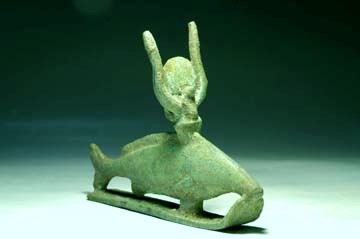
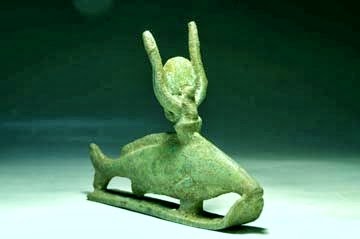
The city may have originally been dedicated to Seth as it was the gateway to the desert Oases, but was later dedicated to Osiris because after his dismemberment, this where the penis of Osiris was eaten by a fish and was the only part of his body not recovered by Isis, who then created a magical phallus to take its place.


The elephant-nosed fish is called Oxyrhynchus or sharp-nosed by the Greeks and is the sacred animal of the city.  During the Ptolemaic era it was home to a large population of Greeks and was the third largest city in Egypt.


Thousands of papyrus fragments were unearthed on the site, including many important documents about Antinous and the citizens of Antinoopolis, such the Diocletian poem, the cult calendar, Aurelius Horion named as the convener of the Antinous games and the fragments of the Lion Hunt by Pancrates.


Hadrian's arrival was greeted with celebration by the Greek population, many of whom would soon become the first citizens of Antinoopolis.  In the year 205CE renovation work was ordered to restore the Baths, or Hadrianon Thermon which were built during Hadrian’s visit, among other projects.


The papyri fragments remind us of how easily knowledge can be lost, and so we remember the city of Oxyrhynchus, where the sharp-nosed fish consumed the sacred phallus of Osiris, because it was here that so many of our Antinous documents were found, where a temple of Antinous once stood and where his sacred games were celebrated. 


AVE ANTINOUS


Tuesday, March 29, 2022

HADRIAN AT THE CITY NAMED FOR THE FISH
THAT DEVOURED THE PHALLUS OF OSIRIS


AFTER the death of Antinous in October 130 AD, grief-stricken Hadrian continued his journey up the Nile to Upper Egypt.


Hadrian returned downstream upon the Nile in the Spring of 131 AD, stopping at Antinoopolis to review the progress of the new city.


During a nocturnal ceremony the mummified body of Antinous was brought into the new temple called the Antinoeon still under construction and the ceremony known as the Opening of the Mouth was performed.


The immortal spirit of Antinous was enabled to receive the offerings left by worshippers in his temples everywhere in the world.  The body of Antinous was returned to his boat-shaped coffin and carried onto the ship for return to Rome.


Hadrian arrived at the city of Oxyrhynchus, about halfway to Alexandria, at about the March Equinox. The city was located on a canal that flows from the Nile to lake Moeris in the East.


The city may have originally been dedicated to Seth as it was the gateway to the desert Oases, but was later dedicated to Osiris because after his dismemberment, this where the penis of Osiris was eaten by a fish and was the only part of his body not recovered by Isis, who then created a magical phallus to take its place.


The elephant-nosed fish is called Oxyrhynchus or sharp-nosed by the Greeks and is the sacred animal of the city.  During the Ptolemaic era it was home to a large population of Greeks and was the third largest city in Egypt.


Thousands of papyrus fragments were unearthed on the site, including many important documents about Antinous and the citizens of Antinoopolis, such the Diocletian poem, the cult calendar, Aurelius Horion named as the convener of the Antinous games and the fragments of the Lion Hunt by Pancrates.


Hadrian's arrival was greeted with celebration by the Greek population, many of whom would soon become the first citizens of Antinoopolis.  In the year 205CE renovation work was ordered to restore the Baths, or Hadrianon Thermon which were built during Hadrian’s visit, among other projects.


The papyri fragments remind us of how easily knowledge can be lost, and so we remember the city of Oxyrhynchus, where the sharp-nosed fish consumed the sacred phallus of Osiris, because it was here that so many of our Antinous documents were found, where a temple of Antinous once stood and where his sacred games were celebrated. 


AVE ANTINOUS


Saturday, March 19, 2022

ANTINOUS AT A CITY NAMED FOR THE FISH
THAT DEVOURED THE PHALLUS OF OSIRIS


OXYRHYNCHUS in Upper Egypt was well-known in ancient times, but it is even better known today among scholars because of bits of crumbling papyrus which give us important written history.

This city, also spelled Oxyrhynchos, named for an infamous pointy-nosed fish, was one of the last places Antinous saw during the ill-fated journey up the Nile in October of the year 130 AD. 


The Egyptians had many stories about the Passion of Isis and Osiris. 

Oddly enough, there is no one single version of the story from start to finish, only bits and pieces of the story from many sources, many of them totally contradicting other versions.

In one version, it was said that Seth had murdered and mutilated his brother Osiris and had strewn the bodily parts up and down the Nile Valley. 


Grief-stricken Isis set out to find every piece so that she could use magical spells to bring Osiris back to life. With the help of Thoth, she extorted that Sacred Magic from Ra after having poisoned him (but that's another story). 

It was said that she recovered every single part of his body except for his penis, which had been swallowed by the phallic-shaped oxyrhynchus fish.

To this day, Egyptians avoid eating the oxyrhynchus fish because it is considered "unclean."

Isis was forced to create a magical phallus instead, by which she mated with Osiris and brought him to orgasm. The issue from that union was the god Horus.

What must Antinous have thought as his Egyptian guides told him these strange tales of murder, dismemberment and penile penetration? 


There were many other versions. One involved a cedar tree in Lebanon which had grown up around the corpse of Osiris. Another involved the scorpion goddess Selket and six of her stinging sisters guarding the baby Horus, who (in this version) had been born prior to his father's death. 

Who could make sense of these ancient and contradictory tales, each of which the Egyptian priests insisted was true in some way or other? Perhaps there is a version of the story, complete from start to finish, which could resolve all the contradictions. If so, it may have been written on some piece of papyrus found at Oxyrhynchus which has not yet been deciphered.

Against this mythological backdrop, Antinous entered the city of Oxyrhynchus, a Greek city founded by the Ptolemies, that has since become famous for the thousands of papyrus fragments unearthed in its buried libraries.

Flamen Antonius Subia explains the special importance of the imperial visit:

The people of Oxyrhynchus were highly literate and therefore made a welcome stop for the Greek-loving emperor Hadrian.

The visit of Antinous to this city is important because several fragments mention his name, and the sacred poem of the LION HUNT was found here.

We are reminded by Oxyrhynchus of the fragile nature of the written word and how easily knowledge can be lost, and therefore, we sanctify the memory of the city to the importance that these fragments confer about our God Antinous. The Goddess of Oxyrhynchus is Athena-Sophia, patroness of learning.

Saturday, October 20, 2018

ANTINOUS AT A CITY NAMED FOR THE FISH
THAT DEVOURED THE PHALLUS OF OSIRIS


OXYRHYNCHUS in Upper Egypt was well-known in ancient times, but it is even better known today among scholars because of bits of crumbling papyrus which give us important written history.

This city, also spelled Oxyrhynchos, named for an infamous pointy-nosed fish, was one of the last places Antinous saw during the ill-fated journey up the Nile in October of the year 130 AD. 


The Egyptians had many stories about the Passion of Isis and Osiris. 

Oddly enough, there is no one single version of the story from start to finish, only bits and pieces of the story from many sources, many of them totally contradicting other versions.

In one version, it was said that Seth had murdered and mutilated his brother Osiris and had strewn the bodily parts up and down the Nile Valley. 


Grief-stricken Isis set out to find every piece so that she could use magical spells to bring Osiris back to life. With the help of Thoth, she extorted that Sacred Magic from Ra after having poisoned him (but that's another story). 

It was said that she recovered every single part of his body except for his penis, which had been swallowed by the phallic-shaped oxyrhynchus fish.

To this day, Egyptians avoid eating the oxyrhynchus fish because it is considered "unclean."

Isis was forced to create a magical phallus instead, by which she mated with Osiris and brought him to orgasm. The issue from that union was the god Horus.

What must Antinous have thought as his Egyptian guides told him these strange tales of murder, dismemberment and penile penetration? 


There were many other versions. One involved a cedar tree in Lebanon which had grown up around the corpse of Osiris. Another involved the scorpion goddess Selket and six of her stinging sisters guarding the baby Horus, who (in this version) had been born prior to his father's death. 

Who could make sense of these ancient and contradictory tales, each of which the Egyptian priests insisted was true in some way or other? Perhaps there is a version of the story, complete from start to finish, which could resolve all the contradictions. If so, it may have been written on some piece of papyrus found at Oxyrhynchus which has not yet been deciphered.

Against this mythological backdrop, Antinous entered the city of Oxyrhynchus, a Greek city founded by the Ptolemies, that has since become famous for the thousands of papyrus fragments unearthed in its buried libraries.

Flamen Antonyus Subia explains the special importance of the imperial visit:

The people of Oxyrhynchus were highly literate and therefore made a welcome stop for the Greek-loving emperor Hadrian.

The visit of Antinous to this city is important because several fragments mention his name, and the sacred poem of the LION HUNT was found here.

We are reminded by Oxyrhynchus of the fragile nature of the written word and how easily knowledge can be lost, and therefore, we sanctify the memory of the city to the importance that these fragments confer about our God Antinous. The Goddess of Oxyrhynchus is Athena-Sophia, patroness of learning.

Sunday, October 9, 2016

BOYS IN ANTINOOPOLIS EGYPT
HAD SPECIAL PRIVILEGES IN ROMAN TIMES


IN Roman Egypt, 14-year-old boys were enrolled in a youth organization in order to learn to be good citizens, according to a new study into a field that has never properly been studied until now … boyhood in Roman-ruled Egypt.

The researchers from the University of Oslo and Britain's University of Newcastle, have unearthed papyrus documents from the 5th Century AD from OXYRHYNCHUS Egypt. 

(Image: Head of a 2nd Century AD Roman-era boy with Egyptian-style "Sidelock of Horus" in Oslo Museum of Cultural History)

The documents shed new light into boyhood in Egypt in the heyday of Antinoopolis, which was located only a short distance from Oxyrhynchus (also spelled Oxyrhynchos).

Only boys born to free-born citizens were entitled to be members of the town's youth organization, which was called a "gymnasium." These boys were the children of local Egyptians, Greeks and Romans. 

Their families would necessarily have been quite prosperous, and have had an income that placed them in the "12 drachma tax class." 

It is uncertain how large a proportion of the population would have qualified, probably somewhere between 10 and 25 per cent, says social historian and historian of ideas Ville Vuolanto.

Girls were not enrolled as members of the gymnasium, but are often mentioned in the administrative documents as being the boys' siblings. This may have had to do with family status or tax class. Both girls and women could own property, but in principle they had to have a male guardian.


For boys from well-off families of the free-born citizen class, the transition to adult life started with enrollment in the 'gymnasium'.

Other boys started working before reaching their teens, and might serve an apprenticeship of two to four years. 

(Illustration by Roger Payne)

The researchers have found about 20 apprenticeship contracts in Oxyrhynchus, most of them relating to the weaving industry since Oxyrhynchus was a major weaving center in Egypt. 

Males were not reckoned to be fully adults until they married in their early twenties.

Slave children could also become apprentices, and their contracts were of the same type as for the boys of free-born citizens. Slaves lived either with their owners or in the same house as their master, while free-born children generally lived with their parents.

But life was different for slave children nonetheless. Vuolanto says they have found documents to show that children as young as two were sold and separated from their parents.

(Image: Boys learning to write)

In one letter, a man encourages his brother to sell the youngest slave children, and some wine ... whereas his nephews should be spoiled. He writes "…I am sending you some melon seeds and two bundles of old clothes, which you can share with your children."

Little is known about the lives of children until they turn up in official documents, which is usually not before they are in their early teens. 

It seems that children began doing light work between the ages of seven and nine. Typically, they might have been set to work as goatherds or to collect wood or dry animal dung for fuel.

There were probably a good number of children who did not live with their biological parents, because the mortality rate was high.

"It's like putting together a jigsaw puzzle. By examining papyri, pottery fragments with writing on, toys and other objects, we are trying to form a picture of how children lived in Roman Egypt," explains Vuolanto.

The documents originate from Oxyrhynchus in Egypt, which was a large town of more than 25,000 inhabitants. 

(Image: Mummy-face portrait of a young boy from Antinoopolis)

Oxyrhynchus was so important that Antinous and Hadrian visited the city only a few days before Antinous died in the Nile in 130 AD.

The city had Egypt's most important weaving industry, and was also the Roman administrative centre for the area.

Researchers possess a great deal of documentation precisely from this area because archaeologists digging one hundred years ago discovered thousands of papyri in what had once been the city's rubbish dumps.

Wednesday, November 18, 2015

NEW STUDY SHEDS LIGHT ON BOYHOOD
IN ROMAN-ERA EGYPT NEAR ANTINOOPOLIS


IN Roman Egypt, 14-year-old boys were enrolled in a youth organization in order to learn to be good citizens, according to a new study into a field that has never properly been studied until now … boyhood in Roman-ruled Egypt.

The researchers from the University of Oslo and Britain's University of Newcastle, have unearthed papyrus documents from the 5th Century AD from OXYRHYNCHUS Egypt. 

(Image: Head of a 2nd Century AD Roman-era boy with Egyptian-style "Sidelock of Horus" in Oslo Museum of Cultural History)

The documents shed new light into boyhood in Egypt in the heyday of Antinoopolis, which was located only a short distance from Oxyrhynchus (also spelled Oxyrhynchos).

Only boys born to free-born citizens were entitled to be members of the town's youth organization, which was called a "gymnasium." These boys were the children of local Egyptians, Greeks and Romans. 

Their families would necessarily have been quite prosperous, and have had an income that placed them in the "12 drachma tax class." 

It is uncertain how large a proportion of the population would have qualified, probably somewhere between 10 and 25 per cent, says social historian and historian of ideas Ville Vuolanto.

Girls were not enrolled as members of the gymnasium, but are often mentioned in the administrative documents as being the boys' siblings. This may have had to do with family status or tax class. Both girls and women could own property, but in principle they had to have a male guardian.


For boys from well-off families of the free-born citizen class, the transition to adult life started with enrollment in the 'gymnasium'.

Other boys started working before reaching their teens, and might serve an apprenticeship of two to four years. 

(Illustration by Roger Payne)

The researchers have found about 20 apprenticeship contracts in Oxyrhynchus, most of them relating to the weaving industry since Oxyrhynchus was a major weaving center in Egypt. 

Males were not reckoned to be fully adults until they married in their early twenties.

Slave children could also become apprentices, and their contracts were of the same type as for the boys of free-born citizens. Slaves lived either with their owners or in the same house as their master, while free-born children generally lived with their parents.

But life was different for slave children nonetheless. Vuolanto says they have found documents to show that children as young as two were sold and separated from their parents.

(Image: Boys learning to write)

In one letter, a man encourages his brother to sell the youngest slave children, and some wine ... whereas his nephews should be spoiled. He writes "…I am sending you some melon seeds and two bundles of old clothes, which you can share with your children."

Little is known about the lives of children until they turn up in official documents, which is usually not before they are in their early teens. 

It seems that children began doing light work between the ages of seven and nine. Typically, they might have been set to work as goatherds or to collect wood or dry animal dung for fuel.

There were probably a good number of children who did not live with their biological parents, because the mortality rate was high.

"It's like putting together a jigsaw puzzle. By examining papyri, pottery fragments with writing on, toys and other objects, we are trying to form a picture of how children lived in Roman Egypt," explains Vuolanto.

The documents originate from Oxyrhynchus in Egypt, which was a large town of more than 25,000 inhabitants. 

(Image: Mummy-face portrait of a young boy from Antinoopolis)

Oxyrhynchus was so important that Antinous and Hadrian visited the city only a few days before Antinous died in the Nile in 130 AD.

The city had Egypt's most important weaving industry, and was also the Roman administrative centre for the area.

Researchers possess a great deal of documentation precisely from this area because archaeologists digging one hundred years ago discovered thousands of papyri in what had once been the city's rubbish dumps.

Saturday, November 8, 2014

NEW STUDY SHEDS LIGHT ON BOYHOOD
IN ROMAN-ERA EGYPT NEAR ANTINOOPOLIS


IN Roman Egypt, 14-year-old boys were enrolled in a youth organization in order to learn to be good citizens, according to a new study into a field that has never properly been studied until now … boyhood in Roman-ruled Egypt.

The researchers from the University of Oslo and Britain's University of Newcastle, have unearthed papyrus documents from the 5th Century AD from OXYRHYNCHUS Egypt. 

(Image: Head of a 2nd Century AD Roman-era boy with Egyptian-style "Sidelock of Horus" in Oslo Museum of Cultural History)

The documents shed new light into boyhood in Egypt in the heyday of Antinoopolis, which was located only a short distance from Oxyrhynchus (also spelled Oxyrhynchos).

Only boys born to free-born citizens were entitled to be members of the town's youth organization, which was called a "gymnasium." These boys were the children of local Egyptians, Greeks and Romans. 

Their families would necessarily have been quite prosperous, and have had an income that placed them in the "12 drachma tax class." 

It is uncertain how large a proportion of the population would have qualified, probably somewhere between 10 and 25 per cent, says social historian and historian of ideas Ville Vuolanto.

Girls were not enrolled as members of the gymnasium, but are often mentioned in the administrative documents as being the boys' siblings. This may have had to do with family status or tax class. Both girls and women could own property, but in principle they had to have a male guardian.


For boys from well-off families of the free-born citizen class, the transition to adult life started with enrollment in the "gymnasium."

Other boys started working before reaching their teens, and might serve an apprenticeship of two to four years. 

(Illustration by Roger Payne)

The researchers have found about 20 apprenticeship contracts in Oxyrhynchus, most of them relating to the weaving industry since Oxyrhynchus was a major weaving center in Egypt. 

Males were not reckoned to be fully adults until they married in their early twenties.

Slave children could also become apprentices, and their contracts were of the same type as for the boys of free-born citizens. Slaves lived either with their owners or in the same house as their master, while free-born children generally lived with their parents.

But life was different for slave children nonetheless. Vuolanto says they have found documents to show that children as young as two were sold and separated from their parents.

(Image: Boys learning to write)

In one letter, a man encourages his brother to sell the youngest slave children, and some wine ... whereas his nephews should be spoiled. He writes "…I am sending you some melon seeds and two bundles of old clothes, which you can share with your children."

Little is known about the lives of children until they turn up in official documents, which is usually not before they are in their early teens. 

It seems that children began doing light work between the ages of seven and nine. Typically, they might have been set to work as goatherds or to collect wood or dry animal dung for fuel.

There were probably a good number of children who did not live with their biological parents, because the mortality rate was high.

"It's like putting together a jigsaw puzzle. By examining papyri, pottery fragments with writing on, toys and other objects, we are trying to form a picture of how children lived in Roman Egypt," explains Vuolanto.

The documents originate from Oxyrhynchus in Egypt, which was a large town of more than 25,000 inhabitants. 

(Image: Mummy-face portrait of a young boy from Antinoopolis)

Oxyrhynchus was so important that Antinous and Hadrian visited the city only a few days before Antinous died in the Nile in 130 AD.

The city had Egypt's most important weaving industry, and was also the Roman administrative centre for the area. 

Researchers possess a great deal of documentation precisely from this area because archaeologists digging one hundred years ago discovered thousands of papyri in what had once been the city's rubbish dumps.

Tuesday, October 14, 2014

ANTINOUS AND THE PHOENIX AND THE FISH
THAT DEVOURED THE PHALLUS OF OSIRIS


IN mid-October we commemorate the Imperial entourage's arrival in the fabled Egyptian city of Oxyrhynchus the city named for the fish which swallowed the Phallus of Osiris.

Forgotten by everyone except Egyptologists today, Oxyrhynchus was the third-largest city in Egypt (after Alexandria and Mennefer-Memphis) when Hadrian and Antinous visited it in October of the year 130 AD — only a matter of days before Antinous drowned a few kilometers upstream from this city.

For more than 1,000 years, the inhabitants of Oxyrhynchus dumped garbage at a series of sites out in the desert sands beyond the town limits. The fact that the town was built on a canal rather than on the Nile itself was important, because this meant that the area did not flood every year with the rising of the river, as did the districts along the riverbank.

When the canals dried up, the water table fell and never rose again. The area west of the Nile has virtually no rain, so the garbage dumps of Oxyrhynchus were gradually covered with sand and were forgotten for another 1,000 years — it is that phenomenon which meant that priceless documents came down to us virtually intact.

It is of course an irony of history that the documents which came down to us were the "cast offs" and "rejects" from the libraries in Oxyrhynchus — they were the documents which were thrown out to make room for more important documents — which presumably were put to the torch by Moslems in later centuries.

Antonius Subia writes:
Antinous entered the city of Oxyrhynchus, a Greek city founded by the Ptolemies, that has since become famous for the thousands of papyrus fragments unearthed in its buried libraries.

The people of Oxyrhynchus were highly literate and therefore made a welcome stop for the Greek-loving Emperor Hadrian. The visit of Antinous to this city is important because several fragments mention his name, and the sacred poem of the SACRED LION HUNT was found here.

We are reminded by Oxyrhynchus of the fragile nature of the written word and how easily knowledge can be lost, and therefore, we sanctify the memory of the city to the importance that these fragments confer about our God Antinous. The primary Goddess of Oxyrhynchus is Athena-Sophia, patroness of learning.

There were also Greek temples to Demeter, Dionysius, Hermes, Apollo, the goddess Fortune together with Roman temples to Jupiter Capitolinus and Mars.

Apparently, the city had many public buildings, as noted in the papyrii unearthed in the region, as well as places of worship.

Though only traces remain, archaeologists have identified a theater, which could seat 11,000, a hippodrome where the traditional chariot races took place, four public baths, important because there was no running water available in private homes, a gymnasium, which was an important center of cultural life during the Hellenistic and Roman periods, and two small ports on the Bahr Yusuf canal.

It is also likely that there were military buildings, such as barracks, since the city supported a military garrison on several occasions during the Roman period — a military installation which Hadrian no doubt visited.

Hadrian would have delighted in the city's libraries and temples.

Antinous, like adolescents of all ages, no doubt was intrigued by the fact that Oxyrhynchus (Greek for "pointy snout") takes its name from a phallic-shaped fish which was worshiped by the Egyptians because it had devoured the severed penis of Osiris.

There are several versions of the myth concerning the Travails of Isis and Osiris. The Nile is a very long river, and each region seems to have had a local version of the tale of the Death and Resurrection of Osiris.

People in Oxyrhynchus told a version in which Seth, God of Chaos, murdered his brother Osiris and dismembered his body, strewing the various body parts up and down the length of the Nile.

Grieving Isis went in search of her lover's limbs, collecting them and reassembling them. 

She found every bit of him except for his penis, which had been imgested by the Oxyrhynchus fish, giving the creature a distinctly phallic shape.

To this day, some people in Egypt refuse to eat this fish, calling it unclean. Others, however, say its flesh lends potency and virility to men suffering from erectile dysfunction, or that women who eat of this fish will bear strong male children.

To search for the body parts, Isis enlisted the help of her sister Nephthys and Anubis (who is either the son of Nepththys and Seth or possibly the illegitimate son of Isis and Seth, depending on which version of the story you hear). 

Then she used magical spells over life and death (which she had tricked Ra into entrusting to Thoth, who then passed the spells on to her) and magically restored Osiris to everlasting life.

But she wanted a son to avenge Osiris, and so Isis fashioned a magical erect penis of "electron" (a gold/silver alloy of special magical properties) and transplanted it onto the loins of Osiris.

Some say she transformed herself into a hawk and mated with the magical phallus. Others say her wiles were enough to cause a spontaneous ejaculation which sent semen gushing in great arcs.

Sacred Marionettes with enormous pricks were an important part of Egyptian sacred/magical ritual Passion Plays in Oxyrhynchus. Perhaps such a play was staged for the amusement of Hadrian and Antinous. The Greek historian Herodotus describes one such play about the Passion of Isis for her beloved Osiris. Herodotus uses the Greek name Dionysus in place of Osiris.

Herodotus writes:
The rest of the festival of Dionysus is observed by the Egyptians much as it is by the Greeks, except for the dances; but in place of the phallus, they have invented the use of puppets one cubit high (two feet or 60 cms) moved by strings, the hinged male member nodding and nearly as big as the rest of the body, which are carried about the villages by women; a flute-player goes ahead, the women follow behind singing of Dionysus.

The semen with which Osiris sired Horus was no ordinary semen, of course. It was the "Semen of the First God".

Hadrian and Antinous would have heard a lot about the "Semen of the First God" during their travels through Egypt. A few days before they arrived in Oxyrhynchus, they had visited Heliopolis.

That is the town near Mennefer (Memphis/Cairo) where the Egyptian magician/priest Pancrates gave to Hadrian (or rather sold to him at an exorbitant price) a magical spell which could bind another man's affections to him forever ... when the spell was cast properly. If cast wrong, the spell would result in the death of the other man.

There was some speculation in ancient times as to whether the death of Antinous may have be related to this strange Egyptian spell. 

Whether you or I believe in the efficacy of Ancient Egyptian Spellcasting  Hadrian most certainly DID believe in magical spells (being the wise man that he was).

Let's assume Hadrian cast the spell a few days or weeks prior to the death of Antinous — well, that would certainly explain his inordinate grief at the Blessed Boy's death and his penance in declaring Antinous a god … perhaps out of a profound sense of guilt.

Historians have speculated on this point for centuries.

But back to the Phoenix of Heliopolis — the Bennu bird who "Comes into Being by Himself". Hadrian and Antinous visited Heliopolis and were no doubt shown the sacred shrine of the Bennu bird, who was said to have burst forth in a shower of radiant light from the heart of the First God.

This is the same First God who ejaculated into his own mouth to utter the words of creation at the moment of Sep Tepy, the Creation Moment. Other versions say he ejaculated in great arcs which created all the other deities and the entire universe.

Then in mid-October, a few days after visiting the Sacred Shrine of the Phoenix in Heliopolis (and acquiring that virulent bit of spellwork), Hadrian and Antinous visited Oxyrhynchus and heard of the fabled phallus of Osiris.

And a couple of weeks later, Hadrian cradled the limp body of Antinous on the shores of the Nile. The body was limp like a marionette whose strings had been cut. 

Hadrian "wept like a woman" and refused to accept oblivion for his Beloved Boy. Instead, he proclaimed Antinous a god and set about making sure that the Religion of Antinous took root and blossomed.

The OBELISK OF ANTINOUS speaks of Antinous being full of the "Semen of the First God" which is the creative force of the universe. That means Antinous can assume "any form his heart desires" since he (like Osiris) is one with the First God — and one with the Bennu Bird.

Antinous IS the Phoenix.

Monday, September 23, 2013

ANTINOOPOLIS AREA UNDER NEW THREAT
FROM RAMPAGING ISLAMIC RADICALS


EXTRA Egyptian security forces are heading to el-Minya and the Antinoopolis area after the riot-ridden nation's antiquities minister received a letter from Islamic radicals threatening to loot and burn the world-renowned Oxyrhynchus archaeological galleries.

Hadrian and Antinous OXYRHYNCHUS visited during their fateful tour of Egypt in 130 AD, just days before Antinous died at a spot on the Nile where the city of Antinoopolis was founded.

Looting has been occurring off and on for more than a year at Antinoopolis and the modern-day priests of Antinous have spear-headed an ongoing worldwide campaign to STOP THE LOOTING.

Just last month 1,200 irreplaceable exhibits were destroyed or stolen when a mob ransacked a museum at MALAWI just south of Antinoopolis.

Now, the military and police have sent additional security forces to archaeological sites and galleries in the Upper Egypt city of Minya near the ruins of Antinoopolis to help guards of the Ministry of State for Antiquities (MSA) protect the city's heritage.

The additional security personnel travelled to Minya at the request of Minister of State for Antiquities Mohamed Ibrahim, who received a letter from an unknown person threatening to set fire to archaeological galleries and to loot its treasured artefacts  at Al-Bahnasa, the modern name for Oxyrhynchus.

The galleries house a large collection of ancient Egyptian objects that were discovered at Oxyrhynchus, which is famous for its priceless library of ancient documents. 


The gallieries also house artefacts from Antinoopolis and Amarna, the fabled city of the "heretic" Pharaoh Akhenaten.

Al-Bahnasa is a few kilometers north of Antinoopolis. In ancient Egypt, its name was Pr-Medjed, derived from the name of a fish that was thought to have swallowed the severed penis of the god Osiris after his brother Seth murdered Osiris and dismembered his body.

During Greek times, it was known as Oxyrhynchus. It is considered one of Minya's largest archeological sites where more than 100,000 papyri fragments were found, most of them now at the Sackler Library in Oxford.

Ibrahim said that security measures were being tightened in every archaeological site, museums and gallery all over the country, in order to protect them from encroachment or attempts at looting during the current period of political turmoil.

Sunday, September 16, 2012

ANCIENT LOVE POEM PRAISES NERO'S WIFE


A POEM found in Upper Egypt sheds new light on the infamous wife of Emperor Nero, calling her a favorite of the gods.

The poem, written in Classical Greek, treats Poppaea Sabina, the wife of the controversial emperor, as a goddess - describing her ascending into the heavens and painting a touching portrait of the couple.

Due to the lettering style, researchers believe the poem was written around 300 AD - two hundred years after Nero's death, leaving a mystery as to why someone more than 1,400 miles from Rome would wish to write a tribute so many years later.

Nero has gone down in history as one of Rome's most cruel, depraved and megalomaniac rulers, often indulging in orgies and blamed for a devastating city fire which allowed the emperor to rebuild the city to his own tastes.

Poppaea was also criticised at the time and has gone down in history as one of the great villainesses of all time. She was portrayed with exquisite lasciviousness by Patricia Laffan in the splashy Technicolor epic Quo Vadis (photo). 

When, according to ancient records, Nero killed his first wife Octavia, Poppaea was said to have been presented with her head.

She then convinced Nero to commit matricide and was, according to the records, the real power behind the throne.

But the poem sees Poppaea in a different light, with the goddess Aphrodite welcoming her to the stars, telling her: 

My child, stop crying and hurry up: with all their heart Zeus' stars welcome you and establish you on the moon...

The poem was discovered 100 years ago - but was only recently translated.

Two excavators, Bernard Grenfell and Arthur Hunt, found hundreds of thousands of scrolls in ancient city dumps in Oxyrhynchus in Egypt.

The town had a population of around 10,000 at the time of the Romans, and the papyri contained thousands of records and details of life in the era. 

While Nero has gone down as one of history's bad guys, Hadrian has gone down as one of history's good guys. His reign (from 117 to 138 A.D.) came at the beginning of the golden age of the Roman Empire, after the excesses of earler rulers such as Tiberius, Caligula and Nero and before the decline and fall set in.