Friday, December 5, 2025

MEET SANTA'S HELPERS
KRAMPUS AND ANTINOUS/APOLLO


EVER wonder about the origin of Santa's reindeer? They echo Pan, satyrs and fauns who had their own festival in December.

December 5th and 6th is the ancient Roman feast of the Faunalia ... which ironically is still celebrated in Europe and Latin America by millions of children ... who get a visit from Santa and his horned helpers.

Millions of kiddies know that you put your shoe outside the door on the evening of December 5th and that St. Nicholas will fill it goodies on December 6th ... the Feast Day of St. Nicholas.

Children who have been good receive sweets and toys ... but children who have been naughty are punished by St. Nick's furry helpers.

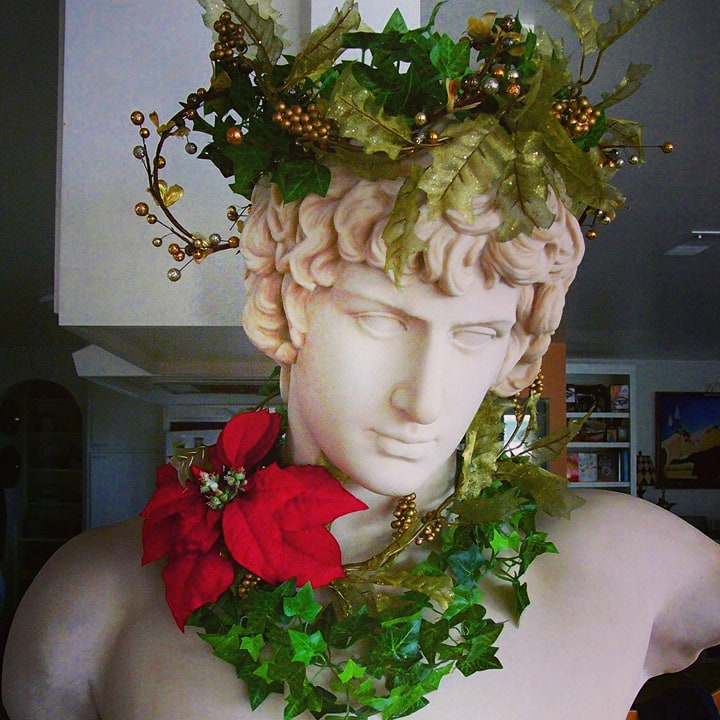
What few people realize is that old St. Nick is related to Antinous/Apollo ... and his helpers are Pan and his hordes of satyrs and fauns.

The pagan history shows that St. Nicholas is a vastly more complex being than most Christians could imagine, stemming from the Temples of Apollo and Artemis in Asia Minor (the birth country of Antinous) which would later be the birthplace of the mythical Nicholas.

The truth is that when you see a department store Santa, you are seeing only a composite being whose multitudinous composite aspects (many of them very dark and spooky) trace their origins back to the beginnings of mankind.

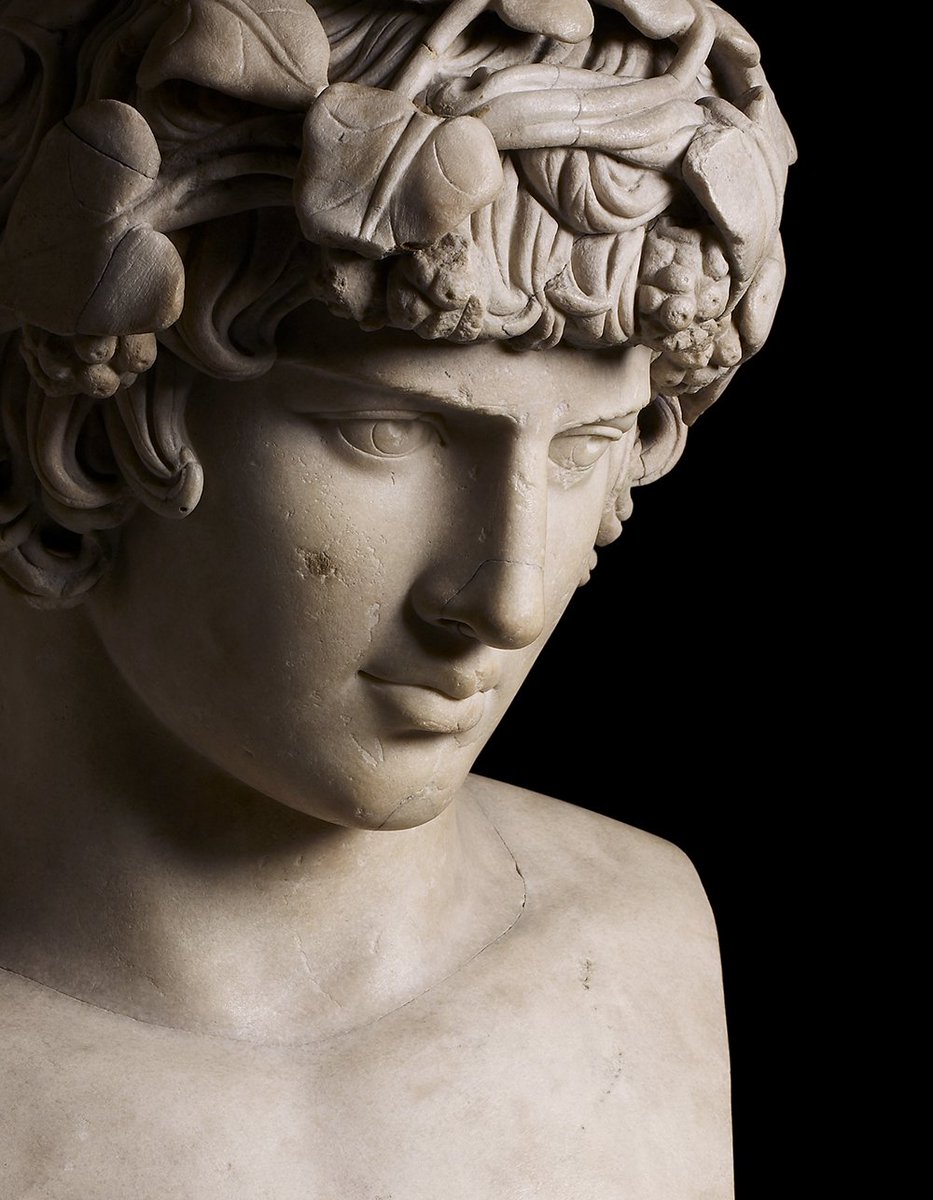
If you look very, very carefully, you will see the face of Antinous/Apollo shining through the centuries of folk customs under a variety of names including Santa, Sinter Klaas, das Christkind and Kriss Kringle.

In some parts of Central  Europe, St. Nick goes from house to house on December 6th accompanied by a coterie that includes figures resembling Pan, Apollo and Artemis (Austrian Alps photo right).

 The legend of St. Nicholas begins in the Turkish town of Patara in Asia Minor which was also the birth land of Antinous. Patara was also the birth place of Apollo and a famous oracle was located there.

Apollo's sister Artemis also had a cult center in nearby Myra, where Nicholas grew up and allegedly became a "bishop." Myra's main cult was dedicated to Artemis Eleuthera, a distinctive form of Cybele, the ancient mother-goddess of Anatolia. She had a magnificent temple in Myra.

Unfortunately, St. Nicholas was zealous in his duties as bishop and took strong measures against paganism. The temple of Artemis and the Apollo oracle were among many other temples in the region that he destroyed. It is said that the very foundations were uprooted from the ground, so complete was its destruction, "and the evil spirits fled howling before him".

St. Nicholas was never officially canonized by the Church. He simply usurped the popularity of Artemis and Apollo and promoted his own reputation for being a protector and a giver of good things.

Antinous/Apollo more or less morphed into Old St. Nick, aka Santa Claus, Father Christmas, Sinter Klaas, das Christkind and Kriss Kringle.

And in a lot of places, Santa has several dark and scary sidekicks — all related to Pan, who also originated in Asia Minor.

In the Alps, Santa's helpers take the form of a demonized Pan who chases and abducts children who have been naughty. He is called Krampus and, thanks to the Internet, Krampus is becoming widely known in English-speaking countries.

In the Nordic and English version, of course, all that is left of Krampus with his horns and hooves and fur is the reindeer which accompany Santa's sleigh. 

In Holland, St. Nick is accompanied on December 5th/6th by a Moorish youth wearing a turban and fur-trimmed costume called Svarte Piet, who delights in teasing naughty children.

In English-speaking countries, prudish Victorians stripped Santa of all his impish devilry. Santa is nice to all and punishes no one. 

In Europe, Santa's Dark Side still prowls — marches defiantly, in fact. In a way, the Anglo-American Santa Claus was lobotomized by the Victorians so that he is only docile and sweet-humoured.

But to understand the REAL Santa Claus, you have to understand his Darker Side. You have to understand where Santa is coming from, literally....

He is composite spirit being who in English-speaking countries is called St. Nicholas, Santa Claus or Father Christmas.

But the deeper you go back into the forests of Europe, the more differentiated this ancient being becomes so that you see his various  component parts — including Antinous-Apollo — all competing against each other — sometimes morphing into each other.

Thursday, December 4, 2025

A VOYAGE TO PARADISE WITH ANTINOUS
ABOARD HIS CELESTIAL BARQUE


ALL those who believe in Antinous the Gay God hold a ticket for the Barque of Millions of Years. We will all be together, making our way towards the unseen Dark Star. This is a journey to paradise with Antinous...he will circle the Sun until the last one of us has boarded..and then we will set forth away into interstellar space until we reach his unseen star...which is a gateway to other worlds beyond.

Todos aqueles que acreditam em Antinous, o Deus Gay, têm um bilhete para o Barque de Milhões de Anos. Estaremos todos juntos, fazendo o nosso caminho rumo à Estrela Negra invisível. Esta é uma viagem ao paraíso com Antinous ... ele circundará o Sol até que o último de nós tenha embarcado ... e então iremos para o espaço interestelar até chegar à sua estrela invisível ... que é uma porta de entrada para Outros mundos além.

Todos los que creen en Antinous el Dios Gay tienen un boleto para la Barca de Millones de Años. Estaremos todos juntos, haciendo nuestro camino hacia la Estrella Oscura invisible. Esto es un viaje al paraíso con Antinous ... él circundará el Sol hasta que el último de nosotros ha abordado ... y entonces partiremos lejos en el espacio interestelar hasta que alcancemos su estrella invisible ... que es una entrada a Otros mundos más allá.


~ANTONIUS SUBIA

Wednesday, December 3, 2025

NOW YOU CAN SEE THE TOMB OF OSIRIS
JUST AS ANCIENT EGYPTIAN PILGRIMS DID


THE 3rd of December is the Feast of the Going Forth of the Netjeru from Abydos (site of the Tomb of Osiris) in Egypt which we commemorate because Antinous has always been equated with Osiris as deity of transcendence over death. 

During this festival the Statue of Osiris was transported down the Nile to visit his tomb in Abydos and then returned in triumph to the temple.

This represented the triumph of Osiris over death. An effigy of Osiris was removed from his temple and processed along the Nile to the jubilation of crowds lining the river banks.

Not many people realized that there is a symbolic Tomb of Osiris which was a pilgrimage site for millions of Egyptians over the centuries.

Many Egyptians even designed their own tombs to be a REPLICA TOMB OF OSIRIS.

Just as people make pilgrimages to the Ganges, Mecca, Lourdes and other sites today, the Ancient Egyptians made pilgrimages to Abydos to make offerings.

Many pharaohs also built symbolic tombs at Abydos in addition to their actual tombs in Thebes, Memphis and elsewhere.

Now you can visit the most sacred ... and most mysterious ... temple in Egypt at night and even explore the fabled Tomb of Osiris.

Desperate to boost tourism, Egyptian authorities have improved the long-neglected Temple of Seti at Abydos ... where for thousands of years, Egyptians made pilgrimages to pay their respects to Osiris.

The Temple of Seti is now outfitted with lighting to enable visitors to see it in all its glory at night, Minister of Antiquities Mohamed Ibrahim said in a surprise announcement.

In addition, the subterranean Tomb of Osiris ... called the Osireion ... has been drained of water and cleared of reeds and waterlilies and is included in tours of Abydos, he said.

Most tourists bypass Abydos, which would be unfathomable to the Ancient Egyptians, who considered it the most Sacred City.

In a way, Abydos was the Ancient Egyptian Mecca or Lourdes ... a place where pilgrims converged for prayers and meditation and to attend the annual Passion Plays which explained the cruel death and mutilation of Osiris and the grief of Isis and the miraculous resurrection of Osiris as Egyptian god of Victory over Death and King of Eternity.

The Tomb of Osiris is a subterranean chamber fed by an underground channel from the nearby Nile, which created a moat inside the chamber. The chamber was accessed by priests via a long, dark passageway.

A mound of earth covered the tomb, symbolizing the original mound which rises out of the cosmic depths in the Egyptian creation myths. 

The mound, which is a feature of illustrations in the Egyptian Book of the Dead, is thought to be the inspiration for the first pyramids.

But that raises the controversial issue of the true age of the Tomb of Osiris, an issue hotly disputed by experts.

The Temple of Abydos was begun by Pharaoh Seti, but completed by his son Rameses the Great after his father died befored it was finished. It features exquisite reliefs in amazingly bright colors. 

Most importantly, from the viewpoint of Egyptologists, one entire wall along a long passage provides a list of all Egyptian pharaohs from the beginning of their history in chronological order.

The temple was largely neglected until the 1950s when a self-taught English Egyptologist named DOROTHY EADY helped with restoration efforts. 

Using insights she claimed to have gleaned from a past life incarnation as a priestess at Abydos, she led archaeologists with uncanny accuracy to the location of such things as the temple library.

She became official Keeper of Abydos and was instrumental in piecing together fragments of bas relief stones ... so that Abydos is now one of the most completely restored Egyptian temples. 

Many books and films have been made about her. Witty and full of life, she loved to regale visitors with tales of her past life.

She brazenly observed ancient rituals at the temple to the astonishment of her Islamic neighbors ... she lived at Abydos year-round for decades.

With her winning smile and encyclopedic knowledge, she won the respect of scholars.

Dorothy Eady, affectionately called Omm Sety by her friends and neighbors, never returned to England, dying in old age at her beloved Abydos.

The Osireion (also spelled Osirion or Osireon) is outside of the temple, behind it. It was discovered by Flinders Petrie and Margaret Murray by chance in 1902. For more than a century, experts have argued over the age of the Osireion. 

Some experts insist it was built in the 19th Dynasty by Seti or Rameses, making it 3,300 years old. 

But others point out that the stone work is similar to the Sphinx Temple at Giza ... which would make it at least 4,500 years old.

The Osireion draws New Age pilgrims who flock to the site in the footsteps of the Egyptians of ages past. 

But the derelict state of the Osireion meant that visitors had to stumble across rocks and sand dunes and then climb down a steep ramp to a veritable swamp overgrown with bullrushes and waterlilies.

In this photo, the reeds have been cleared, but often it is totally overgrown.

Priest Hernestus has vivid memories of leaving his tour group and heading off alone ... finally finding the Osireion ... descending the rickety and slippery ramp ... and being confronted by a toothless Egyptian man who popped out of the reeds, brackish water up to his hips, brandishing a machete.

Hernestus thought, "Well, what better place to die than the Tomb of Osiris?" But it turned out the man was trying to clear some of the undergrowth and only wanted baksheesh (pocket money) to help feed his family.

Nonetheless, the Osireion is one of the eeriest and most mysterious places on Earth ... and you will now be able to pay a proper pilgrimage to it ... as the Ancient Egyptians did.

Tuesday, December 2, 2025

MARQUIS de SADE
SAINT OF ANTINOUS


ON December 2nd, the Religion of Antinous honors the Marquis de Sade for being the first person since ancient times to proclaim publicly his adoration of the beauty of Antinous.

The Marquis de Sade was himself probably what we would nowadays call ambi-sexual. At any rate, homosexual activity is an important item in his program of revolutionary sexual libertinism.

The Comte Donatien-Alphonse-François de Sade, more often called the Marquis de Sade, lent his name to the complex psycho-sexual phenomenon of "sadism" ... that is, the derivation of pleasure from cruelty through inflicting physical pain, mental suffering, or both.

To this day, "sadism" (which was named for him) is a provocative term which turns off conventional-minded people ... and turns on those other people who are into Fetish, BDSM and the many other related fields of sexual endeavour.

Yet there is more to Sade's writings than sadism -- the term coined by Krafft-Ebing in his "Psychopathia Sexualis" (1876). For running  throughout the Sadean oeuvre of plays, stories, essays, novellas, and letters ... and often overlapping with the most calculated outrages of his obscene novels ... is a philosophical discourse on freedom, power, evil and desire.


Donatien Alphonse Francois de Sade was born June 2, 1740, in Paris, France. The Marquis grew up in the decadent excesses of pre-revolution France's aristocracy.

Sade's father, for instance, was arrested while "cruising" the Tuileries Gardens for male hustlers. Throughout most of his life, the Marquis pursued bizarre forms of sexual gratification, he was arrested for his excesses numerous times and spent several periods of time imprisoned.

In 1772, he was sentenced to death as a "sodomite." Though the sentence was lifted in 1776, he was imprisoned for many years. Early in July 1789, as mobs rallied for the revolution, he screamed to the masses from his cell window in the Bastille, telling them that the prisoners were being slaughtered by the guards on orders of the aristocracy. 

The mob subsequently freed him, but the cloud of immorality never lifted and he died broken in mind and body.

And yet it was his imprisonment which resulted in his literary legacy. While serving that sentence in the Bastille, he began to turn his extreme imagination towards writing books and plays, which are a summit of erotic poetry.


It is from these works that the word Sadism is derived because the philosophy of sexual violence and domination was delineated and demonstrated for the first time by the Marquis in his numerous and detailed catalogues of perversions.

One of these works, entitled "The 120 Days of Sodom" was written  while in the Bastille. When the prison was stormed during the French Revolution, many of the works of the Marquis de Sade were lost, including this work. It was miraculously rediscovered in 1904, rolled up in the frame of a bed, and subsequently published.

We consecrate the memory of the Marquis de Sade because he was a sexual revolutionary, who spoke quite openly about homosexuality, and who freely acknowledged that his valet Latour was his personal sodomizer.

And he was among the first to take up the name of Antinous for beauty and homoerotic purposes, naming one of the characters in "The 120 Days of Sodom" after Antinous, describing him in this way:

"Antinous: so named because, like Hadrian's favorite, he had, together with the world's loveliest prick, its most voluptuous ass, and that is exceedingly rare. Antinous wielded a device measuring eight inches in circumference and twelve in length. He was thirty and had a face worthy of his other features."

The Marquis de Sade died December 2, 1814, in Charenton Insane Asylum.

Monday, December 1, 2025

THE NEW STAR OF ANTINOUS


ON December 1st we remember the day in 1999 when a New Star was discovered in the Constellation of Antinous ... a celestial portent for the rebirth of the religion of Antinous in the 21st Century.

It reminded us of that dark night 1,800 years ago when grief-stricken Hadrian looked up into the heavens with tearful eyes and saw a new star in what had until then been the Constellation of Ganymede.

Hadrian proclaimed it the STAR OF ANTINOUS and renamed the constellation after Antinous. 


Flamen Antonius Subia sees parallels to the new discovery which coincides with the re-establishment of the Religion of Antinous for the new Millennium and writes:

"In 1999 on December 1st, a Super Nova was discovered in the constellation Aquila, visible with the naked eye. It was confirmation that the ancient celestial event criticized by Dio Cassius as a lie might indeed have occurred, prompting Hadrian to redraw the map of the constellations and include Antinous among the immortal heroes of antiquity. 

"This new star named by astronomers Nova Aquilae v1492 was a sign of the return of Antinous in the modern age. It was a signal to begin the reconsecration of His sacred religion. 

"The light of this new star passed over the face of the Earth, illuminating the hearts of all those who believe in him, effecting change and demonstrating those whose eyes were directed towards the heavens that the voice of Antinous was beckoning, and the time to revive his religion had finally come, after so many centuries of silence.

"With this sign from Antinous we are compelled, out of love to inflame ourselves for his sake and to spread the light of the New Star to the world."