WE are proud to consecrate French archaeologist Albert Gayet as a Messenger Saint of Antinous for his pioneering efforts to reclaim the city of Antinoopolis from the sands of oblivion.
The city that Hadrian built and dedicated to his lover Antinous flourished for hundreds of years before being looted and plundered and lost to the desert sands of Egypt.
Napoleon's French team of proto-archaeologists mapped and catalogued the remains at the turn of the 19th Century.
But it was this rather curious and eccentric French bachelor who would make the lost city ... Antinoopolis ... famous again.
Antinoopolis became renowned around the world in 1895 when Gayet began exploring the vast necropolis burial grounds south of Antinoopolis.
An estimated 40,000 mummies were buried in the Antinoé necropolis.
Between 1895 and 1911, Gayet worked tirelessly at Antinoé, the French name for the city which became synonymous with his own name.
He stood out against the squalor of the wretched modern village and the moonscape of ancient ruins ... dressed impeccably in a three-piece black linen suit and tie, with a boater hat, a cane and white gloves ... more befitting a stroll on the Champs Élysée in Paris than overseeing Egyptian workers toiling in the blistering Egyptian sun as they unearthed mummies from the sands.
Gayet's crews worked day and night unearthing hundreds of mummies representing all social classes and historical epochs.
To his utter astonishment, many of the mummies were gilded, many were swathed in priceless woolen wraps and others wore Byzantine jewellery and headdresses.
He returned to Paris, where the most exquisite mummies were put on display at the Louvre, attracting throngs of visitors and spawning a "Coptic Craze" throughout Europe and America.
Antinoopolis embroidery and linens inspired Matisse, Renoir and the leading Paris fashion designers, who incorporated the rich colors and designs into their work.
But the craze soon waned. The mummies were packed away in storage, most of them to disintegrate or become lost.
Gayet died in Paris at age 60, impoverished and embittered after having spent 20 years of his life trying to raise funds for further exploration of Antinoopolis.
Unmarried, he bequeathed a number of Antinoopolis artefacts which he had kept for himself to his sister in Dijon, where the artefacts are in the local museum and a street is named after him.
Gayet's dream of a "Musee d'Antinoé" in Paris died with him.
Wednesday, September 17, 2025
FRENCH EGYPTOLOGIST ALBERT GAYET
IS A SAINT OF ANTINOUS
Tuesday, September 16, 2025
ACACIA TREE
BY STEPHANOS KILGORE
SACRED KNIGHT OF ANTINOUS
Monday, September 15, 2025
HADRIAN's VILLA COMES TO LIFE
FOR ANTONIUS SUBIA
FOR ANTONIUS SUBIA
HADRIAN must have delighted in forcing Patrician Romans to make the 20-mile (30 km) trek to his Tibur Villa in the rugged hill country east of Rome.
Perhaps the surroundings reminded him of his native Hispania. Perhaps he just despised Rome and its snooty residents because he had been taunted as a youth for his "Hispanic" accent and provincial manners.
Whatever the reason, he spent most of his reign as emperor far away from Rome, traveling to the far-flung corners of his realm.
And when he wasn't traveling, he resided at his Villa, far removed from the city he abhorred. Anyone who wanted to see him was forced to make the journey over hill and dale out to Tibur. In the days of the "letica" or litter chair, it was an uncomfortable and wearying ordeal.
And it still is, even in these days of rapid transit and buses.
"He must have enjoyed making them come all the way out here," Flamen ANTONIUS SUBIA told Priest Hernestus as they waited for one of the notorious overcrowded and unairconditioned "Blue Buses" that ferry passengers from a suburban commuter rail station out to Tivoli ... and then walking a couple of miles along dusty roads to the imperial compound.
Arriving hot and weary, you then ascend a steepish incline to the walls of the Villa itself before finally arriving, out of breath, at the top of a small hill surrounded by magnificent pines, cypress and olive trees.
It is then that you realize what Hadrian loved about this place. A cool breeze wafts across the hilltop, carrying with it the scent of pine, cedar and wild roses and other flowering plants.
Antonius had never been to Hadrian's Villa until his Sacred Pilgrimage, but he knows the layout of the compound by heart, having studied its floor plans and schematic drawings for years.
"So people would arrive here," Antonius said, pointing to the entry portals only a few meters from the enormous bath complex.
"And they would immediately be invited into the baths to freshen up before being admitted into the presence of the Emperor."
Even in a ruinous state, the baths are breathtakingly enormous, towering the equivalent of six stories overhead.
The private quarters are less easily discerned today, though Antonyus marched through them as if he had always been at home there.
"Just imagine, this is where Hadrian slept," he said in awe.
"And where do you suppose Antinous had his quarters? He must have had separate quarters of his own," Hernestus wondered.
"Somewhere with a nice view, no doubt," Antonius speculated.
The Canopus area of the compound is still stunning even today. At the end of a long pool flanked by Greco-Egyptian style statuary is a seashell motif alcove.
"This is where they dined," Antonius said with a sweep of his hand around the curved base of the alcove, "on dining couches all along here."
Very few tourists were there the day Antonius visited the Villa, just one group from a charter bus and a few hardy souls who had made the rather harrowing trip on a careening and over-crowded public bus and the trek on foot from the bus stop.
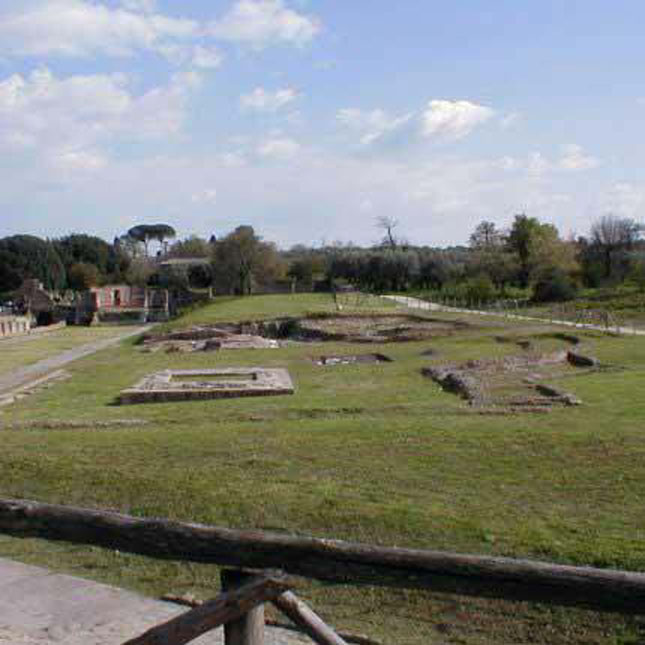
No one was paying any attention to what appeared to be a barren field between the baths and the Canopus. There was no sign indicating that this was the very heart of Hadrian's Villa, the most sacred part of the complex.
The ANTINOEION — the Temple of Antinous.
This was where the OBELISK OF ANTINOUS originally stood. This is possibly where the Lost Tomb of Antinous is located.
The Antinoeion is adjacent to the curving entry pathway. It is the spiritual cornerstone of Hadrian's Villa.
"It was the first thing that anyone saw as they approached," Antonius said with a smile reflecting the satisfaction that Hadrian must have felt. "He made them acknowledge Antinous as a God."
Despite repeated promises by curators of the Villa to erect a sign, there is nothing to mark the sprawling temple complex which may yet conceal the Lost Tomb of Antinous.
Antonyus stood for a long time at the low fence which cordons off the area. To the other tourists, it was just a barren field with a few remnants of marble marking foundations of a few buildings and a plinth where an obelisk may have stood.
But for Antonius, this was Sacred Ground. This was where the Ancient Priests of Antinous had laid down the precepts of a beautiful new religion based on tolerance, love and beauty. This was where Hadrian himself came to commune with his Beloved.
A cool breeze wafted across the field, bringing with it the scent of late summer roses, pine and cedar and the sound of cicadas in the olive trees beyond the field, only a portion of which has been excavated in very recent years.
The rest of the weed-overgrown field is a ripple of mounds of earth. Or are these mounds actually the remains of still more structures, possible the Lost Tomb itself?
"There has to be much more buried under there," Antonius said. "There just has to be."
Click here to join Antonius on his tour of Hadrian's Villa:
Sunday, September 14, 2025
ROMAN SKELETONS BURIED HOLDING HANDS
NOW HAVE BEEN IDENTIFIED AS TWO MALES
TWO ancient Roman skeletons, who mysteriously were buried holding hands, now have been identified as two males, researchers have revealed.
In 2009, archaeologists discovered the remains in the Italian city of Modena. The pair were dubbed the "Lovers of Modena" by the media, the assumption being that they were a heterosexual couple.
The researchers at that time could not determine the gender of the skeletons when they were found in Italy in 2009 because they were badly preserved.
But a new technique, using the protein on tooth enamel, revealed their sex.
The actual relationship between the skeletons from the 4-6th Century AD remains a mystery.
The researchers say the two adult males were intentionally buried hand-in-hand.
Some of the suggestions for the link between the two skeletons are that they are siblings, cousins or soldiers who died together in battle, study author Federico Lugli told Italy's Rai news site (in Italian).
Researchers suggest that their burial site could have been a war cemetery.
The researchers from Italy's University of Bologna said in Scientific Reports that the findings had profound implications for understanding funeral practices at that time in Italy.
Saturday, September 13, 2025
ROME'S GREAT TEMPLE OF JUPITER
DEDICATED ON THIS DAY IN 509 BC
ON the 13th of September the Temple of Jupiter Optimus Maximus atop the Capitoline Hill was dedicated in 509 BC. The ascent of Rome began!
In the old Roman calendar, September was the seventh month of the year in counting March as the first. Among the festivals observed in September were several honoring Jupiter.
He was hailed as the chief of the gods and had many epithets as a result.
Friday, September 12, 2025
RUN LIKE PHEIDIPPIDES
JUST DON'T DIE LIKE PHEIDIPPIDES
Thursday, September 11, 2025
GAY MARTYRS OF TERRORISM
ON September 11th we remember those gay and lesbian men and women who have died in terrorist attacks.
The magnificent Religion of Antinous is not just about beauty and male-on-male sex and it's not just one continuous gay cocktail party. Alas!
The word "alas," by the way is a Latin corruption of the Greek name "Hylas" ... the beloved young companion of Herakles/Hercules. In Mysia, handsome young Hylas was abducted by water nymphs and vanished below the waters of a stream.
Heartbroken Herakles went mad with grief, bellowing "Hylas! Hylas!" and ripping out trees as he frantically searched for his beloved. He never abandoned his search, and his cries of "Hylas! Hylas!" continue to echo through the ages every time we say the word "alas!"
Hadrian and his beloved drowned Antinous have always been associated with Herakles and his beloved drowned Hylas. And so ... alas! ... the Religion of Antinous is profoundly and irrevocably associated with tragedy and with grief. That is the reason why the sculptures of the Beauteous Boy never show him smiling and boyish. He always gazes off to one side, his head tilted slightly downward, with a wistful and slightly melancholy expression on his face.
It's as if he is always whispering, "Alas!"
And so it is fitting that the Ecclesia Antinoi Annals of Saints and Martyrs and Exemplars includes the names of many, many people who have died under tragic circumstances.
Some died of overdoses or suicide. Others, such as the gay college student Matthew Shepard who was bludgeoned to death in Wyoming, were murdered simply because they were gay.
In Iran, coming out is tantamount to a death sentence.
Many, many others have been taken by the scourge of AIDS.
And still others on our list, Aula Sancti Ecclesiae Antinoi, have suffered and died because they just happened to be at the wrong place at the wrong time.
On September 11th we remember those gay and lesbian men and women who have died in terrorist attacks.
They include the gay waiters and pastry chefs in the Windows on the World restaurant on the 110th floor of the World Trade Center, and also the gay and lesbian office workers in the Twin Towers, and the gay passengers and crew aboard the hijacked planes.
They also include the gay victims of the subsequent bombings and atrocities in London, Madrid, Orlando and many other cities.
We don't know the names of most of those people. But one name stands out: Mark "Bear Trap" Bingham.
Mark, 31, was a passenger aboard United Airlines Flight 93 and was flying home to see his mother.
He made a phone call to his mother. He was so distracted by the chaos on board the plane that he identified himself by his full name, saying, "Hi, Mom, this is Mark Bingham."
He just had time to tell her he loved her and that his plane was being hijacked before the phone call abruptly ended.
Mark was a big man at 6 ft 4 in (1.93 m) and 225 pounds (102 kg) and was a rugged rugby athlete. He is believed to have been among the passengers who attempted to storm the cockpit to try to prevent the hijackers from using the plane to kill hundreds or thousands of additional victims.
That assumption is based on the fact that his lover of six years said he had repeatedly fought back against muggers and gay bashers and that Mark definitely would not have surrendered to his fate without first putting up a fight. "Mark was a fighter. He hated to lose ... at anything!"
Mark Bingham may never have even heard of Antinous, and the Ecclesia Antinoi had not been founded yet before he died. He most definitely never expected to be remembered as a gay martyr. And he scarcely could have imagined being memorialized in movies and on websites and in books and TV docu-dramas.
He surely never expected to become a symbol and an icon. But that is what he has become.
And so, on September 11th, we remember Mark "Bear Trap" Bingham as a symbol for all those gay people who happen to be at the wrong place at the wrong time when terrorists strike — as can happen to any of us.
Like Mark (and like Herakles, for that matter), we fight and struggle to do the best we can in our day-to-day lives, but sometimes things just turn out far differently from anything we could ever imagine. Sometimes tragically so ... Alas!