Saturday, September 7, 2024

HAPPY BIRTHDAY TO JERMAINE STEWART
WHO TAUGHT US 'THE WORD IS OUT'


Happy birthday, Jermaine Stewart, born September 7th, 1957, who was one of the first gay artists to break out of the clubs and crossover into mainstream just as the music video was being born and kids were clamoring "I want my MTV!"

Jermaine was an out and proud inspiration to gay kids at home in front of their parents' TV sets in the '80s, and to jaded gay grownups in front of theirs as well. 

He always made you smile and want to get up and push the furniture out of the way and dance.

Jermaine began his performing career as a teenager in Chicago, touring with the Chi-Lites and The Staple Singers and appearing on the "American Bandstand" and "Soul Train" TV shows, which were prototypes for all-music broadcasters.

He would go straight from school in the afternoon to the "Soul Train" studios in Chicago where the show was shown locally in black-and-white — who knew that the show would become a nationwide hit within a few years?

By the early '80s he had worked with Shalamar, Millie Jackson, Tavares, the Temptations, and Culture Club as a background vocalist and dancer.

With the help of Culture Club member Mikey Craig, he landed his first solo recording contract with Clive Davis of Arista Records (10 Records in the UK) in 1984. 

His first single, "The Word Is Out," was produced by Peter Collins and was supported by a video shot in Paris. 

The song reached number 41 in the US R&B and Billboard charts, and was followed by an album of the same name in 1985.

Although "The Word Is Out" did much to enhance Stewart's reputation, it did not prove to be the commercial success Arista had expected.

But things changed with his second album, "Frantic Romantic," which included the song that would be Stewart's biggest hit, "We Don't Have To Take Our Clothes Off." It became an international success, reaching the Billboard Top 5 and number 5 in the UK charts.

Jermaine's third album, "Say It Again," was probably his most successful internationally. He was big in the US and Britain, but he was stupendously popular in Europe and Asia. 

He was a veritable superstar in Germany , where "Don't Talk Dirty To Me" was one of the biggest selling records of 1988, making the top 5.

While other mainstream pop stars went for a mainstream look, St. Jermaine went for eye-popping glitz-and-match attire and a glamour-diva image which Asians and Europeans loved.

This was when his career peaked and began a slow but steady decline as '80s radio-friendly pop tunes fell out of favor. In the early '90s he recorded an album entitled "Set Me Free." The album marked a return to the dance funk style of his pre-fame days. The title track was released as a single in the U.S., but sold poorly. The album was never released ….

Meanwhile, his health was beginning to decline. He did however start recording a new album in 1996, but never finished it. St. Jermaine Stewart died of complications of AIDS on March 17, 1997, at the age of 39.

Ironically, his biggest hit "We Don't Have To Take Our Clothes Off," with its safe sex message, was one of the first mainstream pop responses to the AIDS crisis.

We honor Jermaine Stewart for his courage and for his talent and for his audacity at being an in-your-face '80s gay style icon. Besides, not even Diana Ross had this many costume changes in a four-minute music video:


Friday, September 6, 2024

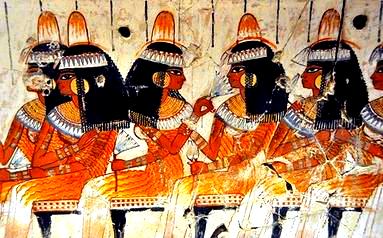
EGYPTIANS REALLY DID WEAR WAX CONES
ON THEIR HEADS, NEW FIND CONFIRMS


ANCIENT Egyptians really did wear wax cones on their heads, according to archaeologists who have found two bodies at Amarna ... a mere 20 kilometers from Antinoopolis ... which have beeswax cones on their heads.

The exact purpose of these cones is unknown, although it has been assumed they were soaked with perfume which slowly released its scent as the cones melted on the wearers' heads.


But many experts have believed the cones never truly existed ... but were only iconographic symbols on the wall murals of Egyptian tombs.

But the discovery proves the wax cones were real.

The team of archaeologists, in collaboration with the Ministry of Antiquities, analysed these head cones, which were discovered in Akhetaten (now known as El-Amarna). The cones, made of beeswax, were found in a non-royal grave.

According to team leader Anna Stevens of Monash University in Melbourne, "By melting and cleansing the hair, the cones might have ritually purified the individual, placing them in an appropriate state to participate in rituals."


While the discovery of these cones shed new light on the headwear of people in Ancient Egypt, their exact purpose is still unconfirmed, raising more questions than they answer.

Amarna was built by the pharaoh Akhenaten and occupied for only 15 years, (1347-1332 BC). 

But despite this brief existence, the city contains thousands of graves, including those of many non-elites. 

Archaeologists from the Amarna Project have been working with the Egyptian Ministry of Antiquities to investigate them, shedding light on the ordinary people of ancient Egypt.


Thursday, September 5, 2024

ROMULUS SHRINE TO JUPITER LOCATED
AT BASE OF PALATINE IN ROME


IN the old Roman calendar, September was the seventh month of the year in counting March as the first. Among the festivals observed in September were several honoring Jupiter. 

He was hailed as the chief of the gods and had many epithets as a result.

As Jupiter Optimus Maximus, he occupied the temple of Jupiter Capitolinus on the Capitoline hill with the goddesses Juno and Minerva. With them, he received a Lectisternium (September 13) and the Ludi Romani  (September 5-19). 

He was honored with festivals as Jupiter Liber and Jupiter Fulminator (September 1) and as Jupiter Stator (September 5).

Jupiter Stator is the hand of Jupiter giving Roman troops their unstoppable force.

Romulus built a temple to Jupiter Stator at the foot of the Palatine Hill, Italian archaeologists say.

The ruins of the shrine to Jupiter Stator (Jupiter the Stayer), believed to date to 750 BC, were found by a Rome University team led by Andrea Carandini.

"We believe this is the temple that legend says Romulus erected to the king of the gods after the Romans held their ground against the furious Sabines fighting to get their women back after the famous Rape (abduction)," Carandini said in the Archeologia Viva (Living Archaeology) journal.


Historians have always been intrigued by ancient references to the temple, but never knew precisely where it was located or what it looked like. The lithograph above is a fanciful 19th Century idea of its possible appearance.

According to myth, Romulus founded Rome in 753 BC and the wifeless first generation of Roman men raided nearby Sabine tribes for their womenfolk, an event that has been illustrated in art down the centuries.

Carandini added: "It is also noteworthy that the temple appears to be shoring up the Palatine, as if in defence".

Rome's great and good including imperial families lived on the Palatine, overlooking the Forum.

Long after its legendary institution by Romulus, the cult of Jupiter the Stayer fueled Roman troops in battle, forging the irresistible military might that conquered most of the ancient known world.


In the article in Archeologia Viva, Carandini's team said they might also have discovered the ruins of the last Palatine house Julius Caesar lived in - the one he left on the Ides of March, 44BC, on his way to death in the Senate.

Wednesday, September 4, 2024

PORTAL TO ANOTHER DIMENSION
IN THE MIDDLE OF MODERN-DAY ROME


IN a quiet corner of a shady plaza in the middle of Rome stands an ages old portal to another dimension.

The "Magical Doorway" (Porta Alchemica) is all that remains of a 17th Century alchemical laboratory which drew scientists from across Europe ... and which drew the wrath of the Inquisition.

The Alchemy Gate or Magic Portal is a landmark from the Villa Palombara built in 1680 by Massimiliano Palombara marquis of Pietraforte on the Esquiline Hill.

The Porta Alchemica is the only survivor of the five gates of the villa Palombara. 

There was a lost door on the opposite side dating from 1680 and four other lost inscriptions on the walls of the mansion inside the villa. 

The marquis was fascinated by occult and esoteric sciences. His wealth and social position enabled him to act as a patron to a number of  alchemists. 

In his villa he also held meetings, attended by other important personages who shared his interests, such as the Swedish Queen Christina, who lived in Rome after having abdicated, the distinguished astronomer Domenico Cassini, the renowned scholar Father Athanasius Kircher, and others.

Villa Palombara had a small detached outbuilding, probably a laboratory, where the occult meetings and the alchemic experiments were secretly held, and occult rituals were performed.

A young doctor and alchemist from Milan named Giuseppe Borri, who had been expelled from the Jesuit college for delving into the occult, came to Rome and joined the circle of Villa Palombara.

A legend says that Borri, sponsored by the marquis, was successful in transforming lead into gold ... creating the Philosopher's Stone of transformational magic. 

But one night he suddenly fled - this really happened, after being stalked by the pope's Inquisition - and left behind a number of papers inscribed with complicated formulae which nobody was able to decipher. 

So Massimiliano Palombara had them inscribed on the doorways of his laboratory.

Another version of the legend says that an occultist calling himself Antimony (an alchemical element whose symbol adorns the portal lentil) conducted experiments at the villa ... and vanished through the doorway one night ... disappearing into a magical dimension ... leaving behind only a solid-gold apple as proof that he could transform matter into gold.


Unfortunately Villa Palombara was completely demolished in the second half of the 1800s, when the new district was built. 

The other doorways were lost ... along with their alchemical formulae.

On both sides of the surviving portal stand two bearded and bandied-legged  statues ... they are statues of the Egyptian deity BES which once stood at a Temple of Isis and Serapis in Ancient Rome.

Knowledge of the Egyptian hieroglyphs had long since been lost when the portal was built. 

The marquis could not have known that BES was a worshiped by the Egyptians not only as a protective deity ... but also as a protector of Egyptian SEM magician-priests.

Or perhaps the marquis was very well aware of this ....

Tuesday, September 3, 2024

ANTINOUS ENCOUNTERS GNOSTICISM
DURING HIS STAY IN ALEXANDRIA


THE Gnostic Father St. Carpocrates was in Alexandria when the Imperial court arrived in September 130 AD. 

His doctrine of Freedom and Libertinism came to flower shortly after the death and deification of Antinous. 

St. Carpocrates taught that we were all equal to the gods, but that we do not remember our divine origin. 

(Image: "Carpocrates" oil on canvas by Antonius Subia)

The process of self-deification involves exposing ourselves to the angels who ruled over forbidden things so as to be free from their control. 

Homosexuality was considered sacred by Carpocrates because it is a form of love fundamentally free from the process of regeneration. 

St. Carpocrates possessed a copy of the Secret Gospel of Mark, which contained a passage from the life of Jesus in which the Savior reveals the Kingdom of Heaven to a boy by laying naked with him.

Flamen Antonius Subia elaborates:

"While in Alexandria, we believe that Antinous blessed and inspired the young Carpocrates to spread his new philosophy to the world. 

"We observe this moment of transfiguration as the mutual consecration exchanged by Antinous the God and Carpocrates the Gnostic, while Hadrian's entourage boarded the fleet of ships and departed from Alexandria.

"Carpocrates blessed the Sacred Boat as Antinous stepped aboard. The profundity of the Carpocratian message is the heart of the Salvation of Antinous."

Monday, September 2, 2024

SAINT WILLI NINJA


ON September 2nd, the Religion of Antinous honors St. Willi Ninja, who made the whole world take notice of a gay ghetto dance style called Vogueing.

Vogueing ... with its angular body movements, exaggerated model poses and intricate mime-like choreography ... and the colorful characters who populated Willi Ninja's world were introduced to the public at large by Paris Is Burning, the award-winning 1990 documentary about New York's drag vogue-ball scene. Later in his career, Willi Ninja also performed in works by postmodern choreographers including Doug Elkins, David Neuman and Karole Armitage.

Vogueing had been around for years, but Willi Ninja brought it to a level of visibility and perfection in performance that no one had ever reached before, according to Sally Sommer, a professor of dance at Florida State University.

"He was tall man, about 6-3," she said, "and God gave him the biggest, broadest dance shoulders in the world, so when he would do those things with his arms it was just so impressive."

Willi Ninja is featured in Sommer's 2006 documentary Check Your Body at the Door.

William R. Leake was born in Queens New York on April 12, 1961. He began dancing at 7. By the early 1980s he was vogueing in Washington Square Park in Greenwich Village and at drag balls throughout Harlem. He prided himself on being a clean, sharp dancer, with swiftly moving arms and hands, and he was deeply inspired by the martial arts ... hence his adopted name, Ninja.

As the "mother" of the House of Ninja ... part dance troupe, part surrogate family ... he became a New York celebrity, known as much for his quick wit and sharp tongue as for his darting limbs.

His ensembles ... a coat made of braided synthetic hair, a suit jacket with a skirt and Doc Marten boots ... also turned heads wherever he went: "SEVERE" is the word.

An androgynous, self-described "butch queen," St. Willi Ninja taught vogueing throughout Europe and Japan, modeled in runway shows for the fashion designers Jean Paul Gaultier and Thierry Mugler and danced in music videos such as Madonna's 1990 hit "Vogue".

He also taught models how to strut, giving stars like Naomi Campbell pointers early in their careers. Before his death in 2006, he worked with the socialite Paris Hilton, whose red carpet sashay has since become her signature.

In 2004, he opened a modeling agency, EON (Elements of Ninja), but he never gave up dancing, appearing on televisions series like "America's Next Top Model" and "Jimmy Kimmel Live", and dropping in at local clubs.

"If he saw someone doing something on the dance floor that he loved, he'd walk up to them and say, 'Oooh, child, you are fierce,'" his friend Archie Burnett recalled. "That was one of his highest compliments."

In 2003 he was diagnosed with HIV, but he continued working to support his elderly mother, despite the fact that he could not afford medical health care for himself.

His mother was a wheelchair-bound woman suffering from Parkinson's. One of Ninja's best friends, fellow dancer Archie Burnett, said St. Willi was always grateful that his mother had taken him to the ballet and the Apollo when he was a boy, which inspired him to become a dancer. So he was determined to care for her at the expense of his own seriously declining health.

St. Willi Ninja died September 2, 2006, three years after an HIV diagnosis. In the end, the famous dancer had lost his sight and become paralyzed. But that didn't stop him from being fabulous.

"He was weak, but let me tell you, he was running the show," his friend Archie said, recalling how his acolytes did his hair in the hospital room.

He said, "Child, if I gonna die, then I want to look as fabulous as possible."

The Religion of Antinous honors Willi Ninja as a Saint of Antinous and Blessed Prophet of Homoeros for his courage in overcoming racial discrimination and homophobia. While others of his generation turned to drugs or alcohol or dysfunctional violence to assuage their shattered self-esteem ... St. Willi Ninja turned to the dance floor, where he converted the simple act of walking into a high-art form of sheer FABULOUSNESS.


Sunday, September 1, 2024

DID ANTINOUS CLIMB THE GREAT PYRAMID?
WHO WOULD HAVE DARED TO STOP HIM?


JUST imagine those last few weeks in September and October of the year 130 AD. Hadrian and Antinous had visited Alexandria.

They had marvelled at the towering lighthouse. Perhaps, in his youthful exuberance, Antinous had even scaled the lighthouse to get a spectacular view from the top.

In Martin Campbell's novel about the life of Antinous, THE LOVE GOD, there are marvelous chapters detailing those heady days in Egypt in September of 130.

They would have visited the Tomb of Alexander the Great and have marvelled at the rock crystal sarcophagus containing the body of the young man who had conquered the world by the time he was just a little over half Hadrian's age.

That's assuming the Tomb of Alexander was still located in Alexandria in the year 130. Like the Tomb of Antinous, no one knows the whereabouts of Alexander's Tomb.

That would have been a recurring theme during their travels through Egypt: The plundering of the tombs of Egyptian rulers.

Hadrian and Antinous would have gazed in awe at the Sphinx and the Pyramids, which were already incredibly old even then. 

It would have been hard to restrain Antinous from climbing to the top of the Great Pyramid, which was 2,500 years old THEN!

And those monuments had long since been plundered. 

The Sphinx had undergone "restoration" work more than 1,000 years before Hadrian and Antinous saw it.

At the Egyptian capital of Memphis, they would have scaled the cliffs on the western fringes of the huge city to visit the famous Step Pyramid of Djoser designed even before the Great Pyramid by the fabled man of science and art known as Imhotep ... who himself was deified after death, just as Antinous soon would be. 

It was Imhotep who set the precedent for the deification of mortals in Ancient Egypt.

Everyone scaled those cliffs to look out over the city and the Nile and the sprawling Temple of Ptah compound ... The House of the Ka of Ptah (Ha-Ka-Ptah), which was so famous, so synonymous with the Land of the Nile that it became the name used by tourists for the land itself: Hakaptah, Aegypto, Egypt.

It must have been spectacular. It must have been one of those things that all tourists do. In London you see Big Ben and the Tower. 

In San Francisco you see the Golden Gate. In Paris, the Eiffel Tower. In ancient Memphis, you climbed the western cliffs for the view across that marvelous city.

The city is gone ... or rather, the city has been uprooted and moved, stone-for-stone a few miles down-river. Memphis, the capital of Egypt, never ceased to exist. It just morphed into Cairo.

The view from the cliffs is still spectacular. To the east is the verdant valley where the ruins of the once-mighty city lay strewn among date palm orchards. To the west lies the desert and the city of the dead. 

You look across rippling sand dunes and stony mounds and your jaw drops as you realise those aren't sand dunes ... they are the remnants of tomb and mortuary monuments large and small, thousands of them stretching as far as the eye can see.

Like the Step Pyramid, many of those tombs had been plundered by the time Hadrian stood there, taking in the scene.

To the south lie the hot lands of the source of the Nile. Still more pyramids dot the horizon.

To the north, more pyramids and tombs. You can see the tips of the Great Pyramid and the two lesser Gizeh pyramids to the north, with a gentle and cooling north breeze blowing in your face.

You stand there in wonderment, oblivious to the urchins tugging your sleeve and trying to sell you bundles of filthy rags which they claim are "genuine old" mummified cats which you can take home as souvenirs.

We can just envision Hadrian standing there, enjoying the view of that bustling city and the ancient pyramids, and smiling to himself as he glanced over and saw Antinous trying to keep his composure while being badgered by children waving blatantly fake cat mummies in his face.

Just imagine Antinous standing there in the late-afternoon sun, the north breeze tousling his hair and robes, atop those cliffs on the cusp between the verdant land of the living in the teeming valley below and the sterile and barren city of the dead on the desert plateau behind him where the sun would soon set.

Shortly after that, they would have visited the city of Schmunu (Hermopolis), the ancient and sacred city of Thoth, the scribe god of writing who taught Isis the magical spells that she used, with the assistance of Anubis, to raise Osiris from the dead after he drowned in the Nile.

It was only a few miles south of Hermopolis that Antinous himself drowned.

All of this would have been fresh in Hadrian's mind, don't you agree? He would have seen how even the Egyptians, despite all their cunning and ingenuity, had been unable to create a plunder-proof tomb.

Grief-stricken, what would he have done. What would you do in Hadrian's place? Would you build a showy tomb? Would you send the body back to the boy's family for cremation? 

Would you build a chapel and tomb at your villa outside Rome? Would you leave the remains of his beloved Antinous to be mummified and entombed on the banks of the Nile?

Wouldn't the prospect of thieves and souvenir-seekers violating his remains be so horrible to you that you would do whatever was required to prevent that?

We don't know about you, but we would have opted for subterfuge. Build great temples to Antinous for all to visit and to see. But bury his precious body in a secret place, a safe place, known only to yourself. A place where no one would think of looking for him.