Wednesday, July 7, 2021

MARTIN CAMPBELL'S HISTORICAL NOVEL
'QUEEN JULIUS CAESAR' IS A TRIUMPH


LOOKING for a holiday book tip? We can most assuredly say that, if you loved THE LOVE GOD, Martin Campbell's historical novel about the life of Antinous ... now you must read his new novel about the early life of Julius Caesar entitled "Queen Julius Caesar" ... now available in Kindle and paperback. ORDER HERE

This meticulously researched book (with 40 pages of glossary and appendices) is a fast-paced page-turner with swashbuckling pirates, orgies and political intrigue. And it has already spawned pre-publication controversy with its provocative title and the tag-line "Rome's greatest ruler was bisexual." 

But far more interestingly, Campbell shows how a cocky, privileged young Patrician, accustomed to getting his way, is forced through adversity and deprivation ... and the intervention of Eastern potentates ... to develop the qualities of character that will make him a great leader.

Along the way, he parlays physical and emotional disabilities (epilepsy, obsessive-compulsive tendencies and self-injury to allay emotional pain) into strengths which will enable him to outwit and outmaneuver his adversaries.

His lessons begin at sea on a galley loaded with gold when pirates commandeer his vessel and hold him for ransom. Cunningly, he informs his captors the ransom is too low, and he finagles and entraps the pirates.

Another man in such a hopeless and helpless situation would give up. But Campbell skillfully shows how Caesar used his wits and his obsessive-compulsive discipline and determination not only to save himself and his adjutants, but also to emerge victorious and to exact cruel vengeance which would earn Caesar a place in the history books as a man not to be trifled with. 

In addition, in Campbell's brilliant historical novel, 20-year-old Caesar's education in leadership comes in the arms (literally) of Nicomedes IV, king of Bithynia, and his consort Nysa. 

Prudish Victorian historians quibbled over the three-way relationship. But Julius Caesar's own troops lustily chanted: "Gallias Caesar subegit, Caesarem Nicomedes," (Caesar laid the Gauls low, Nicomedes laid Caesar low). Hence, the title of this book!

Campbell shows how young Julius Caesar observed the way Nicomedes charmed and coaxed and coerced his courtiers and his naval and land forces into doing his will ... without having to resort to blunt force in the traditional Roman way.

By the end of this at once charming and illuminating book, the reader has accompanied Julius Caesar from bumptious adolescence to manhood as a mature leader who can meet ... and defeat ... anything or anybody who gets in his way.

Through it all, the goddess Minerva provides off-stage asides to the reader in the tradition of the chorus in a Classical stage comedy.

Campbell is working on two more novels ... and we can't wait!

Tuesday, July 6, 2021

'THE LOVE GOD' BY MARTIN CAMPBELL
IS A BRILLIANT NOVEL ABOUT ANTINOUS


THE most brilliant novel about Antinous to appear in over half a century ... THE LOVE GOD ... is authored by our own MARTINUS CAMPBELL, priest of Antinous.

While that sounds like biased praise, we Antinomaniacs are hard to please and would not hesitate to pick apart a poorly researched book or one that denigrated Antinous, even if it were written by one of our best friends ... perhaps especially if it were. 

At the same time, a sycophantic book that presented Antinous as being cloyingly sweet and angelic would be unbearable and not believable.

So we are gratified (and greatly relieved) to report that this book truly is a remarkable work of historical fiction right up there with Marguerite Yourcenar's landmark MEMOIRS OF HADRIAN 60 years ago.

Martin traces the life of Antinous from the moment his tousle-haired head emerges from his mother's womb under auspicious stars in Asia Minor to the moment his head sinks beneath the swirling waters of the Nile on a starry evening in Egypt.

Antinous comes to life as a young man of breath-taking beauty who is filled with conflicting passions and loyalties. He is a young man who at times is naive, yet at other times worldly wise with an ability to see the world as it is ... and to describe it with at times brutal honesty to the most powerful man in the world.

Above all, this is a gentle love story between Antinous and Emperor Hadrian, himself a man of contradictory passions and priorities.

Martin himself is a man shares these passions. He has rebounded from a series of debilitating strokes to resume a daunting array of political activism for LGBTIU health and rights issues ... while working on this novel.

Based in a hilltop home overlooking the sea in Brighton England, he spent the best part of a decade researching this novel, retracing the footsteps of Antinous across Greece and Italy, as far north as Hadrian's Wall and as far south as the Nile in Upper Egypt.

Historical facts are excruciatingly accurate ... even the positions of the stars and planets at the moment of the birth of Antinous have been calculated to precision.

An academic scholar can read this book with satisfaction, noting obscure and arcane references which only the experts in the field of Antinology fully appreciate.

At the same time, however, this is a fun book to read even for those who have never heard of Antinous in their lives and who have no firm grasp of Roman civilization in the 2nd Century AD.

There is intrigue, skulduggery, near-death by lightning, getting lost in a subterranean labyrinth, a storm at sea, earthquakes ... and some fairly hot man sex as well, albeit tastefully brought to the page.

The narrator is the Classical Love God himself: Eros. He shoots his amorous arrows and ensures that Antinous and Hadrian fulfill the destiny which the Fates have in store for them ... despite efforts by certain people in the Imperial Court to thwart the Fates.

But the genius of this book is that there are no black-and-white villains or heroes. Antinous is a young man with all the problems and drives of late adolescence. Hadrian is a man with a mid-life crisis of doubt and regret.

Others such as Empress Sabina and her constant companion Julia Balbilla and their coterie of fawning courtiers and freedmen are not really hateful towards Antinous so much as they are simply perplexed by him. 

They view him the way some members of the Royal Household might look at the favorite Corgi of the Queen, unable to comprehend her affection for it, her grief when it dies.

They whisper amongst themselves: What hold does Antinous have over Hadrian? 

Just who does he think he is? And is he a threat to them? 

What is so different about Antinous that Hadrian doesn't grow weary of him ... as he always has with previous toy boys? 

Because they cannot understand how he fits in the scheme of Imperial court life, some really rather wish he would just disappear ... voluntarily or otherwise. 

And through it all is the boyhood friend of Antinous who has accompanied him on this long journey with mixed feelings and with growing envy and jealousy. 

The boiling emotions all stem from Eros, who winks knowingly at the reader as he shoots one arrow after another with unerring accuracy to ensure that Antinous fulfills his destiny ... to take his place alongside Eros as a God of Love.

The result is a richly entertaining and beautifully written novel which appeals to those seeking authoritative scholarly accuracy as well as readers who just want a riveting and memorable adventure yarn.

The Love God is available as Kindle and as a paperback ... CLICK HERE to order.

Monday, July 5, 2021

WEAR A WREATH OF FLOWERS
DURING THE LUDI APOLLINARES


FROM the 5th to 13th of July is the Ludi Apollinares, a Roman festival in honour of Apollo. This was celebrated with horse racing and theatre plays. Livy writes: "The people took part in them wearing wreaths of flowers. The doors to the houses were opened, meals eaten in the open." So a picnic outside today would make a lovely way to celebrate. Photo art by Keith MezaenAset Hoberg.

05-13 de julho é o Ludi Apollinares , um festival romano em honra de Apollo . Este foi celebrado com corridas de cavalos e peças de teatro . Livy escreve: " As pessoas participaram neles vestindo coroas de flores As portas para as casas foram abertas , refeições consumidas no aberto. ". Assim, um piquenique fora hoje faria uma maneira bonita de comemorar . arte da foto por Keith MezaenAset Hoberg .

5-13to de julio es el Ludi Apollinares , un festival romano en honor de Apolo. Este fue celebrado con las carreras de caballos y obras de teatro . Livio escribe: " Las personas que participaron en ellos con coronas de flores Las puertas de las casas se abrieron , comidas comidas al aire libre. ". Por lo que un picnic fuera hoy haría una bonita manera de celebrar. Foto del arte de Keith MezaenAset Hoberg .

Sunday, July 4, 2021

THE ANTINOUS COLORING BOOK
(YES, THERE REALLY IS SUCH A THING)


WE have seen every sort of Antinous collectible ... jewelry, coffee mugs, T-shirts, amulets, posters ... but even the most avid collectors were surprised (and envious) to learn of the existence of an Antinous coloring book.

Thirty years ago there was a spate of paper-doll cutout books and coloring books for adults. Paper dolls of Joan Crawford and Mae West, for example.

These "children's" books were targeted at adult specialty genre collectors. 

Some were published as refrigerator magnets ... the most famous being Michelangelo's "David" with a wardrobe of magnetic fashion accessories.

By and large, these books were gimmicky and often campy. But some took on serious highlights from art history ... offering coloring books which gave collectors a tongue-in-cheek gallery of famous works of art. There were coloring books of all sorts of things, including ancient civilizations. 

But we had never heard of a coloring book featuring Antinous ... until now ....

One of our far-flung correspondents literally stumbled upon it ... here is what he says:

"I am always on the look out for Antinous finds. You know that feeling when you come face to face with our Beloved. You blink once, twice. Is that him? Then in your heart you know. 

"Sharing my first find is a coloring book titled: 'Liber Romanus Pingendus A Coloring Book of Rome'. I found this in a used book store. You know the kind. The books are stacked floor to ceiling. They all have dust and that smell of old. I know it's weird but, I like that smell, the smell of history. Here are some pages that I know you will like."

Yes indeed ... we certainly like them. And we know you will too. The coloring book includes detailed plates showing Emperor Hadrian, his hand-picked heir Lucius Verus (hand-picked by Hadrian to be co-emperor with Marcus Aurelius), as well as a depiction of the Assumption of Antoninus Pius (Hadrian's immediate successor) ... and two pages devoted to Antinous himself.

Above is Antinous as Phanes encircled by astrological signs and enwrapped by a serpent. 

At right is a line drawing of the famous Lanuvium bas-relief showing Antinous as the rustic deity Sylvanus/Aristaeus harvesting grapes with a dog looking up at him adoringly.

Get out your crayons!

Saturday, July 3, 2021

ANTINOUS WAS PROFOUNDLY HUMAN
AND IS PROFOUNDLY DIVINE

By Novice Priest Adriaan van den Berg


THE statue in the picture is not Antinous, but it seemed so appropriate to what I want to say about Antinous and his faith: That no other faith is as steeped in a sense of human and divine tragedy and in an extreme of sadness as the case of our God Antinous and his death as a mortal and as we believers try appreciate when we consider his final hours and his drowning in the Nile. 

And no other deity or his faith so starkly proceeds to a relief and release from a sense of mortal sadness and human tragedy than Antinous after his death as a mortal and at his appearance in the Underworld and Afterlife when his character and soul affected the normal and usual estimations of the dead and of their souls and the lives they had lived so, that it shook the scales and touched the judges and as he subsequently won their estimation and allegiance and earned and was granted deification. 

Christians believe Jesus tasted hell and ascended to heaven to sit at the hand of god. But Antinous' deification and apotheosis is singular and he did not live a life in which he already was the son of god predestined to be slaughtered.

He was human and his arrival in the afterlife was by his own hand. And yet he had to be judged before he earned divinity and godliness.

The triumph and release are all the more profound in Antinous. Where Jesus fought the devil, Antinous had to overcome his own mortality and humanity and sacrifice himself in the cause of an actual, human relationship and for the love between two persons and so for the love between all beings and deities. 

Small wonder the Obelisk of Antinous suggests he has the seed of the Creator in him and had earned the love of the most powerful of Gods. He sits not by, he entered the world and ether as a most potent new kind of being.

The gods themselves were reborn through Antinous. 

I don't know, but the statue of the youth in the picture seems to depict him as if afflicted by a thorn, golden youth brought to a standstill by something small, minute in the world, yet consequential and fateful stabbing and pointing at him in his very course through the world and bringing the youth to a contemplative standstill. 

For once, the statue in my picture isn't of Antinous, but of a statue that I believe Antinous likes.

Ave Antinous!
ADRIAAN VAN DEN BERG

Friday, July 2, 2021

WHERE IS THE BODY OF ANTINOUS?
By Our Novice Priest Adriaan van den Berg


WHERE Where is the body of Antinous? 


Many will know these possibilities, but we'll touch upon them again and name the possible locations of the tomb and remains of Antinous, which is one of the most vexing questions in archaeology: 


First, Egypt, the city of Antinoopolis, in a temple or special tomb, or in a shaft and underground tomb sunk in the mountains above Antinopolis.


Next, the Antinoeion temple complex at Hadrian's villa at Tivoli near Rome. Could he have bern buried elsewhere, Bithynia maybe, Claudiopolis perhaps? Greece, in Athens which Hadrian had loved so? These are the possibilities.


It is interesting to contemplate the possibility of the tomb of Antinous being found. Who can lay claim to his remains? We are concerned - one scholar is searching in secret since he fears fundamentalist fanatics from other religions might attempt to destroy the remains.


Of course it might go to the academic institution which might have found it, or to a cooperating museum.


I can tell you this: I am confident Priests of Antinous dread the treatment of Antinous' remains as just another common exhibit ... they would like to take possession and take care of it, to venerate and adore it ritually & to bring it out and present it so others can do the same and so all may see on special feast days. 


And what I'm sure they would like to do is to cover the bones with gold and to keep anything else (e.g. if his organs are found in canopic jars), preserved in similar yet new vessels. 


At present we don't have a location where where future priests might keep the remains, but will find an appropriate place. What are your thoughts on these matters? 


Ave Antinous!
Adriaan van den Berg
Novice Priest of Antinous

Thursday, July 1, 2021

THE DAY ONE OF THE MOST BEAUTIFUL
STATUES OF ANTINOUS WAS FOUND


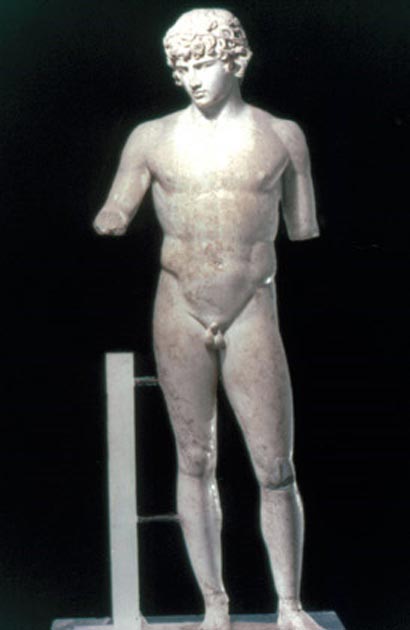
ON July 1st, 1894, this historic photograph was taken of the discovery of one of the most beautiful statues of Antinous ever found.

French archaeologists were in the process of uncovering this statue at the Temple of Apollo at Delphi in Greece when the photographer asked the diggers to pose for posterity.

Hadrian and Antinous visited Delphi and were initiated into Mysteries.

The Delphi Antinous statue was found standing perfectly upright, which indicates that it had been very carefully buried by the priests so as to protect it from marauding Christians. Apparently this statue was considered to be very special.

There are many larger-than- life statues of Antinous. And there are many busts. But the Delphi is one of the few life-size statues, and Johnston said it is possible that it was indeed modeled from the living Antinous.


If that was indeed the case, then it is possible, according to John J Johnston, a leading expert on Antinous, that Antinous was 5-foot-8 (173 cms) in height.

Owing to the long exposure time, the photographer asked the workmen to stand still (or as still as possible) for what must have seemed like an eternity to these simple men (one or two looking like a young Antinous) while the shutter was open.


This photo is one of the most emotionally touching portraits of ANTINOUS THE GAY GOD. It proves that the Ancient Priests of Antinous took special care to hide their precious statue from the barbarians. They didn't just dump Him into a hole -- they carefully buried Him standing upright with dignity!!

The photo is superb ... Antinous stands eternally in focus in the center ... the mortal men are blurred like the flames of votive candles which flicker briefly and go out ... only Antinous endures.

One young Antinous-looking man's face is in focus ... representing those few mortals who look into the Mysteries of Antinous....