Tuesday, November 26, 2019

HOW TO PLAN YOUR OWN
FESTIVE ANTINOUS BIRTHDAY PARTY


ANTINOUS was born on November 27 and worshipers around the world are busy planning their own festivities ... from Chile to Canada and from New England in the US to New South Wales in Australia.

November marks the start of the ancient pagan Festive Season, a season which is still full of fabulous party dates ... including Christmas, New Year's Eve, Twelfth Night and of course American Thanksgiving. Dia de los Muertos and Halloween/Samhain usher in this Festive Season of twinkly lights and over-eating and drinking way too much. 

Our brothers and sisters at the Fundación Epithimia Antinoo in Mexico are busy making final preparations for an Antinous birthday fiesta. 

For worshipers at the Templo de Antinoo México Temple of Antinous in Mexico City, the fiesta requires weeks or even months of preparation because the papier-mâché icons are created by artist Yanko Garibaldi ... each a work of art. Caricaturist Sirius has also created iconic images of the Martyrs and Saints of Antinous.

Other images on this page offer inspiration for Antinous Birthday festivities. 

At right is "Das Gastmahl" (The Symposion Feast) by Anton von Werner (1877) - preliminary color sketch as part of a series of wall murals on the theme of "Roman Life" for the Café Bauer (53 x 89 cm) (Privately Owned).

Images below are courtesy of the gifted artist FELIX D'EON and serve as an inspiration for Antinous Birthday festivities in the open air ... in the Southern Hemisphere, where the jacarandas are in bloom and summer will soon be here.

These ancient festivities go back WAAAAY before Christianity, of course. So it's a safe bet that Hadrian and Antinous would recognize many of the features of these festivities

So when you plan your Antinous Birthday Party, you can mix-and-match customs from all sorts of pagan Festive Season holidays, in full knowledge that Hadrian and Antinous would nod in approval.

It should be celebrated with feasting and drinking and singing and carousing. Green boughs (palm fronds, holly, pine boughs or whatever is native to your climate) should decorate the feast room in honour of the forests of Bithynia, the highlands of modern-day Turkey where Antinous was born.


Electric lights should be turned off in favor of candlelight or at the very least those strings of tiny "fairy lights" Moslems use during Ramadan and Hindus during Divali and Christians at Christmas.

The one really bright spot in the room should be a bust or image of Antinous, which is spotlighted, signifying our belief that Antinous brings light into the world.

The Antinous Rosy Lotus would be perfect. But since not everyone has access to lotus blossoms in late November, orchids would also be fine. 


Bithynia was well known even in Ancient Times for its forest orchids and the Romans loved orchids ... even orchid root beverages!

Orchids would be lovely as well as being a Hellenistic conversation piece. 


If they are too pricey, then your favorite seasonal flower will do. 

Look around and find something that is beautiful and unique to your own locale which you think would be very nice.

The Birthday of Antinous would be a wonderful opportunity for a costume party, also in keeping with the Halloween-Carnaval-Christmas flavor of these ancient pagan holidays. Guests might be encouraged to come as Greco-Romans or Egyptian priests.

The menu could be Mediterranean, with lots of finger foods such as tahini and couscous and humous and pita bread, stuffed olives, eggplant/aubergine, goat's cheese and so on. 


Refried beans (which the Egyptians call "fuul" and eat for breakfast) would be ideal since the theory goes that the Moors introduced "fuul" to the Spaniards, who introduced it to the New World, where it became refritos ... Mexican refried beans.

But you should feel free to go local with favorite regional dishes of your home area. 


There must be lots of good South American dishes which would be perfect, or Scottish specialties, or Aussie barbecued prawns or New England pot pies ... good simple "plebeian" food which is festive and spicy and filling.

In keeping with these pagan festivals, foods should represent birth and regeneration: beans, peas, black-eyed peas, pumpkins, squash, nuts, berries.

It doesn't really matter what food is served, of course, as long as it's delicious and plentiful, and as long as there is plenty of drink to wash it down, wine or beer or just good old iced tea.


Beer is appropriate, since the Ancient Egyptians were brewing beer thousands of years before Antinous was born.

Antinous' last meal may have been refried beans and beer and flat bread.

In a change from holiday cakes and cookies, how about baking Antinous cookies? 


Bake simple sugar cookies which have been cut out to resemble stars, comets, an imperial crown and Bithynian fir trees and lions and so on and decorate them with Antinoian lettering or symbols.

Instead of gingerbread men, make gingerbread Antinouses. The gingerbread man, after all, is thought to come from pagan rituals for honoring Thor or other gods. 


Generally, they are sweet dough which is filled with a nut-date-spice filling representing rebirth and spiritual sustenance. You still find them today on St. Nicholas' feast day throughout Europe.

Whatever you bake, make sure to include a small "surprise" somewhere in the cake or muffin or cookes for some lucky guest to chomp down on. It doesn't have to be a diamond ring, but a trinket of some sort is always fun. 


If that is too challenging for your skills as a confectioner, then just an ordinary cake with the letters "A-N-T-I-N-O-U-S" in store-bought candy lettering would do the job just as nicely. 

Or just a large "A" in icing in the middle of the cake.

Another tradition should be oracle games. This is the first major festival of the New Year in the Antinoian liturgical calendar, so oracles are appropriate.

And when your guests suggest you are robbing traditions from Christian festivals, just look them square in the eye and insist that the Christians stole these wonderful traditions from us pagans because the Christians didn't have any of their own. 


Where would Christian holidays be without pagan traditions?

Who knows? Perhaps Hadrian and Antinous enjoyed these very same pagan traditions in their Saturnalia revelries.

One more thing: Mistletoe. Mistletoe is plentiful in the forests of Bithynia. You can never have enough mistletoe ... as these two 1928 vendors in Paris show.


Antinous would be well familiar with mistletoe. I'm sure he would like it as a reminder of his boyhood hikes through the woods of home.

Use your imagination and you'll come up with lots of ideas.

Let the Festive Season Begin with an Antinous Birthday Party!

Monday, November 25, 2019

THIS IS THE DAY THE ORION NEBULA
WAS DISCOVERED AND NAMED


ON 25 November 1610 French astronomer Nicolas-Claude Fabri de Peiresc (Peiresc) discovered the Orion Nebula and coined the term "nebula". 

The Ancient Egyptians equated Orion with Osiris ... the rise of the Orion Constellation and dog star Sirius coincided with the Nile Inundation ... symbolized by Osiris rising from the dead.

Like Osiris, Antinous died in the Nile and rose to divinity. The first miracle of Antinous was the bountiful Nile Inundation in 131 AD which ended a long drought ... bringing life from death.

Sunday, November 24, 2019

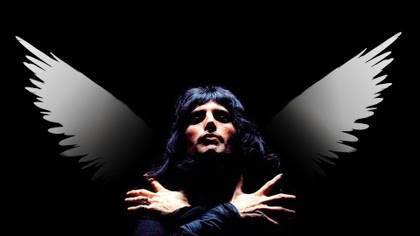
FREDDIE MERCURY
SAINT OF ANTINOUS


ON November 24th the Religion of Antinous celebrates the outrageous life of St. Freddie Mercury.

St. Freddie Mercury whose death from AIDS on this date in 1991 shocked the world, was a courageous performer whose gayness, while not always stated, was a visible part of his persona. He served as an inspiration for millions of gay men, particularly those who, like him, fight ethnic prejudice every day of their lives.

St. Freddie, who was of Indian Parsi descent, and who was born on the island of Zanzibar and grew up in India, has been referred to as "Britain's first Asian rock star."

Like all great showbiz artists, St. Freddie was acutely aware of his public image and went to great lengths to cultivate the persona of Freddie Mercury -- and to hide any trace of the little Parsi boy named Farrokh Bulsara. Freddie Mercury -- or rather the showbiz image called Freddie Mercury -- was beyond all definitions of ethnic origin, or sexual orientation or political affiliation. Not surprisingly, many people were confused and sometimes irritated by the image.

People criticized him for "hiding" his ethnic background. But as a friend told an interviewer after Freddie's death, "[Farrokh] Bulsara was a name he had buried. 

He never wanted to talk about any period in his life before he became Freddie Mercury, and everything about Freddie Mercury was a self-constructed thing."

People also criticized him for not "coming out" publicly. But again, Freddie Mercury (the showbiz image) was beyond gender limitations. 

In fact, Mercury referred to himself as "gay" in a 1974 interview with NME magazine. He was frequently spotted at the cruisiest gay bars across Europe, the UK and America. On the other hand, he would often distance himself from partner Jim Hutton during public events in the 1980s.

Freddie Mercury (the rock icon) was too big to be contained in one gender mold.

He was diagnosed with HIV in 1987. Everyone knew he was sick and everyone surmised the reason. But Freddie Mercury (the image) could never die.

And so it was, that Freddie Mercury never acknowledged his illness until November 23, 1991, when a tersely worded statement was issued announcing that he had AIDS.

A few hours later, he was dead. At the age of 45.

Although he cultivated a very flamboyant stage personality, several sources (including people of my own acquaintance who knew him "intimately") refer to Mercury as having been very shy in person. He also granted very few interviews. Mercury once said of himself: "When I'm performing I'm an extrovert, yet inside I'm a completely different man."

One man was an Indian Parsi kid called Farrokh Bulsara who had been born in Zanzibar.

The other man was FREDDIE MERCURY:

Farrokh Bulsara died on November 24, 1991.

Freddie Mercury will live forever.

The Religion of Antinous honors Freddie Mercury as a Saint of Antinous because he embodies the artistic genius and the flamboyant courage that inspires each of us to strive to be a "star". St. Freddie Mercury admonishes us to strip off the guise of conventionality and the put on our "star" outfits and to take the stage of life. He teaches us to live each day as if it is forever.

Saturday, November 23, 2019

LION MUMMIES FOUND FOR FIRST TIME
AT A SITE IN EGYPT VISITED BY ANTINOUS


TWO mummified lions, dating back about 2,600 years, have been discovered in a tomb full of cat statues and cat mummies in Saqqara, the Egyptian Ministry of Antiquities announced today at a press conference.

Hadrian and Antinous visited Saqqara in the autumn of 130 AD and may have seen the vast BUBASTEUM temple complex of the cat goddess Bastet in the Saqqara plateau cliff face overlooking the teeming city of Mennefer/Memphis Egypt.

"This is the first time [that a] complete mummy of a lion or lion cub" has been found in Egypt, said Mostafa Waziri, the general secretary of Egypt's Supreme Council of Antiquities, who led the team that made the discovery. 

Analysis is ongoing, but it appears the lions are fairly small ... about 3 feet (just under 1 meter) in length, Waziri said, suggesting that they were not fully grown when they died. 

Three other mummies that belong to large cats (the exact species is unclear) were found near the two lions. These three other mummies could belong to leopards, cheetahs or other forms of big cat. About 20 mummies of smaller cats were also found near the lion cubs.

The Antiquities Ministry announced the find at the foot of the Bastet Temple, dedicated to the worship of cats among ancient Egyptians, in the vast necropolis.

Antiquities Minister Khaled El-Enany described the discovery as "a (whole) museum by itself".

He said initial archaeological studies showed that five of the mummies are lion cubs.

Other artifacts uncovered in the dig included statues of an Apis bull, a mongoose, an ibis, a falcon and the ancient Egyptian god Anubis in animal form.

The artifacts belong to the 26th Dynasty which dates back to the seventh century BC, Enany said.

The trove also boasts a collection of ancient Egyptian deities in the form of 73 bronze statuettes depicting the god Osiris, six wooden statues of Ptah-Soker and 11 statues of Sekhmet, the warrior goddess of healing.

Egypt has sought to promote its unique heritage as a way to revive its vital tourism sector, which has been badly hit by political insecurity and attacks.

However, critics say archaeological sites and museums suffer from negligence and poor management.

More photos below:


ANTINOUS AND HADRIAN DEDICATE
THE TEMPLE OF ZEUS IN ATHENS


Construction of the great temple of Olympian Zeus in Athens was not complete when Hadrian arrived with Antinous and the glorious Imperial court in the autumn of 128 AD.

But the inner Cella was finished, and the gold and ivory statue of Zeus was ready for consecration. 

The Temple was a sign of the devotion that Hadrian had for the Athenian people, and the ancient Gods of Greece, and the magnificence of Our Father Zeus, whose representative on Earth Hadrian was. 

Consecration of this temple, which was presided over by Hadrian as Pontifex Maximus, with the elegance and divine presence of Antinous by his side, was a central event leading to the declaration of the Greeks that Hadrian was the living incarnation of Zeus. 

It was at this time that Hadrian began the unification of the Greek people with the formation of the Panhellenios, a league representing all the regions of Greece. 

From this moment forward, Hadrian was proclaimed, worshipped and honored as the living representative of Zeus throughout Greece and especially in Asia Minor, which was the birthplace and stronghold of the Imperial Cult. 

We honor Hadrian as Zeus, Our Father, and through him extend our adoration to Olympian Zeus, Jupiter Capitolinus, by whose strength the world was set in order.

Friday, November 22, 2019

WE PRAY TO ANTINOUS/DIANA
TO GUIDE US IN OUR HUNT BY MOONBEAMS


TONIGHT, November 22,  is one of the festivals of Diana goddess of the Moon and hunting. 

She is goddess of wild places and wild animals and the protector of young women, pregnant women and those giving birth. 

Diana is the twin sister of Apollo. 

As Antinous is often assimilated to Apollo, he therefore substitutes as the twin of Diana, though he can often be viewed as her male double, so that Antinous is Diana. 

Antinous and Diana are both hunters, and moon deities, and they are also gods of magic and darkness. 

Diana is often compared to Hecate, the supreme goddess of Theurgian magicians, who rose to prominence during the reign of Marcus Aurelius. 

Antinous therefore is the male equivalent of Hecate.

ANTONIUS SUBIA says: "We pray to Diana to guide us in our hunt and to illuminate our nights with the silver light of her sublime power. We recognize that the Moon of Diana is the Moon of Antinous."

Thursday, November 21, 2019

ICONIC GAY PORN STAR JOEY STEFANO
IS A SAINT OF ANTINOUS


WE honour iconic gay porn actor Joey Stefano as a saint of Antinous. 

Nicholas Anthony Iacona Junior was born January 1, 1968, in suburban Philadelphia USA and died November 21, 1994, of a drug overdose. 

Over the course of his five-year career, Stefano appeared in 58 gay adult films, and two music videos with Madonna. 

Despite his success, Stefano did not save his earnings and relapsed into drug and alcohol abuse. 

In 1990, he was diagnosed HIV positive. 

On November 21, 1994, Stefano's body was found in a motel room in Hollywood. He was 26 years old.

He symbolizes gay men who skyrocket to celebrity but who fall into disillusionment and ruin just as quickly.