Saturday, April 7, 2018

ANTINOUS IN ARABIA SAW PETRA GARDENS
NOW REDISCOVERED AFTER 2,000 YEARS


EXPERTS have made an astonishing find at Petra, the fabled caravan trade route crossroads city which Antinous and Hadrian visited on their way to a rendezvous with destiny in Egypt.

They have revealed a startlingly advanced irrigation system and water storage system that enabled the desert city's people to survive ... and to maintain a magnificent garden featuring fountains, ponds and a huge swimming pool.

The engineering feats and other luxuries attest to the ancient Nabatean capital's former splendor and wealth some 2,000 years ago.

Earlier a GIANT MONUMENTAL PLATFORM was discovered just a kilometer from the ruins of the city in Jordan. The archaeologists describe the unparalleled find as "a large rectangular platform" that measures 55 meters by 50 meters (184 feet by 160 feet) and was essentially "hiding in plain sight."

Petra is perhaps best known for its sandstone canyon that leads directly to Al Khazneh, The Treasury, seen in the climax to "Indiana Jones and the Last Crusade" where the heroes, played by Harrison Ford and Sean Connery, ride out of the canyon and into the Treasury in their quest for the Holy Grail.


However, 2,000 years ago, Petra was renowned for completely different reasons.

It was one of the most famous water stops in the Middle East, where camel caravan routes linked distant cities.

Now archaeologists are discovering the Nabataean capital, situated in the southwestern deserts of Jordan, once was adorned with an exquisite, artificially irrigated garden.

It featured paths likely shaded by vines, trees and date palms, and grasses, which were cultivated next to a huge, 44-meter wide swimming pool.

The Nabataeans’ ability to tame nature, and conspicuous consumption of a precious resource, water, was pure propaganda.

It was a means to display wealth and power, which they could do thanks to the ingenious hydraulic system they invented, which allowed the people not only to reserve enough water for their own needs, but to water the lavish garden with fountains and an open-air pool.


It had previously been unthinkable that water, a scarce resource in the desert wastes, would have been used for anything but necessity.

"The pool marks the terminus for an aqueduct that transported water from one of the springs, 'Ein Brak, located in the hills outside of Petra," Leigh-Ann Bedal, anthropologist from Penn State Behrend College, told Haaretz. "The pool’s monumental architecture and verdant garden served as a visual celebration of the Nabataeans' success at providing water to the city center."

Ongoing excavations in Petra have uncovered a shaft that appears to have led water more than 10 meters downward, from the aqueduct system to the pool level.

The archaeologists have also found underground channels that helped control runoff during the rainy season, revealing the true complexity of the system for the first time.


Occupied since prehistoric times, the lost Nabataean civilization made the part-carved, part-built city their capital and a major caravan center of trade from the 4th Century BC to the first century AD.

During Hellenistic and Roman times it became a major caravan centre for the incense of Arabia, the silks of China and the spices of India ... a crossroads between Arabia, Egypt and Syria-Phoenicia.

Hadrian and Antinous stopped at Petra on their way from Antioch to Alexandria.

Friday, April 6, 2018

ANTINOUS IS THE GOD OF THE GAYS
BUT WAS HE GAY IN THE MODERN SENSE?


WE are often asked whether Antinous was gay during his mortal lifetime ... truly gay, at least as we understand the complex sociological and orientation that exist today.

This stunning portrait by famed collage artist DOUG STAPLETON shows modern faces superimposed on the face of Antinous.

But was Antinous "gay" in the modern sense?

Scholars have quibbled ... especially in Victorian times ... that Hadrian and Antinous were not homosexuals in the modern sense.

Instead, they were engaged in a socially acknowledged erotic relationship between an adult male (the erastes) and a younger male (the eromenos) usually in his teens ... or so the uptight scholars argued.

These semantic nuances allowed academics to sidestep the socially loaded issue of calling some of the greatest figures in history "practicing homosexuals" ... because that might imply that homosexuality was in fact not a degenerate mental illness, but instead was perfectly normal.

Even up until the turn of the 21st Century, many academicians (mostly male) persisted in avoiding the "G" word when referring to Hadrian and Antinous.

All of that changed at a news conference in London a few years ago.

"Hadrian was gay, and we can say that now. The Victorians had a problem with it. But we can say it." Thorsten Opper, a British Museum curator of Greek and Roman sculpture shocked the stuffy world of academia when he made that statement ... at a news conference announcing the Museum's Hadrian: Empire and Conflict" exhibition in 2008.

The British Museum, that bastion of staid and conservative scholarship, signaled a paradigm shift in historical awareness of homosexuality. 

The collage portrait of Antinous by artist Doug Stapleton on this page symbolizes the many layers of perception of gayness through the ages.

Our own high priest, Flamen Antonius Subia, explains the change in attitude that has taken place ... it is not so much gayness which has changed ... but rather the cultural perception of gays has changed ... not only society's perception of gays ... but more especially the perception of gayness amongst gays.

"Gay has always been and always will be, or so I feel," Antonius says. "Antinous was gay in the way that gays were in Roman times, which is different from how gays were in the 1950's, which is different from how gays are now," he says.

"Antinous represents the divine essence that we all hold in common, so yes, I believe that in his own way and for his time, Antinous was gay just like we are now."

Thursday, April 5, 2018

LOOK INTO THE EYES OF A GAY PERSON
AND YOU SEE ANTINOUS LOOKING BACK


OUR Flamen Antonius Subia likes to say that when you look into the eyes of a gay person, you see Antinous looking back at you. (Portrait entitled "Restored Antinoos" above by Damylion.)

And that means Antinous is the one who looks out of my eyes and out of your eyes and out of everyone's eyes ... that Antinous is the beholder and the beheld ... Antinous is the same center.

You know that when you look at another human being, and you look straight into their eyes, it feels uncomfortable. There's something embarrassing about looking into someone's eyes too closely.

It's as though you might find out who that person really is. And what do you suppose that would be?

Do you suppose that another person who looks deeply into your eyes will read all the things you're ashamed of, all your faults, all the things you are guilty of? Or is there some deeper secret than that?

The eyes are our most sensitive organ, and when you look and look into another gay person's eyes you are looking at the most beautiful jewels in the universe.

And if you look down beyond that surface beauty, it's the most beautiful jewel in the universe for the simple reason that it is Antinous the Gay God looking at you.


We are the eyes of Antinous. So in a way, when you look deeply into somebody's eyes, you're looking deep into yourself, and the other person is looking deeply into the same self ... Antinous the Gay God.

Tuesday, April 3, 2018

MEXICO'S FIRST SAINT OF ANTINOUS
IS VICTIM OF HOMOPHOBIC VIOLENCE


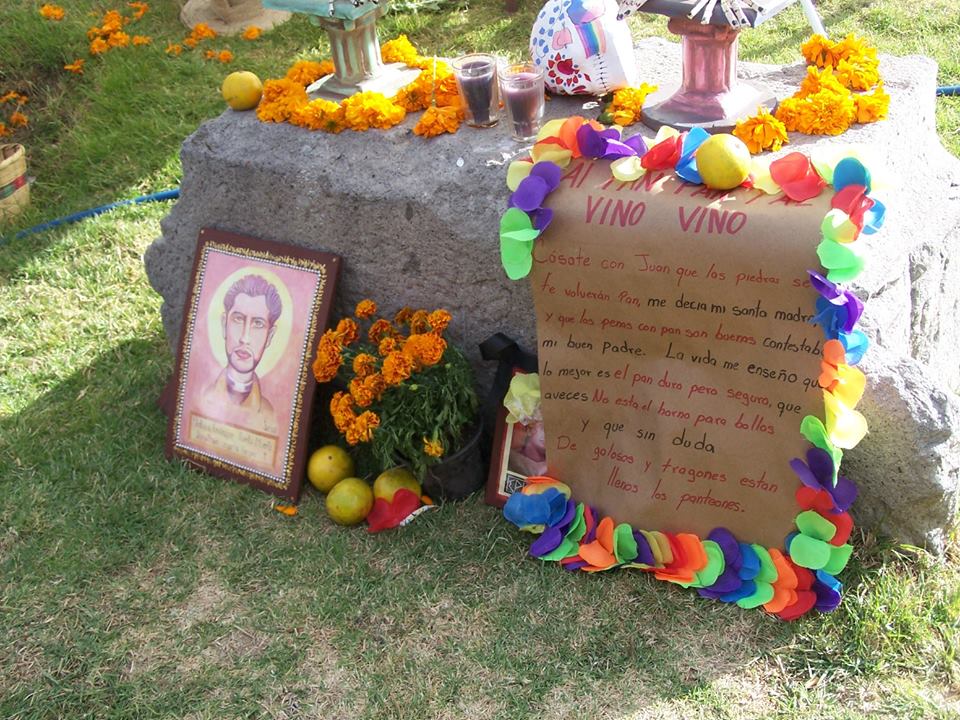
WORSHIPERS of Antinous in Mexico City today solemnly commemorate the anniversary of the horrific murder of the first martyr saint of Antinous in Mexico: Jorge Fernandez Martínez, a victim of homophobic violence.

He was brutally murdered by unknown assailants near his home in the Mexico City suburb of Tultitlán on 3 March 2016.

Forensic tests showed he had been tortured, raped and asphyxiated. His broken body lay undiscovered for days.

Grieving neighbors who had known and loved him for nearly 20 years held a wake and asked for dignified funeral services conducted under the auspices of Epithimia Antinous with Pride Tultitlán Committee and Estamos Contigo.

The rites were held at the famous Shrine of Santa Muerte (Our Lady of Sacred Death) in Tultítlan led by Enriqueta Vargas.

Our sister group Epithimia Antinous at the TEMPLO DE ANTÍNOO MÉXÍCO holds an annual vigil for him during ceremonies at the sanctuary of Santa Muerte in Tultitlán near Mexico City.

Carlos Oseguera Loraca, head of the Templo, says:

Today we commemorate the anniversary of the death of our brother in Antínoo Jorge Fernández Martínez, First Saint of Antínoo in Mexico, victim of homophobic violence in the Municipality of Tultitlán, State of Mexico. 

We also thank the Eclesiae Antinoi for having remember him on this date through the International Blog of Antinous the Gay God.

And we thank our brothers throughout the world who have raised their prayers for their eternal rest at the side of Antinous the God Gay. 

Praised be the gods because there will be justice in this life or in the other, for the crimes of hatred against our community! And let's say together with FLAMEN ANTONIUS SUBIA:


"When Antinous died, he passed into the realm of the dead where he met with our Lord Osiris and they became one God. A single God to rule the Underworld, travel through the chambers of darkness, cross the rivers of blood, cross the lakes of fire, where the light of his beautiful heart shines like a beacon. All the souls of gays, lesbians and trans will be reunited to give them a safe exit from the kingdom of shadows. He will welcome you all in his Million Year Barque. Not a single soul will be left behind forgotten and without love. Everyone will find a place of love and peace by their side. Let us raise our voices of praise, always in this way, from now on, until the end of time ... "! 

Ave Antinoo!

WE PRAISE GILBERT BAKER
CREATOR OF THE RAINBOW FLAG


ANTINOUS embraces Gilbert Baker ... creator of the rainbow flag. He was a civil rights activist, army veteran and self-taught tailor. He created the symbol of the LGBTQ movement 40 years ago. He would have celebrated his 66th birthday during Pride 2017.

Gilbert Baker is a Saint of Antinous!

Antinous abraça Gilbert Baker ... criador da bandeira do arco-íris. Ele era um ativista de direitos civis, veterano do exército e alfaiate autodidata. Ele criou o símbolo do movimento LGBTQ há 39 anos. Ele teria celebrado seu 66º aniversário durante o Pride 2017 .

Antinous abraza a Gilbert Baker ... creador de la bandera del arco iris. Era activista de los derechos civiles, veterano del ejército y sastre autodidacta. Creó el símbolo del movimiento LGBTQ hace 39 años. Habría celebrado su 66 cumpleaños durante el Orgullo 2017 .

Monday, April 2, 2018

HANS CHRISTIAN ANDERSEN
SAINT OF ANTINOUS


WE remember Danish fairy tale writer Hans Christian Andersen as a Saint of Antinous because he was gay although he may never have acted on his gayness.

Biographer Jens Andersen says the author could not overcome societal strictures against homosexuality ... but also could not bring himself to marry a woman.

In modern parlance, "he was just not that into girls", according to the author.

In an almost Freudian manner, Andersen channeled his sexual energies into his writing, creating some of the finest fairy-tale fiction ever written.

He fictionalized his biography as a wonderful fairy tale, even naming his autobiography "The Fairy Tale of My Life".

His own life read like a fairy tale. He was born April 2, 1805, in Odense, the son of a poor shoemaker and an illiterate laundry woman. 

Like "The Ugly Duckling", he was an eccentric boy who was teased merciless by other children for being odd-looking and awkward and for wearing hand-me-downs.

At age 14 he moved to Copenhagen in hopes of finding other misfits like himself. He succeeded beyond his dreams, winning the hearts of leading bourgeois families, who sponsored his education. 

Andersen finished his secondary schooling in 1828 and determinedly set about establishing himself as a writer. He published his first novel within a year and was soon on his way to fame, churning out novels, travel books, dramas, autobiographies and poetry. 

Firmly established as a Danish man of letters, he turned his talents to fairy tales in 1837, he began writing the fairy tales that won him international fame and access to the royal houses and cultural elites of Europe. 

He travelled widely, touring Europe and Britain. In London, he stayed with Charles Dickens, who found the effeminate, fussy, self-centered and hypochondriacal bachelor a tiresome guest.

While Andersen's novels are traditional romantic works celebrating religion and nature and displaying a deep faith in God, his fairy tales offered room for his subconscious mind to work out "relationship issues", according to his biographer.

Many of the fairy tales may be read as gay allegories, and some are clearly autobiographical. 

For instance, "The Little Mermaid" was written after a crisis Andersen suffered in 1836 at the marriage of Edvard Collin. 

Andersen's novel "O.T.", depicting an intimate male friendship, is also influenced by this unrequited love, according to the biographer.

Although Andersen typically conducted one-sided infatuations with young men, he did experience a more reciprocal romantic friendship with the Hereditary Grand Duke of Weimar, Carl-Alexander von Saxe-Weimar-Eisenach, whom he met in 1844. 

In his later years, Andersen was infatuated with the young ballet dancer, Harald Scharff.

Andersen died on August 4, 1875. It was not until 1893 that his sexuality was publicly discussed, when a newspaper hinted that he may have been a homosexual. 

In 1901, an article in Magnus Hirschfeld's Jahrbuch fuer sexuelle Zwischenstufen also discussed him as a homosexual.

Actually, says his biographer, Andersen may never have had sexual relations with anyone. The pages of his diaries are festooned with crosses which he used to indicate masturbation.

The famous crosses suggest that he was an ardent masturbator, who meticulously recorded this act, as he recorded everything else in his life.

Throughout his life, Hans Christian Andersen thought of himself as the ugly duckling … a misfit undeserving of being loved by anybody.

Sunday, April 1, 2018

THE VENERALIA
WHEN VENUS BLESSES HOMOSEXUAL LOVE


ON April 1st we honor Venus Urania, who blesses homosexual love.

When Saturn castrated his father Uranus, and separated the sky from the earth, by cutting away the testicles of heaven, Venus, the Great Goddess of Love was born, where the foam of the testicles washed ashore on the island of Cyprus.

She was attended by the Erotes, the spirits of desire, as seen in this image: "D'après Botticelli" 1984, acrylic on canvas, by the noted Italian artist, Marco Silombria. Soon afterwards she created the three Graces.


She was brought into Olympus by marrying Vulcan, the smith god, but Venus is an older, and more powerful than the Olympians, except for Zeus, because she is directly descended from Uranus, the heavens.

Venus shared her love with almost all the gods, to the humiliation of Vulcan, Juno's son, but her most ardent desire was for the war god Mars, whose virile masculinity is in direct contrast to her voluptuous feminine grace.

Together Mars and Venus fought for the Trojans against the other jealous goddesses, and though Zeus gave victory to the Greeks, he promised Venus that her chosen people would have their revenge.

Flamen Antonius Subia says:

So it was that Venus guided her son Aeneus and his followers out of the burning city and across the world to the place where Rome would one day stand. The descendants of the Trojan refugees and of Mars were Romulus and Remus who founded Rome, whose sons, through War and Love would conquer the world.

Julius Caesar claimed to be descended from Venus through Aeneus, and so she became the guardian spirit of the Emperors.

In the year 135 Hadrian dedicated the Temple of Venus and Roma. Hadrian built one of the largest Temples in Rome for the Great Goddess of Love and for the Spirit of the Deified City. 
Hadrian intended with this Temple to proclaim to the Romans that the Empire was the child of Love and War, but that Love, through the Goddess Venus, was to be the foremost power. We dedicate this day to Venus Urania, who blesses homosexual love.