TWO Roman swords, hundreds of military artifacts and a pair of 2,000-year-old wooden toys swords have been discovered at a fort in northern England.
The metal blades and wooden toy swords were unearthed during an excavation of a Roman cavalry barrack at Vindolanda on Hadrian's Wall.
Archaeologist Dr Andrew Birley said the finds were like "winning the lottery".
The items will all go on display in the site's museum in Northumberland in the autumn.
The first sword was found by volunteer Rupert Bainbridge in the corner of a living room of the barrack.
It had a bent tip and a Vindolanda spokesman said it was the "ancient equivalent of a modern soldier abandoning a malfunctioning rifle".
Mr Bainbridge said he was "excited" by finding "such an extraordinary artefact".
A second sword, without a wooden handle, pommel or scabbard but with the blade and tang intact, was found in a neighbouring room.
The weapon would have been valuable at the time, leading archaeologists to think its owner left the fort in a hurry.
In another room were two small wooden toy swords which he said are "almost exactly the same as those that can be purchased by tourists visiting the Roman wall today" (photo right).
Other items found in the barracks' floor included bath clogs, leather shoes, knives, brooches, arrowheads and ballista bolts.
Dr Birley said: "You can work as an archaeologist your entire life on Roman military sites and, even at Vindolanda, we never expect or imagine to see such a rare and special object as (the swords).
"It felt like the team had won a form of an archaeological lottery."
The finds are believed to date from about 120 AD when the fort was thought to be home to about 1,000 people.
ON September
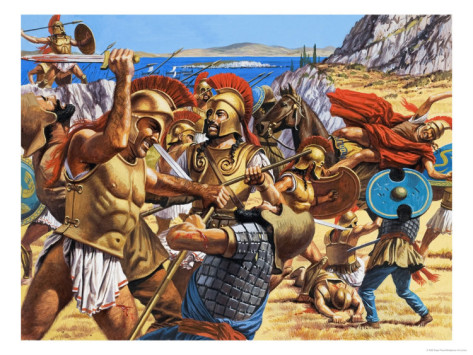
12, 490 BC, 10,000 Greeks use superior tactics to push 100,000 Persians
back into the sea at the Battle of Marathon Bay ... forever changing
the course of Western Civilization.
Though outnumbered 10 to 1, the Greeks won thanks to their new tactics.
Instead
of individual soldiers fighting one-to-one duels, the Greeks rolled out
their "phalanx" battle line of Hoplite soldiers who fought as one
impenetrable unit.
The
Battle of Marathon was a watershed in the Greco-Persian wars, showing
the Greeks that the Persians could be beaten; the eventual Greek triumph
in these wars can be seen to begin at Marathon.
The
battle also showed the Greeks that they were able to win battles
without the Spartans, as they had heavily relied on Sparta previously.
This win was largely due to the Athenians, and Marathon raised Greek esteem of them. Since the following two hundred years saw the rise of the Classical Greek civilization, which has been enduringly influential in western society, the Battle of Marathon is a pivotal moment in history.
The battle is perhaps now more famous as the inspiration for the marathon race.
Although thought to be historically inaccurate, the legend of the Greek messenger Pheidippides running
to Athens with news of the victory became the inspiration for this
athletic event, introduced at the 1896 Athens Olympics, and originally
run between Marathon and Athens.
Pheidippides was a
professional "hemerodrome" (foot courier) who was sent to Sparta to
request help when the Persians landed at Marathon, Greece.
He ran 240 km (150 mi) in two days. Thanks to him, the Persians were defeated.
He
then ran the 40 km (26 mi) from the battlefield near Marathon to Athens
to announce the Greek victory over Persia in the Battle of Marathon
(490 BC) with the words "Chairete, nikomen!" ("Rejoice, we are
victorious!") ... before collapsing and dying ... uttering "Cairete"
(Rejoice) with his final rasping gasp of breath.
Image at top of entry: "Man Runs First Marathon To Bring News of Greek Victory Over Persia" painting by Tom Lovell (1909–97)
ON September 11th we remember those gay and lesbian men and women who have died in terrorist attacks.
The
magnificent Religion of Antinous is not just about beauty and
male-on-male sex and it's not just one continuous gay cocktail party.
Alas!
The word "alas," by the way is a Latin corruption of the
Greek name "Hylas" ... the beloved young companion of Herakles/Hercules.
In Mysia, handsome young Hylas was abducted by water nymphs and
vanished below the waters of a stream.
Heartbroken Herakles went
mad with grief, bellowing "Hylas! Hylas!" and ripping out trees as he
frantically searched for his beloved. He never abandoned his search, and
his cries of "Hylas! Hylas!" continue to echo through the ages every
time we say the word "alas!"
Hadrian and his beloved drowned
Antinous have always been associated with Herakles and his beloved
drowned Hylas. And so ... alas! ... the Religion of Antinous is
profoundly and irrevocably associated with tragedy and with grief. That
is the reason why the sculptures of the Beauteous Boy never show him
smiling and boyish. He always gazes off to one side, his head tilted
slightly downward, with a wistful and slightly melancholy expression on
his face.
It's as if he is always whispering, "Alas!"
And
so it is fitting that the Ecclesia Antinoi Annals of Saints and Martyrs
and Exemplars includes the names of many, many people who have died
under tragic circumstances.
Some died of overdoses or suicide.
Others, such as the gay college student Matthew Shepard who was
bludgeoned to death in Wyoming, were murdered simply because they were
gay.
In Iran, coming out is tantamount to a death sentence.
Many, many others have been taken by the scourge of AIDS.
And
still others on our list, Aula Sancti Ecclesiae Antinoi, have suffered
and died because they just happened to be at the wrong place at the
wrong time.
On September 11th we remember those gay and lesbian men and women who have died in terrorist attacks.
They
include the gay waiters and pastry chefs in the Windows on the World
restaurant on the 110th floor of the World Trade Center, and also the
gay and lesbian office workers in the Twin Towers, and the gay
passengers and crew aboard the hijacked planes.
They also include the gay victims of the subsequent bombings and atrocities in London, Madrid, Orlando and many other cities.
We don't know the names of most of those people. But one name stands out: Mark "Bear Trap" Bingham.
Mark, 31, was a passenger aboard United Airlines Flight 93 and was flying home to see his mother.
He
made a phone call to his mother. He was so distracted by the chaos on
board the plane that he identified himself by his full name, saying,
"Hi, Mom, this is Mark Bingham."
He just had time to tell her he loved her and that his plane was being hijacked before the phone call abruptly ended.
Mark
was a big man at 6 ft 4 in (1.93 m) and 225 pounds (102 kg) and was a
rugged rugby athlete. He is believed to have been among the passengers
who attempted to storm the cockpit to try to prevent the hijackers from
using the plane to kill hundreds or thousands of additional victims.
That
assumption is based on the fact that his lover of six years said he had
repeatedly fought back against muggers and gay bashers and that Mark
definitely would not have surrendered to his fate without first putting
up a fight. "Mark was a fighter. He hated to lose ... at anything!"
Mark
Bingham may never have even heard of Antinous, and the Ecclesia Antinoi
had not been founded yet before he died. He most definitely never
expected to be remembered as a gay martyr. And he scarcely could have
imagined being memorialized in movies and on websites and in books and
TV docu-dramas.
He surely never expected to become a symbol and an icon. But that is what he has become.
And
so, on September 11th, we remember Mark "Bear Trap" Bingham as a symbol
for all those gay people who happen to be at the wrong place at the
wrong time when terrorists strike — as can happen to any of us.
Like
Mark (and like Herakles, for that matter), we fight and struggle to do
the best we can in our day-to-day lives, but sometimes things just turn
out far differently from anything we could ever imagine. Sometimes
tragically so ... Alas!
ON
September 10th we remember the brutal mutilation murder of a gay
teenager on this date in 2014 in Brazil ... the first official saint of
Antinous in Brazil. The death of 18-year-old JOÃO ANTÔNIO DONATIgalvanized worshipers of Antinous into proclaiming him the first martyr saint of Antinous in Brazil. His
severely beaten body was found in the city of Inhumas in the state of
Goiás with his neck fractured and both legs broken and with his mouth
and trachea stuffed with a plastic bag and a paper note, on which had
been scrawled an anti-gay hate message saying that this is what should
happen to all queers. His horrific bruises, lacerations and contusions showed that he had put up a desperate struggle against his attackers.
On
the same day that João was killed, two other gays were beaten and a
transvestite was murdered in the same state. But the images of João's
smiling Facebook selfies instantly touched the hearts of millions.
Outrage swept the nation, with protest marches and vigils held in
numerous cities.
Brazil
has the largest Antinous faith community in the non-English speaking
world, and adherents of Antinous have taken the unprecedented move of
proclaiming João the first Saint of Antinous in Brazil.
Brazilian Novitiate Priest DECO RIBEIRO says more than 300 LGBTIU victims of homophobic
murders were reported in Brazil in 2015 alone, though the true figure is unknown.
"Hundreds more have died since then," says Deco. "Each and every one of these is a martyr who is symbolized by João Antônio Donati. He was a vibrant young man filled with all the hopes
and dreams of so many his age, and who became yet another victim of
homophobia in Brazil, and who so deeply touched us that we have been moved
to initiate something in our country that has long been in the offing:
the Declaration of Apotheosis and canonization of the martyrs of
homophobia in Brazil."
Noting
that anti-gay hate crimes and murders are frequent in Brazil, Deco
says: "This is the first statement and official nomination amid many
others that will follow continuously over time honoring the names of many
victims who have died in the past and who inevitably will be murdered in
the future."
He
adds, "We are setting out upon a long and arduous road which will
entail hard battles for criminalization of homophobia in a country that
has become increasingly Christo-Fascistic, homophobic and intolerant in a
grotesque throwback of catastrophic and irreparable proportions. This
is a turning point in history."
At the Hollywood Temple of Antinous, the founder of the modern religion of Antinous, ANTONIUS SUBIA, says:
"My prayer goes out to Antinous to take João
Donati into his embrace, to give him a place of glory and bliss and
show him that the world is not merely a place of hatred and violence,
but that love still exists here.
"May
his short beautiful life prove to be a changing point for Brazil, may
his violent death awaken his country to the darkness and hatred that has
infiltrated their society.May
he be a martyr whose violent death brings an end to such things in the
future," Antonius said in the statement issued moments ago.
After João's death, his FACEBOOK page was filled with messages of condolence.
A
month before his murder, he updated his profile image with the
accompanying message: "Determination, courage and self-confidence are
decisive factors for success.
"No
matter what obstacles and difficulties. If we are possessed of an
unwavering determination, we will be able to overcome them."
IN many religions the number seven is sacred ... Christians
honor the Seven Archangels … but (typically) apocryphal texts and
regional denominations can't agree on the lists of seven. The big four
are certain: Michael, Gabriel, Raphael and Uriel, but after that things
get a bit iffy.
Depending
on which "church" is involved the seven may include: Raguel, Sariel,
Baracael, Ieadiel, Sealtiel, Peliel, Gamael, Jerahmeel, Izidkiel, Hanael
or Kepharel.
Oh and at least one list includes Lucifer, the fallen angel.
In
Santeria Las Siete Potencias Africanas (Seven African Powers) are the
best known and most powerful Orishas of the Yoruban pantheon. There are endless variations worldwide.
Many
Protestants, of course, denounce all mention of angels, potencias or
even saints as idolatrous, further confusing the situation for many
modern seekers.
The Religion of Antinous has no "angels" (fallen or otherwise) in the Judeo/Islamic/Christian sense.
But
the Romans depicted many ascendant souls as having wings and assisting
in elevating mortal humans to attain celestial realms.
By sacred synchronicity, we know the names of Seven Ancient Priests of Antinous. They are:
JULIUS FIDUS AQUILA, Epistrategos and Architect of Antinoopolis.
ARISTOTIMOS, Priest of Delphi.
HOSTILIUS MARCELLUS, Priest of Corinth.
ISIDORUS DIDYMUS, Priest of Alexandria.
NICIAS, Priest of Rome.
PUBLIUS SUFENAS LUPERCUS, Fratriarch and Eunostos, Naples.
MARCUS DOMITIUS EUPHEMUS, Mysteriarch, Bithynion-Claudiopolis
There were many other priests, of course. But alas, their names went unrecorded.
We have no portraits of any of these Seven Ancient Priests. And their mortal appearance is of little importance.
Priest
Hernestus wears prayer beads and a bracelet with seven charms and beads
representing the Seven Ancient Priests. He prefers to think of them
transcending Time and Space ... serving as mediators in modern guise for
all of us.
Rather
than worshiping mythical angelic beings, we honor these seven human
beings of flesh and blood who really lived and who devoted their lives
to Antinous.
They were priests of Antinous ... we honor them ... men who lived and breathed and
who remind us that angels come in many guises ... angels are all around
us in our everyday lives.
IN a quiet corner of a shady plaza in the middle of Rome stands an ages old portal to another dimension. The
"Magical Doorway" (Porta Alchemica) is all that remains of a 17th
Century alchemical laboratory which drew scientists from across Europe
... and which drew the wrath of the Inquisition. The
Alchemy Gate or Magic Portal is a landmark from the Villa Palombara
built in 1680 by Massimiliano Palombara marquis of Pietraforte on the
Esquiline Hill. The Porta Alchemica is the only survivor of the five gates of the villa Palombara.
There
was a lost door on the opposite side dating from 1680 and four other
lost inscriptions on the walls of the mansion inside the villa. The
marquis was fascinated by occult and esoteric sciences. His wealth and
social position enabled him to act as a patron to a number of
alchemists. In
his villa he also held meetings, attended by other important personages
who shared his interests, such as the Swedish Queen Christina, who
lived in Rome after having abdicated, the distinguished astronomer
Domenico Cassini, the renowned scholar Father Athanasius Kircher, and
others. Villa
Palombara had a small detached outbuilding, probably a laboratory,
where the occult meetings and the alchemic experiments were secretly
held, and occult rituals were performed. A
young doctor and alchemist from Milan named Giuseppe Borri, who had
been expelled from the Jesuit college for delving into the occult, came
to Rome and joined the circle of Villa Palombara. A
legend says that Borri, sponsored by the marquis, was successful in
transforming lead into gold ... creating the Philosopher's Stone of
transformational magic. But
one night he suddenly fled - this really happened, after being stalked
by the pope's Inquisition - and left behind a number of papers inscribed
with complicated formulae which nobody was able to decipher. So Massimiliano Palombara had them inscribed on the doorways of his laboratory. Another
version of the legend says that an occultist calling himself Antimony
(an alchemical element whose symbol adorns the portal lentil) conducted
experiments at the villa ... and vanished through the doorway one night
... disappearing into a magical dimension ... leaving behind only a
solid-gold apple as proof that he could transform matter into gold.
Unfortunately Villa Palombara was completely demolished in the second half of the 1800s, when the new district was built. The other doorways were lost ... along with their alchemical formulae. On
both sides of the surviving portal stand two bearded and bandied-legged
statues ... they are statues of the Egyptian deity BES which once stood
at a Temple of Isis and Serapis in Ancient Rome. Knowledge of the Egyptian hieroglyphs had long since been lost when the portal was built. The
marquis could not have known that BES was a worshiped by the Egyptians
not only as a protective deity ... but also as a protector of Egyptian
SEM magician-priests.
Or perhaps the marquis was very well aware of this ....
Happy
birthday, Jermaine Stewart, born September 7th, 1957, who was one of
the first gay artists to break out of the clubs and crossover into
mainstream just as the music video was being born and kids were
clamoring "I want my MTV!"
Jermaine
was an out and proud inspiration to gay kids at home in front of their
parents' TV sets in the '80s, and to jaded gay grownups in front of
theirs as well.
He always made you smile and want to get up and push the furniture out of the way and dance.
Jermaine
began his performing career as a teenager in Chicago, touring with the
Chi-Lites and The Staple Singers and appearing on the "American
Bandstand" and "Soul Train" TV shows, which were prototypes for
all-music broadcasters.
He
would go straight from school in the afternoon to the "Soul Train"
studios in Chicago where the show was shown locally in black-and-white —
who knew that the show would become a nationwide hit within a few
years?
By
the early '80s he had worked with Shalamar, Millie Jackson, Tavares,
the Temptations, and Culture Club as a background vocalist and dancer.
With
the help of Culture Club member Mikey Craig, he landed his first solo
recording contract with Clive Davis of Arista Records (10 Records in the
UK) in 1984.
His first single, "The Word Is Out," was produced by Peter Collins and was supported by a video shot in Paris.
The song reached number 41 in the US R&B and Billboard charts, and was followed by an album of the same name in 1985.
Although
"The Word Is Out" did much to enhance Stewart's reputation, it did not
prove to be the commercial success Arista had expected.
But
things changed with his second album, "Frantic Romantic," which
included the song that would be Stewart's biggest hit, "We Don't Have To
Take Our Clothes Off." It became an international success, reaching the
Billboard Top 5 and number 5 in the UK charts.
Jermaine's
third album, "Say It Again," was probably his most successful
internationally. He was big in the US and Britain, but he was
stupendously popular in Europe and Asia.
He
was a veritable superstar in Germany , where "Don't Talk Dirty To Me"
was one of the biggest selling records of 1988, making the top 5.
While
other mainstream pop stars went for a mainstream look, St. Jermaine
went for eye-popping glitz-and-match attire and a glamour-diva image
which Asians and Europeans loved.
This
was when his career peaked and began a slow but steady decline as '80s
radio-friendly pop tunes fell out of favor. In the early '90s he
recorded an album entitled "Set Me Free." The album marked a return to
the dance funk style of his pre-fame days. The title track was released
as a single in the U.S., but sold poorly. The album was never
released ….
Meanwhile,
his health was beginning to decline. He did however start recording a
new album in 1996, but never finished it. St. Jermaine Stewart died of
complications of AIDS on March 17, 1997, at the age of 39.
Ironically,
his biggest hit "We Don't Have To Take Our Clothes Off," with its safe
sex message, was one of the first mainstream pop responses to the AIDS
crisis.
We
honor Jermaine Stewart for his courage and for his talent and for his
audacity at being an in-your-face '80s gay style icon. Besides, not even
Diana Ross had this many costume changes in a four-minute music video: