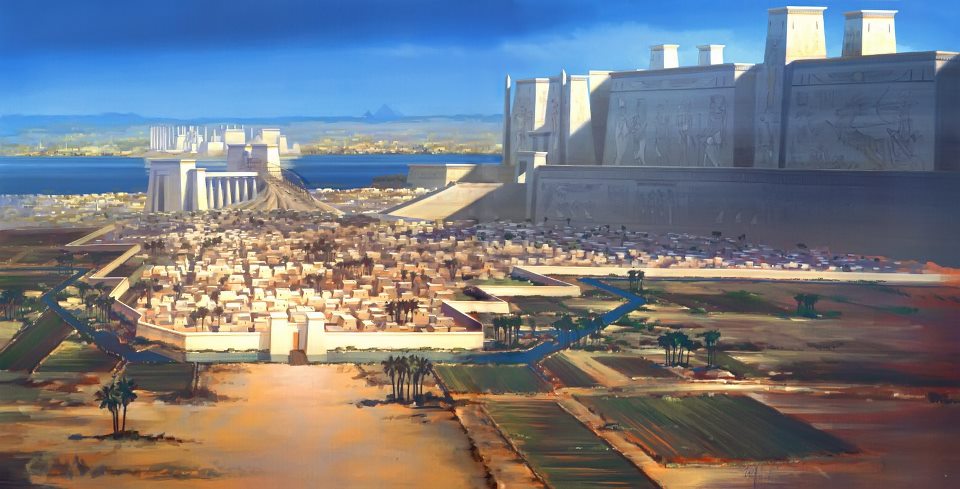
ANTINOUS had thus far beheld the wonders of various sanctuaries and monuments ... colossal statues hewn from blood-red stone that were the equal of any in Roma, the sprawling urban centers choked with imports from every corner of the earth, a harvest of gold and goldsmiths, whose crafts became the ornaments of the affluent from Roma to far more distant, barbaric lands- yet he had seen nothing that made him gasp in astonishment as did "the noblest of cities", Memphis, and its very ancient grandeur.
Hadrian's ship had landed at the water steps of the great southern portal of one of the several imposing palaces that fronted the Nile, scintillating in the fierce heat of the sun that seemed to shatter over everything and everyone in this most hallowed of cities. As their craft had entered the famous port of Memphis, his local guides had enticed Antinous with stories of the renowned shipyards of the God Ptah, the workshops of the goldsmith's guilds whose handicrafts were well known in Roma, and the elephantine, fortress-like walls of the Temple of Ptah. Here were obelisks piercing the liquid azure of the afternoon sky, with their pyramidions sheathed in glowing electrum. Beyond them rose mountainous pylons, gates and royal statues that seemed to dwarf all else for miles around. It was all very enthralling. And yet Antinous had come to receive the counsel of the High Priest of Ptah, the God for whom all of these marvels had been consecrated.

What perfection was to be seen in the craft of man's hand...enormous and yet sensual alabaster colossi, sphinxes, divine images, and every other splendid and costly thing the mind could fathom.
Yet it was the ancient Mysteries of Memphis that had caused mighty Hadrian to make inquiries on behalf of Antinous, whose thirst for high learning knew no bounds.
A retinue stood waiting for Antinous beneath the blessed shelter of the palace portico. Antinous approached, bowing his head, not knowing which of these distinguished foreigners was the High Priest of the God Ptah. A tall, shaven headed and linen draped man came forward, and raised his hands in the gesture of reverence.
"Welcome and blessing to you, Antinous, heart-friend of our Lord Hadrianus Caesar, who is the Lord of Crowns and ruler of the Two Lands! I am Neferkaptah, and I am the Chief of Priests of the God Ptah in the Soul-Mansion of Ptah. Is the noblest city in Egypt fulfilling your expectations and satisfying your heart?"
Antinous relaxed and smiled, noticing the kindness and curiosity evident in the faces of the other priests. "Satisfy?...why no, much more than satisfy! I am stunned by all I have seen of this city of marvels. Our guides today pointed out the endless outdoor market as we approached, which I am told is the largest in Egypt...perhaps in the whole world! There are the giant sphinxes that look like marble, but I am told they are alabaster...and the high walls of the city itself, which our guide told us are the oldest and tallest in the entire land. Alexandria is a wonder of the mind, it is true, butthis, Memphis, is a wonder of the eyes!"
The High Priest smiled knowingly, waving Antinous to follow him beneath the bulk of the portico and through an imposing gate in the high wall. Everywhere he looked were to be seen sculpted and painted reliefs of the highest quality, delicately carved statues of glittering stone, columns and tiles that shined a glossy sky blue. Everything around him seemed to focus one's attention upon the crafts of the hands...that of stone masons, goldsmiths, jewelers. Antinous was taken aback almost to the point of speechlessness, however, he was here to receive the initiations of Ptah, and to take back with him a portion of their wisdom.
"I have seen at a distance the Pyramid that our guides told us was built by Imhotep-"
"Oh, but of course, you want to hear about Imhotep!"
Antinous blushed, but Neferkaptah smiled enthusiastically. "The Holy Pyramid was constructed by an army of the finest craftsmen in Egypt in the service of King Netjerykhet, but it was Imhotep the Son of Ptah who imagined how it could be accomplished, and it was his genius that made what you have seen possible.
"Homage to You Imhotep, Son of Ptah, the Good Physician, the Kindhearted God!
"Imhotep was born to a woman named Khreduankh, whose beauty caught the eye of the God Ptah Himself, and it was from His seed that Imhotep came forth, having even at his birth the powers of a Seer together with all the knowledge of a priest of Ra. He knew the stars in their courses, and the measurements of creation, and he had the knowledge and blessedness to heal the sick and cure the diseases of the flesh. Did they point out to you the temple where the God Imhotep, as the Son of Ptah, reveals cures to the sick as they dream? Well, then perhaps you know already the fame of Imhotep throughout the known world, for not only do the people of this city and Egypt come to be healed in His shrine, but also people from across the Great Green Sea...."
"I know that the Hellenes associate Imhotep with Asklepius", Antinous said, "and that they believe He cures barrenness and impotence, and even fatal conditions. Aren't there miracles attributed to Imhotep during His life?"
Neferkaptah nodded. "And you saw it!...the Holy Pyramid, from which King Netjerykhet was sent aloft to the Imperishable Stars, to be the divine leader and guide of Egypt for all eternity. My son, Imhotep was an innovator, not merely an architect who followed in the footsteps of others. Memphis, Alexandria and Egypt entire is filled with scholars and architects...so many trained monkeys who mimic what they read and see in the genius of others. What Imhotep did was excell beyond the great works of his predecessors, taking the original design for the tombs of hallowed persons, and shaping it into something truly sublime. His is a miracle of the mind, the imagination, which is one of the greatest testaments to his divinity.
"Your own Hadrianus Caesar is said to be such an architect and visionary...one who takes what he has inherited and pushes it beyond what others thought possible. To exceed the limitations imposed by the lower mind, the mundane intellect...that is the course of one who has received the direct blessing of the Gods. It is that way in your Roma, and so it is that way here in my Egypt, which is the House of the God Ptah, Architect of the World!"
Antinous recalled some of the things his tutors had told him about the origins of Egypt and the Great God Ptah. "Speaking of the House of Ptah, is it not true that the Hellenes gave Egypt its name, or rather, that the name Egypt is taken from the language of the Hellenes, when they beheld the wonders of the Temple of Ptah at Memphis and recognized its universal importance?"
"That is so, my son. The Hellenes knew that the most ancient city of Memphis ... which was hailed as Men-Nefer by the Ancients ... was the first capital of the Egyptian state, and that it was here, in our very own Temple of Ptah, where every king that has sat upon the throne of Egypt has received the Double Crown.
Aleksandras, whom they call Great, the Son of Zeus-Ammon, was crowned as Pharaoh of Egypt in the Temple of Ptah, as was your beloved Hadrianus Caesar, Lord of the Two Lands.
For Ptah is the King-Maker, the Establisher of Laws, who founded the first temple in the first city of Egypt, and that city, this city, was known as Ibebu-hedj, the 'White Walls', where at its heart rose Hawt-ka-Ptah, 'The Soul-Mansion of Ptah'.
"The Hellenes pronounced the name of Ptah's holiest temple Aigyptos, and it was from their speech that the name of our Egypt came forth. And Ptah is the King of the Gods in His temple here, because it is recognized in Memphis that Ptah is the Genius from Whom speech, intellect and thought came into being. Without Him, the Hellenes, Romans, the Egyptians, and indeed the peoples of all the world would not have intellect or speech or even existence itself, for Ptah is the Great God Who gave birth to the Cosmos and all the things dwelling in it!"
Antinous and his hosts had finally arrived at the Great Temple of Ptah, which was just south of the primary enclosure of the ancient capital of Egypt. Its great white walls (from which the oldest district of 'White Walls' received its name) were crenellated like some military fortress, and Antinous recognized that its massive corners gave way to high watch towers that were likewise crenellated. Tall flagstaffs sheathed in gold stood proudly before soaring pylons into which were carved, in exquisite relief, images of the God Ptah receiving abundant offerings. The heady fragrance of myrrh incense rose in a palpable cloud above the entourage, and then the sound of chanting, which echoed off lofty stone ceilings.
"Hail to Ptah Who is South of His Wall, who created in the beginning in His loneliness, when there was no one beside Him. Who came into existence by Himself and fashioned in the beginning, in that neither father nor mother had made His body. The truly lone one. He who made the gods and who created, but who indeed was not created".
Antinous braved a remark as they approached the entrance proper, the hallowed Soul-Mansion of the God Ptah. "The Hellenes know Ptah as Hephaestus, I have been told by my tutors, while my people know Him as Vulcan, and we see Him as the Wielder of the blacksmith's hammer and fire. We know Vulcan as the creator of the blacksmith's arts".
"It is certainly true that the God Ptah is the divine patron of all handicrafts", Neferkaptah answered, "...which include the arts of the forgers, goldsmiths, metal-smiths and jewelers. All of these are the products of the heart and tongue of Ptah, Who spoke them into existence, but so too are all the labors of the hands...stone masonry, sculpting, painting, architecture, mining and ship building."
The Priest added, "You have seen the famous ship yards of Memphis, which equal any in the known world, including Alexandria. Here too are the ateliers of the Temple, whose divine images in gold, precious stones and electrum are found in every temple in Egypt, and in the Royal Court," he said.
"It is known that the Servants of Ptah, that is to say His craftsmen, are among the finest in the world. They certainly have no equal in all of Egypt; for the God Ptah is not solely the patron of artisanship or craftsmanship, but rather the Progenitor of the finest quality work of which men are capable. It is excellence itself...this quality of having perfected a thing to the point where it cannot be improved upon...that is the hallmark of the God Ptah throughout creation. The very activity or attitude of striving for excellence in one's work is the very nature of the God Ptah, Who has selected the perfect forms of all creatures and plants, given them birth through the speech of His tongue, and bestowed upon them the breath of life".
Just then the entourage entered the sanctified outer courtyard of the Temple of Ptah, where grandiose and more humble stone images of the God Ptah stood in the presence of flaming braziers and tables choked with delicious offerings. Priests and acolytes moved to and fro with diligence, trimming wicks and lighting lamps, and dropping pellets of myrrh over the hot coals of the braziers. A presence of devotion and solitude pervaded the atmosphere, which spoke to the heart of Antinous of the first-fruits of the human heart.
"Is love part of the creation offered by the Great Ptah to His servants upon the earth?", Antinous queried, his heart fluttering with admiration for the beauty and harmony of the images surrounding him.
 Neferkaptah placed a warm hand on Antinous' bare shoulder. "In our ancient teaching ... which comes from the time when the Holy Pyramid was envisioned by Imhotep ... it is said that the God Ptah thought the names of every thing to be created within His heart, which was then repeated by His tongue, and that it was through this divine miracle that all created things came into being.
"The heart and the tongue are the two instruments by which Ptah the very Great God brought out His vision for the created world, thus making it a reality. It is the heart that is the mind of all creatures in the world, for the heart speaks and the limbs obey. And when the tongue repeats what the heart has engendered, then life proceeds...activity shapes progress, and events unfold. This is the handiwork of Ptah, Who gave form to the heart that it might direct the limbs and the passions.
"But know too that Ptah is called the King of the Gods not merely because of His creative power, which makes kings in the world of men, but because He created the Gods. It was the desire, the passion...the love of Ptah that made the Souls of all the Gods, and determined that they should come to rest in their statues of stone and wood and metal, and it was Ptah Who ordained the cults of all the Gods, Their temples and worship, so that the Gods could receive the first-fruits of the earth from humankind. But also, it was through the love of Ptah that the Gods should receive the offerings of humankind, and intervene on their behalf, for men and women, together with all the creeping creatures of the earth, are the handiwork of Ptah's heart and tongue. We, Antinous...you and I and revered Hadrianus Caesar, are the thoughts of Ptah's passion, and the desires of His heart, and the fruit of His tongue...and so it shall always be!"
Antinous was filled with awe and humility in the presence of such a teaching, which inspired within his own heart the desire to receive the Mysteries of Ptah more fully and deeply. And so Antinous followed Neferkaptah into the dim inner court of the Temple of Ptah, and there received an answer from the very Great God Ptah.