Thursday, June 21, 2012

THE SOLSTICE
AND THE DELPHINEA OF ANTINOUS


THE JUNE SOLSTICE is one of the most sacred days in the Liturgical Calendar of the Religion of Antinous.

It is the day when Ra Herakhte, the heavenly father of Antinous, stands still for a moment. In the Northern Hemisphere it is the longest day  and from now on the days become shorter and shorter. For our brothers in the Southern Hemisphere, this is the Shortest Day and from now on the days become longer and longer.

That is an important aspect to remember about the Religion of Antinous. The Blessed Boy is beyond such constraints as Summer and Winter or even Life and Death. For Antinous, the days are ALWAYS getting longer and the they are ALWAYS getting shorter.

For HE lives in our hearts — wherever we are.

The Religion of Antinous celebrates a whole cluster of Sacred Events on this magical day, which we call The Delphinea as a collective term. The Delphinea is the celebration of the beautiful, golden-haired god of light, Apollo, for starters.

And then we celebrate the day that Hadrian and Antinous met and fell in love. But on this date we also celebrate the beautiful boy Hyacinthus.

And we celebrate June 21st as the day in the hot summer of the year 130 AD when the Imperial entourage crossed the Sinai desert and entered into Egypt on the final, fateful leg of that final, fateful journey. A year earlier, on this date, they had entered Ephesus in triumph. 

On June 21st of the year 130 AD, however, they were entering a drought-stricken Egypt (breadbasket of the empire) where the local populace looked to their emperor for a miracle.


That miracle would occur, but at a terrible price. Antinous would plunge into the Nile and drown. The following season, the Nile would inundate the croplands, bringing bounty and abundance once more to Egypt and, as a consequence, to the hungry empire.

The Bountiful Flood of the year 131 is the first of the many miracles attributed to Antinous the Gay God.

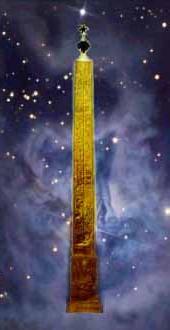
And on June 21st of the year 131, Hadrian would commission the OBELISK OF ANTINOUS, the Egyptian hieroglyphic text of which comprises our religion's greatest single document of faith.

All of these overlapping dates are confusing, of course. But one of the most brilliant modern-day followers of Antinous wrote the following words on this very topic. A visionary artist living in the San Francisco Bay Area, KEVIN KIHN wrote:
"It's my feeling that Hadrian and Antinous are always eternally arriving at Ephesus, at Athens, at all the Hellenic and Hellenistic cities where Hadrian was particularly beloved. Hadrian will always be bereaved and bereft weeping on the shore of the Nile, and always perpetually with his Antinous. For I fancy that time is like a spool or reel of film on which every frame is eternally preserved, and all times past are present even in the now."
But first, let's spool the reel of time back to Apollo and the Solstice! Antinous would be associated with many deities in the generations to come. Among his many names, the Beauteous Boy was adored as Antinous-Apollo.

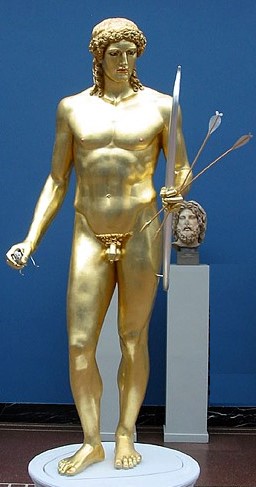
The glorious image above left shows a modern reproduction of the Apollon Parnopios which has been gilded and fitted with gemstone eyes to show how it might have looked in a temple where a ray of sunlight would have set it ablaze in gleaming light.

The Delphinea is the celebration of the beautiful, golden-haired god of light, Apollo, and of his triumph over the great and monstrous Python which was wrapped around holy mount Parnassus. The Python was the creation of Juno, a creature of jealousy whose coils were meant only to stifle and constrict the grace of that which was to proceed from the Sacred Way of the holy city of Delphi.

Apollo shot the Python and destroyed it, when he was only three days old, which is like the brilliance of the Sun dispelling the covering of night. He set the black stone which had fallen from the sky, called the Omphalos, over the navel of the Earth, and charged a Sibyl, a priestess of the Great Mother to watch over the stone and to convey his wisdom to mankind.

Flamen Antinoalis Antonyus Subia explains the significance for us Antinoians:
"The Oracle of Delphi, called a Pythoness, was overtaken while seated atop a golden tripod, by a fire that is the breath of the God. Apollo is the Flower Prince reborn, he is the Twin brother of Dionysus, the Twin brother of Diana. He is the Son of Zeus, and the inheritor of his Kingdom, just as Aelius Caesar was the chosen son of Hadrian.

"Apollo is the God of wisdom and art, the speaker of truth, the deliverer of radiance, reason and beauty. Apollo is the God of Socrates and Plato, and he is the God of Pythagoras who claimed to be his son, exhibiting a golden thigh as proof. Apollo is the unconquered light, the full manifested brilliance, power and wisdom of Orpheus.
"Of all the gods, Apollo is the most boy-loving, though the touch of his heart was invariably fatal. He is the genius of the dying boy-gods. We pray to Apollo, the great god of homosexuality, and seek his guidance on this day, the longest day of the year."
  
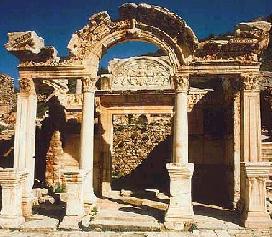
During the June 21st Solstice, when we celebrate the Delphinea, the Religion of Antinous also commemorates the entry of Hadrian and Antinous into the fabled city of Ephesus in the year 129.

Ephesus had 300,000 inhabitants at its peak in the time of Hadrian, and it drew thousands of devotees to the shrine of the goddess annually. Even today, Ephesus is one of the most complete and most splendid ancient sites in the world and still draws thousands of tourists every year. The Great Library of Ephesus, which Hadrian patronized and greatly expanded, has been lovingly restored.

The Temple of Ephesus was one of the wonders of the ancient world. It was consecrated to Artemis, in her Asian element as a Phrygian-Hittite goddess of the hunt, a youthful manifestation of the Great Goddess of Mount Ida and Dydimus.


The old Temple had burned down on the night that Alexander the Great was born, but after his conquest, Alexander ordered the reconstruction of the Temple, which was still standing when Hadrian and Antinous visited.

Antonyus Subia explains the parallels between Artemis and Antinous and why we celebrate this Sacred Day:
"Artemis is considered the female Antinous, as his divine twin, the only goddess to exhibit lesbian qualities. She was worshipped as Diana alongside Antinous by the funeral society of Lanuvium. Ephesus was one of the first cities to proclaim Hadrian a living God, and one of the first to adhere to his veneration as a Divus.
"The presence of Antinous and Hadrian with their very pronounced Artemisian qualities must have made a deep impression on the Ephesians, in that they were aware that the city was being visited by living gods. It is to Artemis of Ephesus that this day is Sacred, as the female twin of Antinous, the Bithynian hunter god."
And on June 22nd the Delphinea concludes when we honor the beautiful boy from Sparta known as Hyacinthus. The astonishing beauty of Hyacinthus and his long, flowing blonde hair was first noticed by Zephyrus, the God of the West Wind. The moisture laden Zephyrus fell madly in love with the boy, and attempted many times to seduce Hyacinth. But every time the boy rejected the wind god, whose breeze is the most lovely and most arousing.

Antonyus relates what happened next:

 "It was then that Apollo noticed Hyacinthus and fell completely in love with him also. Unlike with Zephyrus, when Apollo revealed his love to Hyacinthus, he was not rejected, but his shining love was returned many fold. The two, who were like twins, whose long, blonde curls, rustled together in the jealous wind of Zephyrus, enjoined a passionate love affair ...
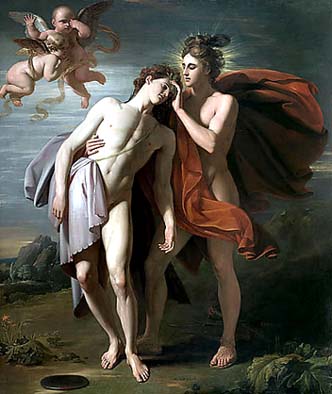

"... until one day, the sight of their happiness proved too much for Zephyrus to endure, and while Apollo and Hyacinthus were throwing the discus together, the wind god sent a gust of air, when Apollo threw the golden disk, causing it to fall directly on the perfect head of Hyacinthus who died instantly from the blow.

"It was all an accident, and a tragedy, but Apollo was beside himself with grief, like Hadrian holding the body of his beloved Antinous.

"The Sun God turned the blood that flowed through the soft curls into the flower that we call the Hyacinth. The Death of Hyacinthus is the divine metaphor for the beauty and tragedy of life taken from the young in their full vigor, falling victim to the accidents of youth. It is also a warning to those who would approach the majesty of the great god Apollo, who is rightfully called the Far-Shooter, and the falling of the golden discus is a sign that the powers of the sun at this time of the year, though at their greatest, are slowly fading. The disk strikes Hyacinth on the head and the days grow shorter."

Wednesday, June 20, 2012

HADRIAN'S VILLA OBSERVATORY

TOWER ALIGNED TO SOLSTICES


HADRIAN would have been planning a long night tonight in his personal observatory, despite the fact that it is the shortest night of the year — the Summer Solstice — which is exact shortly after midnight in Rome tonight. 

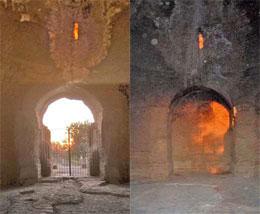
First, he would observe the setting sun sending a shaft of goldish-red light through a certain slit in his observatory tower to illuminate a golden statue of the Egyptian Goddess Isis.

Then there would be oracles at midnight. You can just see the cluster of priests and augurs, chanting and offering sacrifices amidst billowing clouds of incense. 

An Etruscan haruspex or two would be wearing yellow robes and conical hats as they inspected the entrails of animals. Patrician augurs would be wearing their finest ceremonial togas as they listened for messages from nocturnal birds. Babylonian astrologers would be clad in garish robes with multi-tiered crowns as they scanned the heavens and babbled to each other about their arcane calculations. 

And naturally the Egyptian priests would do their utmost to out-do all the others with outlandish make-up, headdresses and robes to the cacophony of sistrums, gongs and the whoosh of incendiary incense sending up pastel-colored clouds of smoke to the wailing of a priestess of Isis in the throes of a trance.

Scores of Imperial court officials and hangers-on would be stifling yawns as the oracles took most of the night. 

But yawns would turn to gasps of wonder and praise when the Emperor announced that he had just seen the RISE OF THE STAR OF ANTINOUS over the eastern horizon.

Then at dawn, the Emperor would climb stairs to the upper chamber to observe the Solstice Sunrise on June 21st.

He would announce the outcome of the oracles and whether the Antinoian Auspices for the coming year were favorable.

Modern Priests of Antinous will be celebrating rites at the HOLLYWOOD TEMPLE OF ANTINOUS to mark not only the Solstice but a very special New Moon, which we call the ANTINOUS SUMMER BLUE MOON. It is special because it is the second New Moon in the sign of Gemini since both Sun and Moon aligned in Gemini a month ago. 

This "extra" New Moon occurred just hours ahead of the Solstice. The Solstice itself occurs at 4:08 p.m. Los Angeles time Wednesday, which is just after midnight Thursday in the UK and Europe. For our brothers in Australia, it occurs about midday Thursday and it is the Winter Solstice, the shortest day of the year.

The meditations of the Hollywood Priests of Antinous will be focused on an Italian archaeologist and her team who will be spending this Solstice at the ruins of a tower on a hillock at Hadrian's Villa which was the Emperor's own private observatory. 

These experts, led by MARIA DE FRANCESCHINI, have demonstrated that the observatory tower is in fact aligned to the Solstices. She believes the observatory was dedicated to the Egyptian goddess Isis, who raised Osiris from the dead to become a god of resurrection and transfiguration — just as Hadrian declared Antinous a god of resurrection and transfiguration.
 

For centuries, experts had been mystified by the layout of the sprawling complex of marble baths, banquet halls, luxurious residences, gardens, shrines and unidentified structures 30 kilometers outside Rome.

Hadrian's Villa was a sprawling complex of buildings, temples, gardens, a zoo and — yes — even an observatory tower on a hillock on the edge of the compound from which Hadrian could observe the heavens. 


 But, in an article published in the journal Nature last year, De Franceschini wrote that she believes the mystery-shrouded Rocca Bruna Tower, long held to be Hadrian's private observatory, is in fact aligned so as to produce sunlight effects for the seasons.

She describes her findings personally in the video at the top of this entry. 

De Franceschini says that during the summer solstice, rays of light pierce the tower and another of the villa's buildings. In the Rocca Bruna Tower, dawn sunlight during the summer solstice enters through a wedge-shaped slot above the door and illuminates a niche on the opposite side of the interior (image courtesy nature.com). And in a temple of the Accademia building, De Franceschini has found that sunlight passes through a series of doors during both the winter and summer solstices. 

"The alignments gave me a new key of interpretation," says De Franceschini, who adds that the two buildings are connected by an esplanade that was a sacred avenue during the solstices. Based on ancient texts describing religious rituals and study of recovered sculptures, she thinks the sunlight effects were linked to religious ceremonies associated with the Egyptian goddess Isis, who was adopted by the Romans.

De Franceschini, who works with the University of Trento in Italy, has published a book describing the archaeo-astronomical work, VILLA ADRIANA ARCHITETTURA CELESTE. She credits two architects, Robert Mangurian and Mary-Ann Ray, for initially noticing the light effect in Rocca Bruna.

According to nature.com, Robert Hannah, a classicist from the University of Otago in New Zealand, says that De Franceschini's ideas are plausible. "They're certainly ripe for further investigation," he says.

Hannah believes that the Pantheon, designed by Hadrian in Rome with a circular opening at the top of its dome, also acts as a giant calendrical sundial, with sunlight illuminating key interior surfaces at the equinoxes and on the spring equinox on April 21st, the city's birthday.

Few classical buildings have been investigated for astronomical alignment, says Hannah, partly because it is much easier to check for alignments in prehistoric structures such as Stonehenge, which do not have potentially contradictory artefacts.

De Franceschini spends every solstice at Hadrian's villa, seeking further verification. Our thoughts and prayers go with her during this special season of the ANTINOUS SUMMER BLUE MOON and the Solstice.


We can envision Hadrian, sick with grief and alone after the death of Antinous, ensconced in his observatory tower scanning the heavens for a sign from his Beloved Boy, praying to Isis for her to work her magic on Antinous ....

Tuesday, June 19, 2012

NICK DRAKE

SAINT OF ANTINOUS


ON JUNE 19th the Religion of Antinous commemorates the birth of SAINT NICK DRAKE, the sexually ambivalent English singer who died under very mysterious, Antinous-like circumstances at a young age and who became an artistic icon for future generations of dreamers and artists.

Nicholas Rodney Drake was born on June 19th, 1948, to an upper middle class English family living in Burma. His father was an industrialist and there was never much question about Nick's financial future. Indeed, he would have been a wealthy middle-aged man today had he done nothing at all. But Nick never ceased to wonder and worry about his spiritual future. Despite or perhaps precisely because of his admission to Cambridge University, Nick Drake was convinced that he should shun a financially certain future and pursue a future as a musician.

Nick Drake learned to play piano at an early age, and began to compose his own songs, which he would record on a reel-to-reel tape recorder he kept in the family drawing room in rural England.

In 1966 he spent some time in the South of France where he purportedly became acquainted with "the best sort of pot" and perhaps experimented with LSD — and possibly sex with both females and males.

Returning to England, he realized he was not suited to receive a degree from Cambridge University. Nick abruptly and shockingly (as far as his family was concerned) ended his studies at Cambridge nine months before graduation, and in autumn 1969 moved to London to concentrate on a career in music.

Nick signed to Island Records when he was 20 years old and released his debut album, Five Leaves Left, in 1969. By 1972, he had recorded his second album — Bryter Layter and part of his third, Pink Moon. Neither of the first two albums sold more than 5,000 copies on their initial release in Britain, much less abroad. He never made an American breakthrough, unlike other major British artists of the era.

Nick was devastated and depressed. His excruciating shyness to perform live or be interviewed further contributed to his lack of commercial success. Despite this, he was able to gather a loyal following.

He managed to complete his third album, Pink Moon, recorded in midnight sessions in the winter of 1971, immediately after which he withdrew from both live performance and recording, retreating to his parents' home in rural England. Once again, it did not sell well. He felt he was a failure. On November 25th, 1974, Nick Drake retired to his upstairs bedroom where he took a cocktail anti-depressants which killed him. He was found stretched over his bed next morning by his mother.

The Religion of Antinous honors Nick Drake as a prophet of Homoeros. He was a man who saw through the transparent barriers between sexuality to see the spiritual truth of reality. He was one of those many men who are never sure of their sexuality. But it is unimportant whether he was "gay" or not.

Nick Drake is a symbol of these sorts of dreamy and shy men who live existences of quiet despair. Nick Drake could play better riffs on the guitar than almost anybody of his generation. He had a beautiful voice. He was a gifted song-writer. He knew he had more talent in his little finger than most well-paid artists would ever possess. But his career never took off. The big break never happened. Nobody appreciated him. He was broke and disillusioned.

His sister says she believes he took an overdose of anti-depressants thinking he wanted it to either cure him or kill him, because he couldn't go on living in such despair of being an artistic failure. How many people in the economic meltdown of the early 21st Century don't feel the same despair? And yet ....

Nick Drake could scarcely have dreamt as he swallowed a handful of pills on a dreary November evening in his parents' house in the English Midlands that he would become a major recording star with fans around the world — 30 years after his death. His three albums now are cult chart-busters around the world.

When we remember Saint Nick Drake, we must remember too that Antinous is the patron of these sensitive souls who die untimely and tragic deaths at an early age. Antinous is the River Man who drowned in the Nile ....


Monday, June 18, 2012

GHOST DOCTORS DETECT "SOMETHING"

IN THE EGYPTIAN WING OF THE MET


ANTINOUS and Hadrian must have been fascinated by the weird and spooky tales they heard during their final, fateful journey up the Nile in 130 A.D.

The Egyptian Book of the Dead combined with a host of magical rituals, amulets and protocols enabled the ancient Egyptians to cheat death and rise again in the afterlife.

And maybe some ancient Egyptian ghosts have made that journey and returned — well at least to New York's Metropolitan Museum of Art, according to Pete and Stew Kandel (know as Dr. Pete and Dr. Stew) paranormal investigators and licensed New York City tour guides calling themselves "Ghost Doctors."

The Ghost Doctors
— who lead groups of adventurous amateur ghost hunters through a variety of NYC's iconic landmarks including the famous Metropolitan Museum of Art — have been searching the hallways and galleries of this famous New York institution for signs of paranormal activity and have found the Egyptian wings to be buzzing with activity.

"The ancient Egyptians held the afterlife in great reverence and much of their culture was devoted to the belief that death is only the beginning," says Dr. Stew. "With this in mind, if you're conducting a paranormal investigation of the Met, the Egyptian wings are definitely a must."

Recently on a ghostly hunt at the Met, the two ghost hunters picked up some strange unusual activity. With a battery of electronic ghost hunting equipment in hand accompanied by a group of anxious but excited ghost hunters-in-training, they detected something.


"We were passing through one of the smaller galleries on the way to the Temple of Dendur (photo right) when one of our instruments just went off," says Dr. Pete. "In fact one particular participant in our group was the first to uncover this activity which was further collaborated by others as well."

The Ghost Doctors say each and every ghost hunt is unique as they never know what will turn up during an investigation.

 
We wonder what Emperor Hadrian would have thought of the Ghost Doctors. The Emperor is known to have had a fascination (even an obsession) with magic and mystical rites, secret initiations and astrology. He even cast his own horoscopes.
 
There is even a theory, mentioned by historian Royston Lambert, that Hadrian may have cast a spell that rebounded and resulted in the death of his beloved Antinous. During that fateful final trip up the Nile, just weeks before Antinous died, it was said that Hadrian and Antinous stopped at Heliopolis. 
 
That is the town near Mennefer (Memphis/Cairo) where the Egyptian magician/priest Pancrates gave to Hadrian (or rather sold to him for an exorbitant sum) a magical spell which could bind another man's affections to him forever ... when the spell was cast properly. If cast wrong, the spell would result in the death of the other man.

There was some speculation in ancient times as to whether the death of Antinous may have be related to this strange Egyptian spell. Whether 21st Century sceptics believe in the efficacy of Ancient Egyptian Spellcasting, Hadrian most certainly DID believe in magical spells (being the wise man that he was).  

Let's assume Hadrian cast the spell a few days or weeks prior to the death of Antinous ... well, that would certainly explain his inordinate grief at the Blessed Boy's death and his penance in declaring Antinous a god ... perhaps out of a profound sense of guilt. 


So we are left to wonder what Hadrian would have thought of the NYC Ghost Doctors and their ectoplasmic claims.

"We constantly get photos emailed to us from people who have gone on our ghost hunting adventures," says Dr. Stew. "People get excited and rightfully so, when they download the pics from a recent ghost hunt and see something strange."

So the next time you're walking through the Met and happen to come across some 3,000-year-old mummies, no need to go looking for Dr. Indiana Jones, New York has its own Doctors
— The Ghost Doctors.

Ghost Doctors (http://www.ghostdoctors.com), based in New York City, is the premier ghost hunting tour in NYC. Their ghosts hunts can be suited for both public, private and corporate events.

Sunday, June 17, 2012

CARAVAGGIO's LATE MASTERPIECE

UNVEILED IN ROME


CARAVAGGIO's masterpiece "Resurrezione di Lazzaro" (Resurrection of Lazarus) has been unveiled at Rome's Museo di Roma after a meticulous seven-month restoration.


The oil painting shows Jesus pointing to the figure of Lazarus as he is raised from the dead, in a pose which drew inspiration from The Creation of Adam, a panel from Michelangelo's frescoes on the ceiling of the Sistine Chapel in which God breathes life into Adam.


Both Caravaggio and Michelangelo are SAINTS OF ANTINOUS. We honor Saint Caravaggio as an extraordinary painter whose homoerotic images of males have caused art historians to call him the first modern painter. St. Caravaggio is the Patron of Gifted Bad Boys — Gay Boys who are blessed with incredible talents but who are too impatient and too rebellious to abide by the rules of society.


In his Lazarus painting, Caravaggio depicted himself, with dark hair and a beard and standing close to Jesus, as one of several onlookers who witnessed the miracle.


The Resurrection of Lazarus suffered over the years from being kept in damp conditions in a church in Messina, in eastern Sicily.


One of the Renaissance master's most important works, it was painted in Sicily soon after he fled from Malta, where he had taken refuge after being sentenced to death for killing a love rival in Rome.


Caravaggio, known as one of history's most tormented painters, was involved in frequent brawls and vicious beatings.


The painting was commissioned in 1608 by Genovese merchant Giovan Battista Lazzari and hung in the family chapel. Caravaggio died two years later, aged 39.


Caravaggio is the master of the CHIAROSCURO technique – the contrasting of large areas of inky darkness with beams of light to accentuate the drama of the scene.


The work is considered among the most representative of Caravaggio's "chiaroscuro" (light and dark) technique perfected at the end of his life, with the light symbolising divine grace.


The painting was created in "the last and most agitated and tormented part of his life", the organisers of the exhibition in Rome said.


Daila Radeglia, of the Higher Institute for Conservation and Restoration, said it was "one of the reference points of Caravaggio's artistic journey".


The artist, whose full name was Michelangelo Merisi da Caravaggio, died just a year later, most probably in Porto Ercole on the coast of Tuscany.


His death, at the age of 36, has been blamed variously on malaria, an intestinal infection and lead poisoning.


In April an Italian art historian put forward a new theory – that the artist was murdered on the orders of the Knights of Malta to avenge the attack on one of their members.


"Resurrection of Lazarus" will be on display at the Museo di Roma until mid-July when it will return to Messina.

Saturday, June 16, 2012

ANTINOUS IS THE GOD OF LOST BOYS

HE WANDERS WITH WILD BOYS


ANTINOUS is the Lord of Lost Boys, having died so tragically at such a young age himself. Antinous Wanders with Wild Boys and is the Protector of Sensitive Souls who seek to elude the harsh rigors of this earthly existence.


Antinous is the God of youths such as the "Forest Boy" — dubbed the "Waldjunge" by the German tabloids — an English-speaking teenager who showed up in Berlin last year saying he had been living in forests for five years. He was the biggest sensation since the mysterious "Piano Man" back in 2005 who showed up on the shores of England, clutching a music manuscript and unable to say who he was.

The 17-year-old, who turned up at Berlin's city hall, said he had been walking for two weeks but had no idea who he was or where he was from.
He told officers that he and his father moved to the forest about five years ago following the death of his mother and had lived off the land since, sleeping in a tent and remote huts.
He said his father had also died recently and that he had buried him in a shallow grave before setting off to find help. But he said he cannot remember where he buried his father.
Detectives said the teenager, who gave his name as Ray, spoke a little German, but his first language appeared to be English.
He was able to tell officers his name and his date of birth, but claimed not to remember either of his parents' names or anything of his life before he entered the forest.
Despite being dishevelled, he was described as being fit and healthy and showing no signs of malnourishment or abuse.
In Germany, a country where EVERY person has identity papers, it is almost inconceivable that a teenager could be totally "undocumented."
Most European countries have ironclad bureaucratic regulations requiring people to be registered with the police, with tax authorities, health insurance authorities, and all sorts of local, state and federal agencies. You can't get a job or buy a car or rent an apartment without presenting all sorts of documents proving you exist.

In Britain and other English-speaking countries, of course, there are no identity papers. Americans use driver's licenses for identification. But in Europe EVERY body has ID papers.

So the authorities in Germany were stumped — basically, his existence was impossible. He did't show up on bureaucratic radar. He was a non-entity.

Either he was the most cunning fraudster ever — or there was a very great mystery concerning him — almost as if he was a being from a distant star who has fallen to Earth, like some old David Bowie movie.
Until now, German authorities had issued only a computer composite rendering of the Forest Boy (top left) since, under German law, minors cannot be identified in police investigations. But in desperation, they finally released a photo (above right) this week and it was published throughout Europe — and within hours the case was solved.

He is Robin Van Helsum, a 20-year old from Hengelo in the Netherlands who was reported missing by his family last September, just days before he turned up in Berlin with his incredible story.

"He has admitted that he is a fraud," Thomas Neuendorf of the Berlin Police told THE DAILY TELEGRAPH.

School friends contacted Dutch police after recognising him from the photograph and his stepmother, seemingly his only family, was contacted to confirm it.

"We went to him with the new information this morning and he said: 'OK, you got me — I am Robin and I made the whole story up," Mr Neuendorf said on Friday.

He is the biggest sensation since the mysterious "Piano Man" (photo left) back in 2005 who showed up on the shores of England, clutching a music manuscript and unable to say who he was.

He turned out to be a young man who was trying to escape a horrible father in a village in Bavaria.

German authorities finally tracked down the identity of the "Piano Man" and pronounced the case closed because they found his identity papers. 

Now German authorities — who cannot conceive of anything existing outside of bureaucratic documentation — have an identity for the "Forest Boy." Ray/Robin has a name, but they still insist that he is delusional.

Only Antinous knows for sure — and he isn't telling!
 

Friday, June 15, 2012

SEE WHAT'S FIERCE AND HOT

IN ANCIENT ROMAN FASHIONS


HOLLYWOOD costume designers and hairstylists are heading for the Getty Villa Museum in California this summer for Ancient Roman fashion shows. 

The ROMAN RUNWAY project will feature the latest in 2nd Century AD fashions, courtesy of members of the historical reenactment group LEGIO VI VICTRIX.

They'll portray on the catwalk how garments reflected Roman values, socio-economic class (they still do), and historical changes during the days of the Roman Empire. The Getty calls it "going behind the seams."


"This is an absolute must for Hollywood costume designers, since there are so many great period dramas on cable now," said THE HOLLYWOOD REPORTER, referring to top-rated shows like "Spartacus" (photo).

"It's pretty important for hairdressers, too — there will be a Roman ornatrix on hand — that is, a specialist in ancient Roman hairstyles. And visitors will actually have a chance to try on costumes and props."


The fashion shows will take place on Saturdays, June 23 and 30 and Sundays, June 24 and July 1 from 11:00 a.m. to 1:00 p.m. and 3:00 p.m. to 5:00 p.m. at the Getty Villa's Education Courtyard off the Pacific Coast Highway in Pacific Palisades.  

The "Roman Runway" shows are free, but you will still need a ticket, which can be procured at www.getty.edu or by calling 310-440-7300. 

We've never heard of anything like this, and can't wait to check it out. After all, L.A. is all about vintage clothes — and these clothes are seriously vintage.