Thursday, July 7, 2016

ANTINOUS SHOOTS HIS ARROWS
INTO YOUR HEART


THE PERSEID meteors streak across the heavens from mid-July to mid-August. Go outside on a clear night and you will see dozens of meteors.

They appear to originate in the Constellation of Antinous right in the middle of the July and August night sky — as though Antinous is shooting arrows at you.

The CONSTELLATION OF ANTINOUS is directly right overhead in mid-heaven at this time of year. Go outside about 10 p.m. when it is good and dark and look up. You will see the Milky Way bisecting the sky from north to south. Look for the "Summer Triangle" formed by the stars Vega, Deneb and Altair — they seem to straddle the brightest part of the Milky Way.

Altair is the head of Aquila the Eagle — and Antinous is directly under the Eagle. 

The PERSEIDS are a great opportunity for ANTINOUS STAR MAGIC. 

How you cast the wish is up to you. If you re a Druid, Wiccan or even just a lapsed Catholic, you know some simple rituals. You can write a wish on a piece of paper and then go outside and look up and, as you repeat the wish aloud while tearing up the piece of paper, a shooting star will catch your eye — and you hold the palm of your hand in front of your mouth and blow away the bits of paper.

The Shooting Star does the rest.

There are many, many other ways of working ANTINOUS STAR MAGIC. As always with such things, the "magic" is within your heart and soul. So there are no firm-and-fast rules ... it all depends on you. 


If you are an ARIES, you probably don't believe in such foolishness as "wishing on a star" — but you love to gamble, and so you'll make a wish. And when it comes true, you'll be all the happier.

If you are a TAURUS, you know precisely what you want to wish for, something you've wanted for a long, long time. A leatherette recliner, for example. You love the romance and beauty of a summer evening. You've brought along a lawn chair and a hamper full of food and drink. 

If you are a GEMINI, you will be out with friends and you will be talking, laughing or else texting and twittering so much that you may forget to look up and make a wish.

If you are a CANCER you will be overwhelmed by the sheer romantic beauty of it all. You love the cosy setting and being with close friends or family. When you look up, you will make a special wish upon a star in hopes of finding that certain someone. You may stop pouting about how that other special someone broke your heart.

If you are a LEO, you will be convinced that Antinous is indeed shooting these love arrows your way — just for your own personal benefit, of course! And you will make a very grand wish, and you can't wait to show off and brag when it comes true.

If you are a VIRGO, you don't believe in luck, only in thankless hard work, and so you doubt that any wishes ever come true. You are wary of lying back on the grass because you are worried that a tick might bite you and you would contract Lyme Disease. It would be just your luck — Besides, you know it's selfish to wish for things for yourself. And anyway, you think you don't deserve to have a wish come true. But you DO deserve it!

If you are a LIBRAN, you can't decide on just one wish. So you make two wishes (at least). You secretly know you deserve to have your wishes come true more than anybody else, but you are far too diplomatic and tactful ever to say so openly. Your wishes involve matters of love and grace and beauty. You publicly wish good luck to all the others and they all thank you and think you're so nice. Everyone thinks you're their friend and you encourage them in that. Of course, secretly you think they're all morons, and if their lame wishes come true and your lovely wish doesn't come true — then there's no justice in this world.

If you are a SCORPIO, then you will also wish for love — but skip the grace and beauty and get down to the hot and heavy. Something with gleaming black leather and chrome steel chains. That wish better come true, too. You demand obedience.

If you are a SAGITTARIUS, your wish comes true instantaneously — or perhaps has already come true before you actually made the wish. Sagittarians have a direct hotline to the stars, so you always get your wishes -- and don't mind letting others know about it, either.

If you are a CAPRICORN, you don't believe in such frivolous nonsense as wishing on a star. But you have a list of very practical things you would like to wish for. Good dividends on investments, for example. So there's no harm in making a wish. If it comes true, it was "coincidence".

If you are an AQUARIUS, you will be counting the shooting stars ("Wow, 60 in just one hour, that's one a minute!") and you will be estimating what speed they must be traveling to reach the burn-out temperature. You're indoors, of course, watching the spectacle on NASA's streaming video website. You wrote down a wish for a new iPhone on a slip of paper, but you forgot where you put it, maybe it's stuck to the cheese under the Domino's Pizza next to your keyboard. Who cares? There are so many shooting stars to count.

If you are a PISCES, you have made elaborate plans to position yourself on a hilltop where your friends the UFO space aliens will be sure to spot you in your glow-in-the-dark jump suit. Your wish is for the aliens to abduct you ... again.

Make a wish!

HERNESTUS  

Wednesday, July 6, 2016

BAS-RELIEF OF EGYPT'S LAST MAGICIAN-KING
RESCUED AT LAST MOMENT FROM LOOTERS


A stolen limestone relief of Egypt's last native-born magician-pharaoh that was smuggled out of Egypt has been handed to the Egyptian embassy in Paris.

Egypt's antiquities ministry has been trying for years to recover the stolen relief of King Nectanebo II of the 30th dynasty that was smuggled out of Egypt over a decade ago.

Shaaban Abdel-Gawad, the supervisor-general of the Antiquities Recuperation Department, told Ahram Online that the object was stolen from a temple in the Saqqara necropolis during the 1990s.

It was spotted last week being put up for auction in Paris and Egyptian authorities moved in and stopped the sale.

Gawad said the relief is carved in limestone and weighs 80 kilograms. 

It depicts the lioness goddess Sekhmet who is adorned with the sun disk on top of her head. 

The King Nectanebo II cartouche is also found beside Sekhmet.

Nektanebos II is well-known as a sorcerer-king who, when the Persian fleet was bearing down on Egypt, used effigy model ships in a tank to cast magical spells that destroyed the invading forces at sea before they could reach the landing beaches.

In the eyes of the Egyptians, he was their last great king prior to the gradual descent into serfdom under the Persians, Greeks and, finally, the Romans.

Nectanebo II was ultimately defeated and, in the summer of 342 BC, Artaxerxes entered Memphis-Heliopolis, where the Persians installed a satrap.

Nectanebo fled to Upper Egypt and finally to Nubia, where he was granted asylum. 

He, however, preserved a degree of power there for some time. With the help of Chababash, Nectanebo made a vain attempt to regain the throne.

Soon after Alexander the Great's godhood was confirmed by the Oracle of Zeus Ammon, a rumor was begun that Nectanebo II, following defeat in his last battle, did not travel to Nubia but instead to the court of Philip II of Macedon in the guise of an Egyptian magician/priest. 

There, while Philip was away on campaign, Nectanebo II convinced Philip's wife  Olympias that Amun was to come to her and that they would father a son. 

Nectanebo, disguising himself as Amun, slept with Olympias and from his issue came Alexander. 

This myth would hold strong appeal for Egyptians who desired continuity and harbored a strong dislike for foreign rule.

Hadrian loved tales of mystery and magic and … as pharaoh of Egypt himself … no doubt was very familiar with the legend of Nectanebo II, the magician/pharaoh who was the father of Alexander.

Tuesday, July 5, 2016

RUINS OF ANCIENT GREEK NAVAL BASE
DISCOVERED SUBMERGED NEAR ATHENS


IN a bustling port near Athens thousands of years ago, a massive structure housed hundreds of warships that likely took part in a pivotal Greek victory against the Persian Empire, according to a team of Danish archaeologists.

The ships, named "triremes" for their three rows of oars, are long gone. 

But underwater archaeologists who spent more than a decade excavating the site where they once rested found remnants of the so-called "ship sheds" that protected the boats, part of an enormous and fortified naval stronghold beneath what is now the Mounichia fishing and yachting harbor.

This shipyard complex is one of the largest known structures in the ancient world, according to a statement by the Copenhagen  Carlsburg Foundation, which contributed funding toward the archaeological excavation.

Divers uncovered six sheds, which lead archaeologist Bjørn Lovén described in a statement as "monumental." 

According to Lovén, an associate professor in maritime and classical archaeology at the University of Copenhagen, each of the sheds measure 23 to 25 feet (7 to 8 meters) high, and 164 feet (50 m) long. 

The structures protected the war vessels against shipworm, a marine mollusk pest that burrows into wood, and kept the ships from drying out and warping.

Divers not only excavated and mapped the long-lost shipyard, but also recovered pottery shards and fragments of wood from a colonnade's foundation that dates from between 520 and 480 B.C. 

According to Lovén, this suggests that at least some of the ships sheltering there were part of the Athenian fleet that defeated the Persian army during the Battle of Salamis in 480 BC ... a pivotal moment in Greek history.

"A Persian victory would have had immense consequences for subsequent cultural and social developments in Europe," Lovén said in the statement. "The victory at Salamis rightly echoes through history and awakens awe and inspiration around the world today."

Original article on Live Science.

Monday, July 4, 2016

'QUINTILIE VARE, LEGIONES REDDE!'
COINS CONFIRM SITE OF TEUTOBURG BATTLE


WHERE was the Battle of Teutoburg Forest fought in the year 9 AD? That is a trick question which school teachers have loved to spring on their pupils for generations.

The answer, of course, is that the Battle of Teutoburg Forest was fought at Teutoburg Forest, changing the course of Western Civilization. But where is that?

Now, for the first time, archaeologists say they have found eight gold coins which confirm the location was at a place called Kalkriese Hill … which is a short distance from the modern-day Teutoburg Forest.

Such a find is extremely rare, the researchers say, and this recent discovery at Kalkriese Hill expands the number of gold coins collected at the site by more than double the previous amount.

The coins featured images of the Emperor Augustus, with the imperial princes Gaius and Lucius Caesar on the back, and all date back to a period before the ancient battle. Thus they were carried by the legions into the battle.

The defeat of the crack troops, who were led to their deaths by ex-Consul Publius Quinctilius Varus, effectively changed the course of Western Civilization.

Prior to 9 AD, Emperor Augustus Caesar pursued a course of military expansion across the Rhine and into central and northern Europe. After 9 AD, the Rhine became the frontier between the "civilized" Roman world and the "barbaric" lands to the east and north.


Prior to becoming emperor, Hadrian himself had served a stint of duty along the Rhine. As emperor, he consolidated the borders of the empire and his forces never ventured across the Rhine into across-the-Rhine Germania.

Historians have always referred to the Battle of Teutoburg Forest as a defining moment which affected the course of history. 


It has even been cited as a factor in both world wars, especially by the French and British, who considered themselves to have a Roman heritage, as opposed to the Germans, whom war propagandists condemned as the descendants of barbarians.

As a result, Germany was never incorporated into the Roman Empire, leaving that region a breeding ground for barbarian incursions which eventually would bring down the empire and eventually (according to Allied war-time propaganda) result in two world wars.

Arminius, known as Herrmann to the Germans, has indeed come down through German history as a heroic symbol of liberty and German national strength. Herrmann turned back the Roman occupation forces forever, according to the popular interpretation by German nationalists. 


In the late 19th and early 20th Century, unscrupulous German leaders used Hermann as a rallying figure in wars of aggression.

A monument near the site of the Teutoburg Forest battlefield celebrates Herrmann as a national hero. Thousands of German tourists visit the site annually. And the regional soccer team (in Bielefeld) is called Bielefeld Arminia. "Armin" is a popular name for German boys to this day.

Archaeologists in recent years have determined the exact location of the battle near the modern village of Engter north of the city of Osnabrueck. Bones, weapons and armour from the fleeing soldiers of the XVII, XVIII and XIX Legions are strewn along a narrow 17-km-long stretch of marshy woodlands bounded by confining hills to the north and south.


Now the coins definitely confirm that location.

Arminius had been educated in Rome and had become a trusted friend of Varus. The idea was that raising future chieftains in Rome would bond them to Rome when they returned to their families on the frontier.


Arminius was an example of how that policy could backfire and result in knowledge of Roman ways being used against the Romans. Arminius ingratiated himself with Varus, who was one of the most influential men in Rome, a friend of Augustus Caesar himself. 

It was that trust in Arminius which resulted in Varus leading a punitive expedition into an indefensible, boggy forest without sentries or reinforcements ... on advice of his trusted friend Arminius.

In the resulting massacre, Roman soldiers fled for their lives. Most were cut down in the mud. Blue markings in the graphic show where Roman bodies and armament have been found. 


Those who survived were sold into slavery or else were placed in wicker cages and burned alive as sacrifices to the Germanic deities. 

Reports of the battle are sketchy for the simple reason that almost no one survived to report what had happened.

Never before had three entire legions been wiped out in a single battle. The defeat was so devastating that the numbers of the Legions XVII, XVIII and XIX were retired forever, never again to appear in the Roman Army's order of battle. 


Augustus was so traumatized by the loss of three elite legions that he went into a prolonged state of mourning as though for a beloved son ... he tore his clothes, refused to cut his hair for months and, for years afterwards, was heard to moan from time to time, "Quintilie Vare, legiones redde!" ("Quinctilius Varus, give me back my Legions!").

This scene from the epic BBC/PBS mini-series I, Claudius dramatically recreates how Augustus received the news:


Sunday, July 3, 2016

LOOTERS SIFTED THROUGH POMPEII RUINS
BUT MISSED SKELETON GOLD COINS


EVEN in ancient times, looters stopped at nothing to find gold ... even rifling through the skeletons of victims of the Pompeii disaster in search of treasure, according to a grisly new discovery.

Experts have found four skeletons, including one of a teenage girl, in the ruins of a bronze workshop on the outskirts of Pompeii on the road to Herculaneum.

The group of people seem like they tried to take shelter in the back room of the shop when Mount Vesuvius unleashed a deadly eruption in 79 AD.


Images from the excavation show a jumbled mass of bones emerging from a trench. 

The skeletons appear to have been disturbed by looters who went digging through the ash in search of valuables some time after the volcanic eruption, according to the archaeologists' announcement.

But the looters missed three gold coins that date back to between the years 74 and 78, as well as a flower in gold leaf, which probably was part ofa pendant from a necklace, the researchers said. 

A furnace discovered in the shop has led the excavators to speculate that the building was a bronze workshop.

The discovery adds to the hundreds of bodies, or at least body imprints, that have been found at Pompeii since the 19th century.

Saturday, July 2, 2016

DID ANTINOUS AND HADRIAN VISIT
THIS SANCTUARY OF PAN/FAUNUS?


EXPERTS in Israel have discovered what may turn out to be a sanctuary to the god Pan/Faunus which may have been seen by Antinous and Hadrian during their trip through the Eastern Provinces.

Archaeologists unearthed a gateway in the city of Hippos where they discovered a large and rare mask of Greek God Pan. 

The mask is an extraordinary find and suggests the ancient sanctuary was dedicated to the Greek God Pan.

According to experts, bronze masks of this size are extremely rare and usually do not depict Pan or any of the other Greek or Roman mythological images.

University of Haifa archaeologist Michael Eisenberg led a team that unearthed a 1.8-meter-tall (6-foot-tall) Roman gate near a stone building where the mask was found, leading him to speculate that the gate might have led to a sanctuary dedicated to Pan. 

"The mask, and now the gate in which it was embedded, are continuing to fire our imaginations," Eisenberg says. 

"The worship of Pan sometimes included ceremonies involving drinking, sacrifices and ecstatic rituals, including nudity and sex. This worship usually took place outside the city walls, in caves and other natural settings." 

The possible sanctuary was located near the city gates and was constructed sometime during the reign of Hadrian, who was emperor from 117 AD to 138 AD. 

Hadrian and Antinous traveled through the area in 129-130 AD.

Hippos-Sussita is located about 2 km east of the Sea of Galilee in the Sussita National Park of the National Parks Authority.

In recent years, the mysteries of Hippos-Sussita have been revealing their secrets in an extraordinary way.

In 2011, scientists found an ancient sculpture of Hercules. Two years later a basalt tombstone with a sculpture of the deceased’s bust was uncovered. 

Now there is a new surprise: the only finding of a bronze mask of unnatural size, in the form of the god Pan/Faunus.

In Greek mythology, Pan was the god of the wild, hunting and companion of the nymphs. He was depicted as being half human, while having the legs and horns of a goat, just like a faun. 

His Roman counterpart was Faunus and he was in many ways similar to Herne the Hunter, the horned god and lord of the forest in British mythology.

Until now it was thought there were no temples attributed to Pan, but he was rather worshipped in natural settings such as caves.

A more thorough cleaning in the lab, revealed strands of a goat beard, long pointed ears, and other characteristics that led Dr. Eisenberg to identify the mask as depicting a Pan/Faunus/Satyr.

"Now that the whole gate has been exposed, we not only have better information for dating the mask, but also a clue to its function," Eisenberg said in a statement. "Are we looking at a gate that led to the sanctuary of the god Pan or one of the rustic gods?"

Pan is the son of Antinous .. not "our" Antinous, but "Antinous the Suitor" of Homer's Odyssey and Iliad.

At the online Temple of Antinous, our own ANTONIUS SUBIA  explains the esoteric reason for the connection between Antinous and Pan.  He notes that there are two deities named Pan ... the Great Pan who is "all things" ... and the lesser Pan who is the cloven-footed goat-horned god. 

The "Little Pan" is the son of Antinous ... not OUR Antinous, but rather the Antinous of Greek mythology who was slain by Odysseus for having hit on his wife Penelope while Odysseus was off on his Odyssey.

Two different Pans. Two different Antinouses.

It gets a little confusing.

But Antonius suggests there is a clue to the names ... he says it is because they all came from the same place. Antonius points out that it was in August of the year 128 that Hadrian and Antinous traveled through the Peloponnesus and visited the home of Antinous's ancestors in Arcadia, at the city of Mantineia. 

Here is how Antonius explains the Pan-Pan and Antinous-Antinous connection at the online TEMPLE OF ANTINOUS:

"This is an important first event for Antinous as it represents his return to the place of the origin of his blood, which is the source of his mysterious name. Mantineia was to become the fourth most sacred city of the religion of Antinous, honoring Our God with a Temple and Sacred Games. The Queen who founded the city was named Antinoea, she was led to the site of the city by a serpent or dragon. 

"While in the city, Antinous and Hadrian pay homage at the grave of Epaminondas, the great Theban general who defeated the Spartans in the battle of Mantineia, but died after shortly after the victory from his wounds. The battle was won because of the courage of the Sacred Band, also known as the Army of Lovers, a corps of 300 homosexual lovers. Mantineia is the home of the prophetess Diotima, who was the teacher of Socrates, from whom he learned his philosophy of Love, particularly the mysteries of Venus Urania, which is a metaphor for gay love. 

"And Mantineia is the birthplace of the horned god Pan, son of Penelope and 'Antinous the Suitor.' The patron deity of Mantineia, and of all Arcadia is the Great God Pan. There are two gods named Pan, the Great Pan, who is all things, and the Little Pan, who is the son of 'Antinous the Suitor.' 

"We dedicate ourselves to the dual nature of Pan, the most ancient faith of Antinous, the goat-horned god, who follows in the train of Dionysus, and is the King of Satyrs. We seek to understand that within our Antinous is the nature of the Great Cosmic Pan, and also the Little Cloven-hoofed Pan of Mantineia."

Friday, July 1, 2016

THE DAY ONE OF THE MOST BEAUTIFUL
STATUES OF ANTINOUS WAS FOUND


ON July 1st, 1893, this historic photograph was taken of the discovery of one of the most beautiful statues of Antinous ever found.

French archaeologists were in the process of uncovering this statue at the Temple of Apollo at Delphi in Greece when the photographer asked the diggers to pose for posterity.

Hadrian and Antinous visited Delphi and were initiated into Mysteries.

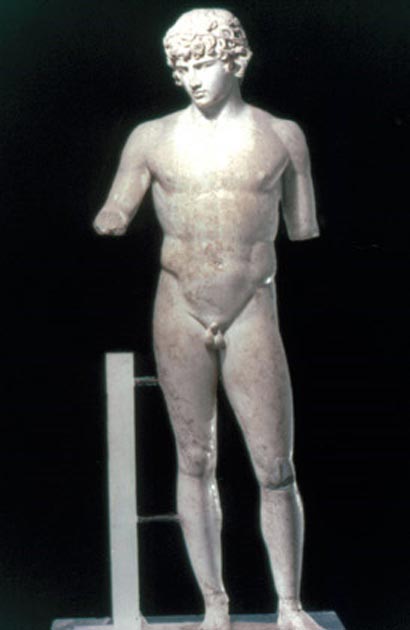
The Delphi Antinous statue was found standing perfectly upright, which indicates that it had been very carefully buried by the priests so as to protect it from marauding Christians. Apparently this statue was considered to be very special.

There are many larger-than- life statues of Antinous. And there are many busts. But the Delphi is one of the few life-size statues, and Johnston said it is possible that it was indeed modeled from the living Antinous.


If that was indeed the case, then it is possible, according to John J Johnston, a leading expert on Antinous, that Antinous was 5-foot-8 (173 cms) in height.

Owing to the long exposure time, the photographer asked the workmen to stand still (or as still as possible) for what must have seemed like an eternity to these simple men (one or two looking like a young Antinous) while the shutter was open.

This photo is one of the most emotionally touching portraits of ANTINOUS THE GAY GOD. It proves that the Ancient Priests of Antinous took special care to hide their precious statue from the barbarians. They didn't just dump Him into a hole -- they carefully buried Him standing upright with dignity!!

The photo is superb -- Antinous stands eternally in focus in the center -- the mortal men are blurred like the flames of votive candles which flicker briefly and go out -- only Antinous endures.

One young Antinous-looking man's face is in focus -- representing those few mortals who look into the Mysteries of Antinous....