SCIENTISTS have confirmed what the Ancient Egyptians always knew ... that scarab beetles can use the Milky Way to help them navigate at night.
Experts have always known that African dung beetles use the sun and the moon as directional markers when rolling balls of dung containing their precious eggs away from other beetles.
But it had never been scientifically proven that the beetles ... sacred to the Egyptians as symbols of transformation ... used the Milky Way as a directional marker on moonless nights.
Dung beetles are known for rolling up balls of dung for later use as food and a depository for their eggs. Once they collect the dung, the beetles quickly roll the ball away from the dung pile to avoid having it stolen by other beetles. They do this by moving in a straight line.
With the dung ball deposited in a safe place, the eggs hatch into larvae which then metamorphose into winged beetles ... and fly off, soaring towards the warmth-giving sun. Thus, the scarab became associated in Ancient Egyptian mysticism with the transformation of base material into the divine. The Egyptian glyph for scarab beetle ... "kheper" ... means "transform".
The Egyptians also associated the scarab beetle with movements of the sun, moon and stars. While the link to the sun and moon were easily proved, scientists did not have proof of a link to the stars ... until now.
To test whether the beetles were using the stars as a navigational aid, scientists put the beetles into a dung-rolling course and filmed their behavior. The beetles were able to move in a straight line on moonlight nights and also on moonless nights when the Milky Way was visible.
When the sky was overcast, the beetles were unable to roll the dung balls in a straight line. When the beetles had tiny visors taped onto their heads to block their view of the night sky, they spent their time wandering aimlessly.
Next, they tested their speed on a 2 meter platform. On nights when the Milky Way was visible, the beetles were able to cross the platform in as little as 40 seconds. On cloudy nights, it took the beetles nearly 2 minutes to cross the platform.
Lastly, scientists tested the beetles inside of a planetarium. The dung beetles moved more efficiently when the ground was lit by the light of the Milky Way. When the ground was lit by the light of only a few bright stars, the beetles performed worse.
This research is believed to be the first study to document the use of the Milky Way for orientation in the animal kingdom.
ON January 13th the Religion of Antinous celebrates the birthday of Aelius Caesar.
Lucius Ceionius Commodus Verus was born on January 13th, 101, most likely in Rome. He was from an old wealthy Etruscan family.
His grandfather, after whom he had been named, had been a Consul and his father a Senator.
(Images by PRIEST UENDI)
Lucius Ceionius was beautiful and elegant, well educated, and was given over to a life of pleasure and voluptuousness.
He was a teenager when Hadrian came to power in 117, and his flamboyant and attractive character was a compliment to his physical beauty that soon gained the attention of the new Emperor.
It is believed that Hadrian and Lucius were lovers during the early years of Hadrian's reign, perhaps for the period of six years prior to Antinous.
When Hadrian met Antinous in the year 123, Lucius was 22 years old, and in keeping with the Greek philosophy of pederastic love, it is very likely that their love affair had transformed into what would become a life-long friendship between the Emperor and his now matured Lucius.
Antinous entered Hadrian's heart just as Lucius was moving on to his responsibilities as a patrician citizen of Rome. There were rumors of rivalry, as spoofed in this cartoon by Priest Uendi showing Lucius left, Hadrian at right and Antinous between them.
While Hadrian was courting the young Antinous, Lucius married Domitia Lucilla and had three children by her, one of which was the later Emperor known as Lucius Verus, who is often confused with his father.

After the Death of Antinous, as Hadrian began to grow ill, his attention turned again to his still beloved Lucius, and on August 10, 136, Hadrian surprised the world by adopting Lucius and declaring him to be his successor.
Suspicions abounded, as the eccentric and delicate character of Lucius hardly seemed appropriate to rule the Empire after such a man as Hadrian.
But there must have been more to Lucius than history has preserved. He assumed the name Aelius Caesar, and was sent to govern Pannonia along the Danube, but became ill and returned to Rome in the winter of 137, where he died on January 1st.
He is remembered and adored as a god, as the brother of Antinous, the twin and second love of Hadrian. We call him the Prince of Flowers.
 ON January 12th, as the Sun moves out of alignment with the STAR OF ANTINOUS, we celebrate the festival of ANTINOUS NAVIGATOR.
Flamen Antonius Subia explains it this way:
"Antinous the Transfigured steps away and The Boat of Millions of Years in One Moment, leaves the shore of the known cosmos, sailing out into the darkness of the abyss on its voyage to the Black Star, the way of the void, where the heaven of Antinous lies concealed beyond the veil of the cloud of unknowing, where he enters the fullness of the Place of Light, and restores the unity of the Aeons.
"This is the Via Negativa whereupon the soul-triumphant is lost in the open space of non-being, awaiting the Dark Bird of Night, the Thunderbird-Phoenix-Eagle that will elevate his heroic spirit to immortality. Only Antinous can guide the Boat of Millions of Years across this expanse of darkness.
"This journey, which ends as it begins, which arrives as it departs, is the eternal heaven which Antinous has accomplished for all those who are his chosen, who answer his call, and who believe in him."
ON January 11th the Sun aligns with the STAR OF ANTINOUS for the most glorious day in our liturgical calendar ... Victoria Antinoi.
This is the day that the 72 days of mourning and mummification are finished and Antinous emerges from the perils of the Underworld to shine "younger than the newborn sun," as the Ancient Egyptian texts say.
Flamen Antonius Subia says:
"Antinous in glory and radiance, stands between our cosmos and the abyss that is known as the Veil. He has returned as Antinous the Savior. This is the End of the sacred period of 72 days following the earthly mummification of the body of Antinous.
"The preservation of his perfect body was completed by the Egyptian priests, providing him with a carnal vessel for millions of years.
"This is the day upon which Antinous overcomes the 72 princes who rule over the cycles of life and death in the underworld and the outer limit of the cosmos, and our god becomes Antinous the Victorious.
"This is the Coming Forth By Day of Antinous so that he can sail in his Barque of Millions of Years. His triumph becomes the celestial procession, and together with the saints and blessed spirits of the immortals and divinized men, Antinous prepares to step away from the limit of the cosmos and enter the darkness of the void beyond."
 ON January 10th we solemnly remember the gays who were burned at the stake in the Middle Ages..
The Heretics of the Middle Ages were the last defenders of the Gnosis, against the authority of the Catholic Church. Like the Gnostic Fathers before them, they advocated homosexuality as a sacred form of love.
When the Order of Knights Templar was disbanded in 1310, the inquisitors discovered (under torture) that Heresy, Homosexuality and Devil Worship were interrelated. They represented a united Satanic assault on the power of the Church and the stability of Christian Civilization.
Heresy infected the soul by undermining faith, Witchcraft bred hatred in the form of hexing, but Homosexuality was the vilest of the three because it infected Love, turning a man from his natural affection for a wife, and causing him to waste his seed in lecherous desire.
The homosexual was a danger because he was a threat to the perpetuation of the family and of the human race. He fostered chaos, and weakened the already tenuous position of a society hemmed in by Islam, infected with Plague, and torn apart by War. The Bible warned that any city guilty of the crime of Sodomy would be destroyed by the fire of heaven, so the solution of the Church, in order to avert god's wrath, was to burn the Sodomites.
The Gay Burning Times lasted six hundred years, seven hundred including the Nazis Holocaust (which was based on the same principles) a period of torture, murder and all out war against our kind, lasting much longer than Heresy and Witchcraft combined, which even continues to this day.
The most intense period of burning was the 1600's through late 1700's in France and England, hundreds of thousands were burned at the stake.
The word "Faggot" which means fire-log is said to have derived from the practice of piling the Sodomites upon the pyre, at the feet of the Heretics, because a Sodomite was not worthy to burn standing up.
Flamen Antonius Subia says:
We who believe in Antinous, and in the sanctity of Homosexuality, solemnly remember the cruel death of the Sodomites who burned for us. Antinous was with them, he burned by their side.
On this last day, Antinous the God redeems the souls of all those who were burned, tortured, strangled, beheaded, or otherwise executed and condemned to Hell by the Church.
That we may never forget the human sacrifice that was inflicted on our brothers and sisters, we consecrate the overthrow of the last Archon to the memory of the Heroic Sodomites who knowing that our form of Love was punishable by death, Loved as Homosexuals nevertheless, and almost willingly gave themselves to be Burned at the Stake. We pray that they will bless us with their fire in our own struggle for liberation.
THE good news is that Romans had indoor plumbing centuries before the rest of the world had running water and flushing toilets.
The bad news is that Ancient Rome's toilets, baths, aqueducts and sewage systems those public baths and shared latrines spread intestinal parasites and body lice.
People in the pre-historic times as well as in the Dark Ages who had to make do without plumbing actually had fewer worms and lice than the Romans.
The findings are contained in an article in the latest edition of Parisitology journal by Piers Mitchell, an archaeologist at the University of Cambridge.
Mitchell surveyed parasite numbers from latrine archaeological sites, in mummified remains and in fossilized feces before and after the implementation of Imperial Rome's hygiene projects.
The data suggest that roundworms and other parasites that spread through contact with feces maintained their numbers despite sanitation efforts ... perhaps because Romans used human feces to fertilize their crops and rarely changed the water at some public bath houses.
Romans also had no toilet paper, instead sharing a sponge-on-a-stick.
Fish tapeworm was even more common in Roman times that in the Bronze or Iron Ages, Mitchell claims.
He attributes to the popularity of GARUM, a fermented fish sauce in ancient Rome.
Regular bathing throughout the Empire also appears to have done little to curb populations of ectoparasites like head lice.
 ANTINOUS probably loved dogs.
The only portrait which shows Antinous alongside an animal is by the artist Antonianus of Aphrodisias found at Lanuvium showing Antinous harvesting grapes ... with a small dog looking up at him adoringingly.
Antinous no doubt was familiar with the Haralez, the beneficent canine spirits of the remote mountains of his native Bithynia and Armenia.
While the mountain mythology of that region possesses many heroes, monsters and spirits, the Haralez have always been the most beloved.
ANTINOUS probably loved dogs.
The only portrait which shows Antinous alongside an animal is by the artist Antonianus of Aphrodisias found at Lanuvium showing Antinous harvesting grapes ... with a small dog looking up at him adoringingly.
Antinous no doubt was familiar with the Haralez, the beneficent canine spirits of the remote mountains of his native Bithynia and Armenia.
While the mountain mythology of that region possesses many heroes, monsters and spirits, the Haralez have always been the most beloved.
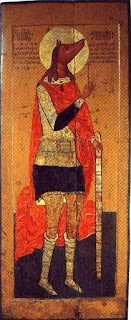 The Haralez assume canine form and guide and protect humans in peril.
Few people in modern-day Turkey know of the Harelez, and indeed, these Celtic myths were fading by the time Antinous was born in the 2nd Century AD.
But he might have heard old-timers speak of how, when a valiant man falls in battle, the Haralez comes to his rescue and, by licking his wounds, restores him to life.
The popularity of the Haralez never died out completely. Even today, Armenian folk tales mention the "perpetual lickers" who restore life to the dead.
The Haralez assume canine form and guide and protect humans in peril.
Few people in modern-day Turkey know of the Harelez, and indeed, these Celtic myths were fading by the time Antinous was born in the 2nd Century AD.
But he might have heard old-timers speak of how, when a valiant man falls in battle, the Haralez comes to his rescue and, by licking his wounds, restores him to life.
The popularity of the Haralez never died out completely. Even today, Armenian folk tales mention the "perpetual lickers" who restore life to the dead.

 SCIENTISTS have confirmed what the Ancient Egyptians always knew ... that scarab beetles can use the Milky Way to help them navigate at night.