Friday, July 7, 2023

MARTIN CAMPBELL'S HISTORICAL NOVEL
'QUEEN JULIUS CAESAR' IS A TRIUMPH


LOOKING for a holiday book tip? We can most assuredly say that, if you loved THE LOVE GOD, Martin Campbell's historical novel about the life of Antinous ... now you must read his new novel about the early life of Julius Caesar entitled "Queen Julius Caesar" ... now available in Kindle and paperback. ORDER HERE

This meticulously researched book (with 40 pages of glossary and appendices) is a fast-paced page-turner with swashbuckling pirates, orgies and political intrigue. And it has already spawned pre-publication controversy with its provocative title and the tag-line "Rome's greatest ruler was bisexual." 

But far more interestingly, Campbell shows how a cocky, privileged young Patrician, accustomed to getting his way, is forced through adversity and deprivation ... and the intervention of Eastern potentates ... to develop the qualities of character that will make him a great leader.

Along the way, he parlays physical and emotional disabilities (epilepsy, obsessive-compulsive tendencies and self-injury to allay emotional pain) into strengths which will enable him to outwit and outmaneuver his adversaries.

His lessons begin at sea on a galley loaded with gold when pirates commandeer his vessel and hold him for ransom. Cunningly, he informs his captors the ransom is too low, and he finagles and entraps the pirates.

Another man in such a hopeless and helpless situation would give up. But Campbell skillfully shows how Caesar used his wits and his obsessive-compulsive discipline and determination not only to save himself and his adjutants, but also to emerge victorious and to exact cruel vengeance which would earn Caesar a place in the history books as a man not to be trifled with. 

In addition, in Campbell's brilliant historical novel, 20-year-old Caesar's education in leadership comes in the arms (literally) of Nicomedes IV, king of Bithynia, and his consort Nysa. 

Prudish Victorian historians quibbled over the three-way relationship. But Julius Caesar's own troops lustily chanted: "Gallias Caesar subegit, Caesarem Nicomedes," (Caesar laid the Gauls low, Nicomedes laid Caesar low). Hence, the title of this book!

Campbell shows how young Julius Caesar observed the way Nicomedes charmed and coaxed and coerced his courtiers and his naval and land forces into doing his will ... without having to resort to blunt force in the traditional Roman way.

By the end of this at once charming and illuminating book, the reader has accompanied Julius Caesar from bumptious adolescence to manhood as a mature leader who can meet ... and defeat ... anything or anybody who gets in his way.

Through it all, the goddess Minerva provides off-stage asides to the reader in the tradition of the chorus in a Classical stage comedy.

Campbell is working on two more novels ... and we can't wait!

Thursday, July 6, 2023

HOW'S THIS FOR A DIVINE SIGN?
ANTINOUS MAKES MIRACULOUS APPEARANCE
ON HOLLYWOOD TEMPLE'S STREET CORNER


ANTINOUS miraculously appeared on July 6th, 2018, which is International Kissing Day ... literally around the corner from the Hollywood Temple of Antinous.

A larger-than-life, hand-painted wall advertisement adorned a building at the corner of La Brea and Melrose in Hollywood.

The advertisement was for Sabrina Carpenter's new single, which was being released that week. The image was all over social media.

"As soon as I saw the picture I knew where it was and ran down to see if it was true," our spiritual leader ANTONIUS SUBIA says. "It's a miracle! It's a great sign from Antinous!"

The image chosen by the artist for the advertisement is ... as sacred synchronicity would have it ... the Townley Antinous ... the same bust which is on the main altar of the Hollywood Temple of Antinous.

Now, the same bust of Antinous (as Dionysus-Bacchus) was featured as cover art for Sabrina Carpenter's single "Almost Love" ... and was emblazoned on a wall just a few steps away from the Hollywood Temple of Antinous!

The actress and singer's track was the first from her upcoming third album "Singular".

That weekend, Sabrina debuted the song with an amazing performance at Wango Tango in Los Angeles.

"The moment when the light is red before the go. The moment when the curtain’s down before the show. The moment when you’re done, but maybe just one more. That's how I feel before I get you all alone," she sings on the song.

Wednesday, July 5, 2023

WEAR A WREATH OF FLOWERS
DURING THE LUDI APOLLINARES


FROM the 5th to 13th of July is the Ludi Apollinares, a Roman festival in honour of Apollo. This was celebrated with horse racing and theatre plays. Livy writes: "The people took part in them wearing wreaths of flowers. The doors to the houses were opened, meals eaten in the open." So a picnic outside today would make a lovely way to celebrate. Photo art by Keith MezaenAset Hoberg.

05-13 de julho é o Ludi Apollinares , um festival romano em honra de Apollo . Este foi celebrado com corridas de cavalos e peças de teatro . Livy escreve: " As pessoas participaram neles vestindo coroas de flores As portas para as casas foram abertas , refeições consumidas no aberto. ". Assim, um piquenique fora hoje faria uma maneira bonita de comemorar . arte da foto por Keith MezaenAset Hoberg .

5-13to de julio es el Ludi Apollinares , un festival romano en honor de Apolo. Este fue celebrado con las carreras de caballos y obras de teatro . Livio escribe: " Las personas que participaron en ellos con coronas de flores Las puertas de las casas se abrieron , comidas comidas al aire libre. ". Por lo que un picnic fuera hoy haría una bonita manera de celebrar. Foto del arte de Keith MezaenAset Hoberg .

Tuesday, July 4, 2023

ANTINOUS IN LAODICEA
THE MERCURIAL CITY OF FINANCES


LAODICEA was the financial center of the Eastern Empire plus being the location of a fabled Temple of Hermes/Mercury (photos on this page).

And in these 21st Century days of financial crisis it is interesting to see how Emperor Hadrian promoted his own "financial stability mechanism" with on-site bail-outs and emergency cash injections.

In July 129 AD, Hadrian and Antinous arrived in triumph at Laodicea following their glowing visit to Ephesus.

The welcome was stupendous, especially since the Laodiceans knew the emperor was bringing not only chests full of money but also trade and business contracts and tax incentive reforms, all aimed at boosting prosperity and banking security.

The city stood on a spur of Mount Salbacus, one mile from the left bank of the Lycus, between the Asopus and Mount Cadmus, where it had a commanding view of the region between the Lycus and the Caprus.

It was one of the principal cities of Asia Minor, both as a major production center and a commercial hub, being famous for its woollen fabrics and its sandals.


It had received from Rome the title of free city, and it became the centre of a conventus juridicus, which comprised twenty-four cities besides itself.

Its wealthy citizens embellished it with beautiful monuments. The city had a school of  medicine and gave birth to the two skeptic philosophers, Antiochus and Theiodas. 


Its coins and inscriptions show evidence of the worship of Zeus, Æsculapius, Apollo, and the emperors.

Laodicea was one of the richest cities in the world, being the banking center of the east. So, great preparations must have been made for the visit of the Imperial entourage.

Entering the city of Laodicea during the summer of 129, Hadrian and Antinous were immediately welcomed by the wealthy population.


Due to its location and to the nearby medicinal baths, the city of Laodicea was a banking capital of the region and a place where wealthy merchants went to retire and enjoy the clean mountain air.

It was therefore a place very enthusiastic about the reforms that Hadrian had made and about his policies of Hellenism, which the Laodiceans would have considered good for business.

The Laodiceans had a great Temple to Zeus, Apollo and to Hermes, and it is the Temple of Hermes that is here of great importance because in Roman theology.


Mercury was the god of commerce which was all important in the rich city of Laodicea. It is therefore to the wealth of commerce, which had enriched the lives of the retirees of Laodicea, that we praise the policies of Hadrian the leader of Roman business.

FLAMEN ANTONIUS SUBIA suggests deeper spiritual insights which make this "Mercurial" city special to us:

"Antinous must have had an intense initiation into these financial mysteries, which were carried out in the courtyard of the Temple of Mercury, close to the watchful eye of the god. We pray to Mercury who ensures our livelihood and the success of the material world, which keeps our modern civilization in a constant state of progress."

Monday, July 3, 2023

DID ANTINOUS EAT PIZZA?


DID Antinous eat pizza? 

Archaeologists in the ancient Roman city of Pompeii have uncovered a fresco which depicts what might be the ancestor of the Italian pizza. 

The flatbread depicted in the 2,000-year-old fresco "may be a distant ancestor of the modern dish," Italy's culture ministry said. 

The fresco in the hall of a house next to a bakery confirms that, even if it didn't have mozarella, tomatoes, pineapple or jalapenos, the Romans knew something similar in the 1st Century AD!

Did you know that pizza was invented by Aeneas? The origin of pizza is in Virgil's Aeneid! 

The hero Aeneas sails the seas with other fugitives from Troy. They seek a new home. They are starving when they land on the shores of Italy. They only have some stale round loaves of bread to eat. 

They collect some "fruits of the field" (cheese? herbs? garlic?) and put these on top of the thin base. 

"Hey! We're even eating our tables!" says Ascanius, the son of Aeneas. (Heus! Etiam mensas consumimus inquit Iulus!)

Immediately, Aeneas remembers a prophecy: When you arrive at a place so tired and hungry that you eat your tables, you will know you have reached your promised land. 

Antinous remembers this story when he and Hadrian order pizza ... delivered by their lararium winged genius! So when you eat pizza, remember to quote the words of the son of Aeneas: Heus! Etiam mensas consumimus!

Saturday, July 1, 2023

ANTINOUS IS THE COVER BOY
OF AN INTERIOR DESIGN MAGAZINE


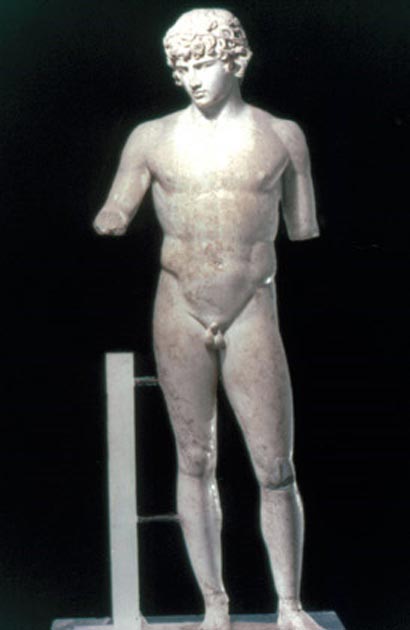
ANTINOUS the cover boy! A replica of the famous Delphi Antinous adorns the cover of the July 2023 issue of WORLD OF INTERIORS magazine.


By sacred synchronicity, July is also the month this statue was discovered at Delphi in Greece. A well-known photograph was taken on July 1st, 1894, showing workmen standing around the newly excavated statue.


The similarly iconic July 2023 cover shot by photographer Matthieu Salvaing shows metamorphic rock forms stalagmites framing Antinous in world-famous interior designer Jacques Garcia's newly created artificial grotto at a chateau in Normandy France which he has restored and vastly expanded and improved upon over the years.


Like European monarchs of old, Jacques Garcia has a regal vision of the life he wishes to lead. A country seat of some magnificence was key, so around 40 years ago the Paris-based interior decorator, who is actually quite modest but visited lots of historic castles and manors as a child, acquired Château du Champ de Bataille, a red-brick pleasure dome in a vast park in Normandy. 


Every few years, as time and money allow, he adds another scene to the domestic composition, another touch of extravagance: here a temple dedicated to Leda, a queen, whom Zeus, disguised as a swan, seduced; there a Rajasthani-style mini palace for entertaining that Garcia calls the Pavillon des Rêves and that incorporates Mughal architectural elements from centuries past. 


Over the past decade, a grotto has materialized, an artful destination that he describes as "one more element which adds to the philosophy, the sensitivity, the poetry, and the sense of travel". 

It is the latest extravagance to ornament Champ de Bataille, and the most dramatic: a brooding mountain of basalt-encrusted concrete that is almost entirely camouflaged with vegetation and perched atop a rusticated arcade. 

Golden gates open to a descending staircase, and one passes into a fever dream of sparkle and shine, like stepping into a geode. Beneath a golden vaulted ceiling pierced by an oculus, silvery mirrors reflect rugged walls of channeled basalt and columns that are clad in annealed charcoal to mimic obsidian and crowned by golden masks.

A statue of Antinous along with statues of other Classical deities and beings are tucked into niches, striking alluring attitudes as they gaze on to a central space that serves as a theatre in the round. 

Stalagmites of schist rise from the limestone, marble and red-brick floor and creep up the columns, framing a circular channel of rushing water. Even more stalagmites emerge from an exterior pond that Garcia excavated along one side of the grotto. 

Delectably conceived and grandly scaled ... the heart of the grotto is 15 meters high, from floor to ceiling ... it is quite mad, he admits, but so is its inspiration. 

The Venus Grotto at Schloss Linderhof in Germany is one of Ludwig II of Bavaria’s most superbly delirious creations, an 1870s fantasia equipped with a miniature lake on which the addled monarch set sail in a gilded barge in the shape of a seashell, the whole installation replicating a scene from Tannhäuser by Richard Wagner, Ludwig's emotional and musical obsession. 

Small wonder that Garcia and a former associate, Philippe Pottier, found themselves bewitched on their inaugural visit to the Rococo castle more than a decade ago. 

Fortuitously, they remembered a neglected spot at Champ du Bataille, about 100 meters from the château’s right flank, but just far enough out of sight to establish a new garden feature that would come as a surprise to wandering guests. 

Though the germ of the grotto was Bavarian, the interior is Garcia’s take on a French one, the Grotto of Tethys at Versailles, designed by André Le Nôtre in the 1660s and demolished two decades later when Louis XIV required more domestic square footage and the palace was expanded. Some of Le Nôtre’s fittings were relocated to the park of Château de Saint-Cloud, specifically a group of stone statues of gods and goddesses; Garcia had them replicated in plaster for his project. 

Last year, to celebrate the folly's completion, he hosted a party where performers in Roman garb and gilded masks disported themselves as a counter-tenor was accompanied by a cellist, and champagne flowed (‘Très Louis Quatorze,’ Levy-Alban, who was in attendance, dryly recalls.) A concert has followed, as well as a choir event.

Château du Champ de Bataille, 8 Route du Château, 27110 Sainte-Opportune-du- Bosc, France. Ring 00 33 2 32 34 84 34, or visit chateauduchampdebataille.com

Photos below:


THE DAY ONE OF THE MOST BEAUTIFUL
STATUES OF ANTINOUS WAS FOUND


ON July 1st, 1894, this historic photograph was taken of the discovery of one of the most beautiful statues of Antinous ever found.

French archaeologists were in the process of uncovering this statue at the Temple of Apollo at Delphi in Greece when the photographer asked the diggers to pose for posterity.

Hadrian and Antinous visited Delphi and were initiated into Mysteries.

The Delphi Antinous statue was found standing perfectly upright, which indicates that it had been very carefully buried by the priests so as to protect it from marauding Christians. Apparently this statue was considered to be very special.

There are many larger-than- life statues of Antinous. And there are many busts. But the Delphi is one of the few life-size statues, and Johnston said it is possible that it was indeed modeled from the living Antinous.


If that was indeed the case, then it is possible, according to John J Johnston, a leading expert on Antinous, that Antinous was 5-foot-8 (173 cms) in height.

Owing to the long exposure time, the photographer asked the workmen to stand still (or as still as possible) for what must have seemed like an eternity to these simple men (one or two looking like a young Antinous) while the shutter was open.


This photo is one of the most emotionally touching portraits of ANTINOUS THE GAY GOD. It proves that the Ancient Priests of Antinous took special care to hide their precious statue from the barbarians. They didn't just dump Him into a hole -- they carefully buried Him standing upright with dignity!!

The photo is superb ... Antinous stands eternally in focus in the center ... the mortal men are blurred like the flames of votive candles which flicker briefly and go out ... only Antinous endures.

One young Antinous-looking man's face is in focus ... representing those few mortals who look into the Mysteries of Antinous....