Thursday, June 28, 2012

NOT ANTINOUS THE GOD

BUT ANTINOUS THE SATURN MOON CRATER


THE STAR OF ANTINOUS is well known. And many people are aware that there is also an ANTINOUS ASTEROID ... but few people have heard of the ANTINOUS CRATER.

It is located on one of the moons of Saturn, the moon named for the Titan sea goddess Tethys, daughter of Uranus and Tellus/Gaea. The Antinous Crater is located at the bottom of this photo taken by the Cassini probe in a flyby. The bigger crater is Penelope.

This crater was named in 1982 after the "OTHER" Antinous — the infamous Antinous of Homer's Odyssey and the Iliad. That is obvious from the association with Penelope. It is highly possible that our God Antinous was in fact named for Homer's Antinous.

For the Ancients, names were not a matter of coincidence. A person's name MEANT something. Nomen est omen
— a name is a sign. So why was Antinous given the name of someone who is generally considered to be a scoundrel?

Homer's Antinous was one of the "Suitors of Penelope," the group of moochers who showed up at her doorstep while her husband Odysseus was off fighting the Trojan wars and attempted to woo her and abscond with as much of Odysseus's fortune as they could before he returned
— if he EVER returned. 

After all, he had been gone for years. Their argument was that he was a "dead beat" spouse and that he had abandoned Penelope and, at any rate, was most probably dead.
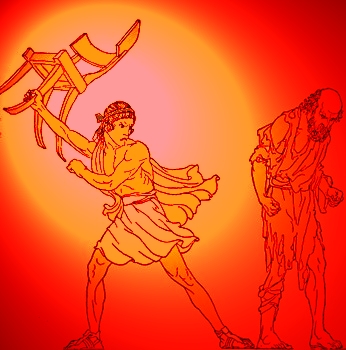

 Antinous was the craftiest of the suitors and plied Penelope with costly gifts. 

Then at last — at long last — Odysseus returned in the disguise of a beggar. 

Only his faithful dog recognized him. Penelope did not! 

Antinous did not recognize him either and, thinking he was just a homeless street schizo, attacked him with a chair to drive him off.

Later on, during an archery tournament, Odysseus "accidentally" shot Antinous and killed him.

As with much of the Odyssey and the Iliad, it is hard to tell who the "good guys" are and who the "bad guys" are. Homer's Antinous is not exactly a saint, but he in't really guilty of any crime either.

Penelope is the guilty one. As so often in Greek mythology, the women are treacherous and untrustworthy (just think of Pandora). One small detail which you probably did not learn in school was that Penelope had sex with Homer's Antinous and with ALL the other suitors. 


FLAMEN ANTINOALIS ANTONYUS SUBIA explains:
"And the resulting child from that pan-sexual tryst was born a little monstar with horns and hooves. He was called Pan because he was the son of Antinous and ALL the suitors. Penelope couldn't look at him, so she abandoned him, and he was taken in by Mercury, who absolutely adored the little monster.

"Ah yes, Penelope gave birth to Pan in Mantinea!"

Mantinea/Bithynia is the ancestral homeland of our own Antinous. So the name was of regional origin.

But that is not all because, in actual fact, Homer's Antinous was associated with magic. He was something of a wizard. 

According to legend, Homer's Antinous possessed the fabled Mirror of Vulcan/Hephaestus, which enabled him to peer into the past and the future.

So the name Antinous was always associated with myth and magic, even in ancient times. Hadrian, who was fascinated with all things Greek, would have recognized the association between young Antinous and the ancient Greek myth and magic.

As for the fabled Mirror of Vulcan/Hephaestus — that is the stuff of Antinoian myth and magic for a future blog entry ....

Wednesday, June 27, 2012

SAINT JUDY GARLAND

AND THE STONEWALL RIOTS


ON JUNE 27 the Religion of Antinous commemorates the Stonewall Riots and Judy Garland, Saint of Antinous.

It is the day our Liturgical Calendar sets aside for remembrance of that sultry summer evening in Greenwich Village in the summer of 1969 when a bunch of drag queens and assorted other gay men decided they weren't in the mood to put up with yet another raid by the corrupt and brutal NYPD.

Gays had had enough and they had just suffered a terrible shock — Judy Garland's tragic death on June 22 had rocked the gay world. It was said that 13 twisters raged through Kansas the day Judy died.

Judy had died in London, and amid much news media hype, her body was flown back to New York for a memorial service which drew a huge crowd of grief-stricken gay men who gathered outside Campbell's Funeral Chapel in Manhattan — on June 27, 1969.

Afterwards, the bars were jammed with gay men drowning their sorrows in booze and drugs while listening to Judy Garland songs full blast on every jukebox.

The mood was electrified by a sense of solidarity in grieving for a fallen idol. Gay men had surprised themselves by turning out enmasse for Judy's funeral. They had experienced strength in numbers for the first time. 
They had been on national TV news. In an unprecedented move by primetime national news anchormen, Walter Cronkite and Huntley-Brinkley had talked about Judy Garland's "tremendous appeal among male homosexual fans" — at supper time when whole families were watching the evening news!

Blacks were standing up for their rights. Women were burning their bras. The Chicano Movement was gathering steam. And now "ho-mo-sexuals" (the announcers were unaccustomed to speaking the word aloud) had the audacity to congregate outside a sacred chapel in broad daylight — and even allowed themselves to be shown on the evening news!

Straight people had been confronted with homosexuals right there on television beamed into their homes. And
— more importantly — homosexuals had seen themselves and their brothers/sisters on national television news.

The mood was electrified.

It was a Friday night. Late June. Hot and steamy. The bars were filled to bursting. Gay men were sharing a rare moment of solidarity in powerful emotions. There was a feeling, not only in New York, but around the world, that a paradigm shift had taken place. A gay icon had died suddenly and tragically (shades of Antinous) and gay people everywhere found themselves in a catharsis of identity change.

And THAT moment was when the Manhattan police happened to stage one of their periodic raids on queers. Basically it was a routine raid on an average gay bar. Nobody had reckoned with what would happen next. Even gay men were surprised by what happened next.

Especially gay men.

Grief turned to outrage. It was a spontaneous uprising fuelled by rage. The vice squad was overwhelmed. Reinforcements had to be sent in. Gay men stood their ground and advanced on the police, pushing them back.

It was the turning point for us. Gay men throughout America, and later in London, Berlin, Sydney and elsewhere began standing up for themselves under the banner "Remember Stonewall".


That was over 40 years ago. This year an estimated five million people marched and danced through the streets of Sao Paulo, Brazil, in this year's Gay Pride Parade.

It is a fitting continuance of that spirit of solidarity which was ignited on that humid Friday evening after Judy's funeral.

In a sense, Judy Garland died for us. Had it not been for her tragic death
— strangling on vomit over a toilet bowl in a London hotel suite — there might not have been any Stonewall Riots.

Flamen Antinoalis Antonyus Subia puts the Stonewall Riots into a spiritual context:
"It was the first resistance by homosexuals against the repression of two thousand years, and the beginning of the Gay Liberation movement. The importance of the Stonewall Riots is the awakening of gay consciousness, the throwing off of the coils of the python that had for so many centuries enveloped our divine form of Love. This sacred revolt is holy to Apollo, Dionysus, and Diana combined as the guardian spirits of Homosexuality. Our modern Gay society was born on this occasion, and all of the peace and freedom that we have obtained in the these short decades are due to the courage that erupted on that Sacred Night in front of the Stonewall Bar."

Tuesday, June 26, 2012


CAPITOLINE WOLF MAY BE MUCH NEWER

THAN WINCKELMANN THOUGHT


THE CAPITOLINE WOLF, a bronze statue representing Ancient Rome's most famous symbol, was probably sculpted during the Middle Ages, some 17 centuries later than what has long been thought.

Researchers at the University of Salento, who carried out radiocarbon and thermoluminescence tests, believe the statue dates from around the 12th Century AD and not the 5th Century BC, the Italian newspaper  Corriere della Sera reported.

The statue, which is kept at Rome's Capitoline Musuems, depicts a she-wolf suckling human twins.

The pair represent Romulus and Remus, brothers who, according to legend, founded Rome in 753 BC.

Most experts believe the twins were added in the late 15th Century AD, probably by the sculptor Antonio Pollaiolo.

However, the she-wolf was thought to have been a much older work, possibly pillaged from the Etruscans by conquering Roman soldiers and then used as a symbol of the founding myth of their city.

Ancient Roman writers, such as Pliny the Elder and Cicero, mentioned a statue of a she-wolf suckling the twins which they said was very old and sacred to citizens of Rome. But experts have always doubted whether this was that particular statue or a much later copy, especially since it is in such relatively pristine condition. 

"Now the thesis is that it is medieval copy of an original Etruscan work," Rome's municipality supervisor for culture, Umberto Broccoli, said at a news conference.

Broccoli noted that 18th Century German art historian Johann Joachim Winckelmann had first attributed the statue to an Etruscan maker in the 5th Century BC.

Openly homosexual Winckelmann, a SAINT OF ANTINOUS, is called the father of modern archaeology and the father of art history. Winckelmann cited the sculpting of the wolf's fur as indicating it was in the Etruscan style, not the later Roman style.

"The scientific debate has lasted for centuries, at least from Winckelmann onwards, and it is my opinion that we will never have a definitive answer," Broccoli said.

However, the latest study had brought "much more clarity," Broccoli added.


Monday, June 25, 2012

ANTINOUS AND THE SEVENTH

WONDER OF THE WORLD


ANTINOUS and Hadrian may not have seen all Seven Wonders of the Ancient World (they didn't make it to Babylon), but they definitely visited most of them — including the Temple of Artemis at Ephesus in June of 129 AD.

In the new novel "The Seven Wonders" by STEVEN SAYLOR there is a stunning description of the Temple of Ephesus — both the fabulous and monumental exterior as well as the awesome interior.

Reading this description gives you something of an idea of what greeted the eyes of Emperor Hadrian and Antinous as they entered the fabled city of Ephesus during the cycle of the Summer Solstice in the year 129 AD as part of their three-year tour of the Eastern Empire.

Ephesus had 300,000 inhabitants at its peak in the time of Hadrian, and it drew thousands of devotees to the shrine of the goddess annually. Even today, Ephesus is one of the most complete and most splendid ancient sites in the world and still draws thousands of tourists every year. The Great Library of Ephesus, which Hadrian patronized and greatly expanded, has been lovingly restored.

The Temple of Ephesus was consecrated to Artemis in her Asian element as a Phrygian-Hittite goddess of the hunt, a youthful manifestation of the Great Goddess of Mount Ida and Dydimus.


The Ephesus form of Artemis looks strange to our eyes — and looked strange to Roman eyes as well.

The Roman Artemis — called Diana — is a virgin huntress. She carries a bow and wears a short, simple tunic suitable for the chase.

But Artemis of Ephesus — presumably more ancient — stands stiffly upright with her bent elbows against her body, her forearms extended and her hands open. She wears a crown, and outlining her head is a nimbus decorated with winged bulls. More bulls and other animals adorn the stiff garment that covers her lower body, almost like a mummy casing.

From her neck hangs a necklace of acorns  and a ring of zodiacal figures, and below this you see the most striking feature of Artemis of Ephesus — a mass of pendulous, gourd-shaped protrusions that hang in a cluster from her upper body. At first glance, they appear to be multiple breasts. But in fact these protrusions are bulls' testicles.

You can read the full description (which we have only paraphrased here) in Saylor's marvelous novel, along with vivid details of the festive procession of the goddess through the streets of Ephesus and the sacrifice of scores of bulls to the virgin goddess at the temple — a ritual which Antinous must have seen with his own eyes.

The Temple had burned down on the night that Alexander the Great was born, but after his conquest, Alexander ordered the reconstruction of the Temple, which was still standing when Hadrian and Antinous visited.

ANTONIUS SUBIA explains the parallels between Artemis and Antinous and why we celebrate this Sacred Event:

"Artemis is considered the female Antinous, as his divine twin, the only goddess to exhibit lesbian qualities. She was worshipped as Diana alongside Antinous by the funeral society of Lanuvium. Ephesus was one of the first cities to proclaim Hadrian a living God, and one of the first to adhere to his veneration as a Divus.

"The presence of Antinous and Hadrian with their very pronounced Artemisian qualities must have made a deep impression on the Ephesians, in that they were aware that the city was being visited by living gods. It is to Artemis of Ephesus that this day is Sacred, as the female twin of Antinous, the Bithynian hunter god."

Sunday, June 24, 2012

STROLL THROUGH POMPEII

WITH GOOGLE WORLD WONDERS


POMPEII, Stonehenge and other ancient and modern sites are now available for armchair exploration thanks to Google's World Wonders Project, which lets people from around the world get a panoramic view of some of the world's most iconic historical locations.
 
A whopping 132 sites spanning 18 countries are on offer, dwarfing the original Seven Wonders of the Ancient World. These span a variety of categories, including archaeological sites, architecture, cities and towns, historical sites, monuments and memorials, palaces and castles, parks and gardens,  places of worship, regions and landscapes, and wonders of nature.
 
Among the collection are Stonehenge, Pompeii, the Kyoto temples, Shark Bay, and the Yosemite National Park. The only surviving ancient Wonder, the Great Pyramid of Giza, is not on the list, but we expect it is only a matter of time before Google expands this collection to feature more important “wonders” throughout the world.

The service employs Street View technology to provide a digital look at sites that may otherwise be inaccessible to many people. Since many of these could not be filmed by Google's cars, the company used trikes that carried cameras close enough to take pictures.

It is not just a Street View look at the famous buildings or natural formations, however, as Google is also providing 3D models and YouTube videos, in addition to historical information for research or just for curiosity. Google partnered with UNESCO, the World Monuments Fund, Getty Images and Ourplace for information and photographs.

Google has been launching a number of projects as part of the Google Cultural Institute to preserve and share famous historical material. It is publishing high-resolution images of the Dead Sea Scrolls, digitizing the archives of Nelson Mandela, and showcasing the world's art as part of its Art Project, which expanded form 17 museums to 151 in April.

The Google World Wonders Project can be accessed here.

Saturday, June 23, 2012

NOVA: ONLINE PYRAMID ADVENTURE


TOUR EGYPT this summer without the heat and pesky flies and even peskier tourists? Want to walk around the Sphinx? Clamber inside the Great Pyramid of Giza and seek out the pharaoh's burial chamber? Visit the magnificent tombs and temples of ancient Thebes?


Then check out NOVA: ONLINE PYRAMID ADVENTURE from the producers of the WGBH sciences series for PBS.

In this multi-layered, highly visual interactive, view 360° panoramas, "walkaround" photos, and other breathtaking imagery shot throughout the Giza Plateau and ancient Thebes (modern-day Luxor), often with special permission.

You'll see Old and New Kingdom tombs and temples, pyramids and statues, and a 140-foot-long wooden boat that is 4,600 years old. Enjoy this unique journey through the Land of the Pharaohs.

This clearly written and well designed site by PBS features the educational material of an episode of the award-winning NOVA science TV series presented in the format of an interactive website. 

The Online Pyramid Adventure includes clickable diagrams of four major pyramids and a high resolution gallery where you can examine 360 degree views of burial chambers and passage ways – some of which are closed to the public and can only be seen on this site!
 

Friday, June 22, 2012

BOLLYWOOD'S FIRST-EVER

HIJRA FILM WINS L.A. AWARDS


IN WHAT is being heralded as a breakthrough for India's transgender Hijras, a blockbuster Bollywood all-dancing, all-singing melodrama about Hijras has taken top honors at The Los Angeles Movie Awards (LAMA) in the International Films category. 

The Hindi-language film "QUEENS! — Destiny of Dance" took the first prize in the international films category, as well as awards for best director for David Atkins, best cinematography, best costume design, best supporting actress for Seema Biswas and best special effects.

It is the first-ever Bollywood film about hijras, and industry analysts say the awards will encourage filmmakers in India to tackle this controversial topic more often.

The story is told through the eyes of a young Hijra named Mukta, the archetype of Hijras — the most beautiful, the best dancer in the community, a natural leader whom all the other girls look up to. She is potentially the next Amma (Hijra mother) of the community.

That is ... until the arrival of a total stranger into their midst — a young 16-year-old whom Amma names Nandini. Right from the outset, Nandini is an enigma and a mystery — where has she come from? Did someone send her? And if so, what is the purpose of her arrival?

And what really is she? Is she in actuality a goddess, as Amma resolutely believes her to be? Is she a female? Is she male? Is she Hijra?

Director David Atkins says he wanted to celebrate the Hijra way of life using the metaphor of a colourful dance of destiny ....