Thursday, June 14, 2012

NEW STEVEN SAYLOR BOOK

PUTS THE WONDER BACK IN OLD GORDIANUS


GORDIANUS is back and his legions of fans can take delight in finding out — at long last — how Gordianus the naive teenager became cunning and cynical "Gordianus the Finder," the finest sleuth in the turbulent waning days of the Roman Republic.


THE SEVEN WONDERS is the prequel to a dozen previously published Gordianus novels and short-story collections by award-winning, openly gay writer STEVEN SAYLOR. 

Last seen, Gordianus was semi-retired and had more or less been turned out to pasture by Saylor, who turned his attention to epic novels about Rome spanning generations and centuries. Those epic novels were really quite good — good, but not great — and Gordianophiles were worried.


Had Saylor done what Sir Arthur Conan Doyle did with Sherlock Holmes? Weary of writing "trivial" serialized short novels, and itching to be regarded as the next Dickens, Conan Doyle dispensed with Holmes  — sent him hurtling over the Reichenbach Falls with Moriarty. And Conan Doyle turned to epic novels which were quite good — but not great.


Under pressure from fans (and his publishers), Conan Doyle grudgingly brought Holmes back in a "now it can be told" prequel about his most remarkable case prior to his tragic demise — "The Hound of the Baskervilles" — considered Conan Doyle's best novel, if only because grieving readers were so delighted to see their hero in his youthful prime of vim and vigor.


Saylor has done the same with THE SEVEN WONDERS, which is in many ways his best novel. Gordianus is no longer old and world-weary. He is 18 years old, wide-eyed and boyishly naive. All his sleuthing skills are there, but he hasn't yet developed a really good investigator's ability to look at a case objectively and to eliminate the impossible, so that whatever remains (no matter how improbable), must be the truth.

Gordianus develops this ability during his travels with his tutor Antipater of Sidon to see all Seven Wonders of the World.

As always, Saylor's historical accuracy is impeccable, and his readers have fun cross-referencing even minor characters and place names in their bedside LEMPRIÈRE'S for subtle details and wry clues that more casual readers may overlook.

This is "vintage" Saylor at his best, stringing together vignettes and colorful characters which seem to bear no relation to each other and which this brilliant author then weaves together into a Holmesian final chapter in which all is revealed.

(Speaking of revelations, there are a few "spoilers" in the next few paragraphs ....)

This time the vignettes and characters could not be more disparate. There are murders and mysterious goings-on which young Gordianus solves easily and whose outcome the reader has just as easily foreseen.

Some of these vignettes have appeared as short stories in magazines and seem to have been cobbled together for the book. The reader is just about to conclude that this is indeed primarily a travelogue collection of short mysteries in exotic locales, when ... all of a sudden ... Saylor works his magic and begins weaving all those disparate vignettes and characters together into a tale of espionage and intrigue which poses an imminent threat to Rome itself.

Young Gordianus realizes (as does the reader) that everything had been inter-connected and nothing and no one had been what it had appeared to be.

"The world is not as simple as you think," Antipater says to Gordianus. And it would never be as simple ever again for Gordianus in his subsequent exploits. The lessons he learns from Antipater put his career into perspective.

Along the way, young Gordianus beds gorgeous wenches at the Olympiade, consorts with a witch in the ruins of Corinth, sees a boy morph into a girl at the pool of Hermaphroditus, gets seduced by a high-class madame in Hallicarnassus, has gay sex with a beefy blond Gaul who is the true-life Colossus of Rhodes, receives sexual favors from a priestess of Ishtar in Babylon and even has mystical conjugal union with Isis in a sarcophagus buried deep inside the Great Pyramid.


Everything culminates in a fiery climax atop the Pharos Lighthouse at Alexandria when all is revealed quite literally in a blinding flash — and Gordianus the nice teenager from Rome has become "Gordianus the Finder."

After the success of "Hound of the Baskervilles", Conan Doyle had no choice but to write additional "prequels" about the early adventures of Sherlock Holmes, and eventually had to bring Holmes back from the dead so as to fight the Kaiser in World War I.

Last seen, the Great Detective had "definitely retired from London" and had taken himself "to bee-farming on the Sussex Downs" of southern England ... where he presumably still resides, when not appearing in some book, movie or TV mini-series.

That means Saylor now has no choice but to pen further early adventures of Gordianus and to stave off his demise indefinitely. Gordianus still alive somewhere in the world today? Impossible, you say?

Improbable, yes. Impossible, no .... not for Gordianus ... not for Steven Saylor.

Wednesday, June 13, 2012

KING LUDWIG II of BAVARIA

SAINT OF ANTINOUS


ON JUNE 13th the Religion of Antinous commemorates the life of King Ludwig II of Bavaria, who died on this date in 1886 under mysterious circumstances in an Alpine lake. As with Antinous, his death is shrouded in myth and legend and it will never be known whether he drowned accidentally or whether he was assassinated.

Born August 25, 1845, Ludwig was only 18 when he ascended to the throne of Bavaria in 1864. He was the last truly sovereign monarch of that Alpine nation, which was engulfed by Prussia during his reign and very much against his wishes.

While the king of Prussia was planning a war against France, and various other crowned heads of Europe were scheming and conniving to commit war and bloodshed, "Mad" King Ludwig (as he was called) devoted the entire resources of his land to the performing and visual arts, commissioning operas by Richard Wagner and building the most astounding fairy-tale castles and palaces.

In the build-up to the Franco-German war, as troops were marching off to battle, Ludwig did not bother to see off his military forces. Instead, he went off on a jaunt to Switzerland to confer with Wagner on plans for a Wagnerian opera house in Munich. The opera house was never built, due to opposition from local critics. Instead, it was built at the Bavarian town of Bayreuth to the specifications of the composer, paid for by Ludwig personally.

Shockingly, in a staunchly Roman Catholic land, Ludwig never married and instead surrounded himself with handsome manservants, artists and architects.

Indeed, Ludwig is best known as a closeted gay man whose legacy is intertwined with the history of art and architecture, as he commissioned the construction of several extravagant fantasy castles (the most famous being Neuschwanstein below) and was a devoted patron of Wagner, who might never have finished his "Ring" cycle without Ludwig's ostentatiously generous support.

In an age of fiercely militaristic nationalism, Ludwig came under intense pressures from his advisers to abandon his artistic projects and to devote himself to empire-building. Feeling harassed and irritated by his ministers, he considered dismissing the entire cabinet and replacing them with fresh faces. The cabinet decided to act first.


 Seeking a cause to depose Ludwig by constitutional means, the rebelling ministers decided on the rationale that he was mentally ill, and unable to rule.

Medical psychiatry was in its infancy, and a panel of "experts" assembled mostly anecdotal evidence of the king's "madness" to satisfy the ministers.


The list of "mad" behavior included his extreme shyness, his distaste for politics and state affairs, his complex and expensive flights of fancy (including moonlit picnics at which his young groomsmen were said to strip naked and dance), conversations with imaginary persons, sloppy and childish table manners and sending servants on lengthy and expensive expeditions to research architectural details in foreign lands.
He was deposed on June 9, 1886, and placed under house arrest at a castle on the shores of Lake Starnberg south of Munich where he was under the constant watchful eye of a psychiatrist.

On June 13, around 6:00 pm, Ludwig asked the psychiatrist to accompany him on a walk along the shore of Lake Starnberg. The doctor agreed, and told the guards not to follow them. The two men never returned. At 11:30 that night, searchers found both the king and his doctor dead, floating in the shallow water near the shore.

Ludwig was known to be a strong swimmer, the water was less than waist-deep where his body was found, and the official autopsy report indicated that no water was found in his lungs. Nonetheless, the official death certificate listed suicide by drowning. The death of the doctor was never explained.

Most other monarchs of his era have been forgotten, or else their names have been cursed by succeeding generations for laying the groundwork for the First World War. But Ludwig was only interested in laying the groundwork for grand architecture and enduring cultural masterpieces. His legacy of art and architecture — and homoerotic romance — continues to inspire and to enchant.

Tuesday, June 12, 2012

ANTINOUS IN THE STRANGEST PLACES

EVEN AT THE SUPERMARKET


ANTINOUS shows up in the most extraordinary places — even at the supermarket magazine rack.

Some years ago, Hachette published a magazine series entitled THE GODS OF ANCIENT EGYPT which featured special issues on scores of Egyptian deities — nearly 100 in all — each sporting a glossy brochure and an epoxy resin figurine in a little plastic "display case." The magazines were widely available at booksellers and newsstands around the world.

Antinous was featured in Issue 88 — possibly the most collectible issue in the whole series.

The Hachette magazines have long since gone out of print, but the figurines are still found on eBay and other online marketplaces. Antinous is hard to find, but occasionally he turns up and the bidding turns fierce as ANTINOMANIACS fight to possess the little 4.5-inch (14 cm) figurine.


Just hours ago, the one pictured above left sold on eBay for nearly $50 in "NRFB" condition — "Never Removed From Box."

It is "only a fake" of course. But that does not make it any less sacred or magical to anyone who loves Antinous. In ancient times, Antinous figurines, images, coins and medallions were prized by his worshipers as a sort of portable Sacred Token or Pocket Shrine.

In his authoritative book about Antinous, BELOVED AND GOD, Royston Lambert points out that in ancient times many followers of the Blessed Youth felt it was necessary to have a tangible representation of Antinous with them at all times for protection and for blessings:

"Some of the devotees evidently could not bear to be parted from the beneficial and reassuring presence of their Antinous and therefore had small, light-weight travelling busts or bronzes made to accompany them on their journeys."

Poor people made do with more crudely made representations, such as coins and figurines and medals made of lead, clay and other base materials. The demand was so great that there was a rife trade in which we would nowadays call "copyright piracy" among artisans turning out "illicitly yet more crude and cheap medallions of this hero whose images, miracles and protection were obviously sought by countless poor folk of faith."


People of modest means who were lucky enough to get their hands on one of his clay figures or commemorative coins would carry them with them for protection, often even wearing them:

"Many were pierced by holes and hung from the neck as talismans: Antinous' image offering protection against evil, sickness and death," says Lambert. 

Other such tiny statuettes, figurines, coins and medallions were placed in portable shrines or pouches or adorned away-from-home altars, and others were buried with the dead "to invoke the god's aid on the perilous journey into the unknown."

We look at the little Hachette Antinous figurine and see only a cheap epoxy resin plastic action figure, crudely hand-painted in some Chinese sweat shop. 

But imagine how the Ancient Priests of Antinous would have gaped in wonder at this little figurine swaddled in cellophane, along with a book of shiny pages unlike any papyrus, pages adorned with inscrutable glyphs and breath-takingly realistic images. 

Where we see ordinary plastic, the Ancient Priests would see a wondrous statuette fashioned in what to them would be a magical putty-like material not like anything found on Earth.

Clearly, it was fashioned by the Gods themselves — clearly, ANTINOUS THE GAY GOD truly is "immanent" (in-dwelling) in this miraculous vessel.

And the Ancient Priests would, of course, be absolutely right. 

Monday, June 11, 2012

THE RISE OF THE STAR OF ANTINOUS


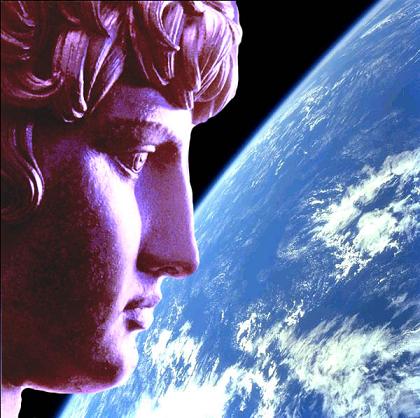
ON JUNE 11th, the Religion of Antinous celebrates the Rise of the Star of Antinous. This is the date in our Liturgical Calendar when the Constellation of Antinous begins to rise over the horizon at sunset. It is visible on the eastern horizon along the banks of the Milky Way.

Wherever you live on this blue marble we call Earth, you can see the Constellation of Antinous on starry nights from mid-June through late October when, in synchronicity with the Death of Antinous in late October, the Star of Antinous descends below the western horizon in the glare of the setting sun.
 

The Constellation of Antinous is no longer recognized by astronomers (just as Pluto has been demoted to the rank of "dwarf planet"). But it is still visible from any point on Earth nestled between Sagittarius and Capricorn and in the talons of Aquila (the Eagle Constellation) representing the Imperial Eagle which carried Antinous to lofty heights.

The most visible identifiers are the three bright stars of Aquila — Altair at the crown of his head, Tarazad, and Alshain. Alshain is derived from Arabic for "Two Friends" which astrologers have cited as a hint as to how to interpret the Sign of Antinous.

The Star of Antinous is however difficult to see. Most people cannot see it at all. You won't find it on any star chart. Like the Star of Bethlehem, it is a mystery and a conundrum about which many theories have been written.

And even if you could see it, the light which reaches your eyes would have left the star thousands of years ago — perhaps about the time that Emperor Hadrian discovered the star.

The simple truth of the matter — and the most beautiful facet of all — is the fact that Hadrian discovered the Star of Antinous with his own tear-filled eyes as he looked skyward in grief after the death of his beloved Antinous. Distraught and weeping, the emperor stood under the canopy of the star-studded heavens and looked up the River Nile towards the spot where his Beloved Boy had died. And he saw a new star which he recognized as a celestial sign that the gods had taken Antinous to be one of them.


You have to realize that Hadrian was a keen astronomer/astrologer himself. He knew the heavens like the back of his hand and he was so adept at casting horoscopes that it was said he had determined the exact hour of his death. He built an observatory at his sumptious villa outside Rome. And the tour of Egypt had brought him into contact with the finest Egyptian magician/priests, one of whom taught him how to cast a binding spell which could give him dream-visions and could also cause someone to fall hopelessly in love with him or — depending on how it was cast — even cause that person to die in agony.

Hadrian was that sort of control freak. Despite the fact that he was the mightiest man on Earth who could send a man to death on a whim (and did so, on occasion), he also wanted control over the future. And he wanted to be able to force someone to love him and never, never leave him.

Much has been theorized about those fateful final days leading up to the death and deification of Antinous and Hadrian's discovery of the STAR OF ANTINOUS.

Yes, much has been written about these events and about Hadrian's obsession with magic and astrology and soothsayers. One of the more fanciful versions was published in a novel in the mid-1950s by the German author Ernst Sommer. Entitled simply Antinous, the novel suggests Antinous sacrificed his own life to save his beloved emperor during the imperial tour of Egypt in the year 130 AD.


The dramatic climax of the plot has Hadrian lying in a villa in Hermopolis, feverish and at death's door after having been bitten by a mosquito. The emperor writhes in bed, calling out Antinous's name. The Empress Sabina and heir-apparent Lucius, jealous but also fearful that the presence of Antinous might further agitate the emperor, issue orders that the boy be kept away from the emperor.

After several daring attempts to sneak into the villa, Antinous is finally put under house arrest aboard an imperial vessel anchored a few miles upstream near the fallen-down Temple of Bes (the future site of the Sacred City of Antinoopolis). Lucius has ordered that he be put in irons to prevent him from sneaking off to visit Hadrian. But the guards cannot bring themselves to place the beauteous boy in irons, in defiance of Lucius's orders. Instead, they merely confine him to his quarters below deck with a single porthole overlooking the nighttime waters of the Nile.

Sensing that the emperor is dying, Antinous realizes his love for Hadrian is boundless and that nothing can keep them apart. Thinking back to his discussions about life and death with Jewish Rabbis, Christian clerics and Egyptian priests of Osiris, he realizes that the day has come. The hour has arrived. It is time to surrender everything he has — in a pure act of love that will transform everything.

He opens the porthole hatch and sees an unusually bright star which seems to beckon. He steps out of his clothes and leaves them (his last earthly possessions) lying in a heap on the floor. He climbs deftly out the porthole and slips quietly into the water.

At the same moment, Hadrian breathes his last breath, to the horror of Sabina and Lucius and the others who are gathered at his bedside. In a state now beyond physical life, Hadrian opens his eyes to see Anubis standing before him with outstretched hands, lifting him out of bed and guiding him away down many dark corridors. At last, Hadrian is taken through a massive portal and into a chamber where Thoth is waiting beside scales placed before Osiris.

Thoth begins the Weighing of the Heart ceremony as Osiris asks who this person is who seeks admittance to his realm. In the midst of the solemn proceedings there is a loud banging at the portal and Anubis announces that someone has arrived to offer his own heart in exchange for the emperor's heart, so that Hadrian might live and walk the earth again. That person is standing unseen just outside the portal. After brief discussion, the Egyptian deities acknowledge that the Law of Maat specifically envisions such an exchange and that, indeed, it is the most sacred and powerful of covenants — surrendering one's own heart on the Scales of Truth for that of a loved one. Such love cannot be denied. The offer cannot be denied.

Genesthoi — So Be It Done!

Back at the death bed in the Hermopolis villa, Hadrian gasps suddenly and his eyelids fly open, to the amazement of everyone who thought he had just expired. Sensing what has happened, he speaks hoarsely of a vivid dream involving deities. He looks around and demands to know where Antinous is.

"Where is he? What have you done with him? I know he would be here at my side if he were physically able. Bring him to me at once!"


But as Sabina and Lucius stammer excuses, and before the runners can summon Antinous, a boat crewman bursts into the room with the news that Antinous is missing and presumed to have drowned in the Nile.

Hadrian suffers a relapse, but the Egyptian magic is well done. So he cannot die this time. As the search for Antinous continues, with hope waning each day, Hadrian retreats to the rooftop observatory of the villa in Hermopolis which has been placed at his disposal by a wealthy Hermopolite. The emperor stares into the heavens night after night, refusing to give up hope that Antinous might yet be alive, perhaps dazed and confused and lost somewhere along the river.

Then one night he looks into the heavens and sees the proof that he has been looking for since the disappearance of Antinous. He summons the empress and Lucius and the entire court and also calls for the chief astrologer of the Temple of Thoth in Hermopolis to come quickly.

He informs them that a new star has appeared in the heavens and that it is a celestial sign that Antinous has left this earthly existence to ascend to the pantheon of the gods. He has surrendered everything on behalf of his beloved emperor, just as he had always said he would. Everyone thinks Hadrian has suffered another relapse and is delusional with fever. But the astronomer arrives and swiftly confirms that the sharp-eyed emperor has indeed discovered an uncharted star.

As Hadrian leaves to issue orders for the deification of Antinous, construction of the city at the spot where he drowned and erection of temples throughout the world, the astronomer remains behind in the rooftop observatory with the wealthy owner of the house. Where precisely is this new star, the owner asks. "I know quite a bit about the stars for an amateur, but I can't for the life of me see anything at the spot in the heavens where Caesar was pointing just a while ago."

The astronomer says that the new star is definitely there and that astronomers throughout the world will confirm its existence and it will be recorded duly in all the star charts.

"Yes, but can't you point it out to me?" the wealthy man pleas. "I'm straining my eys looking, but I just can't see anything."

The astronomer answers, "And that is why you will never be a good astronomer. You scan the heavens with your eyes, but not with your heart."

So Hadrian looked into the nighttime skies and discovered a new star to point the way to that new religion. As a scholar and man of science he was able to see it with his own two eyes. Perhaps it was a super-nova which flared and then went out — who knows? He saw it and his court astronomers confirmed it and the Constellation of Antinous was recorded in the star charts for 19 centuries to come.

But more importantly, Hadrian discovered the Star of Antinous shining in his heart. The Death of Antinous showed him a way to make his vision of the perfect religion a reality on Earth. It was the Light he was seeking. It was the Light of Antinous.

So when you look up into the nighttime skies tonight in search of the Star of Antinous, don't be surprised if you can't find it with your physical eyes. You can't find it in physical space, which is why Flamen Antinoalis Antonyus Subia calls it the Dark Star of Antinous. Look inside your heart and you will find it shining there with all the beauty of a dream of perfection ....

Lumen Antinoi Adiuva Nos!

(Light of Antinous, Sustain Us!)


Sunday, June 10, 2012

'ZOMBIES vs. GLADIATORS'

COMING TO A SCREEN NEAR YOU


GLADIATORS are all that can save Imperial Rome from a horde of hungry zombies in a new action-packed movie screenplay scenario.

Hellraiser creator and prolific horror and fantasy writer Clive Barker has been signed to write the action horror project, Zombies vs. Gladiators, for Amazon Studios. 

Set in ancient Rome, the Zombies vs. Gladiators story opens as a shaman who is about to die in the Colosseum casts a spell that unleashes the world's first zombies. It's up to an intrepid gladiator to stop the spread of the zombie horde and save Rome. 

Zombies vs. Gladiators becomes one of 16 film projects in development at Amazon since the division launched in November 2010 with a strategy that uses audience feedback and submissions to develop movie ideas. That led to the submission of 9,000 movie film scripts and 1,000 TV series pilot scripts.  

From the moment it debuted at Amazon Studios, Zombies vs. Gladiators has been one of the most creatively engaging scripts, spurring tremendous interest within the community and movie fans alike, indicating its mainstream and commercial viability for the studio. As a result of this overwhelming and popular support, Amazon is moving forward to develop the project with Clive Barker at the helm. 

"Zombies vs. Gladiators is now in the hands of someone who has written genre-defining material throughout his career," said Roy Price, director, Amazon Studios. "We are excited to see how Clive will add his unique narrative to capture the essence of this story and propel the project into something unique and original that could one day be enjoyed by all audiences."

Said Barker, "I'm excited by the opportunity to interweave two very rich narrative threads. One of them concerns itself with the reality of the decadence of Rome and its rise and fall. The other is a fantastical narrative element - the living dead. My brief to myself on this project is to give the audience not only zombies they have never seen before but also a Rome they have never seen before." 

At any rate, an infestation of flesh-eating zombies in ancient Rome certainly gives newfound vibrancy to Marc Antony's famous line from Shakespeare's Julius Caesar, "Friends, Romans, countrymen, lend me your ears."
 

Saturday, June 9, 2012

RARE JEAN BOULLET "ANTINOÜS"

PORTFOLIO GOES FOR $271 ON EBAY


A SUPERB portfolio of male erotic drawings entitled "ANTINOÜS" by Jean Boullet has sold on eBay for a whopping $271 -- proving once again the selling power of the anything to do with the Beauteous Boy.

Boullet was a gay French artist who illustrated a number of texts during the 1940s and 50s.

"ANTINOÜS" is a collection of 33 explicit homoerotic drawings laid into wrappers, one of 467 copies printed.

Inspired by Jean Cocteau, Boullet became known in France as "the painter of masculine beauty”, illustrating texts by Edgar Allan Poe, Raymond Asso and poems of Villon and Verlaine.

Fundamentally libertarian, anti-clerical and anti-establishment driven in his pursuit of the weird and taboo, Jean Boullet was also passionate about sexology, magic, demonology, and gay mythology.

Boullet was found hanging from a tree in Algeria in 1970, exact details surrounding his death remain unclear to this day.

Friday, June 8, 2012

JOHANN JOACHIM WINCKELMANN

SAINT OF ANTINOUS


ON JUNE 8th the Religion of Antinous commemorates the flamboyantly gay man who is the father of modern archaeology, our own Saint Johann Joachim Winckelmann.

Born in Stendal, Germany, on December 9, 1717, he is called the father of modern archaeology because of his scientific studies of the excavations of Pompeii and Herculaneum in Italy.


He was a student of classical art and his many writings, including the famous History of Ancient Art, are a testament to his adoration of the male form as manifested in Greek and Roman sculpture. 

He wrote openly about his homosexual relationships as early as 1763, and eventually found employment with Cardinal Allesandro Albani, whose art collection he catalogued.


Winckelmann is among the first to conduct a serious study of the art of Antinous, and to have written openly about the significance of the relationship between Hadrian and Antinous. He is also believed to have been part of the first revival of the Religion of Antinous, and Priapus, led in secret by Cardinal Albani.

Winckelmann was murdered in his hotel room in Trier Germany by a young man with whom he was having a casual love affair, on the 8th of June 1768. He was stabbed multiple times including repeated wounds to the groin, evidently out of sexual violence.

For his work as a student of the art of Antinous, and as an early believer the Religion of Antinous, and for the violence of his death, Johann Joachim Winckelmann is revered as an Innocent Martyr of the Religion of Antinous, perhaps the most specifically Antinonine of all those who died as a consequence of their desire for beautiful men.

Notice the painting above by Anton Von Maron. Winckelmann sits in a magnificent costume, gazing on an engraving of Antinous and writing his thoughts, as though the painter has distracted him from his meditation ... but we can be be sure that Winckelmann wanted us to know that Antinous was at the forefront of his thoughts.