EXPERTS have found iron beads in Egypt dating back 5,500 years ... thousands of years before the dawn of the Iron Age when mankind mastered the art of smelting iron.
Where did these beads come from? Surely they didn't just fall from the sky. Or did they?
Diane Johnson, a professor at the Open University in Milton Keynes in the United Kingdom, and several colleagues have solved the puzzle. The team reports in the journal Meteoritics & Planetary Science that the iron beads found Gerzeh Egypt did, indeed, fall from the sky.
These beads are made from meteoric iron, which is so pure it doesn't need to be smelted.
Johnson and her coauthors point out that the Gerzeh "iron seems to be used exclusively for high-status funerary goods, implying that a particular importance was placed upon it."
The ancient Hittites of Turkey were the first to smelt iron, around 1500 BC. In Egypt, the earliest iron smelting dates to around 700 BC. That's why it came as a considerable surprise when archaeologists recovered a handful of iron beads from the Gerzeh cemetery near Cairo dating to around 3500 BC.
Did the ancient Egyptians understand that meteorites came from the sky and is this why the iron was held in such esteem?
Maybe so because the ancient Egyptian term for iron ... "bja" ... might be translated as "stuff of which the sky is made."
There was no iron smelting in North America until around AD 1000, when Vikings brought the technology with them to the briefly occupied site of L'Anse aux Meadows in Newfoundland. It didn't catch on among the indigenous population and wasn't reintroduced until after 1492.
But just as in Egypt, iron artifacts are found at much earlier sites in North America, and the explanation is the same ... native peoples made use of "stuff of which the sky is made."
BRITISH
archaeologists have uncovered the remains of circular stone building
with red and white painted walls that was once a Roman-era shrine which
possibly could have been dedicated to Antinous in the guise of the Celtic war god Antenociticus.
Uncovered in Cornwall
near the Rutland Water Nature Reserve, the shrine consists of a circular
stone building with red and white painted walls, and the skeletal
remains of a man who had been buried in its center.
The Cornwall discovery shares headlines today with the discovery of a stone head of ANTENOCITICUS near Hadrian's Wall in County Durham.
At the Cornwall site, archaeologists
also found more than 200 Roman coins, a small bronze figurine, pottery,
and animal bones that were probably left behind by the ritual slaughter
of lambs and cattle in ritual sacrifices.
“Finding Roman shrines
is not the norm, so we were delighted,” said Jo Everitt, environment
and heritage assessor for Anglian Water.
The shrine was found on land that will be added to the nature reserve.
The shrine is thought to be dedicated to Cocicius, a form of Antenociticus, who is believed to be a Celtic form of Antinous.
Another
Celtic god with whom Antinous was assimilated, according to an
inscription found at Hadrian's Villa is another form of Apollo, is the
god Belenus whose cult was worshiped all over the Celtic world, but is
said to have been particular to Cornwall.

So Antinous has a Cornish connection for some reason.
Roman
sites had been found in the area at Collyweston Great Woods, 14km
(eight miles) to the south-east of Rutland, and another to the
north-west of Rutland Water, near Oakham.
They also found more
than 200 Roman coins, pottery jars, part of a small bronze figurine and
deposits of animal bone, probably from the ritual sacrifice of lambs and
cattle.
A skeleton of a man, aged about 30, was buried in a grave in the centre of the shrine.
The archaeologists believe the shrine fell out of use in 300 AD.
Ms
Everitt added: "We've recreated part of the foundation and wall of the
shrine from the original stone on an area outside of the lagoons so
visitors to Rutland can see what it looked like."
The findings from the dig are currently being displayed at the Rutland Water visitor centre.
EXPERTS in Britain have unearthed a bust of an obscure and mysterious curly-haired deity who may have been the guise of Antinous as he was worshiped by Roman Legions stationed at Hadrian's Wall.
The 1,800-year-old carved stone head of the local war god Antenociticus was discovered buried in an ancient rubbish dump at a fort near the Wall.
The discovery was made by a first-year archaeology student at Binchester Roman fort, near Bishop Auckland in County Durham, as the team dug through an old bath house.
The 20 cm (8 inch) sandstone head, which dates from the 2nd or 3rd Century AD, is almost certainly the Celtic deity Antenociticus, thought to have been identified with Antinous and worshipped locally as a source of inspiration in war.
A similar head, complete with an inscription identifying it as Antenociticus, was found at Newcastle upon Tyne, in 1862.
Dr David Petts, a lecturer in archaeology at Durham University, said: "We found the Binchester head close to where a small Roman altar was found two years ago.

"We think it may have been associated with a small shrine in the bath house and dumped after the building fell out of use, probably in the 4th century AD.
"It is probably the head of a Roman god – we can't be sure of his name, but it does have similarities to the head of Antenociticus found at Benwell in the 19th century.
"Antenociticus is one of a number of gods known only from the northern frontier, a region which seems to have had a number of its own deities.
"It's possibly a local god, though it could have been worshipped at the other end of the wall."
Antinous in the guise of Antenociticus is not mentioned at any other Romano-British site or on any inscriptions from Europe, which is why it has been identified as a local deity.
Archaeologically there is a period of time in AD 126 to
127 when we have no record of where Hadrian was. We do know, however,
that the wall was completed in Ad 128.
It is believed he would
have come to Britannia to oversee the final stages of the wall. It is
further believe he would have brought Antinous with him.
That is
why the locals (mostly of mixed Roman and British blood, by then)
connected Antinous to a local deity Citicus and re-named him
Antenociticus.
Hence the mysterious ruined temple dedicated to Antenociticus, beside the wall.
Alex Kirton, 19, from Hertfordshire, who found the head, said: "As an archaeology student this is one of the best things and most exciting things that could have happened.
"It was an incredible thing to find in a lump of soil in the middle of nowhere – I've never found anything remotely exciting as this."
WHAT gets flushed down the drain today ... may be an archaeological treasure in the future.
That is what archaeologists have discovered in sifting through the detritus from ancient Roman baths, according to ARCHAEOLOGY magazine.
In a recent study, Alissa Whitmore of the University of Iowa examined the broad range of activities that took place in Roman public baths such as the Baths of Diocletian (image above) ... based on what went down the drains.
According to Whitmore, the ancient Romans lost all sorts of precious items, including jewelry, hairpins, and pendants, while bathing. But she also found that they deliberately discarded other things in the baths, such as broken ceramics and glass.
Many of the artifacts that have been discovered in bath drains, such as perfume jars, oil flasks, nail cleaners, and tweezers, were related to hygienic behaviors.
However, other artifacts indicate that less hygienic activities also took place there. Cups, seashells, animal bones, dice, gaming pieces, and needles suggest that feasting, gambling, and sewing occurred in some baths.
The discovery of human teeth and a scalpel also imply that dental and medical procedures may have taken place in some facilities.
"The wide variety of finds really drives home that the baths weren't just for bathing," says Whitmore, "but a major social center, in which people performed a number of different activities while spending time with friends."
IN WAKE OF 'TREASURES OF ANCIENT ROME'
BBC SETS MORE HISTORY DOCUMENTARIES
FOLLOWING the resounding success of "The Treasures of Ancient Rome" on BBC4 which featured Antinous, the BBC has ordered several more documentaries that will explore some of the great empires and their leaders.
"The Treasures of Ancient Rome," hosted by art historian Alastair Sooke (BBC4 promotional photo above), examined the give of art that Rome gave to the world. In one segment, the three-part documentary focused on the artistic legacy Emperor Hadrian and Antinous.
One of our own MODERN PRIESTS OF ANTINOUS was interviewed on camera by Sooke in the documentary, which has aired in Britain and currently is being syndicated throughout the world.
On the heels of that success, BBC Two has commissioned a three-part exploration of Napoleon Bonaparte, a portrait of Roman emperor Caligula and an in-depth look at recently found catacombs in Rome.
"These thoughtful, dramatic, highly colored views of our past offer great stories, great arguments and great characters," said Martin Davidson, commissioning editor, history and business. "Each of these programs takes audiences on a fascinating journey and along the way they’ll shed a new light on periods of history we think we know so well."
BBC Two said that the three-hour series "Napoleon" will look to "shed new light on the emperor as an extraordinary, gifted military commander and a mesmeric leader whose private life was littered with disappointments and betrayals."
The show will see historian Andrew Roberts visit former battlefields of Europe and discuss events that helped shape European history.
"The series also paints a controversial portrait of Napoleon, a man demonized as a dictator as ruthless as Hitler," BBC Two said. "But rather than be remembered as the demon of history and a man responsible for the deaths of hundreds of thousands of soldiers, Napoleon was also the man responsible for securing the success of the French Revolution and who put in place many of the features of the modern state."
Napoleon is a SAINT OF ANTINOUS for precisely that reason and because he decriminalized homosexuality in France.
Meanwhile, the hour-long "Caligula" will explore myths and realities of the life of an emperor who ruled Rome for only four years before being assassinated at age 29.
"He was said to have made his horse a consul, proclaimed himself a living God and indulged in scandalous orgies - and not to mention his construction of vast bridges across land and sea, prostituting senators’ wives and killing half the Roman elite seemingly on a whim," BBC Two said.
The network has also ordered the hour-long "The Mystery of Rome’s X Tombs," which will explore tombs recently discovered in one of Rome’s catacombs. The tombs contained more than 2,000 skeletons, more than usual burial places, and were marked as "X" in the Vatican's underground mapping system.
The show will explore who the dead were, with theories pointing to a wealthy immigrant community or members of Ancient Rome's elite.
LAODICEA was
the financial center of the Eastern Empire.
And in these 21st Century
days of financial crisis it is interesting to see how Emperor Hadrian
promoted his own "financial stability mechanism" ...
... with on-site bail-outs
and emergency cash injections.
In July 129 AD, Hadrian and Antinous arrived in triumph at Laodicea following their glowing visit to
Ephesus.
The welcome was stupendous, especially since the Laodiceans
knew the emperor was bringing not only chests full of money but also
trade and business contracts and tax incentive reforms, all aimed at
boosting prosperity and banking security.
The city stood on a
spur of Mount Salbacus, one mile from the left bank of the Lycus,
between the Asopus and Mount Cadmus, where it had a commanding view of
the region between the Lycus and the Caprus.
It was one of the
principal cities of Asia Minor, both as a major production center and a
commercial hub, being famous for its woollen fabrics and its sandals. It
had received from Rome the title of free city, and it became the centre
of a conventus juridicus, which comprised twenty-four cities besides
itself.
Its wealthy citizens embellished it with beautiful
monuments. The city had a school of medicine and gave birth to the two
skeptic philosophers, Antiochus and Theiodas. Its coins and inscriptions
show evidence of the worship of Zeus, Æsculapius, Apollo, and the
emperors.
Laodicea was one of the richest cities in the world,
being the banking center of the east. So, great preparations must have
been made for the visit of the Imperial entourage.
Entering the
city of Laodicea during the summer of 129, Hadrian and Antinous were
immediately welcomed by the wealthy population. Due to its location and
to the nearby medicinal baths, the city of Laodicea was a banking
capital of the region and a place where wealthy merchants went to retire
and enjoy the clean mountain air.

It
was therefore a place very enthusiastic about the reforms that Hadrian
had made and about his policies of Hellenism, which the Laodiceans would
have considered good for business.
The Laodiceans had a great
Temple to Zeus, Apollo and to Hermes, and it is the Temple of Hermes
that is here of great importance because in Roman theology, Mercury was
the god of commerce which was all important in the rich city of
Laodicea. It is therefore to the wealth of commerce, which had enriched
the lives of the retirees of Laodicea, that we praise the policies of
Hadrian the leader of Roman business.
FLAMEN ANTONYUS SUBIA suggests deeper spiritual insights which make this "Mercurial" city special to us:
"Antinous
must have had an intense initiation into these financial mystieries,
which were carried out in the courtyard of the Temple of Mercury, close
to the watchful eye of the god. We pray to Mercury who ensures our
livelihood and the success of the material world, which keeps our modern
civilization in a constant state of progress."
 ON July 1st, 1893, this historic photograph was taken of the discovery of one of the most beautiful statues of Antinous ever found.
French archaeologists were in the process of uncovering this statue at the Temple of Apollo at Delphi in Greece when the photographer asked the diggers to pose for posterity.
Hadrian and Antinous visited Delphi and were initiated into Mysteries.
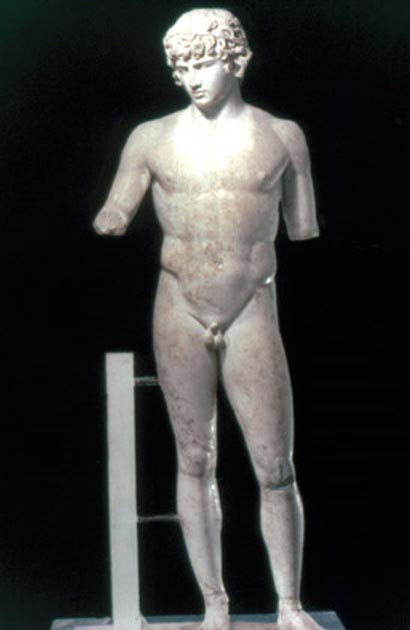
The Delphi Antinous statue was found standing perfectly upright, which indicates that it had been very carefully buried by the priests so as to protect it from marauding Christians. Apparently this statue was considered to be very special.
There are many larger-than- life statues of Antinous. And there are many busts. But the Delphi is one of the few life-size statues, and Johnston said it is possible that it was indeed modeled from the living Antinous.

If that was indeed the case, then it is possible, according to John J Johnston, a leading expert on Antinous, that Antinous was 5-foot-8 (173 cms) in height.
Owing to the long exposure time, the photographer asked the workmen to stand still (or as still as possible) for what must have seemed like an eternity to these simple men (one or two looking like a young Antinous) while the shutter was open.
This photo is one of the most emotionally touching portraits of ANTINOUS THE GAY GOD. It proves that the Ancient Priests of Antinous took special care to hide their precious statue from the barbarians. They didn't just dump Him into a hole -- they carefully buried Him standing upright with dignity!!
The photo is superb -- Antinous stands eternally in focus in the center -- the mortal men are blurred like the flames of votive candles which flicker briefly and go out -- only Antinous endures.
One young Antinous-looking man's face is in focus -- representing those few mortals who look into the Mysteries of Antinous....