OLDEST PORTRAIT OF A PHARAOH
FINALLY IDENTIFIED AFTER 120 YEARS
IT was there for all to see, staring Egyptologists in the face since it was discovered 120 years ago ....
Only now have experts taken a closer look at carvings on rocks near Aswan ... and realized that the carvings show the oldest known depiction of an Egyptian pharaoh ... carved 5,000 years ago.
The discovery shows once again that the sands of Egypt still have much to offer historians ... and that many archaeological treasures are routinely overlooked by experts overwhelmed by the sheer volume of artifacts from Ancient Egypt.
Found on vertical rocks at Nag el-Hamdulab, four miles north of the Aswan Dam, the roughly hewn images depict a pharaoh riding boats with attendant prisoners and animals in what is thought to be a tax-collecting tour.
"We don't know with certainty who the king represented at Hamdulab is. We can guess on paleographic and iconographic grounds," Maria Carmela Gatto, associate research scholar in Egyptology at Yale University and co-director of thee Aswan-Kom Ombo archaeological project in Egypt, told Discovery News.
Indeed, the style of the carvings suggests that the images were made at a late Dynasty date, around 3200-3100 B.C. This would have been the reign of Narmer, the first king to unify northern and southern Egypt, thus regarded by many scholars as Egypt's founding pharaoh.
"There are depictions of local rulers since the first half of the fourth millennium BC, but Hamdulab seems by date to be the earliest datable representation of a king wearing one of the recognizable crowns of the ruler of all Egypt, engaged in a labeled royal ritual," John Darnell, professor of Egyptology at Yale University, told Discovery News.
Discovered in the 1890s by the archaeologist Archibald Sayce, the carvings remained unnoticed for over a century. In the 1960s, Egyptian archaeologist Labib Habachi photographed Sayce's drawings of the rock images, but never published them.
When one of Habachi's pictures resurfaced in 2008, Gatto investigated the site, discovering an entire rock art gallery.
Meanwhile, we are still waiting for someone to dust off a rock inscription which says: "Secret Entrance to Lost Tomb of Antinous Located Under This Stone."
ALL LOVERS OF ANTINOUS
CELEBRATE THE MINOR BACCHANALIA
ON January 6th we celebrate the Minor Bacchanalia.
The
lesser Festival of Dionysus is celebrated when the wine has reached
fermentation. Traditionally a secret ceremony limited to women, but
opened to men during Roman times.
It
is the season in which Dionysus rules at Delphi and at Eleusis, though
the full ceremonies of the Minor Bacchanalia were only performed once
every two years.
Mythologically this is the occasion when the
Titans lure and capture the child Dionysus, charming him with a mirror
and toys. The Titans murder him, rend his limbs from his body and eat
his flesh.
This is the first Wine festival and triumphal
procession of the entourage of Dionysus whose arrival signals the
Victory of Antinous over the forces of life and death as represented by
the Archons.
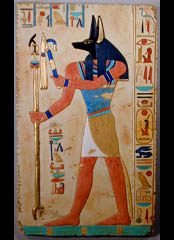
 A cache of eight million mummified dogs has been unearthed in dark catacombs adjacent to the ANUBIEION, the mystery-shrouded Temple of the jackal-headed Egyptian deity Anubis at Saqqara south of Cairo.
The unique, terraced temple compound was built into the face of the cliffs overlooking the ancient Egyptian capital city of Memphis/Mennefer. Beyond the Anubieion lay the necropolis city of the dead. In front of it lay the teeming city nestled in the Nile Valley.
For decades, experts were unsure what purpose the Anubieion served. No where else in Egypt is there a temple dedicated solely to Anubis. Some temples to other deities had niche shrines to the jackal-headed deity who conveyed the souls of the dead to everlasting life.
A cache of eight million mummified dogs has been unearthed in dark catacombs adjacent to the ANUBIEION, the mystery-shrouded Temple of the jackal-headed Egyptian deity Anubis at Saqqara south of Cairo.
The unique, terraced temple compound was built into the face of the cliffs overlooking the ancient Egyptian capital city of Memphis/Mennefer. Beyond the Anubieion lay the necropolis city of the dead. In front of it lay the teeming city nestled in the Nile Valley.
For decades, experts were unsure what purpose the Anubieion served. No where else in Egypt is there a temple dedicated solely to Anubis. Some temples to other deities had niche shrines to the jackal-headed deity who conveyed the souls of the dead to everlasting life.
But the discovery of myriads of mummified dogs in the Anubieion's catacombs makes it clear that the Anubieion was indeed a temple whose goal was to assist people in making the transition from earthly life to eternal life.
The dog mummies were sold to serve as "guide dogs" for souls of the departed.
 As Christianity spread in Egypt, Anubis morphed into St. Christopher ... and many early Coptic images of Saint Christopher depict him with the head of a dog (image at left).
The discovery came during routine excavations at the dog catacomb in Saqqara necropolis by an excavation team led by Salima Ikram, professor of Egyptology at The American University in Cairo (AUC), and an international team of researchers led by Paul Nicholson of Cardiff University.
Initial inspection reveals that dogs of all breeds and ages were mummified, from newborn puppies to decrepit old dogs.
“We are recording the animal bones and the mummification techniques used to prepare the animals,” Ikram said.
Ikram also told National Geographic, which is financing the project, that "in some churches people light a candle, and their prayer is taken directly up to God in that smoke. In the same way, a mummified dog's spirit would carry a person's prayer to the afterlife".
Saqqara dog catacomb was first discovered in 1897 when well-known French Egyptologist Jacques De Morgan published his Carte of Memphite necropolis, with his map showing that there are two dog catacombs in the area.
However, mystery has overshadowed such mapping as it was not clear who was the first to discover the catacombs nor who carried out the mapping, and whether they were really for dogs.
"The proximity of the catacombs to the nearby temple of Anubis, the so called jackal or dog-headed deity associated with cemeteries and embalming, makes it likely that these catacombs are indeed for canines and their presence at Saqqara is to be explained by the concentration of other animal cuts at the site," Nicholson wrote on his website.
"These other cults include the burials of, and temples for, bulls, cows, baboons, ibises, hawks and cats all of which were thought to act as intermediaries between humans and their gods."

Despite the great quantity of animals buried in these catacombs and the immense size of the underground burial places, Egyptologists have focused on the temples and on inscriptional evidence rather than on the animals themselves.
The mysteries behind De Morgan's mapping were unsolved until 2009 when this team started concrete excavations at the cemetery in an attempt to learn more about the archaeological and history of the site.
"Results at the first season showed that De Morgan map has substantial inaccuracies and a new survey is under way," Nicholson said.
"The animal bones themselves have been sampled and preliminary results suggest that as well as actual dogs there may be other canids present. Furthermore the age profile of the animals is being examined so that patterns of mortality can be ascertained."
TEN COMMANDMENTS 'TABLETS' FETCH $60,000
AT MOVIE MEMORABILIA AUCTION
FAKE stone "tablets" brandished by Charlton Heston in the Hollywood blockbuster THE TEN COMMANDMENTS have sold in an auction of film memorabilia for $65,000.
The tablets, upon which the Commandments are written, are the most famous prop in the 1956 Oscar-winning film, in which Mr Heston played Moses.
The tablets are 23 inches tall and 12 inches wide and were originally "constructed of richly hewn fiberglass on wood backing," according to the auction brochure. The engraving on the props is an early Canaanite script that was practiced in the late Bronze Age.
The auction – called Drama, Action, Romance: The Hollywood Auction – took place at Calabasas Hills in California. The tablets were bought by an unnamed bidder for $60,000 (45,000 euros).
The auction brochure states that the props were made to look irregular and chipped as they were "carved" by divine fire.
It said: "These tablets were created by Paramount Studios' scenic artist A. J. Ciraolo who made them to be slightly irregular with molded chips, craters and dings since they were to be carved with God's 'fire bolts', and he painted them in great detail to appear as carved stone."
Mr Ciraolo kept the tablets following the production and removed the fiberglass from the props in order to display them on a plaque. They were sold with a letter of authenticity from the designer's family.
CHINA UNEARTHS ANCIENT PALACE
GUARDED BY TERRACOTTA ARMY
ARCHAEOLOGISTS have unearthed the mortuary palace of Qin Shi Huang, China's first feudal
emperor, inside the vast and sprawling mausoleum which is famous for the terracotta warrior army guarding the enormous complex.
On a scale that would impress even Emperor Hadrian, the palace is 2,264 feet (690 meters) long
and 820 feet (250 meters) wide. And yet, it is only one complex in the first Chinese emperor's vast 22 square-mile (56 square kilometer)
2nd Century BC mausoleum.
The palace complex, about a quarter of the size of Beijing's
Forbidden City, consists of 18 courtyard-style houses and one main
building in the center, researcher Sun Weigang said, according to The
Guardian newspaper.
Sun said that the palace was a clear predecessor to the Forbidden
City, built in the 1400s and later occupied by emperors during the later
Ming and Qing dynasties, as both were built on north-south axes in
keeping with traditional Chinese cosmology.
Archaeologists told Xinhua news agency that despite more than 2,000
years of exposure, the foundations were well preserved. Researchers
found walls, gates, stone roads, pottery and some bricks among the
remains of the ancient palace.
While archaeologists have been excavating the foundations since 2010,
the main burial chamber of China's First Emperor has yet to be
explored. Researchers worry that without the sufficient tools,
excavating the main chamber would do more harm than good. And damage the
precious artifacts inside.
According to reports written by the Han dynasty scholar Sima Qian
centuries after the emperor's death, Qin Shi Huang's tomb is 394 feet
(120 meters) high, encased by vermillion stonewalls and surrounded by
rivers of mercury and protected by booby traps. The tomb's ceiling is
also believed to be covered with precious jewels.
SACRED WAY HADRIAN AND ANTINOUS STRODE
IS NOW VISIBLE FOR ALL TO SEE
HADRIAN was a great lover of religious activities of all sorts and was initiated into the Eleusinian Mysteries in Greece, as was Antinous.
Now archaeologists claim they have found a section of the Athenian Sacred Way that connected Athens with Eleusis ... and which Hadrian and Antinous undoubtedly traversed.
Archaeologists claim that most Athenians had walked the Iera Odos (Sacred Way) in antiquity.
But its exact course of the "Iera Odos" was unknown until construction workers building a new subway line stumbled onto it.
Now, thanks to the subway, modern Athenians will have the chance to follow the same route, only this time underground.
The Iera Odos connected Athens with Eleusis and, throughout its course, it followed the procession of the Eleusinian Mysteries during the celebrations for Demeter and Persephone.
The revealed part is framed by retaining walls and the cemetery built along the Iera Odos. Following the Odos, Greek archaeologists collected sarcophagus, cuttings, marks from an ancient wagon wheel, burial goods and other finds.
Dozens of clay jugs testify that Attica had rich and exploitable resources of underground water. Lamps, loom weights, tools and kernoi (pots where they put fertility seeds), grave offerings from children burials in cemeteries of the Iera Odos attest for a wealth of lost treasures.
The most "fascinating" of all finds, however, as the Secretary General of the Cultural Ministry Lina Mendoni described it, were the bones of an unburied horse, which drowned in one of the Kifissos river floods.
Based on the excavation data, the archaeologists assumed that it fought for its life until the end. It fell and was buried under heaps of alluvium, with its head slightly raised in a last effort to hold itself above the mud that soon covered everything.
The revealed part of Iera Odos was inaugurated this week at a small ceremony.
ANTINOUS JANUS, OPENER OF THE WAYS

ON January 1 the Religion of Antinous marks the moment the Egyptians called SEP TEPY,
the moment of endings and origins, the moment that is not a moment and
is every moment, the place that is no place and is every place.
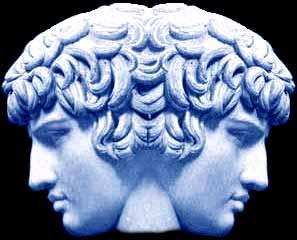
The God Janus, doubled-faced, observes the passage of the common year. Hadrian mourns the tragic death of his Beloved Antinous, who died in October of the year which has now passed.
The Prince of Flowers is dead, and the New God Antinous is rising, just as the STAR OF ANTINOUS will rise in the heavens during the year to come.
Hadrian's Beloved Antinous resides in SEP TEPY, the inner-most celestial sphere, where he is filled with the Semen of the First God which infuses him with godhood.
ANTINOUS THE GAY GOD
emerges from that moment which is no/all moments and from that place
which is no/all places, and he strides forth as one of the Imperishables of heaven.
The Religion of Antinous recognizes the common calendar and uses the
date as a reckoning that pertains only to our place in time and a space
within the earthly sphere.
We know that, though our bodies are of Earth, our spirit is of the Heavens, and through the conquest of Antinous over the 72 Archons our spirit is set free.
Father Janus opens the way for the passage of Antinous through
the outer limit of the celestial sphere. Janus is the mouth of the
serpent that bites its tail, and we observe that as the common year is
born, so the liberation of Antinous from our cosmos nears completion, with only eleven heavenly spirits standing before him.
This is the Holy Day of The Gate, the tool of the priesthood of Religion of Antinous. We wash our sacred stones and seek new auguries for the year.