Thursday, September 6, 2012

THE SUN CAME OUT IN ROME
WHEN ANTONIUS VISITED THE OBELISK


WHEN Flamen Antonius Subia visited the Vatican Museums and St. Peter's Basilica, ominous clouds gathered and rain poured down on his small entourage touring the Vatican.

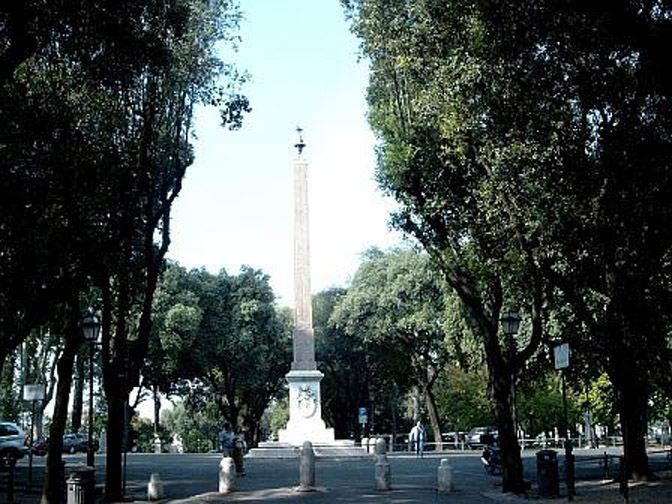
But only a short time later, when Antonyus and Priest Hernestus climbed the Pincian Hill, the clouds parted and the OBELISK OF ANTNOUS was bathed in radiant sunlight.

Reaching the Obelisk on foot from the Vatican is not for the weak-hearted, and involves dashing across busy streets, cutting across crowded plazas and finally climbing a rather steep hill.

There are no signs anywhere to tell you where the Obelisk is located, and it is seldom well-marked on tourist maps.

But Antonyus had his own personal, compiled-by-hand guide manual to Rome. So he led the way as Hernestus huffed and puffed along behind him, hoping that the Flamen knew where he was going.

He did.

At the top of the hill, with no signs to guide him, no indication of where the Obelisk might be, Antonyus studied his guide manual, closed his eyes for a moment, then looked up and pointed to a clump of trees and stated confidently: "It's right there!"

We headed up an unmarked path and, sure enough, the Obelisk was where he had predicted it must be.

And it was at that moment that the dark clouds parted and the Obelisk, fresh-washed from the rain, was aglow in brilliant sunshine. Its granite sides gleamed, the droplets of water in the incised hieroglyphs twinkling like gemstones.

Both priests meditated and prayed before the Obelisk, whose Egyptian hieroglyphic text provides the most detailed and profound prayer and description of Antinous the Gay God which has come down to us.

Just as we had made our farewells to the Obelisk and were preparing to leave, the sun disappeared behind clouds ....

Wednesday, September 5, 2012

ANTONYUS SUBIA TOURS ROME

WITH HIS OWN PERSONAL GUIDE BOOK


FLAMEN Antonyus Subia jokingly says that traveling to Rome with him is a bit like having Sir Edward Gibbon as a travel guide, referring to the 18th Century author of The History of the Decline and Fall of the Roman Empire.

Actually that is not far from true. While he is not the least acquainted with the latest "in" places to eat and drink on the tourist route, he knows the city of the Ancient Romans like the back of his hand.

Sitting at breakfast on the rooftop terrace of his hotel overlooking the Ancient Forum, Antonyus points to a gabled building nearby and says, "That's the Senate House, you know. A bit small, don't you think?"

And pointing in other directions he picks out the Capitoline, the Arch of Constantine and the Colosseum (all of which are obvious) along with many, many minor landmarks which are not at all obvious.

While ordinary visitors to Rome flock to the Trevi Fountain and the Spanish Steps, Antonyus zeroes in on all the Ancient Roman sites, a lot of which are not well-marked or well-known to the average tourist.

"There's the Tomb of Augustus," he says reverentially as we stop along a side street and he points to some tumble-down ruins in a pit.


Aside from two priests of Antinous, not one tourist or other person is in sight. 

It is across the street from Benito Mussolini's 1938 restoration of the Aura Pacis Augustae (the Altar of Augustan Peace), prompting Antonyus to say, "I like what Mussolini did with that altar."

When in doubt, he whips out his guide book. Now, most people buy an ordinary guide book by a big-name publishing house. 


But Antonyus has his own personal guide book, a thick manual which he has put together himself, listing the location of every statue of Antinous and every Hadrian-related structure.

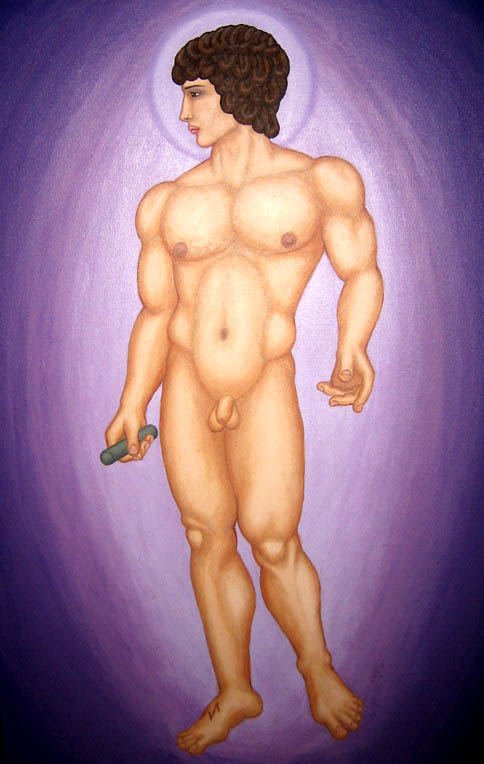
The pages of this Subian guide to Rome are interspersed with his own original art work. So when he arrived at Hadrian's Villa, he not only knew his way through the layout of the villa, but also had art work based on his own pre-visit imaginings of what it looked like in its prime, when Antinous and Hadrian resided there.

In the photo above, Antonyus is holding up his personal guide book to Rome and comparing a page showing his art work with the real thing in the background.

Traveling with Antonyus really is like exploring Rome with Sir Edward Gibbon.

Tuesday, September 4, 2012

ANTINOUS IS BEING FEATURED
IN NEW BBC DOCUMENTARY SERIES


ANTINOUS is featured in the new BBC Four documentary series TREASURES OF ANCIENT ROME, which is being aired Mondays in Britain starting this week.

This documentary was made with the help and advice of the Priests of Antinous. The BBC approached us last year, asking for a priest who could be interviewed on-air for the series. So we have been in on it since the beginning.

As irony would have it, the premiere episode was aired in Britain on Monday evening, the last evening of Antonyus Subia's pilgrimage to Rome. Priest Hernestus was enroute Monday evening back to Germany, hence the delay in reporting this news!

Antonyus and Hernestus discussed the BBC4 documentary during their priestly conclave in Rome, but neither had yet been informed that an air date was imminent. The BBC informed us just a few minutes ago.

Priest Hernestus took part in shooting for the documentary at the Louvre last December, and was interviewed on camera by show host ALASTAIR SOOKE to explain the significance of Antinous not only in ancient times but also his continuing legacy up to the present day.

One of Britain's leading art critics and presenters of BBC arts documentary series, Alastair Sooke (above) traces how the Romans went from being art thieves and copycats to pioneering a new artistic style - warts 'n' all realism. 

Roman portraits reveal what the great names from history, men like Julius Caesar and Cicero - and Antinous - actually looked like. 

In the series, Hernestus explains to the audience the impact Antinous has had on art throughout the ages and the impace he continues to make even today. 

In other segments, modern-day artists demonstrate the ingenious techniques used to create these true to life masterpieces in marble, bronze and paint.

The documentary is produced and directed by TIM DUNN, a director of dramatic and documentary series you are bound to have seen.

Tim Dunn's BBC series are regularly syndicated for broadcast around the world -- so watch for this series on your local public broadcaster or premium cable arts channel!

ANTONYUS SUBIA LEAVES "PRAYER TRAIL"

THROUGHOUT ROME DURING PILGRIMAGE


FLAMEN Antonyus Subia has left a veritable "Prayer Trail" throughout Rome during his Sacred Pilgrimage to the Eternal City.

At every Statue of Antinous, at every Sacred Site associated with Hadrian and the Beloved Boy, he has meditated and left prayers.

"I have seen every major Antinous statue or bust," he told Priest Hernestus on the final full day of his week-long pilgrimage to the City of the Emperors.

While "normal" tourists go sightseeing, Antonyus went Antinous-seeing. He tracked down and located every image of Antinous at all the major museums, at the Bank of Italy (shielded behind bullet-proof glass) and even images of Antinous used in billboard advertising!

His visit to Hadrian's Villa was an absolute high point of his visit, which had been timed to coincide with the first-ever Antinous Exhibition at the Villa. Some of the finest Antinous statues, reliefs, busts, coins and other imagery ever assembled in one place at one time was there for Antonyus to offer prayers to.

Prayers were offered on behalf of all gay people but in particular for the followers of Antinous all around the world.

He made a photographic record of every step of his pilgrimage. The photos and videos will be used as inspiration for art work and a particular future Sacred Project he is currently working on.

Monday, September 3, 2012

ANTONYUS SUBIA HONORS ANTINOUS ART

AT VATICAN MUSEUMS


FLAMEN Antonyus Subia is spending today at the Vatican Museums, honoring the breath-takingly beautiful statues devoted to Antinous the Gay God.

The Vatican Museums contain one of the world's finest collections of Antinous-related art, and Antonyus reserved the entire day to explore the museums as one of the highlights of his Sacred Pilgrimage to Rome.

Priest Hernestus, who has traveled to Rome from Hamburg Germany, is accompanying Antonyus to the museums with the generous support of Priest Uendi, who is in constant contact from Hollywood.

As Flamen Antinoalis, or "Arch Priest," Antonyus is ever mindful that he is the first practicing and widely recognized modern priest of Antinous to have worshiped in front of the image of Antinous in Rome in centuries.

Antonyus planned this current Sacred Pilgrimage to coincide with the unprecedented ANTINOUS EXHIBITION at Hadrian's Villa, a once-in-a-lifetime event.
 

Sunday, September 2, 2012

ANTONYUS SUBIA AT HADRIAN'S VILLA

FOR UNPRECEDENTED ANTINOUS EXHIBITION


FLAMEN Antonyus Subia is spending the day at Hadrian's Villa for one of the highlights of his Sacred Pilgrimage to Rome — the first exhibition devoted to Antinous ever to be held at the Tivoli villa compound.

Priest Hernestus has journeyed from Germany to join Antonyus for the Antinous Exhibition, thanks in great part to the largesse of Priest Uendi, who is in constant contact with them both from Hollywood.

Running now through November 4th, hundreds of Antinous-related statues and other artefacts from around the world are on display. The exhibition is entitled "Antinoo: Il fascino della bellezza" (Antinous: A Fascination With Beauty) — and Antonyus says the exhibition lives up to its name.

Amazingly, this is the first time EVER that the curators of Hadrian's Villa (the Superintendence for Archaeological Heritage of Latium Villa Adriana Antiquarium) have launched an exhibition solely devoted to Antinous.

Despite the traffic and long lines, the wait is worth it, Antonyus says. Once inside, visitors see 50 incomparable Antinous-related treasures, including sculptures, reliefs, gems and coins — all testimony to the love of the Emperor Hadrian for the Bithynian youth.


The exhibition is accompanied by an OFFICIAL CATALOGUE published by Electa which explains in loving detail not only the objects on view in the exhibition but also the ardent same-sex relationship between Hadrian and Antinous.

Antonyus and Hernestus inspected the archaeological dig site of the Antinoeion pavilion at the Villa. Hadrian designed this shady hideaway as a recreation in miniature to Canopus, the town on the western arm of the Nile Delta where Hadrian and Antinous sought refuge from the hustle and bustle (and religious strife between Christians and Jews) which they had encountered at nearby Alexandria in the hot summer of the year 130 AD. 


Their days together in Canopus were a final moment of unalloyed joy for Hadrian and Antinous only a few weeks before tragedy struck along the Nile in Upper Egypt.

The two priests of Antinous thoroughly toured the exhibition. It is divided into four sections, which display works from an array museums and collections. On view are items which for the most part were originally found at Hadrian's Villa or which the curators hope to encourage the current owners to hand over to the Villa.

The first section includes a series of portraits Hadrian and Antinous, including the marble bust of the Vatican Museums and the beautiful bronze from the Archaeological Museum of Florence.

The second section focuses on the many divine aspects of the young "Bitinio" (Bithynian Boy), such as his association with Apollo and Dionysus as well as his portrayal as a priest of Attis.

The third section focuses on the recent discoveries at the Antinoeion dig site, primarily representation of Antinous in the guise of Osiris. Hadrian had made a point of associating Antinous with Osiris, who died in the Nile and rose from the waters of the Nile, the chief Egyptian deity of fertility and transfiguration. In the exhibition you can admire the breathtaking red quartzite statue of Antinous-Osiris, on loan from the Dresden State Art Collections (Staatliche Kunstsammlungen zu Dresden).

The last section focuses on the continuing and unabated influence of Antinous in art and literature throughout the centuries. Among the loans Antonyus admired was one of the precious volumes of the "Viaggio pittorico di Villa Adriana" (Pictorial Journey to Villa Adriana) by Agostino Penna of 1831-36, which contains a beautiful portrait of Antinous now located in the Vatican Museums, in the Sala della Rotonda.

Saturday, September 1, 2012

ANTONIUS SUBIA VISITS
THE OBELISK OF ANTINOUS


FLAMEN Antonyus Subia, as part of his Sacred Pilgrimage to Rome, has visited the OBELISK OF ANTINOUS.

As Flamen Antinoalis or "high priest," Antonyus is the first practicing and widely recognized priest of Antinous to bow down in front of the Obelisk since the Fall of Rome and the rise of Christianity.

The Obelisk currently stands on the Pincian Hill in Rome, but no one is quite certain where it originally stood.

We know for certain that Emperor Hadrian commissioned the Obelisk after the tragic death of Antinous. It is thought that the Obelisk originally stood at Hadrian's Villa, but some experts have also speculated that it could originally have been located at the Mausoleum of Hadrian.

The original location is of importance because the Obelisk contains clues as to the whereabouts of the LOST TOMB OF ANTINOUS.

Under the direction of Hadrian, the Obelisk was incised with EGYPTIAN HIEROGLYPHS which provide us with the most important Sacred Text concerning the Sacred Nature of Antinous the Gay God. Alas, the portion of the text which discusses Antinous's earthly life is almost entirely illegible, with only faint references to his family, but not enough to provide any information.

The Obelisk text discusses in some detail His deification and the Sacred Miracles he can work.

But one of the most tantalizing portions of the hieroglyphic inscription refers to the location of the Tomb of Antinous. The text says:


ANTINOUS THE GOD IS HERE!
HE RESTS IN THIS PLACE
WHICH IS IN THE BORDER FIELDS OF OUR LADY ROME!

Clearly, those words indicate that the Obelisk once stood at the Tomb of Antinous. But because the Obelisk has been moved several times over the centuries ... we do not know where the tomb is!