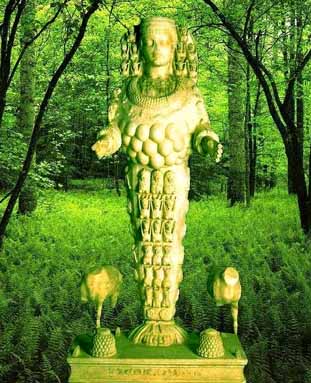
DIANAthe Divine Huntress was born on this day, according to the Lanuvium inscription which is consecrated to Antinous and Diana.
She is said to be the twin sister of Apollo, but our belief is that the virgin huntress is the female Antinous, his twin sister, goddess of lesbian beauty just as Antinous is the god of gay beauty.
Diana and Antinous are deities of the Moon.
As Antinous is often assimilated to Apollo, he therefore substitutes as the twin of Diana, though he can often be viewed as her male double, so that Antinous is Diana.
She is Helen of Troy to the Castor and Pollux of Antinous-Apollo, they share not only the attribute of hunters, and of the moon, but also as gods of magic and darkness.
Diana is often compared to Heckate, the supreme goddess of Theurgian magicians, who rose to prominence during the reign of Marcus Aurelius. Antinous therefore is the male equivalent of Heckate.
We pray to Diana to guide us in our hunt and to illuminate our nights with the silver light of her sublime power. We recognize that the Moon of Diana is the Moon of Antinous.
On this night we venerate the Virgin, she who guides new life into the world, goddess of beasts, the mistress of the hounds, the archeress, the young Great Mother of Ephesus.
Sunday, August 12, 2012
HERCULES INVICTUS
ON AUGUST 12th, the Religion of Antinous honors Hercules Invictus, the champion of homosexuality.
The Great God Hercules, defender of mankind against chaos, the son of
Zeus, the strongest and mightiest man that has ever lived, was one of
the first of the Greek gods to be worshipped by the Romans.
The Greeks of southern Italy introduced the Cult of Hercules at such
an early date that the Romans were convinced that Hercules was
indigenous. Indeed, he was admitted by Romulus into the sacred Pomeria,
the spiritual protective wall of the city of Rome.
The cult of Hercules was centered at Tibur, where Hadrian built his
magnificent Villa, and Hadrian is often compared to Hercules for his
travels, his physical strength, courage, and his sexual prowess.
Hercules was driven mad by Hera and forced to murder his wife and
children. In order to atone for his sin, he visited the oracle of Delphi
and was instructed to submit to twelve labors.
Hercules accomplished them all, and many others including the release
of Prometheus from bondage. He was also a sexual champion and the
number of his lovers is very long, and they include boys such as
Abderus, Chonus, Haemon, Hylas, Iokastus, Iolaus, Nestor, Philoctetes,
Polyphemus, Telamon, Abderus, Admetus, and Dryops.
Without question, Hercules was a champion of homosexuality, and a
defender of mankind against the forces of evil. For his benefit to
mankind, he is venerated as a God and Protector of the Religion of Antinous.
Saturday, August 11, 2012
THE ACCESSION OF HADRIAN
AS EMPEROR OF ROME
WE ALL KNOW the anguish of
worry.
But few of us have to worry about being
murdered by rivals — Hadrian spent years in exactly this sort of
anguish. On August 11th, the Religion of Antinous commemorates the accession of Hadrian to the throne as Emperor of Rome, succeeding Trajan. Hadrian had to wait many years in a very deadly sort of legalistic
limbo before he became emperor. Trajan was in no hurry to name him
officially as his heir, fearing Hadrian might then bump him off. While
they shared many affections — and even shared some young men — they
shared little trust in each other.
And so Hadrian was left waiting and wondering and worrying year after
year. Wondering when or if he would become Emperor. Worrying what would
happen if Trajan were to die suddenly and some rival contender became
Emperor — and perhaps murdered Hadrian.
We all know this sort of worry-and-wait situation, albeit on a less
history-changing scale. We apply for a job, or we await a loan approval
or we await a buyer's final offer on the house or we await confirmation
that our lover in Afghanistan is safe and sound — and there is nothing
we can do but worry and wait. Hadrian sought out soothsayers,
astrologers and magicians to assuage his fears.
Hadrian had been on tenterhooks for years wondering whether Trajan
would formally adopt him as his heir. If Trajan died without the issue
of succession being settled, it could result in civil war — or at least
in the assassination of Hadrian by some other ambitious man.
Then finally, while on campaign in Nikomedia, capital of Bithynia,
Hadrian receives word that Trajan unexpectedly died on August 8th. He
learns that Trajan's "deathbed will" named him as the emperor's adopted
son and successor. It is believed that Trajan's wife, the Empress
Plotina (who adored Hadrian), forged the will of her husband, naming
Hadrian as successor.
Whatever happened, the Legions proclaimed Hadrian emperor on August
11th. The support of the army insured the validity of our Emperor's
claim, ushering in the Sacred and Golden Age of the Antonines, the dynasty of peaceful and wise emperors which would end with Marcus Aurelius.
Our own Flamen Antinoalis Antonius Subia explains what this means to gay men everywhere:
"Hadrian became Emperor over Rome at the pinnacle of her glory. Her
boundaries stretched farther than ever before; farther than they ever
would again. Millions of people were subject to his authority. As
Emperor, Hadrian first made peace with the Parthians, surrendering some
of the land that Trajan had occupied, and then began the work of
consolidating the Empire from the inside. "We celebrate the Accession of Hadrian as the
miracle that might never have been, without which Antinous would never
have been known, and our religion would never have been born. Hadrian is
Our Father, Our Emperor and Our Capitoline God, we recognize on this
day that the beginning of his age is the beginning of our own."
On August 11th, please take a moment to remember the day on which Hadrian's long and heartfelt
dreams and ambitions became reality and the path was paved for him to
begin work on creating a civilization based on Hellenistic tolerance —
and above-all his dream of founding the perfect religion based on love
and beauty.
May the Divine Hadrian help us all achieve our heartfelt dreams and ambitions in this regard.
ON AUGUST 10th, the Religion of Antinous honors the Reverend Montague Summers,
saint of Antinous, who was a very upfront and openly gay member of the
Sacred Band of Lover/Warriors at the turn of the last century and who
published a book of Uranian poetry entitled Antinous.
Born April 10, 1880, the Rev. Montague Summers died at the age of 68 on this day in 1948.
Here is a splendid contemporary description of him:
"During the year 1927, the striking and somber figure of the
Reverend Montague Summers in black soutane and cloak, with buckled shoes
— à la Louis Quatorze — and shovel hat could often have been seen
entering or leaving the reading room of the British Museum, carrying a
large black portfolio bearing on its side a white label, showing in
blood-red capitals, the legend 'VAMPIRES'."
While everyone else in Late Victorian and Edwardian England was
constrained by strictures of class and morals, Montague Summers thumbed
his nose at all restrictions of any kind. Having studied theology to
become an Anglican clergyman, he suddenly claimed he had received a
visionary call to become a Roman Catholic priest. He donned self-styled
priestly robes and called himself "Reverend Alphonsus Joseph-Mary
Augustus Montague Summers" — when in fact he had not been ordained
officially by anybody.
It was shocking enough in England to convert to Catholicism and
become a priest. But to become a fake priest was even more scandalous.
But there was more ....
All the while he was also seriously studying the Occult and became
friends with the crowd of Occultists who hung out at Watkins Books just
off Leicester Square in London's theatre district — still even today one
of the "craftiest" places to see and be seen.
In the late 19th Century, Watkins was the only book shop in England
(or perhaps in the world) which specialized in esoteric books and witchy
things. It was frequented by Madame Blavatsky and Bram Stoker and
Arthur E. Waite and Pamela Colman Smith and — of course — Aleister
Crowley. Summers became friends with Crowley and they enjoyed playing
off each other, claiming they were opposite "polarities" of magical
craft.
When Crowley announced he was a modern-day wizard, Summers responded
by announcing he was a modern-day Catholic witch hunter. He wrote his
own Malleus Maleficarum which claimed to be an accurate account of witchcraft and of the methods necessary to combat it.
He also wrote a book on The History of Witchcraft and Demonology, saying:
"In the following pages I have endeavored to show the witch as she
really was — an evil liver: a social pest and parasite: the devotee of a
loathly and obscene creed: an adept at poisoning, blackmail, and other
creeping crimes: a member of a powerful secret organization inimical to
Church and State: a blasphemer in word and deed, swaying the villagers
by terror and superstition: a charlatan and a quack sometimes: a bawd:
an abortionist: the dark counselor of lewd court ladies and adulterous
gallants: a minister to vice and inconceivable corruption, battening
upon the filth and foulest passions of the age".
As with everything that Rev. Summers wrote, it is difficult to
determine whether his intention was to condemn or to praise. He was so
clearly fascinated by the Occult that one never knew quite whether he
was "for it" or "against it."
There was no doubt, however, about his love of handsome youths. It
was said that he had never been ordained because of rumours of
improprieties with boys as a school teacher, teaching upper class
English schoolboys the finer points of Latin.
Indeed, Summers was for a while part of the circle of the Uranian poets, who celebrated ancient Greco-Roman erastos/eromenos man-boy love. His first book, Antinous and Other Poems appeared in 1907 and was dedicated to male-male love.
He was fascinated by Classical male-male love, and by the lives of
the Catholic saints, especially Saint Catherine who was drawn and
quartered and who lives on as the English teatime "Hot Cross Bun"
symbolizing the way Catherine was torn limb-from-limb into four
gore-spewing pieces rather than give up her faith. Very tasty with tea
and clotted cream.
Rev. Summers reveled it telling young boys that their favorite snack
symbolized the brutal dismemberment of a lady of faith. All of it told
alongside Latin grammar lessons and tales of vampires and werewolves.
After his books on witchcraft, he wrote authoritative books on vampires, including The Vampire: His Kith and Kin (1928) and The Vampire in Europe (1929), and later a definitive book on werewolves, The Werewolf
(1933). The werewolf book influence a whole generation of movie-makers,
especially the German writer Curt Siodmak who wrote the screenplay for
the 1941 horror classic The Wolf Man starring Claude Rains and Lon Chaney Jr.
Nearly everything that you have seen in Hollywood werewolf movies
(wolf bane, silver bullets, etc.) comes straight from Curt Siodmak's
reading of Rev. Summers book back in the 1930s.
The main difference between Rev. Summer's books on vampires and
werewolves and books by other experts was that the other experts
referred to these beings as "folklore superstitions" or as "pathological
psychoses" in deranged minds. But when you read Rev. Summers' books,
you know that he believed in the real actual true-life existence of
vampires and werewolves.
In the old Hollywood werewolf movies, when a character went to the
bookshelf and pulled down a book on werewolves and turned to a page with
a woodcut illustration of a man-wolf — that was a cinematic reference
to the 1933 book by Rev. Summers which was in fact on the shelves of
well-stocked scholarly libraries around the world.
Summers's work on the occult is notorious for his unusual and
old-fashioned writing style, his display of erudition, and especially
his undoubted belief in the reality of the subjects he treats.
He was also fascinated by 19th Century Gothic literature. The genre was best exemplified by Mary Shelley's Frankenstein early in the century and the genre came to a thrilling close at the end of the 19th Century with Bram Stoker's Dracula.
Uptight Victorian readers had read Gothic horror novels with a
mixture of shock and delight and Summers recognized the art form of the
Gothic novel as a symbol of a romantic backlash against urbanization and
industrialization.
He knew that "horror" was here to stay as a part of popular culture —
as indeed it is. Every book shop, every video/DVD store has a big
"Horror" section.
He helped to make horror a serious study of academic research by writing The Gothic Quest: a History of the Gothic Novel (1938), A Gothic Bibliography (1940) and he published a collection of Gothic horror stories in The Supernatural Omnibus (1931) and Victorian Ghost Stories (1936).
Above all, Rev. Summers was very strange and eccentric. The Times of London called him "in every way a 'character' and in some sort a throwback to the Middle Ages".
He was also unabashedly and openly homosexual in an age when others
(such as St. Oscar Wilde) faced jail and ruination for being gay.
Summers was a member of the Order of Chaeronea, a secret society for
gay men founded in 1897 by George Ives, which was named after the
location of the battle where the Sacred Band of Thebes was
finally annihilated in 338 BC. The Sacred Band consisted of 150
homosexual couples and the reason was that lovers would fight more
fiercely and more cohesively at each other's sides than would
heterosexual men who were "just buddies."
Rev. Summers is a Blessed Prophet of Homoeros and a Dedicant and Messenger of Antinous among the Aula Sancti Ecclesiae Antinoi (our list of saints).
Thursday, August 9, 2012
ROMAN, CELTIC ARTEFACTS UNEARTHED
BY ROMANIAN HIGHWAY WORKERS
ROMANIANhighway construction workers have stumbled onto a veritable treasure trove of Ancient Celtic, Roman and Greek coins and other artefacts.
In all, nine caches were found in what is being called one of the biggest archaeological discoveries in Romania, reports ROMANIA INSIDER.
Highlights include numerous bronze artefacts and over 280 Greek and Roman silver
coins along the route of the future highway between Sibiu and
Nadlac in Romania. One of the discoveries, a small iron replica
of a chariot was deemed unique in the region.
The objects, dating from the early Neolithic to the
Medieval Ages, will be restored and placed on exhibit in May 2013.
A team of 40 Romanian and foreign archeologists are involved in the extensive dig which stretches for 40
kilometers across three counties, Sibiu, Alba
and Hunedoara.
This is one of the biggest archeological digs ever
undertaken in Romania, according to Sabin Luca, director of the
NATIONAL BRUKENTHAL MUSEUM.
The researchers discovered a Bronze age settlement and "the first level of
colonization which could be connected to our ancestors dates from the
Celtic era, in the 3rd and 2nd centuries BC," according to Sabin Luca.
He said the small iron chariot is almost unique. In Celtic areas, it was customary for a tiny iron chariot to be buried alongside a full-size chariot, but in this case it was buried separately. The piece
was in 80 pieces and its restoration took three weeks.
The archeologists found weapons, tools, weapon tips, heels and a
stash of 280 silver coins, including Ancient Greek and Roman examples.
"While hundreds of such silver caches have been found elsewhere, it is highly unusual for such a cache to be found at an archeological site by researchers. Discoveries
are usually accidental," the Brukenthal museum director explained.
Wednesday, August 8, 2012
RUINS OF AQUA VIRGO AQUEDUCT
FOUND UNDER A ZARA STORE IN ROME
CONSTRUCTION workers expanding the Zara flagship store in Rome have stumbled onto a previously unknown section of the AQUA VIRGO, one of most important aqueducts in Roman history.
The famous Trevi Fountain draws its water from what modern-day Romans call the "Acqua Vergine Antica" aqueduct, which is almost entirely underground.
Archaeologists came across the aqueduct under the intersection of Via del Tritone as excavations began to enlarge the retail premises at the former Rinascente building off Via del Corso, now the home of Spanish retail giant Zara.
The experts carried out a hurried inspection. However the expansion plan for the clothing store – scheduled to take two and a half years – continues, with the intention of opening a larger store in 2015.
Plans are to preserve the ruins and make them visible to visitors, similar to other archaeological discoveries under the capital's shops such as the Ikea store at Anagnina.
The Vergine aqueduct is one of the several built to serve
ancient Rome with pure drinking water. The name derives from the name of
its predecessor, AQUA VIRGO, constructed by Marcus Agrippa in 19 BC.
Along its more than 20 km length, the aqueduct dropped only 4 meters to reach Rome in the center of the Campus Martius. At its height, the aqueduct was capable of supplying more than 100,000 cubic meters of water every day.
The aqueduct ran underground for nearly all of its length. In 537, the Goths besieging Rome tried to use this underground channel as a secret route to invade Rome, according to Procopius.
After deteriorating with the fall of the Roman Empire, Aqua Virgo was repaired by Pope Adrian I in the 8th century. Following a complete restoration and extensive remodeling from its source to its terminus points from the Pincio to the Quirinale and within Campo Marzio, in 1453, Pope Nicholas V consecrated it Acqua Vergine.
Zara opened its Rome flagship store for business in the restored Palazzo Bocconi in time for the Christmas shopping season in 2010. The five-floor flagship store became the firm's third outlet in Rome after its other nearby locations in Largo Goldoni and Galleria Alberto Sordi.
Tuesday, August 7, 2012
CHAVELA VARGAS DEAD AT 93,
'THE ROUGH VOICE OF GAY TENDERNESS'
CHAVELA VARGAS, the forceful lesbian songstress who was born in Costa Rica and rose to fame in Mexico, and influenced generations on both sides of the Atlantic, has died at age 93.
She was especially known for her rendition of Mexican rancheras,
but she is also recognized for her contribution to other genres of
popular Latin American music.
Never one to hide her lesbianism, she has been an influential interpreter in
America and Europe, muse to figures such as Pedro Almodóvar, hailed for her haunting performances, and called "la voz áspera de la ternura," the rough voice of tenderness.
FLAMEN ANTONYUS SUBIA speaks for millions of gays in the Spanish-speaking world when he says her passing is a saddening loss. He grew up with her music.
ANTONYUS RECALLS:
My parents had always played her music it...among many other
singers...she was the only one who made an impact on me. She was the
only one who stood out...mostly because I could tell that she was
crazy...she wasn't trying to sound pretty or traditional...but more like
someone having an attack of too much feelings.
It wasn't until I was in my late
teens that a friend pointed out that all her love songs are sung about
women, I hadn't even noticed, I had just taken them at face value, you
broke my heart songs, without really thinking about the context...that
was when I really started to like Chavela Vargas...when it suddenly
dawned on me that this dramatic, bellowing woman, who was such a
favorite of my parents, was A LESBIAN!!!
As it turns out she was a hard-core lesbian, though never public
about her sexuality, she never actually hid it...it was pretty much
right there for everyone to see. She drank heavily, carried a gun and
wore a big red poncho...how can you not love a lesbian such as that?!
Eventually the drinking became too much and she dropped out of making
music for a long, long time...only to return about 10 years ago, at 83
years of age with a new album...and it was during her
return that I finally learned that, yes indeed, just as I suspected, she
was in fact a Lesbian. My favorite quote is when she said:
"I've never even been to bed with a man. Never. That's how pure I am; I have nothing to be ashamed of. My gods made me the way I am." - Chavela Vargas
I nominate Chavela Vargas for the Sainthood of Antinous.