Showing posts with label mummy. Show all posts

Monday, August 31, 2026

ANTINOUS ENABLES YOU TO DISCOVER
THE INTELLIGENCE OF THE HEART


IN ancient times, Antinous was known as a miracle worker. His worshipers prayed to him for miracles, oracles, visions and answers to problems in their daily lives.

The Egyptian hieroglyphs on the OBELISK OF ANTINOUS state clearly that Antinous answers the prayers of all who call upon him through dreams and visions, for example.

The hieroglyphs also make cryptic references to his ability to work magic through his heart. This is a reference to the Ancient Egyptian concept of the "Intelligence of the Heart."

The Egyptians knew that the brain is the center of motor activity and sensory perception. But they believed the heart is the center of a form of intelligence which has baffled most mainstream Egyptologists ... who assume the Egyptians believed the heart was where cognitive thinking occurs.

But the Egyptians had a very different view of the universe from our rational, scientific view of the universe. We dissect facts and analyze them. But while the Egyptians were very good at analyzing facts, they also retained the Zen-like ability to see the whole ... which leads to contemplation ... not analysis.

The Egyptians understood that if you want to find an intelligent solution to a problem, your brain can do the work. You have all the necessary intelligence inside the bone in your skull.

However, most people use their brains the same way they use their muscles. You can strain your head just as if it were a muscle, and work very hard trying to arrive at an answer, but it doesn't really work that way.

When you really want to find an answer to something, what you need to do is contemplate the problem. Visualize your question as well as you can, and then simply wait.

If you don't, and if you instead try to find the solution through brute mental strength, you may be disappointed, because any solution that comes in that way is likely to be wrong.


But when you have waited for a while, the solution will come of itself. That is what the Egyptians called the Intelligence of the Heart ... using your heart instead of your head.

It will work for you in the same way your stomach will digest your food for you without your having to supervise it consciously. Our attempts to supervise everything consciously have all led to consequences that aren't too good for our stomach, and the reason for that is quite simple.

Conscious attention, which employs words, cannot think of very much. We are forced, therefore, to ignore almost everything while we are thinking. We think along a single track, but the world doesn't proceed along a single track.

The world is everything happening altogether everywhere, and you just can't take all that into consideration because there isn't time.

However, the Intelligence of the Heart can take it all into consideration because it is capable of handling innumerable variables at once, even though your conscious attention cannot...


The hieroglyphs on the Obelisk of Antinous promise that Antinous the Gay God enables us to discover the Intelligence of the Heart ... the Intelligence of HIM ... he opens his heart to you .... 

Wednesday, August 26, 2026

NINE MILLION MUMMIFIED DOGS
FOUND AT EGYPTIAN TEMPLE OF ANUBIS


AS Antinous and Hadrian journeyed up the Nile in August and September of 130 AD, they must have seen the mighty monuments at Memphis ... and the sprawling cliffside ANUBIEION, the mystery-shrouded Temple of the jackal-headed Egyptian deity Anubis at Saqqara south of modern Cairo.

But was Antinous aware that nine million dog mummies were entombed there?

The unique, terraced temple compound was built into the face of the cliffs overlooking the ancient Egyptian capital city of Memphis-Mennefer. Beyond the Anubieion lay the necropolis city of the dead. In front of it lay the teeming city nestled in the Nile Valley.

For decades, experts were unsure what purpose the Anubieion served. No where else in Egypt is there a temple dedicated solely to Anubis. Some temples to other deities had niche shrines to the jackal-headed deity who conveyed the souls of the dead to everlasting life.

But the discovery of myriads of mummified dogs in the Anubieion's catacombs makes it clear that the Anubieion was indeed a temple whose goal was to assist people in making the transition from earthly life to eternal life.

The dog mummies were sold to serve as "guide dogs" for souls of the departed.

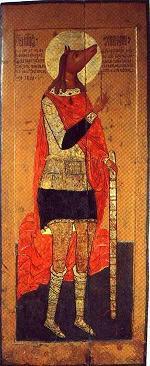
As Christianity spread in Egypt, Anubis morphed into St. Christopher ... and many early Coptic images of Saint Christopher depict him with the head of a dog (image at left).

The discovery came during routine excavations at the dog catacomb in Saqqara necropolis by an excavation team led by Salima Ikram, professor of Egyptology at The American University in Cairo (AUC), and an international team of researchers led by Paul Nicholson of Cardiff University.

Initial inspection reveals that dogs of all breeds and ages were mummified, from newborn puppies to decrepit old dogs.

“We are recording the animal bones and the mummification techniques used to prepare the animals,” Ikram said.

Ikram also told National Geographic, which is financing the project, that "in some churches people light a candle, and their prayer is taken directly up to God in that smoke. In the same way, a mummified dog's spirit would carry a person's prayer to the afterlife".

Saqqara dog catacomb was first discovered in 1897 when well-known French Egyptologist Jacques De Morgan published his Carte of Memphite necropolis, with his map showing that there are two dog catacombs in the area.

However, mystery has overshadowed such mapping as it was not clear who was the first to discover the catacombs nor who carried out the mapping, and whether they were really for dogs.

"The proximity of the catacombs to the nearby temple of Anubis, the so called jackal or dog-headed deity associated with cemeteries and embalming, makes it likely that these catacombs are indeed for canines and their presence at Saqqara is to be explained by the concentration of other animal cuts at the site," Nicholson wrote on his website.

"These other cults include the burials of, and temples for, bulls, cows, baboons, ibises, hawks and cats all of which were thought to act as intermediaries between humans and their gods."


Despite the great quantity of animals buried in these catacombs and the immense size of the underground burial places, Egyptologists have focused on the temples and on inscriptional evidence rather than on the animals themselves.

The mysteries behind De Morgan's mapping were unsolved until 2009 when this team started concrete excavations at the cemetery in an attempt to learn more about the archaeological and history of the site.

"Results at the first season showed that De Morgan map has substantial inaccuracies and a new survey is under way," Nicholson said.


"The animal bones themselves have been sampled and preliminary results suggest that as well as actual dogs there may be other canids present. Furthermore the age profile of the animals is being examined so that patterns of mortality can be ascertained."

Friday, May 1, 2026

LOUVERNIOS THE GAY DRUID PRIEST
IS AN INNOCENT MARTYR SAINT OF ANTINOUS


ONE of the more obscure Innocent Gay Martyr Saints of Antinous is Louvernios of Lindow ... a 2,000-year-old bog mummy in England who was a homosexual Druid who most likely offered himself as a human sacrifice against invading Romans to keep them (successfully) out of Ireland.

Also called the Lovernios the Lindow Bog Man, his mummified body was found in 1984. 

That was when a peat cutter in Lindow Moss, on the Mersey River of western England, found the well-preserved body of a man, believed by some scholars to be the sacrificed body of a Celtic Druid from Ireland who had probably come to England to be ritually prepared and sacrificed on May Day, 60 AD to keep the advancing Roman army away from Ireland.

Indeed, the Roman legions stopped just five miles short of Lindow Moss, and never invaded Ireland. The exact date ... 1 May 60 AD ... was ascertained by contents of his stomach which included "scorched bread" of the sort used in Druidic Beltane or May Day festivities.

And historian CONNELL O'DONOVAN presents compelling evidence to prove that this Druid was also a homosexual. the Lindow Bog Man had suffered a quadruple execution of garroting, bludgeoning, slit throat, and drowning in the bog, naked except for an armband of arctic fox fur on his left arm.

Some Celtic historians interpret the fox arm band as meaning "My name is Fox" or Louvernios, an attested ancient Celtic name meaning fox.

However, others suggest the fox armband of Lindow Man (reconstructed face left) signifies not 'My name is Fox', but 'I am a sacrifice', and in particular, a communal scapegoat.

The fox is regarded in many societies, including the Celtic, as an outlaw animal.

The fox lives on the periphery of human society, neither domesticated nor fully wild.

On one hand it is despised by farmers for its depredations on their livestock...while on the other hand it is grudgingly admired for its wiliness ... hence its role as a Trickster figure, such as Reynard the Fox. 

O'Donnell says: "This peripheral and outlaw existence of the fox in the Celtic imagination fits nicely with the probability of Lindow Man's cultic-based homosexuality."

Scholars tend to agree that Tollund Man’s killing was some kind of ritual sacrifice to the gods ... perhaps a fertility offering. To the people who put him there, a bog was a special place. While most of Northern Europe lay under a thick canopy of forest, bogs did not. Half earth, half water and open to the heavens, they were borderlands to the beyond.

To these people, will-o’-the-wisps ... flickering ghostly lights that recede when approached ... weren't the effects of swamp gas caused by rotting vegetation. They were fairies. The thinking goes that Lindow Man's tomb may have been meant to ensure a kind of soggy immortality for the sacrificial object.

Louvernios is the best-looking and best-known member of an elite club of preserved cadavers that have come to be known as "bog bodies."

These are men and women (also some adolescents and a few children) who were laid down long ago in the raised peat bogs of Northern Europe ... mostly Denmark, Germany, England, Ireland and the Netherlands.

They can keep speaking to us from beyond the grave because of the environment’s singular chemistry. A body placed here decomposes extremely slowly. Soon after burial, the acid starts tanning the body’s skin, hair and nails.

As the sphagnum moss dies, it releases a carbohydrate polymer called sphagnan. It binds nitrogen, halting growth of bacteria and further mummifying the corpse. But sphagnan also extracts calcium, leached out of the body’s bones.

This helps to explain why, after a thousand or so years of this treatment, a corpse ends up looking like a squished rubber doll.

Nobody can say for sure whether the people who buried the body in the bog knew that the sphagnum moss would keep him intact. It appears highly unlikely ... how would they? Still, it is tempting to think so, since it fits so perfectly the ritualistic function of Louvernios, perhaps regarded as an emissary to the afterworld.

Saturday, April 25, 2026

MEET MARCO ANTINOUS OF EGYPT
By Flamen Antinoalis Antonius Subia


I have the pleasure to introduce someone very special. A beautiful boy who was very likely one of our brothers.

Mummy of Marco Antinous, encaustic painting on linen, the frieze of the aureus protector in gilded stucco. 


Egyptian civilisation, Roman Empire, 3rd Century. Paris, Musée Du Louvre.

The hauntingly lovely portrait from the heyday of Antinoopolis features the face of a young man with striking, realistic features painted with encaustic (wax-based paint) on thin wood panels and embellished with intricate gold-leaf details.

Portraits like these are highly treasured today. They are often known as FAYOUM PORTRAITS, after the region, near Antinoopolis, where most of them were found. There are fewer than 1,000 extant.

The Ancients believed Antinous worked miracles in the lives of his faithful followers. 

Antinous healed the sick, he granted people love and prosperity, he shielded them from peril.

Historian Royston Lambert's book Beloved and God: The Story of Hadrian and Antinous devotes a full chapter to the Religion of Antinous and mentions the miracles he was able to bring forth.

The oracle priests of Antinous could intercede with the God, or followers could appeal directly to Antinous:
 
"There is evidence of oracles at Tarsos and perhaps at Rome itself," Lambert writes. "No doubt it was through these pronouncements and visitations that he wrought miracles and healing for which he evidently became famous in the east."

In many areas, people named their children Antinous in the fervent belief that he would watch over and protect their offspring all their lives.


Marco Antinous undoubtedly is one of these children named after Antinous ... undoubtedly a follower of Antinous ... we hail Marco Antinous as our brother in Antinous!

~ANTONIUS SUBIA

Friday, January 2, 2026

THE MUMMIFICATION OF ANTINOUS
AS IT MIGHT HAVE BEEN CARRIED OUT


THE newly ordained priests of Antinous were busily overseeing the mummification of his body in the 72 days between his death in late October of the year 130 and early January of 131, many experts believe.

Hadrian founded the city of Antinoopolis on the banks of the Nile where Antinous died and proclaimed the new religion.

While the Emperor continued his tour of Egypt, the priests scurried to carry out his imperial commission.

We do not know for certain what transpired with the remains of Antinous ... or whether they were ever retrieved from the Nile. Perhaps they were cremated. But perhaps the body was mummified.

Using an Antinous Action Figure, we can demonstrate how it may have been done:

We prepared the body by cleansing it with wine. Then we removed the Intestines, Liver, Lungs and Stomach (placing them in Canopic Jars). 

There is a incision mark down his left side to represents where he would have been cut open for the removal of these organs. 

Next we removed the Brains with a hook through the nose (hence the black dot on his nostril). 

The brains were thrown away because the Egyptians felt the heart was the seat of intelligence, not the brain.

We used a basting brush to cleanse him although a hair-dye or cosmetics brush is also applicable. 

The red heart represents the fact that they left the heart in tact, later it will be used in the Weighing-of-the-heart ceremony. 

In the back corner you see Anubis (the God of Embalming) present during this embalming.

We put him in Sea Salt which represents the Natron Salt that the priests would have used. (Himalayan Salt works just as well). 

Then we let him sit in the salt for 40 minutes ... 1 minute for each day the priests would have left the body in the Natron Salt.

Next we wiped him down with spices of Cinnamon, Nutmeg and Allspice with olive oil.

Then the priests would have replaced the eyes with onions stuffed into the sockets. 

Because the salt desiccated the body, then they stuffed the body with mud, sawdust, rags and chaff to make it appear nicely contoured.

Next we began the wrapping process. We used muslin and a mixture of flour and water (1 part to 3 parts) for the paste. 

In ancient times, it took about 15 days to wrap the body and about 20 layers of linen bandages. 

We put Amulets between the layers of Linen … a tiny scarab beetle and a miniature protective eye of Horus.


We allowed him to do a little drying before the final wrapping.

In ancient times the process took 72 days.

In the case of Antinous, this meant his mummy would have been ready for the final ceremonies on January 11th of 131 AD.

By that time Hadrian would have completed his tour of Egypt and would have returned to Antinoopolis for the "Opening of the Mouth Ceremony."

Afterwards, his tomb would have been sealed and the first priests of Antinous would have begun their sacred watch … and the establishment of the new religion.

No one knows the location of the Lost Tomb of Antinous.

Tuesday, November 11, 2025

NIANKHKHNUM and KHNUMHOTEP
SAINTS OF ANTINOUS


ON November 11th the Religion of Antinous honors two men whose love for each other has survived the fall of all ancient civilizations.

We honor Niankhkhnum and Khnumhotep, Blessed Saints of Antinous.They lived in Egypt 2,000 years before the siege of Troy. 

They had been dead and forgotten for 2,650 years when Hadrian and Antinous visited Mennefer (Memphis) Egypt in 130 AD. 

Most likely Hadrian and Antinous stood directly on top of (or very nearly on top of) the lost tomb of these two men — two men who were buried together at the Memphis necropolis some 4,500 years ago.

When the tomb was discovered in 1964 it sent shock waves through the dusty world of Egyptology. The vividly painted reliefs on the walls of the tomb showed an intimate embrace between two male Royal Manicurists — the first recorded depiction of an openly homosexual couple.
Prudish Egyptologists have argued ever since that the two men were "just good friends" or perhaps that they were possibly "twin brothers".

But recent research by more open-minded archaeologists, such as California-based EGYPTOLOGIST GREG REEDER, has offered compelling evidence that the two men were more than "just good friends" or "close brothers."

Greg Reeder has written and lectured extensively on this extraordinary tomb, which was uncovered in 1964 in the necropolis of Saqqara at Memphis, on the west bank of the Nile. The site atop a cliff overlooking the Nile has drawn tourists since ancient times. Julius Caesar and Cleopatra stood atop this cliff and gazed in awe at its ancient tomb structures.

Hadrian and Antinous almost certainly stood on this very same spot in October of the year 130 AD, only weeks before Antinous drowned in the Nile. Beneath their feet was the Lost Tomb of Niankhkhnum and Khnumhotep. The sand has been removed and now that long-lost tomb is no longer lost.

And what a tomb it is! It has a splendid entrance and charming layout befitting a pleasant gay holiday retreat cottage — for an eternal, never-ending holiday vacation.

While grave robbers stripped the tomb of relics in antiquity, the wall paintings reveal tantalizing hints about its original occupants. The men are repeatedly depicted together, sometimes holding hands, sometimes with their arms around each other.

In two instances they are shown with their noses touching — the most intimate embrace permitted in Egyptian art of the time — tantamount to kissing. Their bodies are pressed so closely together that their groins rub against each other in a decidedly intimate sort of way. 

In Ancient Egypt, such male-male depictions were reserved for kings who merged with gods, not for two mortal men.

They are so close together that some Egyptologists have theorized that they may have been Siamese twins joined at the hips.

Other figures, identified as wives and children, are relegated to the background. In one scene, in which the two men share a final banquet before their journey into the afterlife, Niankhkhnum' s "wife" has been plastered over by the craftsmen who decorated the tomb. Khnumhotep's spouse fails to make an appearance at all — highly unusual in Egyptian tomb art, if not totally unprecedented.

Throughout the tomb, the two men are depicted in joyous pursuits, such as this relief vignette (right) showing one of them playing flute accompaniment as the other sings.

The magnificent reliefs show a variety of scenes involving nude or semi-nude males involved in all sorts of artistic and manly activities, such as one scene (below left) of a sort of "Egyptian Rodeo" bull-roping tournament with accompanying scenes of a raucous "beef barbecue" feast.

Or the scene (below right) of athletic youths — so sparingly attired you can see they are circumcised — engaged in a playful mock battle using reed skiffs on the Nile.

Throughout the tomb, the reliefs show men, men, men (and a few token females) engaged in service to the tomb's two male occupants who are — unprecedented in Egyptian Sacred Art — wholly committed to each other. Other tombs invariably show man-and-wife. Not this one.

Hieroglyphs describe the men as "Overseers of the Royal Manicurists" to pharaoh. 
Ostensibly, they were responsible for the care of the pharaoh's hands and were among the select few permitted to touch the ruler. 

However, it is also possible that the title "Royal Manicurist" could be a ceremonial honor similar to the "Order of the Garter".

Though the hieroglyphs say nothing of the two men's relationship, Greg Reeder, an Egyptologist based in San Francisco, believes the wall paintings suggest homosexuality is the answer. Reeder points out that Niankhkhnum and Khnumhotep clearly chose to depict themselves in poses usually restricted to husbands and wives in other tombs. 

"Same-sex desire must be considered as a probable explanation," Reeder said at a lecture in Britain which made headlines a couple of years ago.

"We can only say for certain that the carvings show a profound intimacy between the two men, and the people who built the tomb were possibly unsure how to portray this," the US archaeologist noted.

The tomb was restored by German archaeologists in the late 1970s and opened to the public in the 1990s.

While gay tour operators have not targeted the site, in large part because Egypt outlaws homosexual activity, Greg Reeder's articles and lectures have created gay interest in this long-lost tomb.

"It has now become famous and lots of gay tourists go there," he says with scholarly pride.

Reeder notes that, regardless of whether the two men were sexual lovers, they were definitely two men who loved each other so much that they wanted to spend all eternity in an intimate embrace.

Even their two names are intertwined. Over the entrance to one chamber their names are mingled together so that Niankhkhnum and Khnumhotep become "NiankhKHNUMhotep" — Peace and Life joined in the ram-headed Source-of-the-Nile Deity Khnum, clearly their mutual sacred patron.

Thus, their names blend together, forming a single name: "Joined in Life and Joined in Peace at the Source of All That Lives and Dies and is Born Again for All Eternity". Such is the subtlety of the Egyptian language, which turns a name into a commitment.
Our Flamen Antinoalis Antonius Subia says:

"Niankhkhnum and Khnumhotep is one of the earliest and most vivid portrayals of homosexual love, crossing all boundaries, binding two men and two families for all time, and demonstrating the profound antiquity and sacredness of our form of love." 

Thanks largely to the bold and candid research of Greg Reeder, the names of Niankhkhnum and Khnumhotep have been rescued from oblivion, so that their KAs might live forever — together! 

Wednesday, November 5, 2025

ANTINOOPOLIS MUMMY PORTRAITS
WERE TRUE TO LIFE, EXPERTS SAY


ANTINOOPOLIS is the site of some of the most spectacular portrait art ever found in Egypt. 

Art experts have always marveled at the exquisite encaustic (melted wax mixed with paint) portraits which were used as face plates on mummy cases at Antinoopolis and the nearby Fayoum Oasis.

At Antinoopolis, wealthy people even sheathed their mummies in gold leafturning their dead loved ones into virtual golden statues, according to FRENCH EXPERTS. 

But no one knew how accurate the portraits on those elaborate mummies were.

 Now experts using advanced forensic science have proved that the paintings were true-to-life portraits of the deceased when they had been alive.

“It was pretty exciting,” said Bob Brier, an Egyptologist at Long Island University and lead author of a new study published in the German Egyptological journal ZÄS Zeitschrift für Ägyptische Sprache und Altertumskunde (Journal for Egyptian Language and Studies).  

“We didn’t know what we were going to find,” Brier said.

Brier and colleagues used a CT scanner to produce physical models of the mummies’ skulls. Then a crime artist, who only knew the mummy’s age and gender, used the models to recreate the mummies’ faces. The painstaking process took seven days per mummy.

“We were dying to see what it looked like,” Brier said.

The team then compared the faces to painted portraits entombed with the bandaged bodies.

Two of the four match-ups were strikingly similar.


ht mummy1 jef 121026 wblog Modern Science Unravels Ancient Mummy Mysteries

A mummy from the British Museum was a small woman in her early 20s with delicate features, a narrow face and thick lips. Her face appears to match the features of her portrait. (Image credit: Caroline Wilkinson/University of Dundee Centre for Anatomy & Human Identification)

“It is believed that they were almost certainly painted during the lifetimes of the individuals and clearly were not idealized images,” Brier said of the portraits.

ht mummy2 jef 121026 wblog Modern Science Unravels Ancient Mummy Mysteries

A second mummy from the British Museum was a large man in his 50s with a broad face, thick brow, flat nose, and heavy jaw. His face was very similar to his portrait, which may have been painted when he was younger. (Image credit: Caroline Wilkinson/University of Dundee Centre for Anatomy & Human Identification)

But one face didn’t match the portrait at all, leading the researchers to believe the ancient embalmers might have wrapped the mummy with the wrong portrait.

ht mummy3 jef 121026 wblog Modern Science Unravels Ancient Mummy Mysteries

A mummy from the Glyptotek Museum in Copenhagen was a young man in his 30s with a wide nose, broad cheekbones, thick lips and rounded jawline.  This face looked quite different from the portrait, hinting that a switch might have occurred. (Image credit: Caroline Wilkinson/University of Dundee Centre for Anatomy & Human Identification)

“It is possible that during the mummification procedure, when several bodies were being mummified at the same time, a mismatch occurred,” Brier said.

The fourth mummy’s nose looked more refined in the portrait than in the researchers’ prediction, but his “other facial features and proportions were so consistent between the reconstruction and portrait that no mix-up was indicated here,” Brier said.

ht mummy4 jef 121026 wblog Modern Science Unravels Ancient Mummy Mysteries

A mummy from the Metropolitan Museum of Art in New York City was a man in his early 30s with a wide nose, square jaw and thick lips. His "touched up" portrait appears to show a younger man with a more narrow nose but similar lips and jaw. (Image credit: Caroline Wilkinson/University of Dundee Centre for Anatomy & Human Identification)

The study sheds light on the purpose of the portraits, which represented a shift from symbolic art to realistic art after the Romans conquered Egypt in 30 B.C.

“This study convinced us that some of these portraits were dead-on,” Brier said, adding that some portraits were likely styled to be more flattering to the deceased.

Brier would like to extend the study to include more mummies. But  while there are more than 1,000 mummy portraits, less than 100 are still attached to the people they depict, he said.

“The difficulty is finding portraits that are still bound to the mummy,” he said. “Many portraits were taken off the mummies and sold during the 19th century and early part of the 20th century.”

Tuesday, August 26, 2025

NINE MILLION MUMMIFIED DOGS
FOUND AT EGYPTIAN TEMPLE OF ANUBIS


AS Antinous and Hadrian journeyed up the Nile in August and September of 130 AD, they must have seen the mighty monuments at Memphis ... and the sprawling cliffside ANUBIEION, the mystery-shrouded Temple of the jackal-headed Egyptian deity Anubis at Saqqara south of modern Cairo.

But was Antinous aware that nine million dog mummies were entombed there?

The unique, terraced temple compound was built into the face of the cliffs overlooking the ancient Egyptian capital city of Memphis-Mennefer. Beyond the Anubieion lay the necropolis city of the dead. In front of it lay the teeming city nestled in the Nile Valley.

For decades, experts were unsure what purpose the Anubieion served. No where else in Egypt is there a temple dedicated solely to Anubis. Some temples to other deities had niche shrines to the jackal-headed deity who conveyed the souls of the dead to everlasting life.

But the discovery of myriads of mummified dogs in the Anubieion's catacombs makes it clear that the Anubieion was indeed a temple whose goal was to assist people in making the transition from earthly life to eternal life.

The dog mummies were sold to serve as "guide dogs" for souls of the departed.

As Christianity spread in Egypt, Anubis morphed into St. Christopher ... and many early Coptic images of Saint Christopher depict him with the head of a dog (image at left).

The discovery came during routine excavations at the dog catacomb in Saqqara necropolis by an excavation team led by Salima Ikram, professor of Egyptology at The American University in Cairo (AUC), and an international team of researchers led by Paul Nicholson of Cardiff University.

Initial inspection reveals that dogs of all breeds and ages were mummified, from newborn puppies to decrepit old dogs.

“We are recording the animal bones and the mummification techniques used to prepare the animals,” Ikram said.

Ikram also told National Geographic, which is financing the project, that "in some churches people light a candle, and their prayer is taken directly up to God in that smoke. In the same way, a mummified dog's spirit would carry a person's prayer to the afterlife".

Saqqara dog catacomb was first discovered in 1897 when well-known French Egyptologist Jacques De Morgan published his Carte of Memphite necropolis, with his map showing that there are two dog catacombs in the area.

However, mystery has overshadowed such mapping as it was not clear who was the first to discover the catacombs nor who carried out the mapping, and whether they were really for dogs.

"The proximity of the catacombs to the nearby temple of Anubis, the so called jackal or dog-headed deity associated with cemeteries and embalming, makes it likely that these catacombs are indeed for canines and their presence at Saqqara is to be explained by the concentration of other animal cuts at the site," Nicholson wrote on his website.

"These other cults include the burials of, and temples for, bulls, cows, baboons, ibises, hawks and cats all of which were thought to act as intermediaries between humans and their gods."


Despite the great quantity of animals buried in these catacombs and the immense size of the underground burial places, Egyptologists have focused on the temples and on inscriptional evidence rather than on the animals themselves.

The mysteries behind De Morgan's mapping were unsolved until 2009 when this team started concrete excavations at the cemetery in an attempt to learn more about the archaeological and history of the site.

"Results at the first season showed that De Morgan map has substantial inaccuracies and a new survey is under way," Nicholson said.


"The animal bones themselves have been sampled and preliminary results suggest that as well as actual dogs there may be other canids present. Furthermore the age profile of the animals is being examined so that patterns of mortality can be ascertained."

Thursday, May 1, 2025

LOUVERNIOS THE GAY DRUID PRIEST
IS AN INNOCENT MARTYR SAINT OF ANTINOUS


ONE of the more obscure Innocent Gay Martyr Saints of Antinous is Louvernios of Lindow ... a 2,000-year-old bog mummy in England who was a homosexual Druid who most likely offered himself as a human sacrifice against invading Romans to keep them (successfully) out of Ireland.

Also called the Lovernios the Lindow Bog Man, his mummified body was found in 1984. 

That was when a peat cutter in Lindow Moss, on the Mersey River of western England, found the well-preserved body of a man, believed by some scholars to be the sacrificed body of a Celtic Druid from Ireland who had probably come to England to be ritually prepared and sacrificed on May Day, 60 AD to keep the advancing Roman army away from Ireland.

Indeed, the Roman legions stopped just five miles short of Lindow Moss, and never invaded Ireland. The exact date ... 1 May 60 AD ... was ascertained by contents of his stomach which included "scorched bread" of the sort used in Druidic Beltane or May Day festivities.

And historian CONNELL O'DONOVAN presents compelling evidence to prove that this Druid was also a homosexual. the Lindow Bog Man had suffered a quadruple execution of garroting, bludgeoning, slit throat, and drowning in the bog, naked except for an armband of arctic fox fur on his left arm.

Some Celtic historians interpret the fox arm band as meaning "My name is Fox" or Louvernios, an attested ancient Celtic name meaning fox.

However, others suggest the fox armband of Lindow Man (reconstructed face left) signifies not 'My name is Fox', but 'I am a sacrifice', and in particular, a communal scapegoat.

The fox is regarded in many societies, including the Celtic, as an outlaw animal.

The fox lives on the periphery of human society, neither domesticated nor fully wild.

On one hand it is despised by farmers for its depredations on their livestock...while on the other hand it is grudgingly admired for its wiliness ... hence its role as a Trickster figure, such as Reynard the Fox. 

O'Donnell says: "This peripheral and outlaw existence of the fox in the Celtic imagination fits nicely with the probability of Lindow Man's cultic-based homosexuality."

Scholars tend to agree that Tollund Man’s killing was some kind of ritual sacrifice to the gods ... perhaps a fertility offering. To the people who put him there, a bog was a special place. While most of Northern Europe lay under a thick canopy of forest, bogs did not. Half earth, half water and open to the heavens, they were borderlands to the beyond.

To these people, will-o’-the-wisps ... flickering ghostly lights that recede when approached ... weren't the effects of swamp gas caused by rotting vegetation. They were fairies. The thinking goes that Lindow Man's tomb may have been meant to ensure a kind of soggy immortality for the sacrificial object.

Louvernios is the best-looking and best-known member of an elite club of preserved cadavers that have come to be known as "bog bodies."

These are men and women (also some adolescents and a few children) who were laid down long ago in the raised peat bogs of Northern Europe ... mostly Denmark, Germany, England, Ireland and the Netherlands.

They can keep speaking to us from beyond the grave because of the environment’s singular chemistry. A body placed here decomposes extremely slowly. Soon after burial, the acid starts tanning the body’s skin, hair and nails.

As the sphagnum moss dies, it releases a carbohydrate polymer called sphagnan. It binds nitrogen, halting growth of bacteria and further mummifying the corpse. But sphagnan also extracts calcium, leached out of the body’s bones.

This helps to explain why, after a thousand or so years of this treatment, a corpse ends up looking like a squished rubber doll.

Nobody can say for sure whether the people who buried the body in the bog knew that the sphagnum moss would keep him intact. It appears highly unlikely ... how would they? Still, it is tempting to think so, since it fits so perfectly the ritualistic function of Louvernios, perhaps regarded as an emissary to the afterworld.

Friday, April 25, 2025

MEET MARCO ANTINOUS OF EGYPT
By Flamen Antinoalis Antonius Subia


I have the pleasure to introduce someone very special. A beautiful boy who was very likely one of our brothers.

Mummy of Marco Antinous, encaustic painting on linen, the frieze of the aureus protector in gilded stucco. 


Egyptian civilisation, Roman Empire, 3rd Century. Paris, Musée Du Louvre.

The hauntingly lovely portrait from the heyday of Antinoopolis features the face of a young man with striking, realistic features painted with encaustic (wax-based paint) on thin wood panels and embellished with intricate gold-leaf details.

Portraits like these are highly treasured today. They are often known as FAYOUM PORTRAITS, after the region, near Antinoopolis, where most of them were found. There are fewer than 1,000 extant.

The Ancients believed Antinous worked miracles in the lives of his faithful followers. 

Antinous healed the sick, he granted people love and prosperity, he shielded them from peril.

Historian Royston Lambert's book Beloved and God: The Story of Hadrian and Antinous devotes a full chapter to the Religion of Antinous and mentions the miracles he was able to bring forth.

The oracle priests of Antinous could intercede with the God, or followers could appeal directly to Antinous:
 
"There is evidence of oracles at Tarsos and perhaps at Rome itself," Lambert writes. "No doubt it was through these pronouncements and visitations that he wrought miracles and healing for which he evidently became famous in the east."

In many areas, people named their children Antinous in the fervent belief that he would watch over and protect their offspring all their lives.


Marco Antinous undoubtedly is one of these children named after Antinous ... undoubtedly a follower of Antinous ... we hail Marco Antinous as our brother in Antinous!

~ANTONIUS SUBIA

Sunday, February 2, 2025

THE ENTOMBMENT OF ANTINOUS


AFTER the process of mummification had been completed, and the ceremony of the Opening of the Mouth had given life to the eternal vessel of Antinous, his body was carried on a boat shaped bier into the newly constructed and consecrated tomb.

The tomb was perhaps located in the sacred city of Antinoopolis, but this is not certain.

It might have also been located in Rome, at Hadrian's Mausoleum, or at the Villa of Tibur.

No one knows, because the tomb and the body of Antinous are lost.

Flamen Antonius Subia says:

"We must search for his remains and for his final resting place within our selves. The Entombment of Antinous, like his return to Bithynia, is a final triumph of the Body of Antinous, it is the final part of the earthly journey, and the occasion of the most solemn ceremonies of dedication. We are the Tomb of Antinous, and the Entombment is our moment of impregnation."

This 1938 painting by Robert Hale Ives Gammell is entitled "The Garden of Persephone."

Antonius interprets it thusly:

"Antinous reaps the harvest of our destinies ... Venus and Persephone stand behind him ... his temple blossoms again upon the Holy Mountain."

Saturday, February 1, 2025

HADRIAN OFFICIATES AT ANTINOUS
OPENING OF THE MOUTH CEREMONY


ON February 1st the Religion of Antinous commemorates the Opening of the Mouth ceremony which was undertaken on the mummy of Antinous to ensure his ability to breathe and speak in the Dwat underworld.

By this date in the year 131 the mood of the entire voyage had changed from rapture to disappointment and finally to all-out grief for Hadrian. 

After the death of Antinous on October 28, his body had undergone the 72-day-long process of mummification, which ended in January. Now, Hadrian returned to preside over the ancient Egyptian ritual called the Opening of the Mouth.

Author MARTIN CAMPBELL provides a very moving fictional recreation of this scene in the Nile-side Tomb of Antinous in his newly published novel THE LOVE GOD

While we don't know whether that tomb ever existed, Martin Campbell agrees with historian Royston Lambert that Hadrian most certainly would have presided over some such ceremonies on Egyptian soil.

In this brilliant new novel, the mummy of Antinous is carried into the tomb by seven pallbearers … men who have been hand-picked by the Emperor to become the first priests of Antinous.

They set the mummy in its place for the ceremony and Hadrian explains to each man what he envisions for the new religion. Martin Campbell writes:

"Hadrian stood before each man and dipped his thumb into a vial of liquid. It contained collected, salty liquid from his tears. To each man, he said, 'Accept Antinous as your God. Carry forward his name as our God with my blessing.' He then pressed his damp thumb onto the centre of their foreheads."


Afterwards, the newly ordained Antinous priests watched as Egyptian embalming priests of Anubis, while chanting the sacred words of the Book of the Dead, opened the mouth of Antinous, thereby allowing his spirit to receive homage, which was the high ceremony that opened the way for the immortality of the body.


Antinous was fitted with a vessel of flesh that would last for all eternity.

Antonius Subia explains:

"The Process of mummification was completed on the body of Antinous and the priests of Anubis, while chanting the sacred words of the Book of the Dead, opened the mouth of Antinous, thereby allowing his spirit to receive homage, which was the high ceremony that opened the way for the immortality of the body.

"Antinous was fitted with a vessel of flesh that would last for all eternity. The location of the body of Antinous is unknown, like Isis, a component of the Religion of Antinous is composed of the never-ending search for his scattered, eternal limbs.

"The Opening of the Mouth is sacred to Anubis, the god of mummification, who like a scavenging dog, consumes the flesh of the once living and guides the soul to immortality."

Thursday, January 2, 2025

THE MUMMIFICATION OF ANTINOUS
AS IT MIGHT HAVE BEEN CARRIED OUT


THE newly ordained priests of Antinous were busily overseeing the mummification of his body in the 72 days between his death in late October of the year 130 and early January of 131, many experts believe.

Hadrian founded the city of Antinoopolis on the banks of the Nile where Antinous died and proclaimed the new religion.

While the Emperor continued his tour of Egypt, the priests scurried to carry out his imperial commission.

We do not know for certain what transpired with the remains of Antinous ... or whether they were ever retrieved from the Nile. Perhaps they were cremated. But perhaps the body was mummified.

Using an Antinous Action Figure, we can demonstrate how it may have been done:

We prepared the body by cleansing it with wine. Then we removed the Intestines, Liver, Lungs and Stomach (placing them in Canopic Jars). 

There is a incision mark down his left side to represents where he would have been cut open for the removal of these organs. 

Next we removed the Brains with a hook through the nose (hence the black dot on his nostril). 

The brains were thrown away because the Egyptians felt the heart was the seat of intelligence, not the brain.

We used a basting brush to cleanse him although a hair-dye or cosmetics brush is also applicable. 

The red heart represents the fact that they left the heart in tact, later it will be used in the Weighing-of-the-heart ceremony. 

In the back corner you see Anubis (the God of Embalming) present during this embalming.

We put him in Sea Salt which represents the Natron Salt that the priests would have used. (Himalayan Salt works just as well). 

Then we let him sit in the salt for 40 minutes ... 1 minute for each day the priests would have left the body in the Natron Salt.

Next we wiped him down with spices of Cinnamon, Nutmeg and Allspice with olive oil.

Then the priests would have replaced the eyes with onions stuffed into the sockets. 

Because the salt desiccated the body, then they stuffed the body with mud, sawdust, rags and chaff to make it appear nicely contoured.

Next we began the wrapping process. We used muslin and a mixture of flour and water (1 part to 3 parts) for the paste. 

In ancient times, it took about 15 days to wrap the body and about 20 layers of linen bandages. 

We put Amulets between the layers of Linen … a tiny scarab beetle and a miniature protective eye of Horus.


We allowed him to do a little drying before the final wrapping.

In ancient times the process took 72 days.

In the case of Antinous, this meant his mummy would have been ready for the final ceremonies on January 11th of 131 AD.

By that time Hadrian would have completed his tour of Egypt and would have returned to Antinoopolis for the "Opening of the Mouth Ceremony."

Afterwards, his tomb would have been sealed and the first priests of Antinous would have begun their sacred watch … and the establishment of the new religion.

No one knows the location of the Lost Tomb of Antinous.

Monday, November 11, 2024

NIANKHKHNUM and KHNUMHOTEP
SAINTS OF ANTINOUS


ON November 11th the Religion of Antinous honors two men whose love for each other has survived the fall of all ancient civilizations.

We honor Niankhkhnum and Khnumhotep, Blessed Saints of Antinous.They lived in Egypt 2,000 years before the siege of Troy. 

They had been dead and forgotten for 2,650 years when Hadrian and Antinous visited Mennefer (Memphis) Egypt in 130 AD. 

Most likely Hadrian and Antinous stood directly on top of (or very nearly on top of) the lost tomb of these two men — two men who were buried together at the Memphis necropolis some 4,500 years ago.

When the tomb was discovered in 1964 it sent shock waves through the dusty world of Egyptology. The vividly painted reliefs on the walls of the tomb showed an intimate embrace between two male Royal Manicurists — the first recorded depiction of an openly homosexual couple.
Prudish Egyptologists have argued ever since that the two men were "just good friends" or perhaps that they were possibly "twin brothers".

But recent research by more open-minded archaeologists, such as California-based EGYPTOLOGIST GREG REEDER, has offered compelling evidence that the two men were more than "just good friends" or "close brothers."

Greg Reeder has written and lectured extensively on this extraordinary tomb, which was uncovered in 1964 in the necropolis of Saqqara at Memphis, on the west bank of the Nile. The site atop a cliff overlooking the Nile has drawn tourists since ancient times. Julius Caesar and Cleopatra stood atop this cliff and gazed in awe at its ancient tomb structures.

Hadrian and Antinous almost certainly stood on this very same spot in October of the year 130 AD, only weeks before Antinous drowned in the Nile. Beneath their feet was the Lost Tomb of Niankhkhnum and Khnumhotep. The sand has been removed and now that long-lost tomb is no longer lost.

And what a tomb it is! It has a splendid entrance and charming layout befitting a pleasant gay holiday retreat cottage — for an eternal, never-ending holiday vacation.

While grave robbers stripped the tomb of relics in antiquity, the wall paintings reveal tantalizing hints about its original occupants. The men are repeatedly depicted together, sometimes holding hands, sometimes with their arms around each other.

In two instances they are shown with their noses touching — the most intimate embrace permitted in Egyptian art of the time — tantamount to kissing. Their bodies are pressed so closely together that their groins rub against each other in a decidedly intimate sort of way. 

In Ancient Egypt, such male-male depictions were reserved for kings who merged with gods, not for two mortal men.

They are so close together that some Egyptologists have theorized that they may have been Siamese twins joined at the hips.

Other figures, identified as wives and children, are relegated to the background. In one scene, in which the two men share a final banquet before their journey into the afterlife, Niankhkhnum' s "wife" has been plastered over by the craftsmen who decorated the tomb. Khnumhotep's spouse fails to make an appearance at all — highly unusual in Egyptian tomb art, if not totally unprecedented.

Throughout the tomb, the two men are depicted in joyous pursuits, such as this relief vignette (right) showing one of them playing flute accompaniment as the other sings.

The magnificent reliefs show a variety of scenes involving nude or semi-nude males involved in all sorts of artistic and manly activities, such as one scene (below left) of a sort of "Egyptian Rodeo" bull-roping tournament with accompanying scenes of a raucous "beef barbecue" feast.

Or the scene (below right) of athletic youths — so sparingly attired you can see they are circumcised — engaged in a playful mock battle using reed skiffs on the Nile.

Throughout the tomb, the reliefs show men, men, men (and a few token females) engaged in service to the tomb's two male occupants who are — unprecedented in Egyptian Sacred Art — wholly committed to each other. Other tombs invariably show man-and-wife. Not this one.

Hieroglyphs describe the men as "Overseers of the Royal Manicurists" to pharaoh. 
Ostensibly, they were responsible for the care of the pharaoh's hands and were among the select few permitted to touch the ruler. 

However, it is also possible that the title "Royal Manicurist" could be a ceremonial honor similar to the "Order of the Garter".

Though the hieroglyphs say nothing of the two men's relationship, Greg Reeder, an Egyptologist based in San Francisco, believes the wall paintings suggest homosexuality is the answer. Reeder points out that Niankhkhnum and Khnumhotep clearly chose to depict themselves in poses usually restricted to husbands and wives in other tombs. 

"Same-sex desire must be considered as a probable explanation," Reeder said at a lecture in Britain which made headlines a couple of years ago.

"We can only say for certain that the carvings show a profound intimacy between the two men, and the people who built the tomb were possibly unsure how to portray this," the US archaeologist noted.

The tomb was restored by German archaeologists in the late 1970s and opened to the public in the 1990s.

While gay tour operators have not targeted the site, in large part because Egypt outlaws homosexual activity, Greg Reeder's articles and lectures have created gay interest in this long-lost tomb.

"It has now become famous and lots of gay tourists go there," he says with scholarly pride.

Reeder notes that, regardless of whether the two men were sexual lovers, they were definitely two men who loved each other so much that they wanted to spend all eternity in an intimate embrace.

Even their two names are intertwined. Over the entrance to one chamber their names are mingled together so that Niankhkhnum and Khnumhotep become "NiankhKHNUMhotep" — Peace and Life joined in the ram-headed Source-of-the-Nile Deity Khnum, clearly their mutual sacred patron.

Thus, their names blend together, forming a single name: "Joined in Life and Joined in Peace at the Source of All That Lives and Dies and is Born Again for All Eternity". Such is the subtlety of the Egyptian language, which turns a name into a commitment.
Our Flamen Antinoalis Antonyus Subia says:

"Niankhkhnum and Khnumhotep is one of the earliest and most vivid portrayals of homosexual love, crossing all boundaries, binding two men and two families for all time, and demonstrating the profound antiquity and sacredness of our form of love." 

Thanks largely to the bold and candid research of Greg Reeder, the names of Niankhkhnum and Khnumhotep have been rescued from oblivion, so that their KAs might live forever — together!