Showing posts with label saint of antinous. Show all posts

Friday, September 11, 2026

GAY MARTYRS OF TERRORISM


ON September 11th we remember those gay and lesbian men and women who have died in terrorist attacks.

The magnificent Religion of Antinous is not just about beauty and male-on-male sex and it's not just one continuous gay cocktail party. Alas!

The word "alas," by the way is a Latin corruption of the Greek name "Hylas" ... the beloved young companion of Herakles/Hercules. In Mysia, handsome young Hylas was abducted by water nymphs and vanished below the waters of a stream.

Heartbroken Herakles went mad with grief, bellowing "Hylas! Hylas!" and ripping out trees as he frantically searched for his beloved. He never abandoned his search, and his cries of "Hylas! Hylas!" continue to echo through the ages every time we say the word "alas!"

Hadrian and his beloved drowned Antinous have always been associated with Herakles and his beloved drowned Hylas. And so ... alas! ... the Religion of Antinous is profoundly and irrevocably associated with tragedy and with grief. That is the reason why the sculptures of the Beauteous Boy never show him smiling and boyish. He always gazes off to one side, his head tilted slightly downward, with a wistful and slightly melancholy expression on his face.

It's as if he is always whispering, "Alas!"

And so it is fitting that the Ecclesia Antinoi Annals of Saints and Martyrs and Exemplars includes the names of many, many people who have died under tragic circumstances.

Some died of overdoses or suicide. Others, such as the gay college student Matthew Shepard who was bludgeoned to death in Wyoming, were murdered simply because they were gay. 


In Iran, coming out is tantamount to a death sentence. 

Many, many others have been taken by the scourge of AIDS.

And still others on our list, Aula Sancti Ecclesiae Antinoi, have suffered and died because they just happened to be at the wrong place at the wrong time.

On September 11th we remember those gay and lesbian men and women who  have died in terrorist attacks.


They include the gay waiters and pastry chefs in the Windows on the World restaurant on the 110th floor of the World Trade Center, and also the gay and lesbian office workers in the Twin Towers, and the gay passengers and crew aboard the hijacked planes.

They also include the gay victims of the subsequent bombings and atrocities in London, Madrid, Orlando and many other cities.

We don't know the names of most of those people. But one name stands out: Mark "Bear Trap" Bingham.

Mark, 31, was a passenger aboard United Airlines Flight 93 and was flying home to see his mother. 

He made a phone call to his mother. He was so distracted by the chaos on  board the plane that he identified himself by his full name, saying, "Hi, Mom, this is Mark Bingham." 

He just had time to tell her he loved her and that his plane was being hijacked before the phone call abruptly ended.

Mark was a big man at 6 ft 4 in (1.93 m) and 225 pounds (102 kg) and was a rugged rugby athlete. He is believed to have been among the passengers who attempted to storm the cockpit to try to prevent the hijackers from using the plane to kill hundreds or thousands of additional victims.

That assumption is based on the fact that his lover of six years said he had repeatedly fought back against muggers and gay bashers and that Mark definitely would not have surrendered to his fate without first putting up a fight. "Mark was a fighter. He hated to lose ... at anything!"

Mark Bingham may never have even heard of Antinous, and the Ecclesia Antinoi had not been founded yet before he died. He most definitely never expected to be remembered as a gay martyr. And he scarcely could have imagined being memorialized in movies and on websites and in books and TV docu-dramas.

He surely never expected to become a symbol and an icon. But that is what he has become.

And so, on September 11th, we remember Mark "Bear Trap" Bingham as a symbol for all those gay people who happen to be at the wrong place at the wrong time when terrorists strike — as can happen to any of us.

Like Mark (and like Herakles, for that matter), we fight and struggle to do the best we can in our day-to-day lives, but sometimes things just turn out far differently from anything we could ever imagine. Sometimes tragically so ... Alas!

Thursday, September 10, 2026

GAY TEEN MARTYR JOÃO ANTÔNIO DONATI
FIRST BRAZILIAN SAINT OF ANTINOUS


ON September 10th we remember the brutal mutilation murder of a gay teenager on this date in 2014 in Brazil ... the first official saint of Antinous in Brazil.

The death of 18-year-old JOÃO ANTÔNIO DONATI galvanized worshipers of Antinous into proclaiming him the first martyr saint of Antinous in Brazil.

His severely beaten body was found in the city of Inhumas in the state of Goiás with his neck fractured and both legs broken and with his mouth and trachea stuffed with a plastic bag and a paper note, on which had been scrawled an anti-gay hate message saying that this is what should happen to all queers.

His horrific bruises, lacerations and contusions showed that he had put up a desperate struggle against his attackers.

On the same day that João was killed, two other gays were beaten and a transvestite was murdered in the same state. But the images of João's smiling Facebook selfies instantly touched the hearts of millions.


Outrage swept the nation, with protest marches and vigils held in numerous cities.

Brazil has the largest Antinous faith community in the non-English speaking world, and adherents of Antinous have taken the unprecedented move of proclaiming João the first Saint of Antinous in Brazil. 

Brazilian Novitiate Priest DECO RIBEIRO says more than 300 LGBTIU victims of homophobic murders were reported in Brazil in 2015 alone, though the true figure is unknown.

"Hundreds more have died since then," says Deco. "Each and every one of these is a martyr who is symbolized by João Antônio Donati. He was a vibrant young man filled with all the hopes and dreams of so many his age, and who became yet another victim of homophobia in Brazil, and who so deeply touched us that we have been moved to initiate something in our country that has long been in the offing: the Declaration of Apotheosis and canonization of the martyrs of homophobia in Brazil."

Noting that anti-gay hate crimes and murders are frequent in Brazil, Deco says: "This is the first statement and official nomination amid many others that will follow continuously over time honoring the names of many victims who have died in the past and who inevitably will be murdered in the future."


He adds, "We are setting out upon a long and arduous road which will entail hard battles for criminalization of homophobia in a country that has become increasingly Christo-Fascistic, homophobic and intolerant in a grotesque throwback of catastrophic and irreparable proportions. This is a turning point in history."

At the Hollywood Temple of Antinous, the founder of the modern religion of Antinous, ANTONIUS SUBIA, says:

"My prayer goes out to Antinous to take João Donati into his embrace, to give him a place of glory and bliss and show him that the world is not merely a place of hatred and violence, but that love still exists here.  

"May his short beautiful life prove to be a changing point for Brazil, may his violent death awaken his country to the darkness and hatred that has infiltrated their society.  May he be a martyr whose violent death brings an end to such things in the future," Antonius said in the statement issued moments ago.

After João's death, his FACEBOOK page was filled with messages of condolence. 

A month before his murder, he updated his profile image with the accompanying message: "Determination, courage and self-confidence are decisive factors for success.

"No matter what obstacles and difficulties. If we are possessed of an unwavering determination, we will be able to overcome them."

Though Brazil passed same-sex marriage into law in May 2014, homophobic attacks and transphobic attacks are still common.

Wednesday, September 2, 2026

SAINT WILLI NINJA


ON September 2nd, the Religion of Antinous honors St. Willi Ninja, who made the whole world take notice of a gay ghetto dance style called Vogueing.

Vogueing ... with its angular body movements, exaggerated model poses and intricate mime-like choreography ... and the colorful characters who populated Willi Ninja's world were introduced to the public at large by Paris Is Burning, the award-winning 1990 documentary about New York's drag vogue-ball scene. Later in his career, Willi Ninja also performed in works by postmodern choreographers including Doug Elkins, David Neuman and Karole Armitage.

Vogueing had been around for years, but Willi Ninja brought it to a level of visibility and perfection in performance that no one had ever reached before, according to Sally Sommer, a professor of dance at Florida State University.

"He was tall man, about 6-3," she said, "and God gave him the biggest, broadest dance shoulders in the world, so when he would do those things with his arms it was just so impressive."

Willi Ninja is featured in Sommer's 2006 documentary Check Your Body at the Door.

William R. Leake was born in Queens New York on April 12, 1961. He began dancing at 7. By the early 1980s he was vogueing in Washington Square Park in Greenwich Village and at drag balls throughout Harlem. He prided himself on being a clean, sharp dancer, with swiftly moving arms and hands, and he was deeply inspired by the martial arts ... hence his adopted name, Ninja.

As the "mother" of the House of Ninja ... part dance troupe, part surrogate family ... he became a New York celebrity, known as much for his quick wit and sharp tongue as for his darting limbs.

His ensembles ... a coat made of braided synthetic hair, a suit jacket with a skirt and Doc Marten boots ... also turned heads wherever he went: "SEVERE" is the word.

An androgynous, self-described "butch queen," St. Willi Ninja taught vogueing throughout Europe and Japan, modeled in runway shows for the fashion designers Jean Paul Gaultier and Thierry Mugler and danced in music videos such as Madonna's 1990 hit "Vogue".

He also taught models how to strut, giving stars like Naomi Campbell pointers early in their careers. Before his death in 2006, he worked with the socialite Paris Hilton, whose red carpet sashay has since become her signature.

In 2004, he opened a modeling agency, EON (Elements of Ninja), but he never gave up dancing, appearing on televisions series like "America's Next Top Model" and "Jimmy Kimmel Live", and dropping in at local clubs.

"If he saw someone doing something on the dance floor that he loved, he'd walk up to them and say, 'Oooh, child, you are fierce,'" his friend Archie Burnett recalled. "That was one of his highest compliments."

In 2003 he was diagnosed with HIV, but he continued working to support his elderly mother, despite the fact that he could not afford medical health care for himself.

His mother was a wheelchair-bound woman suffering from Parkinson's. One of Ninja's best friends, fellow dancer Archie Burnett, said St. Willi was always grateful that his mother had taken him to the ballet and the Apollo when he was a boy, which inspired him to become a dancer. So he was determined to care for her at the expense of his own seriously declining health.

St. Willi Ninja died September 2, 2006, three years after an HIV diagnosis. In the end, the famous dancer had lost his sight and become paralyzed. But that didn't stop him from being fabulous.

"He was weak, but let me tell you, he was running the show," his friend Archie said, recalling how his acolytes did his hair in the hospital room.

He said, "Child, if I gonna die, then I want to look as fabulous as possible."

The Religion of Antinous honors Willi Ninja as a Saint of Antinous and Blessed Prophet of Homoeros for his courage in overcoming racial discrimination and homophobia. While others of his generation turned to drugs or alcohol or dysfunctional violence to assuage their shattered self-esteem ... St. Willi Ninja turned to the dance floor, where he converted the simple act of walking into a high-art form of sheer FABULOUSNESS.


Saturday, August 22, 2026

WILLEM ARONDEUS SAINT OF ANTINOUS:
'HOMOSEXUALS ARE NOT COWARDS'


WE honor Willem Arondeus (22 August 1894 – 1 July 1943) as a saint of Antinous for his courage in standing up against hatred, intolerance and bigotry.

He was a Dutch gay non-Jewish artist and writer who led a group in bombing the Amsterdam Public Records Office in order to hinder the Nazi round-up of Jews, was executed with 12 others by firing squad.

He had started life as an illustrator, designer of posters and tapestries and a painter. In 1923 he was commissioned to paint a large mural for Rotterdam City Hall. During that same period, he illustrated poems by J. H. Leopold, Pieter Cornelis Boutens and Martinus Nijhoff. He admired the older Dutch designer Richard Roland Holst, as can be seen in his work. He did not attain much fame and lived in impoverished circumstances.

Around 1935, he gave up visual arts and became an author. The poems and stories he had written in the 1920s went unpublished, but in the year 1938 he published two novels, Het Uilenhuis ('The Owls House') and In de bloeiende Ramenas ('In the Blossoming Winter Radish'), both illustrated with designs by Arondeus himself. 

The year 1939 saw the publication of his best work, Matthijs Maris: de tragiek van den droom ('The Tragedy of the Dream'), a biography of the painter Matthijs Maris, who was a brother of the Dutch artists Jacob and Willem Maris. 

Two years later, Figuren en problemen der monumentale schilderkunst in Nederland ('Figures and Problems of Monumental Painting in the Netherlands') was published, again with designs by the author. 

At that time in 1941, however, Arondeus was already involved with the Dutch resistance movement.

In the spring of 1941, Arondeus started an underground periodical in which he tried to incite his fellow artists to resist the Nazi occupation of the Netherlands. Earlier than others, Arondeus realized that the demand by the Nazi occupiers that all Jews register with the local authorities was not, as the Nazis claimed, for their own safety, but rather so they could be deported to the Westerbork concentration camp and from there to the death camps in occupied Poland. 

In the spring of 1942, Arondeus founded Brandarisbrief, an illegal periodical in which he expressed the artist’s opposition to the edicts imposed by the Reichskulturkammer (Reich Chamber of Culture); the Nazis' cultural committee. 

In 1943, Brandarisbrief merged with De Vrije Kunstenaar ("The Free Artist"), where sculptor Gerrit van der Veen was one of the editors. Together with composer Jan van Gilse; openly lesbian publisher and writer Tine van Klooster and her partner, publisher Koos Schregardus; sculptor Frits van Hall and his sister, dancer Suzy van Hall; and a number of other artists and intellectuals, the group called for mass resistance against the German occupation.

A concerted operation was underway to hide Jews among the local population, with various underground organizations preparing forged documents for Jews. 

Arondeus was a member of one such group, Raad van Verzet (Resistance Council), which also included openly lesbian cellist and conductor Frieda Belinfante and typographer Willem Sandberg, who was then curator at Amsterdam's Stedelijk Museum. 

Within a short while, the Nazis began to expose the false documents by comparing the names with those in the local population registry. 

To hinder the Nazis, on 27 March 1943, Arondeus led a group in bombing the Amsterdam Public Records Office. Thousands of files were destroyed, and the attempt to compare forged documents with the registry was hindered.

Within a week, Arondeus and the other members of the group were arrested. Twelve, including Arondeus, were executed that July by firing squad.

In his last message before his execution, Arondeus, who had lived openly as a gay man before the war, told his lawyer these words, traditionally translated thusly: "Let it be known that homosexuals are not cowards!"

The Dutch original quote is "Zeg de mensen dat homoseksuelen niet per definitie zwakkelingen zijn!" ... literally: "Show people that homosexuals are not by definition wimps!"

Wednesday, August 19, 2026

BEN PASTOR'S 'HORSEMAN'S SONG'
RIVETING GARCÍA LORCA MURDER MYSTERY


WE all know that Spanish poet (and saint of Antinous) Federico García Lorca was murdered by Fascists on August 19th, 1936 ... or do we?

In a brilliant new thriller by author BEN PASTOR he was murdered twice ... once in 1936 and again in 1937 ... and it is up to a persistently thorough German Wehrmacht sleuth to find out what really happened ... and why.

Antinomaniacs are familiar with Ben Pastor for her richly researched historical novel THE WATER THIEF is about the search for the Lost Tomb of Antinous by Roman sleuth Aelius Spartianus. 

In that book, Spartianus not only discovers the whereabouts of the Beauteous Boy's tomb, but also uncovers a nefarious plot to bring down the Roman Empire.

Ben Pastor has written a series of Spartianus mysteries set in the days of the Roman Empire.

But the award-winning Italian-American historian and mystery writer is also the author of a series of novels about a World War II German military detective named Martin Bora who dodges mortar shells and Nazi intrigue to get to the bottom of baffling murders at the risk of life and limb. 


The new novel is entitled THE HORSEMAN'S SONG, a reference to García Lorca's celebrated poem Canción del Jinete (The Horseman's Song) about a young rider galloping through darkness on a journey that ends in death.

Pastor skillfully works this symbolism into this tale of a young Scottish-German officer walking a tightrope of death between Spanish Fascists and Red Republicans ... all grimly intent on annihilating each other ... as German military intelligence spies lurk in the shadows. 

And along the way he must side-step booby-traps placed by envious officers, enamored gay comrades, jealous rebels ... and the love spells of an Aragon bruja witch.

As always with every book by Pastor, the historical research is immaculate and the writing is tight and fast-paced. You can't skip over a single sentence lest you miss a vital clue or insight into the solving of the riddle.

For those of you who have read her earlier Martin Bora novels, all set during World War II, this book is something of a prequel, introducing us to a Martin in his late 20s ... younger and more naive ... a young man galloping on his own journey through dark shadows of death.

It's a book everyone who is interested in Federico García Lorca must read.

Tuesday, August 18, 2026

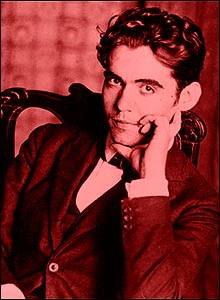
FEDERICO GARCÍA LORCA
SAINT OF ANTINOUS


ON AUGUST 19th, the Religion of Antinous honors St. Federico García Lorca, who was openly gay and who is one of the greatest poets of the Spanish language. 
He was executed by the Fascists on this day, August 19th, during the Spanish Civil War in 1936.

García Lorca's central themes are love, pride, passion and violent death, which also marked his own life.


The Spanish Civil was just getting underway in August 1936 and García Lorca was seen by the right-wing forces as an enemy. The author hid from the soldiers but he was eventually found.

An eyewitness has told that he was taken out of a Civil Government building by guards and Falangists belonging to the "Black Squad". García Lorca was shot in Granada without trial. The circumstances of his death are still shrouded in mystery. He was buried in a grave that he had been forced top dig for himself. 

According to some sources, he had to be finished off by a coup de grâce. One of his assassins later boasted, that he shot "two bullets into his arse for being a queer".

It was the end of a brilliant career as a poet and dramatist who was also remembered as a painter, pianist and composer.

In the 1920s he was close friends with Luis Buñuel and Salvador Dalí, among many others who later became influential artists in Spain. Despite the accolades from artists and critics, he suffered from bouts of depression brought on largely by his inner conflict about his homosexuality.

He was tortured by the demands of being a celebrity in a homophobic society and the yearnings of his gay soul.

During his lifetime only a handful of close friends were allowed to read the collection of gay poems which would be published many years later as his Sonnets of Dark Love. Here is one of them, entitled Love Sleeps in the Poet's Heart:


You'll never understand my love for you,
because you dream inside me, fast asleep.
I hide you, persecuted though you weep,
from the penetrating steel voice of truth.
Normalcy stirs both flesh and blinding star,
and pierces even my despairing heart.
Confusing reasoning has eaten out
the wings on which your spirit fiercely soared:
onlookers who gather on the garden lawn
await your body and my bitter grief,
their jumping horses made of light, green manes.
But go on sleeping now, my life, my dear.
Hear my smashed blood rebuke their violins!
See how they still must spy on us, so near!


With the Catalan painter Salvador Dalí and the film director Louis Buñuel he worked in different productions.

Dalí and Lorca had met in 1923. From the beginning, Lorca was fascinated by the young Catalan's personality and looks. Also Dalí had admitted that Lorca impressed him deeply.

When Buñuel and Dalí made their famous surrealist short film Un Chien Andalou (1928), García Lorca was offended: he thought that the film was about him.

Lorca's friendship with Dalí inspired a poem, a defense of modern art and at the same time an expression of homosexual love. Dalí dedicated his painting of Saint Sebastian to his friend, who often compared himself to the tortured homoerotic martyr.

"Let us agree," Lorca wrote to Dalí, "that one of man's most beautiful postures is that of St. Sebastian."

"In my 'Saint Sebastian' I remember you," Salvador Dalí replied, ". . . and sometimes I think he IS you. Let's see whether Saint Sebastian turns out to be you."

García Lorca was capable only of a "tragic, passionate relationship," Dalí once wrote — a friendship pierced by the arrows of Saint Sebastian.


The Religion of Antinous honors this great artist who lived and loved tragically and passionately and who died tragically for being gay.

Monday, August 10, 2026

MONTAGUE SUMMERS
SAINT OF ANTINOUS


ON AUGUST 10th, the Religion of Antinous honors the Reverend Montague Summers, saint of Antinous, who was a very upfront and openly gay member of the  Sacred Band of Lover/Warriors at the turn of the last century and who published a book of Uranian poetry entitled Antinous.

Born April 10, 1880, the Rev. Montague Summers died at the age of 68 on this day in 1948. 

Here is a splendid contemporary description of him:

"During the year 1927, the striking and somber figure of the Reverend Montague Summers in black soutane and cloak, with buckled shoes — à la Louis Quatorze — and shovel hat could often have been seen entering or leaving  the reading room of the British Museum, carrying a large black portfolio bearing on its side a white label, showing in blood-red capitals, the legend 'VAMPIRES'."

While everyone else in Late Victorian and Edwardian England was constrained by strictures of class and morals, Montague Summers thumbed his nose at all restrictions of any kind. Having studied theology to become an Anglican clergyman, he suddenly claimed he had received a visionary call to become a Roman Catholic priest. He donned self-styled priestly robes and called himself "Reverend Alphonsus Joseph-Mary Augustus Montague Summers" — when in fact he had not been ordained officially by anybody.

It was shocking enough in England to convert to Catholicism and become a priest. But to become a fake priest was even more scandalous. But there was more ....


All the while he was also seriously studying the Occult and became friends with the crowd of Occultists who hung out at Watkins Books just off Leicester Square in London's theatre district — still even today one of the "craftiest" places to see and be seen.

In the late 19th Century, Watkins was the only book shop in England (or perhaps in the world) which specialized in esoteric books and witchy things. It was frequented by Madame Blavatsky and Bram Stoker and Arthur E. Waite and Pamela Colman Smith and — of course — Aleister Crowley. Summers became friends with Crowley and they enjoyed playing off each other, claiming they were opposite "polarities" of magical craft.

When Crowley announced he was a modern-day wizard, Summers responded by announcing he was a modern-day Catholic witch hunter. He wrote his own Malleus Maleficarum which claimed to be an accurate account of witchcraft and of the methods necessary to combat it.

He also wrote a book on The History of Witchcraft and Demonology, saying:

"In the following pages I have endeavored to show the witch as she really was — an evil liver: a social pest and parasite: the devotee of a loathly and obscene creed: an adept at poisoning, blackmail, and other creeping crimes: a member of a powerful secret organization inimical to Church and State: a blasphemer in word and deed, swaying the villagers by terror and superstition: a charlatan and a quack sometimes: a bawd: an abortionist: the dark counselor of lewd court ladies and adulterous gallants: a minister to vice and inconceivable corruption, battening upon the filth and foulest passions of the age".

As with everything that Rev. Summers wrote, it is difficult to determine whether his intention was to condemn or to praise. He was so clearly fascinated by the Occult that one never knew quite whether he was "for it" or "against it."


There was no doubt, however, about his love of handsome youths. It was said that he had never been ordained because of rumours of improprieties with boys as a school teacher, teaching upper class English schoolboys the finer points of Latin.

Indeed, Summers was for a while part of the circle of the Uranian poets, who celebrated ancient Greco-Roman erastos/eromenos man-boy love. His first book, Antinous and Other Poems appeared in 1907 and was dedicated to male-male love.

He was fascinated by Classical male-male love, and by the lives of  the Catholic saints, especially Saint Catherine who was drawn and quartered and who lives on as the English teatime "Hot Cross Bun"  symbolizing the way Catherine was torn limb-from-limb into four gore-spewing pieces rather than give up her faith. Very tasty with tea and clotted cream.

Rev. Summers revelled in telling young boys that their favorite snack symbolized the brutal dismemberment of a lady of faith. All of it told alongside Latin grammar lessons and tales of vampires and werewolves.

After his books on witchcraft, he wrote authoritative books on vampires, including The Vampire: His Kith and Kin (1928) and The Vampire in Europe (1929), and later a definitive book on werewolves, The Werewolf (1933). The werewolf book influence a whole generation of movie-makers, especially the German writer Curt Siodmak who wrote the screenplay for the 1941 horror classic The Wolf Man starring Claude Rains and Lon Chaney Jr.

Nearly everything that you have seen in Hollywood werewolf movies (wolf bane, silver bullets, etc.) comes straight from Curt Siodmak's reading of Rev. Summers book back in the 1930s.

The main difference between Rev. Summer's books on vampires and werewolves and books by other experts was that the other experts referred to these beings as "folklore superstitions" or as "pathological psychoses" in deranged minds. But when you read Rev. Summers' books, you know that he believed in the real actual true-life existence of vampires and werewolves.


In the old Hollywood werewolf movies, when a character went to the bookshelf and pulled down a book on werewolves and turned to a page with a woodcut illustration of a man-wolf — that was a cinematic reference to the 1933 book by Rev. Summers which was in fact on the shelves of well-stocked scholarly libraries around the world.

Summers's work on the occult is notorious for his unusual and old-fashioned writing style, his display of erudition, and especially his undoubted belief in the reality of the subjects he treats.

He was also fascinated by 19th Century Gothic literature. The genre was best exemplified by Mary Shelley's Frankenstein early in the century and the genre came to a thrilling close at the end of the 19th Century with Bram Stoker's Dracula.


Uptight Victorian readers had read Gothic horror novels with a mixture of shock and delight and Summers recognized the art form of the Gothic novel as a symbol of a romantic backlash against urbanization and industrialization.

He knew that "horror" was here to stay as a part of popular culture — as indeed it is. Every book shop, every video/DVD store has a big "Horror" section.

He helped to make horror a serious study of academic research by writing The Gothic Quest: a History of the Gothic Novel (1938), A Gothic Bibliography (1940) and he published a collection of Gothic horror stories in The Supernatural Omnibus (1931) and Victorian Ghost Stories (1936).

Above all, Rev. Summers was very strange and eccentric. The Times of London called him "in every way a 'character' and in some sort a throwback to the Middle Ages". He was also unabashedly and openly homosexual in an age when others (such as St. Oscar Wilde) faced jail and ruination for being gay.

Summers was a member of the Order of Chaeronea, a secret society for gay men founded in 1897 by George Ives, which was named after the location of the battle where the Sacred Band of Thebes was finally annihilated in 338 BC. The Sacred Band consisted of 150 homosexual couples and the reason was that lovers would fight more fiercely and more cohesively at each other's sides than would heterosexual men who were "just buddies."


Rev. Summers is a Blessed Prophet of Homoeros and a Dedicant and Messenger of Antinous among the Aula Sancti Ecclesiae Antinoi (our list of saints).

Monday, July 20, 2026

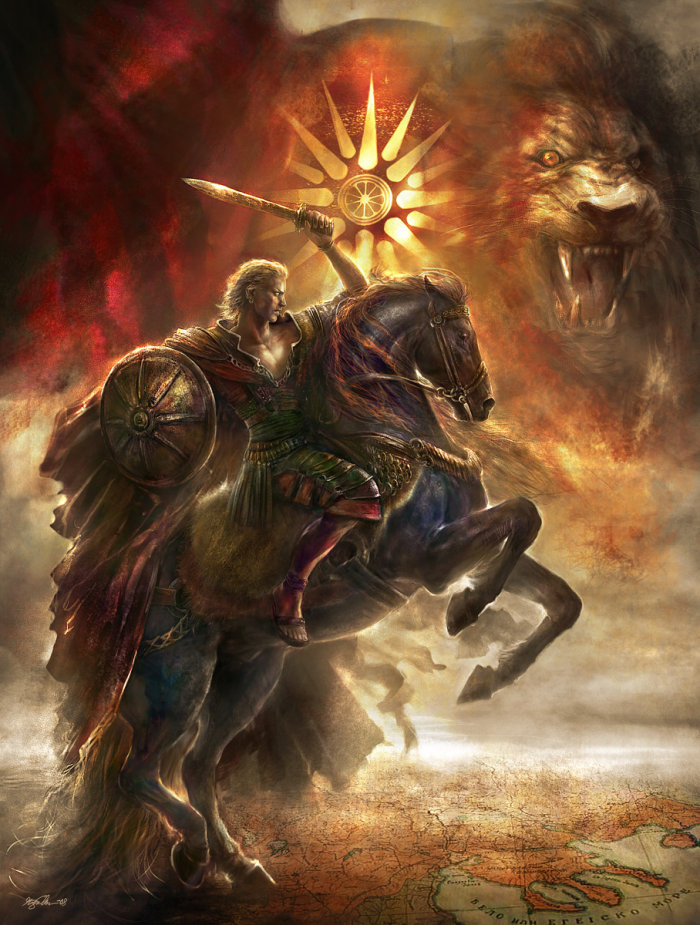
THE BIRTH OF ALEXANDER


IT IS SAID that on the night before the mother of Alexander, Olympias, was to be married to King Phillip of Macedonia, she dreamt that a thunderbolt struck her body and filled it with power.

After the marriage, it is said that Phillip peeked into her chamber, and found her lying with a serpent, and that he afterward dreamt that her womb was sealed and that a lion dwelled within her. 

And on the night that he was born, 20th of July, 356 BC, the great Temple at Ephesus was burned to the ground by a vandal, because the goddess Artemis was away, assisting with the birth of Alexander the Great.

He was considered to be the son of Zeus, and this divine origin was  what was given as an explanation for the unprecedented conquests that he accomplished. In his youth Aristotle, a student of Plato, educated him along with his following of young princes, who were later serve as his generals, and the founders of great dynastic monarchies of the Hellenistic world.

Foremost of these was his ever loyal and devoted Hepheistion, whose reciprocated love for Alexander was homosexual in nature.

In one of their first battles, while Phillip was still king, the young Alexander proved himself by defeating the Sacred Band of Thebes, the army of homosexual lovers who were the most famous and courageous warriors of their time.

Alexander is said to have wept at their destruction, and buried them with honor, erecting a statue of a Lion over their graves.

He would later go one to conquer the entire Eastern world, Asia Minor, Syria, Judea, Egypt, and all of Persia, as far East as India. The Empire of Alexander spread Greek culture throughout the world, and made the communication of far-distant ideas possible so that the new Hellenistic culture that he created, was a combination of classical Greece and of the exotic cultures that were imported from every corner.


After the death of Alexander, at only 33 years of age, he was deified by his generals who divided his great Empire among themselves. We praise the glorious warrior Alexander of Macedonia, and elevate him, and worship him as a God, an example of the greatness of homosexuality, and a heroic protector of the Divine Antinous.

Saturday, July 18, 2026

CARAVAGGIO, SAINT OF ANTINOUS


ON JULY 18th the Religion of Antinous honors Saint Caravaggio.


Michelangelo Merisi da Caravaggio, who died under suspicious circumstances on this day in 1610, was an extraordinary painter whose homoerotic images of young men have caused art historians to call him the first modern painter.

St. Caravaggio is the Patron of Gifted Bad Boys — Gay Boys who are blessed with incredible talents but who are too impatient and too rebellious to abide by the rules of society.

St. Caravaggio was always in trouble. In 1592, when he was not yet 20 years old, he fled Milan after a series of brawls and the wounding of a police officer. He went to Rome and was there, for the most part, until 1606, when he again had to flee. His life in Rome was of growing financial and professional success, but it was also punctuated with crime.

In the years 1600-1606 alone, he was brought to trial no less than eleven times. The charges covered a variety of offenses, most involved violence. It is significant that, despite his reputation for homosexuality, and his endless brushes with the police, he was never charged with sodomy, then a capital offense.

But he was charged with murder. On 29 May 1606 he killed one Tommasoni in a brawl after a disputed game of royal tennis, and had to flee to escape execution. He went first to Naples, then to Malta, where he was feted and made a Knight of St John.

Then, after "an ill considered quarrel" with a senior knight, he was on the run once more, all around Sicily, then on to Naples again.

But this time there was no hiding place. The knights, known for their relentlessness, pursued him, and Caravaggio, now 39 nine, in an attempt to seek forgiveness and refuge in Rome, tried to get there, but died at Porto Ercole, apparently of a fever, though the circumstances are highly suspicious.

Despite his hunted and, in the end, desperate life, he always managed to go on painting, often without a proper workshop of any kind. He was variously described, even by admirers, as a man of "stravaganze" as "uno cervello stravagantissimo" (exceptionally odd) and a "cervello stravolto".

His father died when he was six, his mother when he was 18, which may help to explain his anger at the world. His paintings show that he was a man of the most profound religious convictions, of a humble and contrite heart, and with a fanatical devotion to his art.

 His fundamental ideas were always absolutely clear, though he continually changed and improved his techniques. He believed in total realism, and he always painted from life, dragging poor people in from the street if need be.

He became a great realist by painting flowers and fruit, in a variety  of lights, sometimes pure still lifes, sometimes with street boys, such as the model for Bacchus (above).

To achieve realism, he liked to pull his subject out of surrounding darkness into strong lateral or overhead light, as close to the viewer  as possible.

This was a new kind of art, which was to have momentous consequences. It has led some modern writers to speculate that, born into the 20th or 21st Century, Caravaggio would have been a photographer or a filmmaker.

But that is nonsense. Caravaggio, it is clear, adored the feel and line of a brush on a slightly springy surface, prepared with grey (as a rule), and the sheer creative excitement of using the brush to bring the real world out of the darkness of the canvas.

For the first time in the history of art, Caravaggio eliminated the space between the event in the painting and the people looking at it. He created a kind of virtual reality to give you a feeling as though you are right there inside the painting.


Even we, whose vision and sense of reality has been blunted and distorted by television and the cinema, still get tremendous impressions of participating when we see his great canvases close up. What then must it have been like in the early seventeenth century, for people who had never come across anything approaching this blast of actuality, to be brought face-to-face with a reenactment of sacred events in two dimensions, such as St. Francis of Asisi in Ecstasy?

Artists were particularly struck, or perhaps shocked is a better word, but horribly stimulated too, and stirred to find out exactly how the man did it.

Caravaggio, despite all his difficulties, always finished each piece of work if he possibly could, then went directly on to another, with  fresh ideas and new experiments.

He was a Bad Boy. But he was a gifted genius. The Religion of Antinous honors this Patron of Gifted Bad Gay Boys as an exemplar and saint. Let us lift our glasses to St. Caravaggio.

Tuesday, July 14, 2026

KARL HEINRICH ULRICHS
SAINT OF ANTINOUS


ON JULY 14 the Religion of Antinous honors Saint Karl Heinrich Ulrichs, the world's first gay activist, who lobbied governments 100 years before Stonewall for repeal of anti-gay laws, and who was also Chief Priest of Antinous worldwide in the latter half of the 19th Century.

Even before the term "homosexuality" had been coined, Ulrichs came out to his friends and families and proclaimed in 1864 that he was a "Uranian" — or "Urning" in his native German — and thenceforth waged a one-man campaign for gay rights in Germany.

Sanctus Carolus Henricus Ulrichs, Chief Priest of Antinous in the 2nd half of the 19th Century (worldwide!) wrote incredibly long poems — nearly in epic form — about Hadrian and Antinous.

He wrote a manuscript for a mammoth scientific work on Antinous in history, art, coins and his influence on ancient and modern culture. The manuscript was confiscated and destroyed in a police raid.

As part of his gay-rights lobbying effort, he wrote dozens of pamphlets with titles such as "Researches on the Riddle of Man-Manly Love" aimed at dispelling homophobic myths about same-sex love.

Late in life Ulrichs wrote: "Until my dying day I will look back with pride that I found the courage to come face to face in battle against the spectre which for time immemorial has been injecting poison into me and into men of my nature. Many have been driven to suicide because all their happiness in life was tainted. Indeed, I am proud that I found the courage to deal the initial blow to the hydra of public contempt."

Forgotten for many years, Ulrichs is now becoming something of a cult figure in Europe. There are streets named for him in the German cities of Munich, Bremen and Hanover. His birthday (August 28th, 1825) is marked each year by a lively street party and poetry reading at Karl Heinrich Ulrichs Square in Munich.


The International Lesbian and Gay Law Association presents an annual Karl Heinrich Ulrichs Award in his memory. He died on July 14th, 1895, in L'Aquila, Italy.

Monday, June 29, 2026

GAD BECK, SAINT OF ANTINOUS


ANTINOUS is the God of the Men with the Pink Triangles, gay victims of the Nazis. 

So it is with profound humility that we proclaim an anti-Nazi resistance fighter and the last known gay Jewish survivor of the Holocaust to be a Saint of Antinous.

GAD BECK died in Berlin in 2012 six days before his 89th birthday on June 30.

Beck was a pioneering gay activist and educator in a severely anti-homosexual, repressive post-World War II German society. He was famous for his witty, lively style of speaking.

On a German talk show, he said with a wink to his small physical size, "The Americans in New York called me a big hero. I said no... I’m really a little hero."

Perhaps the single most important experience that shaped his life was the war-time effort to rescue his boyfriend. Beck donned a Hitler Youth uniform and entered a deportation center to free his Jewish lover Manfred Lewin.


After bluffing his way out of the deportation center, as the two youths were hurrying down the road to freedom, Manfred stopped and said he couldn't go on. 

He tearfully said he would never forgive himself if he abandoned his family. So, with a parting kiss, he turned back and Gad never saw him again.

The Nazis would later deport the entire Lewin family to Auschwitz, where they were murdered.

Gad's only memento of Manfred was a little notebook with poems, sketches and essays which Manfred had written, plus a photograph. Gad treasured them all his life.

Speaking about his life as a gay Jew, Beck invoked a line frequently cited about homosexuality: "God doesn't punish for a life of love."

He was featured in the film THE LIFE OF GAD BECK (Die Freiheit des Erzählens: Das Leben des Gad Beck) as well as in the German documentary film PARAGRAPH 175. (The notorious Paragraph 175 of the German Penal Code outlawed homosexuality before Adolf Hitler became chancellor in 1933, and the Nazi party radically intensified the enforcement of the anti-gay law, including deportations to extermination camps.)

Aside from the two documentaries, however, he said with typical humor that he was still waiting for the blockbuster, feature-length movie about his life, and he knew just the man to bring it to the big screen.


"Only Steven Spielberg could film my life – forgive me, forgive me," Beck quipped.

He had immigrated to Israel in 1947. After his return to Germany in 1979, the first post-Holocaust head of Berlin's Jewish community, Heinz Galinski, appointed Beck director of the Jewish Adult Education Center in Berlin.

In a telephone interview with Judith Kessler, editor of the Berlin Jewish community's monthly magazine, Juedisches Berlin, she told THE JERUSALEM POST that Beck would organize gay singles meeting in the center.

"He was open, sweet and would speak with everybody," she said. Kessler, who knew Beck since 1989, added that he would attend the annual Christopher Street Day Parade for gay pride in Berlin and wave an Israeli flag.


Beck's father was an Austrian Jew and his mother converted to Judaism.

The Nazi racial laws defined Beck as mischling (mixed-breed), and he and his father were carted off to a holding compound in the Rosenstrasse in central Berlin.


After the non-Jewish wives of the prisoners launched a massive street protest in 1943, Beck was released. There were "thousands of women who stood for days... my aunts demanded 'give us our children and men'," he said.

The Rosenstrasse demonstration helped debunk the widespread myth in post-Holocaust German society that resistance against Nazism was futile.

"The Rosenstrasse event made one thing absolutely clear to me: I won't wait until we get deported," said Beck.

Following his release, Beck joined Chug Chaluzi, an underground Zionist resistance youth group, and played a key role in securing the survival of Jews in Berlin.

According to the entry about him at the Holocaust Memorial Museum in Washington, he noted that "as a homosexual, I was able to turn to my trusted non-Jewish, homosexual acquaintances to help supply food and hiding places."

Shortly before the end of the war in 1945, a Jewish spy working for the Gestapo betrayed Beck and some of his fellow resistance fighters.

He was held captive at a Jewish transit camp in Berlin. After the defeat of Nazi Germany, Beck continued his Zionist work and helped Jewish survivors emigrate to Palestine. He remained in Israel between 1947 and 1979.

Sunday, June 28, 2026

EDWARD CARPENTER
SAINT OF ANTINOUS


THE last of our three Uranian Patriarchs, Edward Carpenter was born in Brighton England on the 29th of August, 1844, to a very large middle-class family. 

While his brothers went into the military, Edward became a scholar, with great success and eventually even taught at Cambridge where he was required to become ordained as a curate of the Anglican Church.

It was at this time, when he was 24, that he first read Leaves of Grass by Walt Whitman and was completely changed. He resigned his position at Cambridge and devoted his life to the working class, becoming a Socialist philosopher, lecturing, organizing and speaking for working men.

When his parents died, he received an inheritance that he used to purchase a rural estate at Millthrope, which he turned into a veritable Socialist Commune. He repressed his homosexuality for much of his life, channeling his desire into politically inspired friendships.

But the Millthrope house gave him the freedom to express his feelings more openly, and he began to write books on the subject of Uranian Love. He was deeply influenced by Hindu spirituality, and visited India, all of which emerged in his spiritual view of the Socialist movement, which was not so much about political revolution, but directed towards a change in human consciousness, of which homosexuality rapidly became his greatest cause.

While returning from India he met George Merrill on the train. It would be the love of his life. The younger man soon moved into the house at Millthrope, the two became inseparable lovers whose relationship lasted over forty years.

In 1908, he published The Intermediate Sex, the first widely available book on the subject of homosexuality. After the death of John Addington Symonds, with whom he had been closely allied, Edward Carpenter assumed the role as torch bearer, and subsequently published dozens of books and essays for the cause of gay liberation.


He died on the 28th of June, 1929, in Guildford England, and though not widely known at the time, was to later become a spiritual patriarch for the gay liberation movement of the late 1960s and '70s. He is regarded as a Saint and Patriarch of the Religion of Antinous, and remembered as one of the first fathers whose work changed the world with subtle power.

Saturday, June 27, 2026

THE DEATH OF JUDY GARLAND
SPARKED THE STONEWALL RIOTS


THIS is the day the Liturgical Calendar of the Religion of Antinous sets aside for remembrance of Saint Judy Garland, whose death was the spark that ignited the Stonewall Riots on a sultry night in 1969 when a bunch of drag queens and assorted other gay men decided they weren't in the mood to put up with yet another raid by the corrupt and brutal NYPD.

Gays had had enough and they had just suffered a terrible shock — Judy Garland's tragic death on June 22 had rocked the gay world. It was said that 13 twisters raged through Kansas the day Judy died, which — in Kansas — in June — is a pretty safe bet, in any case. But still, and all the same ....

Judy had died in London, and amid much news media hype, her body was flown back to New York for a memorial service which drew a huge crowd of grief-stricken gay men who gathered outside Campbell's Funeral Chapel in Manhattan — on June 27, 1969.

Afterwards, the bars were jammed with gay men drowning their sorrows in booze and drugs while listening to Judy Garland songs full blast on every jukebox.

The mood was electrified by a sense of solidarity in grieving for a fallen idol. Gay men had surprised themselves by turning out en masse for Judy's funeral. They had experienced strength in numbers for the first time. They had been on national TV news.

In an unprecedented move by prime-time national news anchormen, Walter Cronkite and Huntley-Brinkley had talked about Judy Garland's "tremendous appeal among male homosexual fans" — at supper time when whole families were watching the evening news!


Blacks were standing up for their rights. Women were burning their bras. The Chicano Movement was gathering steam. And now "ho-mo-sexuals" (the announcers were unaccustomed to speaking the word aloud) were having the audacity to congregate outside a sacred chapel in broad daylight — and they even showed their faces on the evening news!

Straight people were being confronted with homosexuals right there on television beamed into their homes. And — more importantly — homosexuals were seeing themselves and their brothers/sisters on national television news. Gays in isolated places who had worshipped Judy Garland at the movies or on LP and tape, were now watching other gay people weeping for her in New York. For the first time, gay people in isolated places saw themselves on TV. We were not alone in our grief at the passing of a star with whom we somehow innately felt connected.

It was a Friday night. Late June. Hot and steamy. The bars were filled to bursting. Gay men were sharing a rare moment of solidarity in powerful emotions. There was a feeling, not only in New York, but around the world, that a paradigm shift had taken place. A gay icon had died suddenly and tragically (shades of Antinous) and we gay people everywhere found ourselves in a catharsis of identity change. None of us understood what was happening. Just as it was with being gay, we gay men couldn't explain it, we just "felt" it and "knew" it to be true.

And THAT moment was when the Manhattan police happened to stage one of their periodic raids on queers. Basically it was a routine raid on an average gay bar. Nobody had reckoned with what would happen next. Even gay men were surprised by what happened next.

ESPECIALLY gay men.

We were men who had been accustomed to being timid fraidy-cats. Men who had never dared to stand up for their sexuality. Drag queens and faggots never fought back. That was a fact of gay survival. We knew we were gay. And we knew what we weren't. We were not "MEN".

Grief turned to outrage. It was a spontaneous uprising fuelled by rage. The vice squad was overwhelmed. Reinforcements had to be sent in. Gay men stood their ground and advanced on the police, pushing them back.

It was the turning point for us. Gay men throughout America — and later in London, Berlin, Sydney and elsewhere — began standing up for themselves under the banner "Remember Stonewall".

In a sense, Judy Garland died for us. Had it not been for her tragic death — strangling on vomit over a toilet bowl in a London hotel suite — there might not have been any Stonewall Riots.


Flamen Antinoalis ANTONIUS SUBIA puts the Stonewall Riots into a spiritual context:

"It was the first resistance by homosexuals against the repression of two thousand years, and the beginning of the Gay Liberation movement. The importance of the Stonewall Riots is the awakening of gay consciousness, the throwing off of the coils of the python that had for so many centuries enveloped our divine form of Love. This sacred revolt is holy to Apollo, Dionysus, and Diana combined as the guardian spirits of Homosexuality. Our modern Gay society was born on this occasion, and all of the peace and freedom that we have obtained in the these short decades are due to the courage that erupted on that Sacred Night in front of the Stonewall Bar."

Friday, June 19, 2026

NICK DRAKE
SAINT OF ANTINOUS


ON JUNE 19th the Religion of Antinous commemorates the birth of SAINT NICK DRAKE, the sexually ambivalent English singer who died under very mysterious, Antinous-like circumstances at a young age and who became an artistic icon for future generations of dreamers and artists.

Nicholas Rodney Drake was born on June 19th, 1948, to an upper middle class English family living in Burma. His father was an industrialist and there was never much question about Nick's financial future. Indeed, he would have been a wealthy middle-aged man today had he done nothing at all.


But Nick never ceased to wonder and worry about his spiritual future. Despite or perhaps precisely because of his admission to Cambridge University, Nick Drake was convinced that he should shun a financially certain future and pursue a future as a musician.

Nick Drake learned to play piano at an early age, and began to compose his own songs, which he would record on a reel-to-reel tape recorder he kept in the family drawing room in rural England.

In 1966 he spent some time in the South of France where he purportedly became acquainted with "the best sort of pot" and perhaps experimented with LSD — and possibly sex with both females and males.

Returning to England, he realized he was not suited to receive a degree from Cambridge University. Nick abruptly and shockingly (as far as his family was concerned) ended his studies at Cambridge nine months before graduation, and in autumn 1969 moved to London to concentrate on a career in music.

Nick signed to Island Records when he was 20 years old and released his debut album, Five Leaves Left, in 1969. By 1972, he had recorded his second album — Bryter Layter and part of his third, Pink Moon. Neither of the first two albums sold more than 5,000 copies on their initial release in Britain, much less abroad. He never made an American breakthrough, unlike other major British artists of the era.

Nick was devastated and depressed. His excruciating shyness to perform live or be interviewed further contributed to his lack of commercial success. Despite this, he was able to gather a loyal following.

He managed to complete his third album, Pink Moon, recorded in midnight sessions in the winter of 1971, immediately after which he withdrew from both live performance and recording, retreating to his parents' home in rural England. Once again, it did not sell well. He felt he was a failure. On November 25th, 1974, Nick Drake retired to his upstairs bedroom where he took a cocktail anti-depressants which killed him. He was found stretched over his bed next morning by his mother.

The Religion of Antinous honors Nick Drake as a prophet of Homoeros. He was a man who saw through the transparent barriers between sexuality to see the spiritual truth of reality. He was one of those many men who are never sure of their sexuality. But it is unimportant whether he was "gay" or not.

Nick Drake is a symbol of these sorts of dreamy and shy men who live existences of quiet despair. Nick Drake could play better riffs on the guitar than almost anybody of his generation. He had a beautiful voice. He was a gifted song-writer. He knew he had more   talent in his little finger than most well-paid artists would ever possess. But his career never took off. The big break never happened. Nobody appreciated him. He was broke and disillusioned.

His sister says she believes he took an overdose of anti-depressants   thinking he wanted it to either cure him or kill him, because he couldn't go on living in such despair of being an artistic failure. How many people in the economic meltdown of the early 21st Century don't feel the same despair? And yet ....

Nick Drake could scarcely have dreamt as he swallowed a handful of pills on a dreary November evening in his parents' house in the English Midlands that he would become a major recording star with fans around the world — 30 years after his death. His three albums now are cult chart-busters around the world.

When we remember Saint Nick Drake, we must remember too that Antinous is the patron of these sensitive souls who die untimely and tragic deaths at an early age. Antinous is the River Man who drowned in the Nile .... 


Saturday, June 13, 2026

KING LUDWIG II of BAVARIA
SAINT OF ANTINOUS


ON JUNE 13th the Religion of Antinous commemorates the life of King Ludwig II of Bavaria, who died on this date in 1886 under mysterious circumstances in an Alpine lake. As with Antinous, his death is shrouded in myth and legend and it will never be known whether he drowned accidentally or whether he was assassinated.

Born August 25, 1845, Ludwig was only 18 when he ascended to the throne of Bavaria in 1864. He was the  last truly sovereign monarch of that Alpine nation, which was engulfed by Prussia during his reign and very much against his wishes.

While the king of Prussia was planning a war against France, and various other crowned heads of Europe were scheming and conniving to commit war and bloodshed, "Mad" King Ludwig (as he was called) devoted the entire resources of his land to the performing and visual arts, commissioning operas by Richard Wagner and building the most astounding fairy-tale castles and palaces.

In the build-up to the Franco-German war, as troops were marching off to battle, Ludwig did not bother to see off his military forces. Instead, he went off on a jaunt to Switzerland to confer with Wagner on plans for a Wagnerian opera house in Munich. The opera house was never built, due to opposition from local critics. Instead, it was built at the Bavarian town of Bayreuth to the specifications of the composer, paid for by Ludwig personally.

Shockingly, in a staunchly Roman Catholic land, Ludwig never married and instead surrounded himself with handsome manservants, artists and architects.

Indeed, Ludwig is best known as a closeted gay man whose legacy is intertwined with the history of art and architecture, as he commissioned the construction of several extravagant fantasy castles (the most famous being Neuschwanstein below) and was a devoted patron of Wagner, who might never have finished his "Ring" cycle without Ludwig's ostentatiously generous support.

In an age of fiercely militaristic nationalism, Ludwig came under intense pressures from his advisers to abandon his artistic projects and to devote himself to empire-building. Feeling harassed and irritated by his ministers, he considered dismissing the entire cabinet and replacing them with fresh faces. The cabinet decided to act first.


 Seeking a cause to depose Ludwig by constitutional means, the rebelling ministers decided on the rationale that he was mentally ill, and unable to rule.

Medical psychiatry was in its infancy, and a panel of "experts" assembled mostly anecdotal evidence of the king's "madness" to satisfy the ministers.

The list of "mad" behavior included his extreme shyness, his distaste for politics and state affairs, his complex and expensive flights of fancy (including moonlit picnics at which his young groomsmen were said to strip naked and dance), conversations with imaginary persons, sloppy and childish table manners and sending servants on lengthy and expensive expeditions to research architectural details in foreign lands.

He was deposed on June 9, 1886, and placed under house arrest at a castle on the shores of Lake Starnberg south of Munich where he was under the constant watchful eye of a psychiatrist.

On June 13, around 6:00 pm, Ludwig asked the psychiatrist to accompany him on a walk along the shore of Lake Starnberg. The doctor agreed, and told the guards not to follow them. The two men never returned. At 11:30 that night, searchers found both the king and his doctor dead, floating in the shallow water near the shore.

Ludwig was known to be a strong swimmer, the water was less than waist-deep where his body was found, and the official autopsy report indicated that no water was found in his lungs. Nonetheless, the official death certificate listed suicide by drowning. The death of the doctor was never explained.


Most other monarchs of his era have been forgotten, or else their names have been cursed by succeeding generations for laying the groundwork for the First World War. But Ludwig was only interested in laying the groundwork for grand architecture and enduring cultural masterpieces. His legacy of art and architecture ... and homoerotic romance ... continues to inspire and to enchant.

Wednesday, June 10, 2026

WE WEEP FOR THE DEATH OF ALEXANDER
HEROIC PROTECTOR OF ANTINOUS


IT was on 10 June 323 BC that Alexander the Great died at the palace of Nebuchadnezzar II in Babylon, according to the Babylonian astrological calendar.


His subjects wept and shaved their heads in mourning, some killed themselves, unable to imagine a world without their golden-haired leader.

Many theories have been put forth about the cause of death … poisoning … a decayed liver from alcohol excess … typhoid fever … malaria.

Egyptian and Chaldean embalmers who arrived on June 16 are said to have attested to Alexander's lifelike appearance. This was interpreted as a complication of typhoid fever, which causes a person to appear dead prior to death.

It was said to have taken two years to build an enormous funerary catafalque to convey the body from Babylon.

On its way back to Macedonia, the funerary cart with Alexander's body was met in Syria by one of Alexander's generals, the future ruler Ptolemy I Soter

In late 322 or early 321 BC Ptolemy diverted the body to Egypt where it was interred in Memphis, Egypt

In the late 4th or early 3rd Century BC Alexander's body was transferred from the Memphis tomb to Alexandria for reburial.

It was seen there by Julius Caesar and Cleopatra, Augustus and possibly Hadrian and Antinous.

At some point, however, the whereabouts of Alexander's body became unknown.

In May 2014 Polish archaeologists claimed they found the LOST TOMB OF ALEXANDER in Alexandria.

Later in 2014 Greek archaeologists made a similar claim to have found the Tomb of Alexander at AMPHIPOLIS, but they eventually said they had been wrong.

We, the modern priests of Antinous, praise the glorious warrior Alexander of Macedonia, and elevate him, and worship him as a God, an example of the greatness of homosexuality, and a heroic protector of the Divine Antinous.