Showing posts with label hadrian. Show all posts

Monday, September 14, 2026

ROMAN SKELETONS BURIED HOLDING HANDS
NOW HAVE BEEN IDENTIFIED AS TWO MALES


TWO ancient Roman skeletons, who mysteriously were buried holding hands, now have been identified as two males, researchers have revealed.

In 2009, archaeologists discovered the remains in the Italian city of Modena. The pair were dubbed the "Lovers of Modena" by the media, the assumption being that they were a heterosexual couple.

The researchers at that time could not determine the gender of the skeletons when they were found in Italy in 2009 because they were badly preserved.

But a new technique, using the protein on tooth enamel, revealed their sex.

The actual relationship between the skeletons from the 4-6th Century AD remains a mystery.

The researchers say the two adult males were intentionally buried hand-in-hand.

Some of the suggestions for the link between the two skeletons are that they are siblings, cousins or soldiers who died together in battle, study author Federico Lugli told Italy's Rai news site (in Italian).

Researchers suggest that their burial site could have been a war cemetery.
The researchers from Italy's University of Bologna said in Scientific Reports that the findings had profound implications for understanding funeral practices at that time in Italy.

Sunday, September 13, 2026

ROME'S GREAT TEMPLE OF JUPITER
DEDICATED ON THIS DAY IN 509 BC


ON the 13th of September the Temple of Jupiter Optimus Maximus atop the Capitoline Hill was dedicated in 509 BC. The ascent of Rome began! 

In the old Roman calendar, September was the seventh month of the year in counting March as the first. Among the festivals observed in September were several honoring Jupiter. 

He was hailed as the chief of the gods and had many epithets as a result.


As Jupiter Optimus Maximus, he occupied the temple of Jupiter Capitolinus on the Capitoline hill with the goddesses Juno and Minerva. With them, he received a Lectisternium (September 13) and the Ludi Romani  (September 5-19). 

Thursday, September 10, 2026

GAY TEEN MARTYR JOÃO ANTÔNIO DONATI
FIRST BRAZILIAN SAINT OF ANTINOUS


ON September 10th we remember the brutal mutilation murder of a gay teenager on this date in 2014 in Brazil ... the first official saint of Antinous in Brazil.

The death of 18-year-old JOÃO ANTÔNIO DONATI galvanized worshipers of Antinous into proclaiming him the first martyr saint of Antinous in Brazil.

His severely beaten body was found in the city of Inhumas in the state of Goiás with his neck fractured and both legs broken and with his mouth and trachea stuffed with a plastic bag and a paper note, on which had been scrawled an anti-gay hate message saying that this is what should happen to all queers.

His horrific bruises, lacerations and contusions showed that he had put up a desperate struggle against his attackers.

On the same day that João was killed, two other gays were beaten and a transvestite was murdered in the same state. But the images of João's smiling Facebook selfies instantly touched the hearts of millions.


Outrage swept the nation, with protest marches and vigils held in numerous cities.

Brazil has the largest Antinous faith community in the non-English speaking world, and adherents of Antinous have taken the unprecedented move of proclaiming João the first Saint of Antinous in Brazil. 

Brazilian Novitiate Priest DECO RIBEIRO says more than 300 LGBTIU victims of homophobic murders were reported in Brazil in 2015 alone, though the true figure is unknown.

"Hundreds more have died since then," says Deco. "Each and every one of these is a martyr who is symbolized by João Antônio Donati. He was a vibrant young man filled with all the hopes and dreams of so many his age, and who became yet another victim of homophobia in Brazil, and who so deeply touched us that we have been moved to initiate something in our country that has long been in the offing: the Declaration of Apotheosis and canonization of the martyrs of homophobia in Brazil."

Noting that anti-gay hate crimes and murders are frequent in Brazil, Deco says: "This is the first statement and official nomination amid many others that will follow continuously over time honoring the names of many victims who have died in the past and who inevitably will be murdered in the future."


He adds, "We are setting out upon a long and arduous road which will entail hard battles for criminalization of homophobia in a country that has become increasingly Christo-Fascistic, homophobic and intolerant in a grotesque throwback of catastrophic and irreparable proportions. This is a turning point in history."

At the Hollywood Temple of Antinous, the founder of the modern religion of Antinous, ANTONIUS SUBIA, says:

"My prayer goes out to Antinous to take João Donati into his embrace, to give him a place of glory and bliss and show him that the world is not merely a place of hatred and violence, but that love still exists here.  

"May his short beautiful life prove to be a changing point for Brazil, may his violent death awaken his country to the darkness and hatred that has infiltrated their society.  May he be a martyr whose violent death brings an end to such things in the future," Antonius said in the statement issued moments ago.

After João's death, his FACEBOOK page was filled with messages of condolence. 

A month before his murder, he updated his profile image with the accompanying message: "Determination, courage and self-confidence are decisive factors for success.

"No matter what obstacles and difficulties. If we are possessed of an unwavering determination, we will be able to overcome them."

Though Brazil passed same-sex marriage into law in May 2014, homophobic attacks and transphobic attacks are still common.

Wednesday, September 9, 2026

'QUINTILIE VARE, LEGIONES REDDE!'
COINS CONFIRM SITE OF TEUTOBURG BATTLE


WHERE was the Battle of Teutoburg Forest fought in the year 9 AD? That is a trick question which school teachers have loved to spring on their pupils for generations.

The answer, of course, is that the Battle of Teutoburg Forest was fought at Teutoburg Forest, changing the course of Western Civilization. But where is that?

Now, for the first time, archaeologists say they have found eight gold coins which confirm the location was at a place called Kalkriese Hill … which is a short distance from the modern-day Teutoburg Forest.

Such a find is extremely rare, the researchers say, and this recent discovery at Kalkriese Hill expands the number of gold coins collected at the site by more than double the previous amount.

The coins featured images of the Emperor Augustus, with the imperial princes Gaius and Lucius Caesar on the back, and all date back to a period before the ancient battle. Thus they were carried by the legions into the battle.

The defeat of the crack troops, who were led to their deaths by ex-Consul Publius Quinctilius Varus, effectively changed the course of Western Civilization.

Prior to 9 AD, Emperor Augustus Caesar pursued a course of military expansion across the Rhine and into central and northern Europe. After 9 AD, the Rhine became the frontier between the "civilized" Roman world and the "barbaric" lands to the east and north.


Prior to becoming emperor, Hadrian himself had served a stint of duty along the Rhine. As emperor, he consolidated the borders of the empire and his forces never ventured across the Rhine into across-the-Rhine Germania.

Historians have always referred to the Battle of Teutoburg Forest as a defining moment which affected the course of history. 


It has even been cited as a factor in both world wars, especially by the French and British, who considered themselves to have a Roman heritage, as opposed to the Germans, whom war propagandists condemned as the descendants of barbarians.

As a result, Germany was never incorporated into the Roman Empire, leaving that region a breeding ground for barbarian incursions which eventually would bring down the empire and eventually (according to Allied war-time propaganda) result in two world wars.

Arminius, known as Herrmann to the Germans, has indeed come down through German history as a heroic symbol of liberty and German national strength. Herrmann turned back the Roman occupation forces forever, according to the popular interpretation by German nationalists. 


In the late 19th and early 20th Century, unscrupulous German leaders used Hermann as a rallying figure in wars of aggression.

A monument near the site of the Teutoburg Forest battlefield celebrates Herrmann as a national hero. Thousands of German tourists visit the site annually. And the regional soccer team (in Bielefeld) is called Bielefeld Arminia. "Armin" is a popular name for German boys to this day.

Archaeologists in recent years have determined the exact location of the battle near the modern village of Engter north of the city of Osnabrueck. Bones, weapons and armour from the fleeing soldiers of the XVII, XVIII and XIX Legions are strewn along a narrow 17-km-long stretch of marshy woodlands bounded by confining hills to the north and south.


Now the coins definitely confirm that location.

Arminius had been educated in Rome and had become a trusted friend of Varus. The idea was that raising future chieftains in Rome would bond them to Rome when they returned to their families on the frontier.


Arminius was an example of how that policy could backfire and result in knowledge of Roman ways being used against the Romans. Arminius ingratiated himself with Varus, who was one of the most influential men in Rome, a friend of Augustus Caesar himself. 

It was that trust in Arminius which resulted in Varus leading a punitive expedition into an indefensible, boggy forest without sentries or reinforcements ... on advice of his trusted friend Arminius.

In the resulting massacre, Roman soldiers fled for their lives. Most were cut down in the mud. Blue markings in the graphic show where Roman bodies and armament have been found. 


Those who survived were sold into slavery or else were placed in wicker cages and burned alive as sacrifices to the Germanic deities. 

Reports of the battle are sketchy for the simple reason that almost no one survived to report what had happened.

Never before had three entire legions been wiped out in a single battle. The defeat was so devastating that the numbers of the Legions XVII, XVIII and XIX were retired forever, never again to appear in the Roman Army's order of battle. 


Augustus was so traumatized by the loss of three elite legions that he went into a prolonged state of mourning as though for a beloved son ... he tore his clothes, refused to cut his hair for months and, for years afterwards, was heard to moan from time to time, "Quintilie Vare, legiones redde!" ("Quinctilius Varus, give me back my Legions!").

This scene from the epic BBC/PBS mini-series I, Claudius dramatically recreates how Augustus received the news:


Sunday, September 6, 2026

PORTAL TO ANOTHER DIMENSION
IN THE MIDDLE OF MODERN-DAY ROME


IN a quiet corner of a shady plaza in the middle of Rome stands an ages old portal to another dimension.

The "Magical Doorway" (Porta Alchemica) is all that remains of a 17th Century alchemical laboratory which drew scientists from across Europe ... and which drew the wrath of the Inquisition.

The Alchemy Gate or Magic Portal is a landmark from the Villa Palombara built in 1680 by Massimiliano Palombara marquis of Pietraforte on the Esquiline Hill.

The Porta Alchemica is the only survivor of the five gates of the villa Palombara. 

There was a lost door on the opposite side dating from 1680 and four other lost inscriptions on the walls of the mansion inside the villa. 

The marquis was fascinated by occult and esoteric sciences. His wealth and social position enabled him to act as a patron to a number of  alchemists. 

In his villa he also held meetings, attended by other important personages who shared his interests, such as the Swedish Queen Christina, who lived in Rome after having abdicated, the distinguished astronomer Domenico Cassini, the renowned scholar Father Athanasius Kircher, and others.

Villa Palombara had a small detached outbuilding, probably a laboratory, where the occult meetings and the alchemic experiments were secretly held, and occult rituals were performed.

A young doctor and alchemist from Milan named Giuseppe Borri, who had been expelled from the Jesuit college for delving into the occult, came to Rome and joined the circle of Villa Palombara.

A legend says that Borri, sponsored by the marquis, was successful in transforming lead into gold ... creating the Philosopher's Stone of transformational magic. 

But one night he suddenly fled - this really happened, after being stalked by the pope's Inquisition - and left behind a number of papers inscribed with complicated formulae which nobody was able to decipher. 

So Massimiliano Palombara had them inscribed on the doorways of his laboratory.

Another version of the legend says that an occultist calling himself Antimony (an alchemical element whose symbol adorns the portal lentil) conducted experiments at the villa ... and vanished through the doorway one night ... disappearing into a magical dimension ... leaving behind only a solid-gold apple as proof that he could transform matter into gold.


Unfortunately Villa Palombara was completely demolished in the second half of the 1800s, when the new district was built. 

The other doorways were lost ... along with their alchemical formulae.

On both sides of the surviving portal stand two bearded and bandied-legged  statues ... they are statues of the Egyptian deity BES which once stood at a Temple of Isis and Serapis in Ancient Rome.

Knowledge of the Egyptian hieroglyphs had long since been lost when the portal was built. 

The marquis could not have known that BES was a worshiped by the Egyptians not only as a protective deity ... but also as a protector of Egyptian SEM magician-priests.

Or perhaps the marquis was very well aware of this ....

Saturday, September 5, 2026

ROMULUS SHRINE TO JUPITER LOCATED
AT BASE OF PALATINE IN ROME


IN the old Roman calendar, September was the seventh month of the year in counting March as the first. Among the festivals observed in September were several honoring Jupiter. 

He was hailed as the chief of the gods and had many epithets as a result.


As Jupiter Optimus Maximus, he occupied the temple of Jupiter Capitolinus on the Capitoline hill with the goddesses Juno and Minerva. With them, he received a Lectisternium (September 13) and the Ludi Romani  (September 5-19). 

He was honored with festivals as Jupiter Liber and Jupiter Fulminator (September 1) and as Jupiter Stator (September 5).

Jupiter Stator is the hand of Jupiter giving Roman troops their unstoppable force.

Romulus built a temple to Jupiter Stator at the foot of the Palatine Hill, Italian archaeologists say.


The ruins of the shrine to Jupiter Stator (Jupiter the Stayer), believed to date to 750 BC, were found by a Rome University team led by Andrea Carandini.

"We believe this is the temple that legend says Romulus erected to the king of the gods after the Romans held their ground against the furious Sabines fighting to get their women back after the famous Rape (abduction)," Carandini said in the Archeologia Viva (Living Archaeology) journal.


Historians have always been intrigued by ancient references to the temple, but never knew precisely where it was located or what it looked like. The lithograph above is a fanciful 19th Century idea of its possible appearance.

According to myth, Romulus founded Rome in 753 BC and the wifeless first generation of Roman men raided nearby Sabine tribes for their womenfolk, an event that has been illustrated in art down the centuries.

Carandini added: "It is also noteworthy that the temple appears to be shoring up the Palatine, as if in defence".

Rome's great and good including imperial families lived on the Palatine, overlooking the Forum.

Long after its legendary institution by Romulus, the cult of Jupiter the Stayer fueled Roman troops in battle, forging the irresistible military might that conquered most of the ancient known world.


In the article in Archeologia Viva, Carandini's team said they might also have discovered the ruins of the last Palatine house Julius Caesar lived in - the one he left on the Ides of March, 44BC, on his way to death in the Senate.

Wednesday, September 2, 2026

SAINT WILLI NINJA


ON September 2nd, the Religion of Antinous honors St. Willi Ninja, who made the whole world take notice of a gay ghetto dance style called Vogueing.

Vogueing ... with its angular body movements, exaggerated model poses and intricate mime-like choreography ... and the colorful characters who populated Willi Ninja's world were introduced to the public at large by Paris Is Burning, the award-winning 1990 documentary about New York's drag vogue-ball scene. Later in his career, Willi Ninja also performed in works by postmodern choreographers including Doug Elkins, David Neuman and Karole Armitage.

Vogueing had been around for years, but Willi Ninja brought it to a level of visibility and perfection in performance that no one had ever reached before, according to Sally Sommer, a professor of dance at Florida State University.

"He was tall man, about 6-3," she said, "and God gave him the biggest, broadest dance shoulders in the world, so when he would do those things with his arms it was just so impressive."

Willi Ninja is featured in Sommer's 2006 documentary Check Your Body at the Door.

William R. Leake was born in Queens New York on April 12, 1961. He began dancing at 7. By the early 1980s he was vogueing in Washington Square Park in Greenwich Village and at drag balls throughout Harlem. He prided himself on being a clean, sharp dancer, with swiftly moving arms and hands, and he was deeply inspired by the martial arts ... hence his adopted name, Ninja.

As the "mother" of the House of Ninja ... part dance troupe, part surrogate family ... he became a New York celebrity, known as much for his quick wit and sharp tongue as for his darting limbs.

His ensembles ... a coat made of braided synthetic hair, a suit jacket with a skirt and Doc Marten boots ... also turned heads wherever he went: "SEVERE" is the word.

An androgynous, self-described "butch queen," St. Willi Ninja taught vogueing throughout Europe and Japan, modeled in runway shows for the fashion designers Jean Paul Gaultier and Thierry Mugler and danced in music videos such as Madonna's 1990 hit "Vogue".

He also taught models how to strut, giving stars like Naomi Campbell pointers early in their careers. Before his death in 2006, he worked with the socialite Paris Hilton, whose red carpet sashay has since become her signature.

In 2004, he opened a modeling agency, EON (Elements of Ninja), but he never gave up dancing, appearing on televisions series like "America's Next Top Model" and "Jimmy Kimmel Live", and dropping in at local clubs.

"If he saw someone doing something on the dance floor that he loved, he'd walk up to them and say, 'Oooh, child, you are fierce,'" his friend Archie Burnett recalled. "That was one of his highest compliments."

In 2003 he was diagnosed with HIV, but he continued working to support his elderly mother, despite the fact that he could not afford medical health care for himself.

His mother was a wheelchair-bound woman suffering from Parkinson's. One of Ninja's best friends, fellow dancer Archie Burnett, said St. Willi was always grateful that his mother had taken him to the ballet and the Apollo when he was a boy, which inspired him to become a dancer. So he was determined to care for her at the expense of his own seriously declining health.

St. Willi Ninja died September 2, 2006, three years after an HIV diagnosis. In the end, the famous dancer had lost his sight and become paralyzed. But that didn't stop him from being fabulous.

"He was weak, but let me tell you, he was running the show," his friend Archie said, recalling how his acolytes did his hair in the hospital room.

He said, "Child, if I gonna die, then I want to look as fabulous as possible."

The Religion of Antinous honors Willi Ninja as a Saint of Antinous and Blessed Prophet of Homoeros for his courage in overcoming racial discrimination and homophobia. While others of his generation turned to drugs or alcohol or dysfunctional violence to assuage their shattered self-esteem ... St. Willi Ninja turned to the dance floor, where he converted the simple act of walking into a high-art form of sheer FABULOUSNESS.


Monday, August 31, 2026

ANTINOUS ENABLES YOU TO DISCOVER
THE INTELLIGENCE OF THE HEART


IN ancient times, Antinous was known as a miracle worker. His worshipers prayed to him for miracles, oracles, visions and answers to problems in their daily lives.

The Egyptian hieroglyphs on the OBELISK OF ANTINOUS state clearly that Antinous answers the prayers of all who call upon him through dreams and visions, for example.

The hieroglyphs also make cryptic references to his ability to work magic through his heart. This is a reference to the Ancient Egyptian concept of the "Intelligence of the Heart."

The Egyptians knew that the brain is the center of motor activity and sensory perception. But they believed the heart is the center of a form of intelligence which has baffled most mainstream Egyptologists ... who assume the Egyptians believed the heart was where cognitive thinking occurs.

But the Egyptians had a very different view of the universe from our rational, scientific view of the universe. We dissect facts and analyze them. But while the Egyptians were very good at analyzing facts, they also retained the Zen-like ability to see the whole ... which leads to contemplation ... not analysis.

The Egyptians understood that if you want to find an intelligent solution to a problem, your brain can do the work. You have all the necessary intelligence inside the bone in your skull.

However, most people use their brains the same way they use their muscles. You can strain your head just as if it were a muscle, and work very hard trying to arrive at an answer, but it doesn't really work that way.

When you really want to find an answer to something, what you need to do is contemplate the problem. Visualize your question as well as you can, and then simply wait.

If you don't, and if you instead try to find the solution through brute mental strength, you may be disappointed, because any solution that comes in that way is likely to be wrong.


But when you have waited for a while, the solution will come of itself. That is what the Egyptians called the Intelligence of the Heart ... using your heart instead of your head.

It will work for you in the same way your stomach will digest your food for you without your having to supervise it consciously. Our attempts to supervise everything consciously have all led to consequences that aren't too good for our stomach, and the reason for that is quite simple.

Conscious attention, which employs words, cannot think of very much. We are forced, therefore, to ignore almost everything while we are thinking. We think along a single track, but the world doesn't proceed along a single track.

The world is everything happening altogether everywhere, and you just can't take all that into consideration because there isn't time.

However, the Intelligence of the Heart can take it all into consideration because it is capable of handling innumerable variables at once, even though your conscious attention cannot...


The hieroglyphs on the Obelisk of Antinous promise that Antinous the Gay God enables us to discover the Intelligence of the Heart ... the Intelligence of HIM ... he opens his heart to you .... 

Sunday, August 30, 2026

ANTINOUS WORSHIPERS WORLDWIDE
TAKE PART IN LION HUNT CEREMONIES


ANTINOUS worshipers worldwide participated live online tonight in ceremonies commemorating the SACRED LION HUNT, the final recorded event in the brief life of Antinous ... when he and Hadrian slew a man-eating lion in Egypt in August of the year 130 AD.

Worshipers on both coasts of North America as well as worshipers in South America, Europe and Africa took part in the ceremonies originating at the Hollywood Temple of Antinous.


The skin art image shows Antinous subduing the man-eating Marousian lion in the Egyptian desert in the year 130 AD.

The SACRED LION HUNT was immortalized in poetry and in stone, showing Antinous brashly attacking the lion with his adamantine-tipped spear and wounding it ... so that Hadrian had to gallop to his rescue and dispatch the beast.

Hadrian added medallions to the Arch of Constantine showing him and Antinous with feet on the lion's neck and also making sacrifice to the great lion-killer Hercules.

Soon legend would have it that scarlet-red lotus blossoms had sprung forth from the pool of the lion's blood ... which we honor as the LOTUS MOON, the Pisces Third Quarter Moon in June.

Within a few short weeks after the Sacred Lion Hunt, Antinous himself would be dead. The Sacred Lion Hunt is the last recorded event in His short life.

Flamen ANTONIUS SUBIA celebrated the liturgical ritual in Hollywood.

Antonius noted that the brave may not live forever, but the cautious do not live at all. Tonight's rituals and meditations were aimed at enabling participants to traverse the road between who they think they are and who they can be. The key is to set forth on the journey ... with adamantine-tipped spear in hand ... galloping forward.

Saturday, August 29, 2026

THE ANCIENT PRIESTS OF ANTINOUS
KNEW HOW THE LEOPARD GOT ITS SPOTS


ANCIENT PRIESTS of Antinous at the Great Temple at ANTINOOPOLIS in Egypt were familiar with leopard-skin priestly robes. 

Whether they actually wore leopard skins in the Egyptian priestly manner is unknown, but it is certainly possible.

The Ancient Egyptian magical SEM priests always wore a leopard skin ... as do many African shamans even today.

Indeed, it is highly likely that the Ancient Egyptians got the idea from their southern neighbors — where else could they have got the idea, after all? 

The Egyptians were accustomed to lions and we know that lions were a menace even in the 2nd Century AD when Hadrian and Antinous conducted the SACRED LION HUNT. But it is safe to say that leopards were very rare and highly prized species even in Ancient times — which made them even more magical.

The Egyptians said the leopard started out as a variety of sacred lion, the lion being associated with the sun god Ra and of pharaoh's power and rulership as an incarnation of the sun god. 

The leopard lived in the desert like the lion and was indistinguishable from the lion because the leopard originally had no spots.

This is the cue for Anubis and Seth to enter the scene!

Anubis had a very odd love/hate relationship with Seth. Some said that Anubis was the son of Seth by Seth's consort Nephthys. Others said Anubis was the son of Osiris and Seth's consort Nephthys and that Nephthys placed the baby in the care of her sister Isis to avoid Seth's wrath. 


At any rate, little Anubis was raised by the Osiris side of the divine family, not the Seth side. Anubis and Seth had a very strained relationship, to say the least, full of doubt and suspicion on both sides.

Not surprisingly, Anubis took sides with Isis (as his foster mother) and her son Horus (perhaps his biological half-brother? ) in seeking to avenge the death of Osiris (his own true father?) after Seth murdered Osiris by drowning and mutilating his body.

The struggle between Horus and Seth continues to this day, of course. Seth has the advantage of being able to transform himself into any creature, thus eluding his pursuers. Sometimes he is a hippo. Sometimes he is a crocodile. Sometimes he is a giant serpent. Often, he is a graceful antelope. He can be deceptively beautiful and entrancing.  


The Lie takes many deceptive forms,
always posing as the Truth. 


But Anubis was able, by means of his keen canine senses, to sniff out Seth in whatever form he takes. 

Once, Seth assumed the form of a leopard and blended into the desert sand so well that Horus was unable to spot him from the air as he circled high in the sky upon his falcon wings, using his sharp falcon eyes to scan the Earth.

But Anubis sniffed out Seth and decided to brand him so that everyone would be able to see him. Anubis trotted over to the banks of the Nile and dunked his paws in rich black Nile mud. Then he leapt onto the leopard and left indelible muddy paw prints all over Seth's hide.

That is how the leopard got its spots, according to the Ancient Egyptians.

The highest caste of Egyptian magician/priests wore leopard skins to symbolize the never-ending struggle between the Truth and the Lie. The Lie persists. Seth the Deceiver was not killed by Anubis. But Anubis revealed Seth for the Lie that he is.


And that is why the Priests at the Great Temple of Antinoopolis may have worn leopard skins ... to demonstrate that it is possible to see through the Lie to uncover the Truth that lies underneath.

Wednesday, August 26, 2026

NINE MILLION MUMMIFIED DOGS
FOUND AT EGYPTIAN TEMPLE OF ANUBIS


AS Antinous and Hadrian journeyed up the Nile in August and September of 130 AD, they must have seen the mighty monuments at Memphis ... and the sprawling cliffside ANUBIEION, the mystery-shrouded Temple of the jackal-headed Egyptian deity Anubis at Saqqara south of modern Cairo.

But was Antinous aware that nine million dog mummies were entombed there?

The unique, terraced temple compound was built into the face of the cliffs overlooking the ancient Egyptian capital city of Memphis-Mennefer. Beyond the Anubieion lay the necropolis city of the dead. In front of it lay the teeming city nestled in the Nile Valley.

For decades, experts were unsure what purpose the Anubieion served. No where else in Egypt is there a temple dedicated solely to Anubis. Some temples to other deities had niche shrines to the jackal-headed deity who conveyed the souls of the dead to everlasting life.

But the discovery of myriads of mummified dogs in the Anubieion's catacombs makes it clear that the Anubieion was indeed a temple whose goal was to assist people in making the transition from earthly life to eternal life.

The dog mummies were sold to serve as "guide dogs" for souls of the departed.

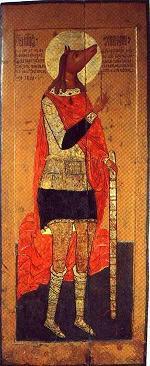
As Christianity spread in Egypt, Anubis morphed into St. Christopher ... and many early Coptic images of Saint Christopher depict him with the head of a dog (image at left).

The discovery came during routine excavations at the dog catacomb in Saqqara necropolis by an excavation team led by Salima Ikram, professor of Egyptology at The American University in Cairo (AUC), and an international team of researchers led by Paul Nicholson of Cardiff University.

Initial inspection reveals that dogs of all breeds and ages were mummified, from newborn puppies to decrepit old dogs.

“We are recording the animal bones and the mummification techniques used to prepare the animals,” Ikram said.

Ikram also told National Geographic, which is financing the project, that "in some churches people light a candle, and their prayer is taken directly up to God in that smoke. In the same way, a mummified dog's spirit would carry a person's prayer to the afterlife".

Saqqara dog catacomb was first discovered in 1897 when well-known French Egyptologist Jacques De Morgan published his Carte of Memphite necropolis, with his map showing that there are two dog catacombs in the area.

However, mystery has overshadowed such mapping as it was not clear who was the first to discover the catacombs nor who carried out the mapping, and whether they were really for dogs.

"The proximity of the catacombs to the nearby temple of Anubis, the so called jackal or dog-headed deity associated with cemeteries and embalming, makes it likely that these catacombs are indeed for canines and their presence at Saqqara is to be explained by the concentration of other animal cuts at the site," Nicholson wrote on his website.

"These other cults include the burials of, and temples for, bulls, cows, baboons, ibises, hawks and cats all of which were thought to act as intermediaries between humans and their gods."


Despite the great quantity of animals buried in these catacombs and the immense size of the underground burial places, Egyptologists have focused on the temples and on inscriptional evidence rather than on the animals themselves.

The mysteries behind De Morgan's mapping were unsolved until 2009 when this team started concrete excavations at the cemetery in an attempt to learn more about the archaeological and history of the site.

"Results at the first season showed that De Morgan map has substantial inaccuracies and a new survey is under way," Nicholson said.


"The animal bones themselves have been sampled and preliminary results suggest that as well as actual dogs there may be other canids present. Furthermore the age profile of the animals is being examined so that patterns of mortality can be ascertained."

Tuesday, August 25, 2026

ANTINOUS WORKS MIRACLES FOR YOU
WHILE YOU DAYDREAM AT WORK


NEXT time you have a difficult problem to solve, and concentrating on it just isn't getting you anywhere, consider this: Maybe you're thinking too hard.

"Walk over to a window and think about the people or cars going by for a few minutes, until you get bored," suggests Josh Davis, research director at the New York Neuro-Leadership Institute. 

"Let your mind wander."

How will that help? "Always being 'on' blocks the brain processes that occur when we daydream," says Davis. 

His book, TWO AWESOME HOURS Science-Based Strategies to Harness Your Best Time and Get Your Most Important Work Done, draws on new discoveries in brain science.

The idea is certainly not new. This enkoimesis (ἐγκοίμησις) "dream-incubation" was used in Abaton sleep chambers of Aesculapius temples where worshipers sought healing visions from the god to cure their ailments.


The Ancient Priests of Antinous knew that enkoimesis "dream-incubation" and zoning out, even for a few minutes, allows your brain to tackle tasks it can't handle when you're busy. 


They called it the medium for Antinous to work miracles in your life.

In ancient times, Antinous was known as a miracle worker. His worshipers prayed to him for miracles, oracles, visions and answers to problems in their daily lives.

The Egyptian hieroglyphs on the OBELISK OF ANTINOUS state clearly that Antinous answers the prayers of all who call upon him through dreams and visions, for example.

The hieroglyphs also make cryptic references to his ability to work magic through his heart. This is a reference to the Ancient Egyptian concept of the "Intelligence of the Heart."

The Egyptians knew that the brain is the center of motor activity and sensory perception. 

But they believed the heart is the center of a form of intelligence which has baffled most mainstream Egyptologists ... who assume the Egyptians believed the heart was where cognitive thinking occurs.

But the Egyptians had a very different view of the universe from our rational, scientific view of the universe. 

We dissect facts and analyze them. But while the Egyptians were very good at analyzing facts, they also retained the Zen-like ability to see the whole ... which leads to contemplation ... not analysis.

The Egyptians understood that if you want to find an intelligent solution to a problem, your brain can do the work. You have all the necessary intelligence inside the bone in your skull.

However, most people use their brains the same way they use their muscles. You can strain your head just as if it were a muscle, and work very hard trying to arrive at an answer, but it doesn't really work that way.

When you really want to find an answer to something, what you need to do is contemplate the problem. Visualize your question as well as you can, and then simply wait.

If you don't, and if you instead try to find the solution through brute mental strength, you may be disappointed, because any solution that comes in that way is likely to be wrong.


But when you have waited for a while, the solution will come of itself. That is what the Egyptians called the Intelligence of the Heart ... using your heart instead of your head.

It will work for you in the same way your stomach will digest your food for you without your having to supervise it consciously. Our attempts to supervise everything consciously have all led to consequences that aren't too good for our stomach, and the reason for that is quite simple.

Conscious attention, which employs words, cannot think of very much. We are forced, therefore, to ignore almost everything while we are thinking. We think along a single track, but the world doesn't proceed along a single track.

The world is everything happening altogether everywhere, and you just can't take all that into consideration because there isn't time.

However, the Intelligence of the Heart can take it all into consideration because it is capable of handling innumerable variables at once, even though your conscious attention cannot...


The hieroglyphs on the Obelisk of Antinous promise that Antinous the Gay God enables us to discover the Intelligence of the Heart ... the Intelligence of HIM ... he opens his heart to you ....

Monday, August 24, 2026

THE HISTORY OF THE ROSY LOTUS
OF ANTINOUS THE GAY GOD


When Emperor Hadrian visited Alexandria,
the poet Pancrates presented him
with a beautiful lotus flower.


Awestruck by the magnificent rosy-red petals,
Hadrian agreed to name the flower
after his beloved Antinous.


Drawings by Julien


Beautiful CG Art by Antonius Subia


Music by Kevin MacLeod


For more info: THE TEMPLE OF ANTINOUS

Saturday, August 22, 2026

WILLEM ARONDEUS SAINT OF ANTINOUS:
'HOMOSEXUALS ARE NOT COWARDS'


WE honor Willem Arondeus (22 August 1894 – 1 July 1943) as a saint of Antinous for his courage in standing up against hatred, intolerance and bigotry.

He was a Dutch gay non-Jewish artist and writer who led a group in bombing the Amsterdam Public Records Office in order to hinder the Nazi round-up of Jews, was executed with 12 others by firing squad.

He had started life as an illustrator, designer of posters and tapestries and a painter. In 1923 he was commissioned to paint a large mural for Rotterdam City Hall. During that same period, he illustrated poems by J. H. Leopold, Pieter Cornelis Boutens and Martinus Nijhoff. He admired the older Dutch designer Richard Roland Holst, as can be seen in his work. He did not attain much fame and lived in impoverished circumstances.

Around 1935, he gave up visual arts and became an author. The poems and stories he had written in the 1920s went unpublished, but in the year 1938 he published two novels, Het Uilenhuis ('The Owls House') and In de bloeiende Ramenas ('In the Blossoming Winter Radish'), both illustrated with designs by Arondeus himself. 

The year 1939 saw the publication of his best work, Matthijs Maris: de tragiek van den droom ('The Tragedy of the Dream'), a biography of the painter Matthijs Maris, who was a brother of the Dutch artists Jacob and Willem Maris. 

Two years later, Figuren en problemen der monumentale schilderkunst in Nederland ('Figures and Problems of Monumental Painting in the Netherlands') was published, again with designs by the author. 

At that time in 1941, however, Arondeus was already involved with the Dutch resistance movement.

In the spring of 1941, Arondeus started an underground periodical in which he tried to incite his fellow artists to resist the Nazi occupation of the Netherlands. Earlier than others, Arondeus realized that the demand by the Nazi occupiers that all Jews register with the local authorities was not, as the Nazis claimed, for their own safety, but rather so they could be deported to the Westerbork concentration camp and from there to the death camps in occupied Poland. 

In the spring of 1942, Arondeus founded Brandarisbrief, an illegal periodical in which he expressed the artist’s opposition to the edicts imposed by the Reichskulturkammer (Reich Chamber of Culture); the Nazis' cultural committee. 

In 1943, Brandarisbrief merged with De Vrije Kunstenaar ("The Free Artist"), where sculptor Gerrit van der Veen was one of the editors. Together with composer Jan van Gilse; openly lesbian publisher and writer Tine van Klooster and her partner, publisher Koos Schregardus; sculptor Frits van Hall and his sister, dancer Suzy van Hall; and a number of other artists and intellectuals, the group called for mass resistance against the German occupation.

A concerted operation was underway to hide Jews among the local population, with various underground organizations preparing forged documents for Jews. 

Arondeus was a member of one such group, Raad van Verzet (Resistance Council), which also included openly lesbian cellist and conductor Frieda Belinfante and typographer Willem Sandberg, who was then curator at Amsterdam's Stedelijk Museum. 

Within a short while, the Nazis began to expose the false documents by comparing the names with those in the local population registry. 

To hinder the Nazis, on 27 March 1943, Arondeus led a group in bombing the Amsterdam Public Records Office. Thousands of files were destroyed, and the attempt to compare forged documents with the registry was hindered.

Within a week, Arondeus and the other members of the group were arrested. Twelve, including Arondeus, were executed that July by firing squad.

In his last message before his execution, Arondeus, who had lived openly as a gay man before the war, told his lawyer these words, traditionally translated thusly: "Let it be known that homosexuals are not cowards!"

The Dutch original quote is "Zeg de mensen dat homoseksuelen niet per definitie zwakkelingen zijn!" ... literally: "Show people that homosexuals are not by definition wimps!"

Friday, August 21, 2026

THE SACRED LION HUNT


ON the 21st of August, with the Sun in the final degrees of Leo the Lion, we commemorate the Sacred Lion Hunt ... when Hadrian and Antinous slew a man-eating lion in Egypt in August 130 AD.

Priests of Antinous celebrate the event in with ritual ceremonies at the Hollywood Temple of Antinous which also see worshipers participating live online from North and South America, Europe and Africa.

During the special ceremonies they also honor the Sacred Rosy Lotus of Antinous ... the pink waterlily said to have sprung forth spontaneously from the lion's blood as it splattered the banks of the Nile.


Flamen Antonius Subia relates in vivid detail the events of the Sacred Lion Hunt: The place is Egypt, somewhere in the rocky wilderness between the scattered oases southeast of Alexandria. 

The time is August of the Year 130 AD. The Sun is poised to enter the Sign of Leo. The Constellation of Aquila the Eagle is at its zenith in the nighttime sky ... just as it is now.

It is the constellation of the Emperor. And the Emperor and his Beloved are touring Egypt when they hear grisly accounts of a man-eating lion marauding the countryside on the edge of the cultivated land. The "Marousian Lion" it was called.

They lead a hunting expedition out into the wilderness. The whole expedition is rife with symbolism from the start since the Sun is in Leo in the daytime skies and the Eagle is soaring in the nighttime skies and the Ancients believed killing lions was tantamount to defeating death itself. Lion hunting was the sport of kings.

When at last the Imperial party flushes out the man-eater, the huntsmen and archers stand back and leave Hadrian to close in on the beast with his steed. Hadrian has just got off an arrow which wounds the animal when, all of a sudden, out of nowhere, young Antinous rides ahead, his reins in his left hand, an adamantine-tipped lance in his upraised right hand.

As the Imperial retinue looks on in horror, the snarling lion charges toward the boy, causing his panicked horse to whinny and wheel about in terror. But Antinous maintains his balance and, instantly judging distance and angle, sends his lance sailing towards the lion as it quickly closed the gap between them. 

The lance slams into its rear flank, inflicting a serious but not fatal wound. Enraged even more, the lion uses its fangs to pull out the lance and charges anew against the Boy who is fumbling with his quiver to ready a shot with his bow. But an arrow is already in the air from behind Antinous, and it whizzes past his ear and hit its mark in the throat of the lion.

It has been fired by Hadrian, who is approaching at full gallop and who, even while the first arrow was still in the air, had already readied a second arrow, which this time penetrates both lungs.

The lion spins about and collapses writhing in the dust, rage in its eyes, blood and saliva guttering from its fanged mouth, gasping for breath as it struggles to get to its feet — because Antinous has dismounted and is sprinting toward it with a drawn dagger.

Hadrian draws his steed to a halt and dismounts with an agility and  lightness befitting a man half his age, fueled by adrenaline and alarm for his Beloved Boy, who faces imminent peril from the mortally wounded lion, still capable of severing an artery with one swipe of its mighty paw.

Hadrian draws his hunting axe from his belt and holds it high as he  lunges onto the lion's back and dispatches the beast with one powerful blow which splits its skull in two with a frightening crack and a spurt of bright red blood which bathes both the older man, now panting and perspiring heavily, and the younger man who still shows no visible expression of concern, just a wild-eyed look of excitement in his eyes, as if he never realized the danger he had been in — as if he thinks he is immortal.

A cheer goes up from the coterie of onlookers when they realize the lion is dead, killed seemingly by a single blow from the Emperor's hand. Courtiers whose eyes are unskilled in the ways of hunting will later claim Hadrian had struck the lion dead with a club.

As soldiers and nervous bodyguards rush forward to make sure everything is all right, the emperor, his adrenalin-strength ebbing as quickly as it came, shakily wraps a blood-spattered arm around Antinous and plants his gilded, spike-soled sandal on the dead animal's neck and nods to Antinous to do the same.

There they stand, bathed in blood and bathed in the adulation of the Imperial coterie, each with one foot on the vanquished man-eater as the animal's blood spreads out and covers the surrounding rocks and sand and a few scrubby wildflowers growing from a crevice in a rock.

Even the flowers are splattered with blood. And these red blossoms  will be plucked by members of the entourage to take back as souvenirs to show to envious courtiers who had not been invited along.

THE SACRED LION HUNT was immortalized in poetry and in stone, with Hadrian adding medallions to the Arch of Constantine showing him and Antinous with feet on the lion's neck and also making sacrifice to the great lion-killer Hercules.


Soon legend would have it that scarlet-red lotus blossoms had sprung forth from the pool of the lion's blood, the lion which had been brought down by Antinous and which had been dealt its death blow by Hadrian — the SACRED RED LOTUS.

Under the Sign of Leo. And under the Constellation of the Eagle. 

Within a few short weeks, Antinous himself would be dead. The Sacred Lion Hunt is the last recorded event in His short life.

And some time afterward, grieving Hadrian would look up into the  nighttime skies with tear-filled eyes and his court astronomers would point out a New Star which had appeared in the southern part of the Constellation of Aquila the Eagle.

The New Star would be interpreted as a celestial sign that Antinous had been raised to the firmament, that the Constellation of the Imperial Eagle had been joined by the CONSTELLATION OF ANTINOUS. It was a sign that Antinous was now a God.

If you go outside tonight and peer out into the darkness with all its deep and hidden dangers, remember Antinous and how he peered out into the barren wilderness with all its deep and hidden dangers. 

He charged forth, his bridle-reins in his left hand and an adamantine-tipped lance in his right, and he faced death unafraid.

For Antinous knew he was immortal.

The Constellation of Antinous, still under the wing of the Imperial Eagle, will be right directly over your head tonight ... shining proof that Antinous is a God and that he is indeed immortal.


Don't look out into the darkness around you and be afraid. Instead, look up and remember the Beloved Boy, who was a fearless hunter, who stalked death itself, and who emerged victorious over it.

Saturday, August 15, 2026

THE BIRTHPLACE OF ANTINOUS
IS THE HOME OF 'MAD HONEY'


TURKEY's hallucinogenic "Mad Honey" is produced when bees pollinate rhododendron flowers in the remote mountainside towns of the Black Sea region ... where Antinous was born and spent his childhood.

After his death and deification, Antinous was identified with ARISTAEUS (below right), the inventor of beekeeping, so it is likely that he knew about the effects of Bithynian "Mad Honey."

He must have seen beekeepers hauling their hives up the slopes of the mountains of his homeland until they reach vast fields of cream and magenta rhododendron flowers. 

Here, they unleashed their bees, which pollinated the blossoms and made a kind of honey from them so potent, it has been used as a weapon of war.

The dark, reddish "Mad Honey," known as "deli bal" in Turkey, contains an ingredient from rhododendron nectar called grayanotoxin ... a natural neurotoxin that, even in small quantities, brings on light-headedness and sometimes, hallucinations. 

Throughout the ages, Bithynia has traded this potent produce with Greece and Rome and (in later centuries) Western Europe, where the honey was infused with drinks to give boozers a greater high than alcohol could deliver.

When over-imbibed, however, the honey can cause low blood pressure and irregularities in the heartbeat that bring on nausea, numbness, blurred vision, fainting, potent hallucinations, seizures, and even death, in rare cases. 

Nowadays, cases of mad honey poisoning crop up every few years ... oftentimes in travelers who have visited Turkey.

Rhododendron flowers occur all over the world, and yet mad honey is most common in the Bithynia region ... the biggest honey-producing region in Turkey.

"There are more than 700 different species (of rhododendron) in the world, but according to our knowledge just two or three include grayanotoxin in their nectars," says Süleyman Turedi, a doctor at the Karadeniz Technical University School of Medicine in Trabzon, Turkey, who studies deli bal's effects and has witnessed more than 200 cases of mad honey poisoning.

In Turkey, not only do the poisonous rhododendrons abound, but the humid, mountainous slopes where Antinous grew up provide the perfect habitat for these flowers to grow in monocrop-like swaths. 

When bees make honey in these fields, no other nectars get mixed in ... and the result is deli bal, potent and pure.

Although the product makes up only a tiny percentage of Bithynia's honey production, it has long held a strong Turkish following.

"People believe that this honey is a kind of medicine," Turedi says. “They use it to treat hypertension, diabetes mellitus and some different stomach diseases. And also, some people use deli bal to improve their sexual performance."

The honey is taken in small amounts, sometimes boiled in milk, and consumed typically just before breakfast, he adds ... not slathered on toast or stirred generously into tea the way normal honey would be.

Its value to customers has given beekeepers an incentive to keep visiting those rhododendron fields and producing it alongside their normal honey products.

Johnny Morris, a travel journalist from the United Kingdom, puts its Turkish predominance partly down to history, too. In 2003, for his popular travel column called "Grail Trail," he went to taste mad honey in Trabzon, a Turkish city that’s backed by mountains and faces the Black Sea.

"It’s got a long history in Turkey," he says. "It was used as a weapon of mass destruction for invading armies."

Indeed, in 67 B.C. Roman soldiers invaded the Black Sea region under General Pompey's command, and those loyal to the reigning King Mithridates secretly lined the Romans' path with enticing chunks of mad honeycomb. 

The unwitting army ate these with gusto, as the story goes.

Driven into an intoxicated stupor by the hallucinogenic honey, many of the flailing soldiers became easy prey, and were slain.

Mad Honey is still sold under the counter at shops in the area today. Turedi explains that Turks in the region have the know-how to consume it responsibly.

"Local people are able to distinguish mad honey from other honeys. It causes a sharp burning sensation in the throat and thus it’s also referred to as bitter honey," he says.

People who have tried is say that even a drop or two of it on the tongue has a numbing effect. Experts say deli bal retains its numbing, head-spinning traits because it is untreated, unprocessed, and essentially pure.

"We know that if you eat more than one spoonful of honey including grayanotoxin, you are at risk of Mad-Honey poisoning," Turedi says.

"In spring and summer, the honeys are fresh and may include more grayanotoxin than in other seasons." 

If that doesn’t dissuade the adventurous foodie, then Turedi says to limit intake to less than a teaspoon, "and if you feel some symptoms associated with mad honey, you should get medical care as soon as possible."

For adherents of Antinous on pilgrimages to the land of his birth, the dangerously sweet syrup retains its ancient mystery, tucked away in shops that are difficult to find.