Monday, January 18, 2016

FEATURED ANTINOUS STATUE OF THE DAY
THE ANTINOUS OF ELEUSIS


THIS statue of Antinous from Eleusis - Ἐλευσίς - is the only one that seems to refer back to an incident in his life, his initiation into the Eleusinian Mysteries of death and resurrection in September 128 AD.

The sculpture was erected after his death in the outer courtyard of Eleusis and captures this instant of his life, though officially it depicts him as the god Dionysos Zagreus, a divinity of suffering abd resurrection associated with the Eleusinian Mysteries.

Technically it is not one of the best of the depictions of Antinous, but it evokes a mood and a moment.


The sulptor clearly envisaged the young lad draped in his himation, standing in the darkened Telesterion (the initiation hall) and confronted with the Eleusinian Mysteries of death and resurrection.

He clutches at the folds of his himation anxiously, insecure, staring wide-eyed, his mouth pursed in awe, with an expression of apprehension, intent rapture and awareness of the tremendous significance of what was being revealed to him.

Even though it is a mediocre statue in workmanship and details it is redeemed by its expressiveness and pathos.

This statue is now housed in the Archaeological Museum of Eleusis: Antinous as Dionysus Zagreus, Inv. 5092, 1.83 m, in marble of Thasos.

Sunday, January 17, 2016

WAS ANTINOUS AS CHUBBY AS THIS STATUE
AT PARIS EXHIBITION OF LOST SUNKEN ART?


WAS Antinous really this chubby? And did Hadrian really look like a lowly bureaucrat as these two sculptures suggest?

Experts on Antinous and Hadrian are hotly discussing this question ... despite the fact that the Alexandria Museum insists they are sculptures of the two lovers.

You can take a first-hand look yourself because both are on view in Paris at the exhibition entitled OSIRIS, MYSTÈRES ENGLOUTIS D'EGYPTE (Osiris Sunken Mysteries of Egypt) which has been extended to run through 6 March 2016.

They are among some fabulous Egyptian monuments and treasures which Antinous himself may have seen ... but which were lost at the bottom of the sea for centuries.

This 2nd Century AD statue (allegedly) depicts Antinous in a Romanized-Egyptian style as a royal personage striding with his left foot forward ... as was the traditional depiction of Egyptian pharaohs and gods.

He is wearing the traditional dynastic kilt which gods and pharaohs were always shown as wearing.

In addition, he appears to have a Uraeus stylized spitting cobra as the centerpiece of his wig-like headdress.


One fist is visible, clinched in the ages-old symbol of divine power seen on countless statues of deities and pharaohs throughout the ages.

It is one of the most unusual statues depicting Antinous as Osiris. The workmanship is more Greco-Roman than Egyptian around the head and face ... but the body adheres to traditional Egyptian artistic style mandates.

He has a rather pensive expression on his face, as if he is gazing off into the far distance.

Originally, of course, the eye sockets would have had gemstone-and-ivory eyes, perhaps outlined with copper "eyeliner."

This splendid statue is part of the stunning exhibition currently on show in Paris which includes sunken treasures.

You have all heard of Franck Goddio, the French marine archeologist who made headlines in the 1990s with his discovery in the Bay of Alexandria of ruins and artefacts which appear to have come from royal palaces, temples and perhaps even the Pharos lighthouse.

It is intriguing to think that Antinous may have gazed on those treasures when he and Hadrian visited Egypt in 130 AD.

Since first discovering the Alexandria treasures, Monsieur Goddio has gone on to trawl the waters a few kilometres east of Alexandria in hopes of discovering the fabled "Lost Cities" of Canopus and HERAKLEION (Heracleion), which he succeeded in finding in 2000.

Goddio's exhibition of "Egypt's Sunken Treasures" has traveled the world.

Now, Goddio is back with even more artifacts retrieved from the bottom of the sea … in the exhibition entitled OSIRIS, MYSTÈRES ENGLOUTIS D'EGYPTE (Osiris Sunken Mysteries of Egypt) at the ARAB WORLD INSTITUTE in Paris.

The exhibition opened in September and runs through 6 March 2016.

It offers the first public viewing of newly discovered Canopus-Herakleion treasures since the two cities vanished below the waves in a series of floods and earthquakes, finally disappearing completely in the late 7th Century AD.

By that time, Egyptian priests had retreated to Canopus-Herakleion and Muslims were sweeping across the land.

Thus the exhibition offers a sort of time capsule of the waning days of paganism when the "barbarians" literally stood at the gates.

There are many statues, mostly fragmentary ones minus heads and limbs ... and one (alleged) statue of Antinous with a facial expression of pensive introspection.

Saturday, January 16, 2016

THE MYSTERY OF ADAM'S 'PENIS BONE'
AND TUT'S MUMMIFIED ERECTION


BORN-again Christians are in an uproar because a professor of the Bible in California has posed the theory that the Adam and Eve narrative in the book of Genesis was mistranslated and that Eve was created not out of Adam’s rib, but his baculum ... literally his "penis bone" or erect penis.

It reminds us Antinoians of the Mystery of the Missing Member involving Tutankhamun's erect penis.

The infamous Bayeaux Tapestry purports to show Eve springing forth from Adam's erection ... though prudish scholars have always claimed it shows them about to conceive Cain and Abel.

But Ziony Zevit, a professor of biblical literature and Northwest Semitic languages at American Jewish University in California, recently presented his argument in an article in Biblical Archaeology Review based both on what he believes to be an erroneous translation for the Hebrew word for "rib" and also on the unique anatomy of the human male, one of the few mammals lacking a baculum.

He also pointed to the fact that men and women have the same number of ribs and that men have an even number of ribs, suggesting none are missing.

Zevit wrote that the translation of the Hebrew word "tsela" as "rib" was incorrect. In fact, leading Jewish Torah scholars have for centuries have been debating the meaning of the Hebrew word.

In a cover story in Biblical Archaeology Review, "Was Eve Made from Adam’s Rib—or His Baculum?," Zevit argued that "tsela" appears 40 times in the Old Testament, but it was translated as "rib" only in the Adam and Eve context.

Elsewhere it was translated as "protuberance," referring to an object protruding from the main body.

Any mention of phalluses causes consternation amongst archaeologists.

For decades the mummified penis of Tutankhamun has been shrouded in mystery ... especially when it mysteriously "vanished" for a number of decades ... only to be found amongst the dust and detritus between his legs a few years ago.

Now a prominent Egyptologists says the embalmers engorged the royal penis so that it was erect ... and it originally stood at a 90 degree angle upwards from his body ... to enhance his identification with Osiris. 

This would contradict Howard Carter's famous first photo of the mummy, which shows the penis pointing towards his toes. However, it is well known that the mummy had been badly damaged by Carter in the process of unwrapping the ancient bandages.

The head had to be severed from the body because the back of the skull was "glued" by perfumed resins to the bottom of the mummy case. The wrists were broken in order to remove bracelets.

But somehow the royal penis and testes miraculously survived this rather rude unwrapping process and were clearly visible in those initial photos ... the first royal photographic portrait of the king.

The portrait was one of nearly 2,000 images taken by Carter's photographer, Harry Burton, as part of a photographic record of each step of Carter's meticulous procedural methods ... setting new standards for archaeological research.

As you can see in the photo, the penis is clearly visible. In fact, by mummy standards, King Tut is really quite well endowed. The mummification process results in dramatic shriveling of soft tissues, of course, reducing even the most prodigious penis to about the size of a sun-dried sultana raisin.

Somehow, in Tut's case, the embalmers managed to retain at least a semblance of respectable manhood.

Did the embalmers pump it full of padding material that would resist shrinking, like some after-world sausage-makers? No one knows how they achieved that. It is one of the puzzles of archeology, the subject of dissertations.

Now, Egyptologist Salima Ikram, a professor at the American University in Cairo, says it is in fact supposed to represent an erect penis ... and it was originally positioned at right angles to the body ... pointing towards the heavens.

The mummified erect penis and other burial anomalies were not accidents during embalming, Ikram suggests, but rather deliberate attempts to make the king appear as Osiris, the god of the underworld, in as literal a way as possible. 

The erect penis evokes Osiris' regenerative powers. Egyptians believed Osiris was killed and dismembered by his brother Seth. Isis found all the scattered pieces ... except for his phallus, which had been swallowed by the phallic-shaped Oxyrhynchus fish.

Isis fashioned a magical phallus by which she, in the guise of a bird, was impregnated by Osiris. Their child was Horus the falcon sun god.

Another anomaly is the absence of a heart. No heart was found in the canopic jars, and no heart scarab was found in Tutankhamun's ribcage. Ikram says the lost heart recalls the story of the god being cut to pieces by his brother Seth and his heart buried.

Making the king appear as Osiris may have helped to undo a religious revolution brought about by Akhenaten, a pharaoh widely believed to be Tutankhamun's father, Ikram says.

Akhenaten had tried to focus Egyptian religion around the worship of the Aten, the sun disc, going so far as to destroy images of other gods. Tutankhamun was trying to undo these changes and return Egypt back to its traditional religion with its mix of gods.

Ikram cautions that her idea is speculative, but, if correct, it would help explain some of the mysteries surrounding Tutankhamun's mummification and burial.

Mystery after mystery surrounds the mummy. 

There was a great outcry in dusty Egyptological circles when the mummy was unwrapped in 1968 in order to be X-rayed, and British researchers discovered not only that the arms and legs had been broken off but also that one ear was missing ... and that the royal penis was gone.

It was obvious that something had happened to the mummy after the portrait photo was taken. Had it been dropped?

For the past four decades, speculation has been rife as to the fate of the mummified member. 

It was generally assumed that Carter or else his benefactor, Lord Carnarvon, had swiped the penis immediately after Burton snapped the photograph.

It was whispered that Carter or Carnarvon may have kept the penis as a kind of gruesome souvenir. Those rumors were spurred by reports that Carnarvon had, in fact, spirited away a few objects from the tomb which were found in his manor house many years after his death ... the same manor house which is the setting for the TV series "Downton Abbey."

But it seemed very out of character for Carter to have done such a thing, or for him to have condoned such a theft by Carnarvon. Carter was incredibly meticulous, spending years cataloging and safe-guarding every last item in the tomb, every shred of fabric, every last bead from long-disentegrated necklaces.

It seemed unthinkable that Carter, a consummate scientist, would have copped the king's cock.

So it was very gratifying when, in 2006, it was announced that the penis had been found ... it had only dropped off and become lost amidst the other debris of the royal groin so that nobody had noticed it.

And what has all of this to do with Antinous? Well, his tomb and his body have yet to be found. Carter's methodology and ethics will doubtless serve as a model.

And Ikram's findings could spur speculation about the sacred-sexual state of the remains of Antinous ... who was also identified with Osiris.

Friday, January 15, 2016

DAVID BOWIE
SAINT OF ANTINOUS


THE death of David Bowie at age 69 has stunned the world, since his battle with cancer remained a family secret until the end.

Priest Martinus has nominated him to become a SAINT OF ANTINOUS.

When homosexuality was still considered a shameful secret to many, Bowie told the world he was gay, and music ... and the lives of many of his fans and followers ... would never be the same.

"I'm gay," declared David Bowie, "and always have been, even when I was David Jones."

When he uttered these now-immortal words in the Jan. 22, 1972, issue of England's Melody Maker, the fledgling starman had just released December 1971's Hunky Dory and already was giving his interviewer a taste of his glam-rock milestone, June 1972's The Rise and Fall of Ziggy Stardust and The Spiders From Mars. 

The British Parliament had only decriminalized homosexuality in 1967 ... post-­Stonewall U.S. gay life was not yet three years old.

He wasn't the first British pop singer to come out (that was Dusty Springfield in 1970); he did it while newly married to Angie Bowie, months after fathering future film ­director Duncan Jones.

But Bowie led the way in contextualizing pop through LGBT identity. The Hunky Dory song "Queen Bitch" is sung in gay vernacular ("She's so swishy in her satin and tat!") from the perspective of a participant in gay life and set to buzzing guitar chords clearly cribbed from The Velvet Underground, which earlier chronicled this gender-mutable world through its ties to Andy Warhol, who had a Hunky Dory tune written about him too.

That same year, Bowie scored a U.K. hit with "John, I'm Only Dancing," a wham-bam of pansexual knowingness considered too outre for U.S. release until hisChangesOneBowie collection in 1976.

That was when Cameron Crowe prodded Bowie to tell Playboy, "It's true ... I am a bisexual. But I can't deny that I've used that fact very well."

By then, Bowie's glam had transformed Elton John from stern balladeer to Technicolor rocker; gave ex-Velvets leader Lou Reed his first smash (the Bowie-produced account of Warhol's stupendously queer Factory, "Walk on the Wild Side"); shook U.K. pop out of its post-Beatles doldrums through glam-rockers SweetSladeT. Rex and so many others; and shaped Elektra Records founder Jac Holzman's final signings before handing the reins to David Geffen: Those were Jobriath, an even more whimsical dandy, and Queen.

And through his R&B radio ­success with "Young Americans" and "Fame," Bowie bolstered disco's early link between clandestine gay dance halls and ­defiantly upscale soul. 

He used his outsider stance not simply to be breathtaking; he also built bridges. You can bet his sartorial influence on the cross-dressing New York Dolls and sponsorship of both Mott the Hoople (he wrote and produced "All the Young Dudes") and Iggy Pop similarly paved a path for what became punk.

And when he went electronic in the late '70s, he begat Gary NumanThe Human League and the New Romantic club scene of Culture Club and Duran Duran.

Suddenly, England's New Wave was awash with baby Bowies both male (Spandau Ballet) and female (EurythmicsAnnie Lennox) that filled the first playlists of MTV.

Even disco's Grace Jones fully ­actualized her ­freakiness when she covered the Bowie/Pop tune "Nightclubbing," which set a stage for today's art-pop transgressions of Lady Gaga and Janelle Monáe.

"I loved how he challenged people about how gender was represented," says Adam Lambert of Bowie's beyond-music contributions.

Married to Iman, a Somali-American, since 1992, Bowie let unconventionally matched and gendered ­heteros know their nonconformity would be cool too. They could all be heroes, each and every day.

Thursday, January 14, 2016

WE HONOR YUKIO MISHIMA
'THE LOST SAMURAI'


ON January 14 we mark the anniversary of the birth of one of modern Japan's most famous, controversial, and mysterious gay personalities ... and a saint of Antinous.

Yukio Mishima (1925-1970) is regarded as one of 20th-century Japan's most prolific writers, and was the first postwar Japanese writer to achieve international fame. 

Nominated on three occasions for the Nobel Prize for Literature, and author of no less than forty novels, essays, poems, and traditional Japanese kabuki and noh dramas, Mishima’s contribution to Japanese literature was indeed profound.

His samurai-inspired ritual "seppuku"suicide by "hara-kiri" (literally stomach cutting, or disembowelment) and beheading on November 25, 1970, at the young age of 45 marked the end of a life that represented for some, a protest against a post-war Japan that seemed to have lost its traditional identity and values under the tide of mass consumerism, and cultural and political Westernization.

The sharp contrasts between the country he grew up in and the Japan he died in were defining influences in his life, shaping his writings, which often questioned the new Japan and harked for a return to days of old. 

Born Kimitaka Hiraoka in Tokyo on Jan 14, 1925, he assumed the nom de plume "Yukio Mishima," cryptically interpreted as "He who chronicles reason," so that his disapproving anti-literary father would not know he was a writer. 

It was however his paternal grandmother, Natsuko Hiraoka, who was to have the most lasting impact on his life. A mere 29 days after his birth until his 12th year, Mishima was separated from his family and raised by his sophisticated yet capricious grandmother whose own background and personality shaped his character.

The young protégé was forced to live a very sheltered life in which sports, playing with other boys, and even going out in the sun were off limits. She was the illegitimate daughter of a Meiji era daimyo with familial links to the all powerful Tokugawas and was reared in a princely household, a samurai-influenced upbringing which she did not let others forget and which instilled in her, and by consequence her grandson, a reverence for Japan's past, and the samurai fascination with beauty, purity and death. 

Her noble past and yet not so noble marriage to a successful bureaucrat arguably contributed to her frustrations, characterized by violent outbursts and morbid fixations. 

Her character had a lasting yet undeclared effect on Mishima’s later works and personality, particularly the insatiable desire for perfection in the mind and body, and the terrible beauty of death at the moment of perfection exemplified by the honored cherry blossom.

Mishima's complexities were not only confined to his writings. A fluent speaker of English, Mishima wore Western clothes and lived in a Western style house while espousing a return to his country’s past values and practices. 

Much mystery also surrounds the exact nature of his sexuality, and his frequenting of gay bars such as the now defunct Brunswick bar in Ginza despite a rushed marriage at 33 which produced two children. 

Mishima's interest in homosexuality is clearly illustrated in one of his seminal books, "Confessions of a Mask" (1948) where he tells of a man who conceals his true self and sexuality behind a mask of lies and pretense. This book is regarded by many as a semi-autobiographical account of the author's own life.

According to his biographers, he had also considered a marriage proposal to Michiko Shoda, the current empress and wife of Emperor Akihito.  Biographers such as close friend John Nathan contend that the tragic writer married not for love but for respectability.

At the earlier age of 30, conscious of the inevitability of aging, and desiring bodily "perfection," he embarked on a strict bodybuilding regime that lasted for the rest of his life. 

His longing for a return to a spiritual Japan which respected the bushido (way of the warrior) code inspired his expertise in karate and kendo, martial arts that he contended allowed one to experience the border between life and death. 

His extreme nationalist credentials were most notably illustrated in his founding of the Tatenokai (Shield Society) in 1968, a small private army of mostly university students dedicated to the bushido code and the protection of the emperor and the martial discipline of pre-Meiji era Japan. 

This dedication was not to Hirohito per se, whom he had criticized for "dishonoring" the war dead by surrendering, and for renouncing his divinity after World War II, but rather to the symbolism of the emperor system for traditional Japan.

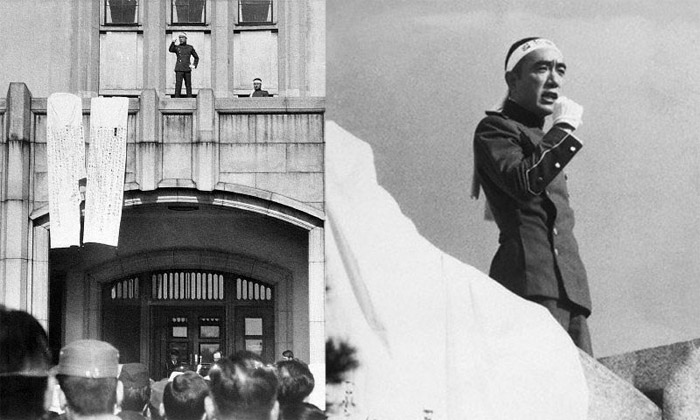
On November 25, 1970, carrying with him a longing for a return to lost samurai values, and an obsession with a purifying and beautiful death, Mishima and four of his Tatenokai followers, entered the Japanese Self-Defense Forces (JSDF) headquarters in Ichigaya and attempted a coup d’etat which they hoped would awaken the Japanese from their spiritual and political slumber. 

Stepping out onto a nearby balcony, Mishima was ridiculed and jeered as he attempted in vain to rouse the present JSDF members below him to his cause. Realizing the hopelessness of his efforts, the "Lost Samurai" went back inside for his final act of drama.

Positioning himself in traditional Japanese manner on the floor of the office which they had seized, Mishima proceeded to ritually disembowel himself with a “tanto” (a small sword), exclaiming “Long live the emperor” just before a pre-ordained “kaishakunin” (the one chosen to decapitate Mishima) and later one other, made an initially botched but ultimately effective attempt at beheading the famed author.

Debate surrounds Mishima’s motivations. Attempting a coup d’etat with only four other people was almost certainly going to be a failure. Comments made to Western journalists about hara-kiri in his writings some years earlier might be more insightful.

At that time, the author claimed that "spiritually, I wanted to revive some samurai spirit. I did not want to revive hara-kiri itself but through the vision of such a very strong vision of hara-kiri, I wanted to inspire and stimulate younger people."

SCARAB BEETLES NAVIGATE
BY STARLIGHT FROM THE MILKY WAY


SCIENTISTS have confirmed what the Ancient Egyptians always knew ... that scarab beetles can use the Milky Way to help them navigate at night.

Experts have always known that African dung beetles use the sun and the moon as directional markers when rolling balls of dung containing their precious eggs away from other beetles.

But it had never been scientifically proven that the beetles ... sacred to the Egyptians as symbols of transformation ... used the Milky Way as a directional marker on moonless nights.

Dung beetles are known for rolling up balls of dung for later use as food and a depository for their eggs. Once they collect the dung, the beetles quickly roll the ball away from the dung pile to avoid having it stolen by other beetles. They do this by moving in a straight line.

With the dung ball deposited in a safe place, the eggs hatch into larvae which then metamorphose into winged beetles ... and fly off, soaring towards the warmth-giving sun. Thus, the scarab became associated in Ancient Egyptian mysticism with the transformation of base material into the divine. The Egyptian glyph for scarab beetle ... "kheper" ... means "transform".

The Egyptians also associated the scarab beetle with movements of the sun, moon and stars. While the link to the sun and moon were easily proved, scientists did not have proof of a link to the stars ... until now.

To test whether the beetles were using the stars as a navigational aid, scientists put the beetles into a dung-rolling course and filmed their behavior. The beetles were able to move in a straight line on moonlight nights and also on moonless nights when the Milky Way was visible.

When the sky was overcast, the beetles were unable to roll the dung balls in a straight line. When the beetles had tiny visors taped onto their heads to block their view of the night sky, they spent their time wandering aimlessly.

Next, they tested their speed on a 2 meter platform. On nights when the Milky Way was visible, the beetles were able to cross the platform in as little as 40 seconds. On cloudy nights, it took the beetles nearly 2 minutes to cross the platform.

Lastly, scientists tested the beetles inside of a planetarium. The dung beetles moved more efficiently when the ground was lit by the light of the Milky Way. When the ground was lit by the light of only a few bright stars, the beetles performed worse.

This research is believed to be the first study to document the use of the Milky Way for orientation in the animal kingdom.

Wednesday, January 13, 2016

THE BIRTH OF LUCIUS AELIUS CAESAR


ON January 13th the Religion of Antinous celebrates the birthday of Aelius Caesar.

Lucius Ceionius Commodus Verus was born on January 13th, 101, most likely in Rome. He was from an old wealthy Etruscan family. 

His grandfather, after whom he had been named, had been a Consul and his father a Senator.

(Images by PRIEST UENDI)


Lucius Ceionius was beautiful and elegant, well educated, and was given over to a life of pleasure and voluptuousness.

He was a teenager when Hadrian came to power in 117, and his flamboyant and attractive character was a compliment to his physical beauty that soon gained the attention of the new Emperor.

It is believed that Hadrian and Lucius were lovers during the early years of Hadrian's reign, perhaps for the period of six years prior to Antinous

When Hadrian met Antinous in the year 123, Lucius was 22 years old, and in keeping with the Greek philosophy of pederastic love, it is very likely that their love affair had transformed into what would become a life-long friendship between the Emperor and his now matured Lucius.

Antinous entered Hadrian's heart just as Lucius was moving on to his responsibilities as a patrician citizen of Rome. There were rumors of rivalry, as spoofed in this cartoon by Priest Uendi showing Lucius left, Hadrian at right and Antinous between them.

While Hadrian was courting the young Antinous, Lucius married Domitia Lucilla and had three children by her, one of which was the later Emperor known as Lucius Verus, who is often confused with his father.

After the Death of Antinous, as Hadrian began to grow ill, his attention turned again to his still beloved Lucius, and on August 10, 136, Hadrian surprised the world by adopting Lucius and declaring him to be his successor.

Suspicions abounded, as the eccentric and delicate character of Lucius hardly seemed appropriate to rule the Empire after such a man as Hadrian.

But there must have been more to Lucius than history has preserved. He assumed the name Aelius Caesar, and was sent to govern Pannonia along the Danube, but became ill and returned to Rome in the winter of 137, where he died on January 1st.

He is remembered and adored as a god, as the brother of Antinous, the twin and second love of Hadrian. We call him the Prince of Flowers.