Showing posts with label hadrian's villa. Show all posts

Friday, July 31, 2026

HADRIAN ALIGNED TEMPLE OF ANTINOUS
TO CATCH DAWN RAYS ON THIS DATE


HADRIAN designed the Antinous Mortuary Temple at his Villa outside Rome so that the rays of the rising sun would illuminate the inner sanctum on the Egyptian festival of the Nile Inundation, according to a US research team.

The new findings come on the heels of studies by other researchers showing that Emperor Hadrian, a skilled architect and astronomer/astrologer in his own right, aligned the Pantheon and the observatory at his Villa to the Solstices.

The new findings are the first indicating a celestial configuration for the Mortuary Temple of Antinous at Hadrian's Villa.

Archaeo-astronomers at Ball State University in the United States say the mystery-shrouded temple, called the ANTINOEION, was aligned so that the first rays of the rising sun would illuminate the East Face of the OBELISK OF ANTINOUS, which would then cast a shadow across a monolithic statue of Antinous-Osiris deep in the inner sanctum of the temple.

Using "solar tracking" technology and highly sophisticated 3-D computer imaging, the Ball State experts say that this sunrise configuration only occurs on July 20th each year.

July 20th was when the Egyptians, at that point in their long history, celebrated the annual Inundation of the Nile, the flood waters which brought nutrient-rich sediment down the river to Egypt to ensure bountiful crops for the coming year.

At other points in Egyptian history, that "Egyptian New Year" festival was celebrated on other dates, owing to vagaries of ancient calendars. But according to Roman writer Censorinus, the Egyptian New Year's Day fell on July 20th in the Julian Calendar in 139 AD, which was a heliacal rising of Sirius in Egypt.

The Ball State University findings are all the more interesting because the First Miracle of Antinous, the July after his death in October 130 AD, was the NILE INUNDATION MIRACLEwhich  ended a years-long drought which had threatened the entire empire with famine since Egypt was Rome's "breadbasket" for grain and produce.


The Obelisk is now located atop the Pincian Hill in Rome, but it almost certainly originally stood at the Antinoeion within the Hadrian's Villa compound. The plinth for the obelisk is still visible.

The Obelisk is covered in Egyptian hieroglyphs which constitute a prayer of praise for Antinous the God, describing his blessings.

The Egyptian hieroglyphs on the East Face of the Obelisk quote Antinous the God as asking Ra-Herakhte the sun god for blessings on Hadrian, and also asking Hapy, the Nile Inundation deity, to bring about a bountiful inundation on his behalf.

In effect, the rays (or "hands") of the sun god "activate" the Egyptian hieroglyphs, bringing this divine prayer to religio-magical life, as the shadow of the Obelisk covers the statue of Antinous-Osiris, master of death and transfiguration.

The Ball State University findings have yet to be verified independently, and the researchers said further studies are underway.


It is possible, of course, that the date July 20th had another significance of a more personal nature involving Hadrian and Antinous. 

On the final leg of a three-year tour of the Eastern Empire, Hadrian and his Imperial entourage arrived in Egypt in the summer of the year 130 AD. 

It is known that Hadrian and Antinous spent time in Alexandria, as well as in the coastal resort of Canopus. And they also slew a man-eating lion in Egypt in the summer of 130 AD.

So July 20th could refer to one of those events. It could, of course, also refer to something of a more intimate nature between the two men which transpired on that date.


Perhaps Hadrian and Antinous took part in celebrations for the Nile Inundation on July 20th of 130 AD in Egypt at which drought-weary Egyptians looked to Emperor Hadrian, as their pharaoh, to provide a miracle. 

Ancient writers speculated that Antinous may have been eager to find a religio-magical way to help his beloved Hadrian, possibly sacrificing his life in return for blessings on the Emperor.

Whatever the date may signify, we know that, barely three months later, Antinous drowned in the Nile, and that grief-stricken Hadrian proclaimed him a God, the last Classical Deity before the Fall of Rome.

He died under mysterious circumstances, with Hadrian saying only that he "fell into the Nile." The Inundation Deity Hapy ensured that the Nile overflowed its banks generously the following July 20th.


Wednesday, July 29, 2026

CENTAUR MOSAIC AT HADRIAN's VILLA
OFFERS INSIGHTS INTO EMPEROR's MIND


ON International Tiger Day, July 29th, we remember that the famous Centaur Mosaic from the grand dining pavilion of Hadrian's Villa at Tibur has intrigued art historians for decades. The mosaic is on view at the Altes Museum in Berlin, along with stunning sculptures of Hadrian and Antinous. But few people have had the opportunity to view it up close with commentary by eminent art historians ... until now!

This video (below), with a running narration by Dr. Steven Zucker and Dr. Beth Harris, provides brilliant insights not only into the Roman interpretation of Greek art, but also into the subtle differences in the way that the Romans and the Greeks perceived their place in the cosmos.

One important point which Drs. Zucker and Harris do not make, however, is that Hadrian was called "The Lion Slayer" because the Emperor and Antinous killed a man-eating lion in Egypt in the summer of the year 130 AD — only weeks before the tragic death of Antinous. 

Another detail is that the centaur downed by the tiger is a female, presumably the mate of the centaur holding the boulder. It is unclear whether the downed mate is dead or only stunned and is about to be rescued — just as Hadrian rescued Antinous from the Egyptian lion in real life.

So Hadrian's dinner guests could look at the mosaic and interpret the bearded centaur as being a mythic aspect of the emperor himself — protecting the Empire from the beastly forces of chaos. Hadrian could also be equated with Chiron, with Antinous perhaps his tutor.

In Greek mythology, Chiron was one of the Titans, the greatest of the Centaurs. Chiron was the tutor to a great many gods and demigods, including Prometheus, Theseus, Achilles and Hercules, to name but a few.

Astrologically, Chiron represents a person's healing energies and, indeed, the word for "surgery" in many European languages (chirurgie in French and German, cirugya in Spanish, chirugia in Italian and Portuguese) comes directly from the Ancient Greek words for "Chiron Hands" — a healer with the skilled hands of the Titan Chiron.

Astrologically, the asteroid Chiron currently is in a highly fortuitous aspect to Pluto — an aspect of cosmic healing which will last on and off through September. Hadrian, who was obsessed with astrology himself, could hardly have looked at this mosaic without pondering cosmic implications.

Zucker and Harris, founders of Smarthistory, aptly point out that this mosaic ... only a tiny fraction of the dining pavilion's mosaic ... must have been a profound source of dinner conversation.


Thursday, July 23, 2026

STAGE PLAY PREMIERES TONIGHT
AT HADRIAN'S VILLA CANOPUS POOL


ON July 23 and 24, 2026, at 9:00 p.m., the Canopus Reflecting Pool Arena at Hadrian's Villa Adriana in Tivoli will host "Memoirs of Hadrian," a play based on the novel of the same name by Marguerite Yourcenar, starring Alessandro Preziosi as the Roman emperor and directed by him.

The play also features Elisa Di Eusanio, with set design by Alfredo Pirri, costumes by Alessandro Lai, and music by Giacomo Vezzani. The performance takes place within the archaeological setting of Villa Adriana, where the theater interacts with the spaces of the ancient imperial residence.

The production explores the portrait of Hadrian through the writer's words, following the inner journey of a man caught between his public role as emperor and his search for his own identity. The character brought to life by Yourcenar thus becomes a figure capable of exploring universal themes such as love and death, desire and beauty, destiny, and the precariousness of power.

The text recounts the imaginary encounter between the writer and her literary creation, Emperor Hadrian, imagined in the final moments of his life on the shores of the Mediterranean as he confronts the approach of death. Through theatrical language, the production reconstructs the dialogue between memory and the present, bringing to life the reflections of a man who looks back on his own existence and the meaning of his choices.

The production is by PATO srl, in collaboration with the Teatro Stabile d'Abruzzo, with support from the MIC, Villa Adriana, Villa d'Este, and the General Directorate of Museums.


Sunday, June 21, 2026

HADRIAN'S VILLA OBSERVATORY TOWER
IS ALIGNED TO THE SOLSTICES


HADRIAN designed his personal observatory at his sprawling villa outside Rome to be in alignment with the Solstices

Imagine the scene during the Solstice cycle: First, he would observe the setting sun sending a shaft of goldish-red light through a certain slit in his observatory tower to illuminate a golden statue of the Egyptian Goddess Isis.

Then there would be oracles at midnight. You can just see the cluster of priests and augurs, chanting and offering sacrifices amidst billowing clouds of incense. 

An Etruscan haruspex or two would be wearing yellow robes and conical hats as they inspected the entrails of animals. Patrician augurs would be wearing their finest ceremonial togas as they listened for messages from nocturnal birds. Babylonian astrologers would be clad in garish robes with multi-tiered crowns as they scanned the heavens and babbled to each other about their arcane calculations. 

And naturally the Egyptian priests would do their utmost to out-do all the others with outlandish make-up, headdresses and robes to the cacophony of sistrums, gongs and the whoosh of incendiary incense sending up pastel-colored clouds of smoke to the wailing of a priestess of Isis in the throes of a trance.

Scores of Imperial court officials and hangers-on would be stifling yawns as the oracles took most of the night. 

But yawns would turn to gasps of wonder and praise when the Emperor announced that he had just seen the RISE OF THE STAR OF ANTINOUS over the eastern horizon.

Then at dawn, the Emperor would climb stairs to the upper chamber to observe the Solstice Sunrise on June 21st.

He would announce the outcome of the oracles and whether the Antinoian Auspices for the coming year were favorable.

Modern Priests of Antinous annually celebrate rites at the HOLLYWOOD TEMPLE OF ANTINOUS to mark the Solstice.

Meanwhile, an Italian archaeologist and her team spends Solstice at  the ruins of a tower on a hillock at Hadrian's Villa which was the Emperor's own private observatory. 

These experts, led by MARIA DE FRANCESCHINI, have demonstrated that the observatory tower is in fact aligned to the Solstices. She believes the observatory was dedicated to the Egyptian goddess Isis, who raised Osiris from the dead to become a god of resurrection and transfiguration — just as Hadrian declared Antinous a god of resurrection and transfiguration.
 

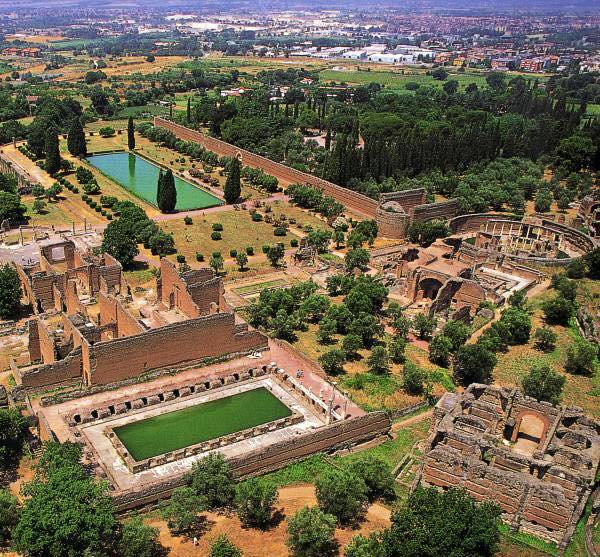
For centuries, experts had been mystified by the layout of the sprawling complex of marble baths, banquet halls, luxurious residences, gardens, shrines and unidentified structures 30 kilometers outside Rome.

Hadrian's Villa was a sprawling complex of buildings, temples, gardens, a zoo and — yes — even an observatory tower on a hillock on the edge of the compound from which Hadrian could observe the heavens. 


 But, in an article published in the journal Nature last year, De Franceschini wrote that she believes the mystery-shrouded Rocca Bruna Tower, long held to be Hadrian's private observatory, is in fact aligned so as to produce sunlight effects for the seasons.

She describes her findings personally in the video at the top of this entry. 

De Franceschini says that during the summer solstice, rays of light pierce the tower and another of the villa's buildings. In the Rocca Bruna Tower, dawn sunlight during the summer solstice enters through a wedge-shaped slot above the door and illuminates a niche on the opposite side of the interior (image courtesy nature.com). And in a temple of the Accademia building, De Franceschini has found that sunlight passes through a series of doors during both the winter and summer solstices.


"The alignments gave me a new key of interpretation," says De Franceschini, who adds that the two buildings are connected by an esplanade that was a sacred avenue during the solstices. Based on ancient texts describing religious rituals and study of recovered sculptures, she thinks the sunlight effects were linked to religious ceremonies associated with the Egyptian goddess Isis, who was adopted by the Romans.

De Franceschini, who works with the University of Trento in Italy, has published a book describing the archaeo-astronomical work, VILLA ADRIANA ARCHITETTURA CELESTE. She credits two architects, Robert Mangurian and Mary-Ann Ray, for initially noticing the light effect in Rocca Bruna.

According to nature.com, Robert Hannah, a classicist from the University of Otago in New Zealand, says that De Franceschini's ideas are plausible. "They're certainly ripe for further investigation," he says.

Hannah believes that the Pantheon, designed by Hadrian in Rome with a circular opening at the top of its dome, also acts as a giant calendrical sundial, with sunlight illuminating key interior surfaces at the equinoxes and on the spring equinox on April 21st, the city's birthday.

Few classical buildings have been investigated for astronomical alignment, says Hannah, partly because it is much easier to check for alignments in prehistoric structures such as Stonehenge, which do not have potentially contradictory artefacts.

De Franceschini spends every solstice at Hadrian's villa, seeking further verification. Our thoughts and prayers go with her during this special season of the Solstice.


We can envision Hadrian, sick with grief and alone after the death of Antinous, ensconced in his observatory tower scanning the heavens for a sign from his Beloved Boy, praying to Isis for her to work her magic on Antinous. 


Wednesday, October 15, 2025

HADRIAN'S VILLA FACES NEW THREAT
FROM ILLEGAL GARBAGE DUMPERS


HADRIAN's Villa, the retreat of Roman Emperor Hadrian, has become a garbage dump, with area people illegally depositing their rubbish, trash, old cars and kitchen appliances around the UNESCO heritage monument.

Hadrian's Villa is now surrounded by discarded fridges and abandoned tires ... despite its status as a Unesco World Heritage Site.

The rural landscape around the 2nd-century complex near Tivoli was once a buffer zone from the ancient filth of urban Rome. And in 1999, Unesco status meant the countryside around the villa needed to be kept clean.

But now, nocturnal fly-by-night garbage dumpers deposit everything from kitchen cupboards to chemical waste among the bushes.

Protests in Rome have already broken out this year against toxic fires, illegal waste management and illegal landfills around the capital.

And now, campaigner Carlo Boldrighini of conservation group Italia Nostra has spoken out of how he uncovered a disused hot tub and kitchen units whilst examining the undergrowth around the villa.

"The locals can be less than civil when no one is looking," he said.

Environmental activist Gianni Innocenti also bemoaned a spate of dumping paint and chemicals by nightfall. Their discoveries included construction waste, vehicle parts, and bin bags filled with metal containers scattered throughout the protected zone.

Unesco's 1999 recognition of Hadrian's Villa outlined how it was "an important and sensitive site that ensures the enhancement, presentation and protection of the outstanding universal value of the property, and as such requires sensitive management and protection."

Saturday, September 20, 2025

THE ROMAN GENERAL UNDER HADRIAN
WHO HAD A VISION OF A STAG


SEPTEMBER 20th is the saint day of Saint Eustace, patron saint of hunters, firefighters and also anyone facing adversity, a Christian saint who is linked by legend to Emperor Hadrian.

Saint Eustace, also known as Eustachius or Eustathius in Latin, purportedly was a general named Placidus, who converted to Christianity and who ... again, according to legend ... was persecuted by Hadrian.


While hunting a stag in Tivoli near Hadrian's Villa, Placidus saw a vision of a crucifix lodged between the stag's antlers. 

He was immediately converted, had himself and his family baptized, and changed his name to Eustace (Greek: Εὐστάθιος Eustathios "well standing, stable, steadfast").

A series of calamities followed to test his faith: his wealth was stolen; his servants died of a plague; when the family took a sea-voyage, the ship's captain kidnapped Eustace's wife Theopista.

And as Eustace crossed a river with his two sons Agapius and Theopistus, the children were taken away by a wolf and a lion. Like Job, Eustace lamented but did not lose his faith.

He was then quickly restored to his former prestige and reunited with his family. 


There is a tradition that when he demonstrated his new faith by refusing to make a pagan sacrifice, Emperor Hadrian condemned Eustace, his wife, and his sons to be roasted to death inside a Brazen Bull ... a bronze statue of a bull or an ox ... in the year AD 118.

However, the Catholic Church rejects this story as "completely false".

Eustace became known as a patron saint of hunters and firefighters, and also of anyone facing adversity; he was traditionally included among the Fourteen Holy Helpers. He is one of the patron saints of Madrid, Spain. The island of Sint Eustatius in the Caribbean Netherlands is named after him.

The German digestif schnapps Jägermeister (German for "Master of the Hunt") has a round logo of a shining cross between the antlers of a deer/stag referring to two persons who had seen such a vision: Saint Hubertus and Saint Eustace.

Monday, September 15, 2025

HADRIAN's VILLA COMES TO LIFE
FOR ANTONIUS SUBIA


HADRIAN must have delighted in forcing Patrician Romans to make the 20-mile (30 km) trek to his Tibur Villa in the rugged hill country east of Rome.

Perhaps the surroundings reminded him of his native Hispania. Perhaps he just despised Rome and its snooty residents because he had been taunted as a youth for his "Hispanic" accent and provincial manners. 

Whatever the reason, he spent most of his reign as emperor far away from Rome, traveling to the far-flung corners of his realm.

And when he wasn't traveling, he resided at his Villa, far removed from the city he abhorred. Anyone who wanted to see him was forced to make the journey over hill and dale out to Tibur. In the days of the "letica" or litter chair, it was an uncomfortable and wearying ordeal.

And it still is, even in these days of rapid transit and buses.

"He must have enjoyed making them come all the way out here," Flamen ANTONIUS SUBIA told Priest Hernestus as they waited for one of the notorious overcrowded and unairconditioned "Blue Buses" that ferry passengers from a suburban commuter rail station out to Tivoli ... and then walking a couple of miles along dusty roads to the imperial compound.

Arriving hot and weary, you then ascend a steepish incline to the walls of the Villa itself before finally arriving, out of breath, at the top of a small hill surrounded by magnificent pines, cypress and olive trees.

It is then that you realize what Hadrian loved about this place. A cool breeze wafts across the hilltop, carrying with it the scent of pine, cedar and wild roses and other flowering plants.

Antonius had never been to Hadrian's Villa until his Sacred Pilgrimage, but he knows the layout of the compound by heart, having studied its floor plans and schematic drawings for years.

"So people would arrive here," Antonius said, pointing to the entry portals only a few meters from the enormous bath complex. 

"And they would immediately be invited into the baths to freshen up before being admitted into the presence of the Emperor."

Even in a ruinous state, the baths are breathtakingly enormous, towering the equivalent of six stories overhead.

The private quarters are less easily discerned today, though Antonyus marched through them as if he had always been at home there.

"Just imagine, this is where Hadrian slept," he said in awe.

"And where do you suppose Antinous had his quarters? He must have had separate quarters of his own," Hernestus wondered.

"Somewhere with a nice view, no doubt," Antonius speculated.

The Canopus area of the compound is still stunning even today. At the end of a long pool flanked by Greco-Egyptian style statuary is a seashell motif alcove.

"This is where they dined," Antonius said with a sweep of his hand around the curved base of the alcove, "on dining couches all along here."

Very few tourists were there the day Antonius visited the Villa, just one group from a charter bus and a few hardy souls who had made the rather harrowing trip on a careening and over-crowded public bus and the trek on foot from the bus stop.

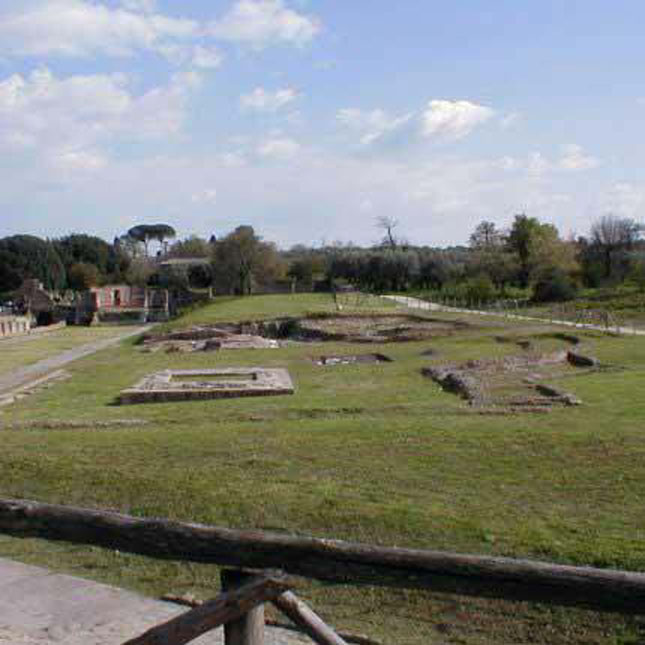
No one was paying any attention to what appeared to be a barren field between the baths and the Canopus. There was no sign indicating that this was the very heart of Hadrian's Villa, the most sacred part of the complex.

The ANTINOEION — the Temple of Antinous.

This was where the OBELISK OF ANTINOUS originally stood. This is possibly where the Lost Tomb of Antinous is located.

The Antinoeion is adjacent to the curving entry pathway. It is the spiritual cornerstone of Hadrian's Villa.

"It was the first thing that anyone saw as they approached," Antonius said with a smile reflecting the satisfaction that Hadrian must have felt. "He made them acknowledge Antinous as a God."

Despite repeated promises by curators of the Villa to erect a sign, there is nothing to mark the sprawling temple complex which may yet conceal the Lost Tomb of Antinous.

Antonyus stood for a long time at the low fence which cordons off the area. To the other tourists, it was just a barren field with a few remnants of marble marking foundations of a few buildings and a plinth where an obelisk may have stood.

But for Antonius, this was Sacred Ground. This was where the Ancient Priests of Antinous had laid down the precepts of a beautiful new religion based on tolerance, love and beauty. This was where Hadrian himself came to commune with his Beloved.

A cool breeze wafted across the field, bringing with it the scent of late summer roses, pine and cedar and the sound of cicadas in the olive trees beyond the field, only a portion of which has been excavated in very recent years.

The rest of the weed-overgrown field is a ripple of mounds of earth. Or are these mounds actually the remains of still more structures, possible the Lost Tomb itself?

"There has to be much more buried under there," Antonius said. "There just has to be."

Click here to join Antonius on his tour of Hadrian's Villa:


Friday, August 1, 2025

THE DEPARTURE FROM TIBUR
FOR THE VERY LAST TIME FOR ANTINOUS


ON August 1st the three-year Sacred Calendar of the Temple of Antinous begins, known as the Peregrinatio ad Orientem, which follows the progress of Hadrian and Antinous on their fateful three-year Tour of the Eastern Provinces. 

The inner circle of Hadrian departs from the Villa at Tibur with solemnity and with prayers to Mercury the god of travelers. (Painting above is "Departure From The Villa At Tivoli" by Eduardo Forti.)

The Villa at Tibur is regarded as the second most sacred city after Antinoopolis because it was here that Hadrian and Antinous lived together for most of their relationship, it was from here that Hadrian would later disseminate the religion of Antinous, and it is believed that the tomb of Antinous may be located in an unexcavated corner of the vast ruins. 

As they depart, Antinous is the acknowledged favorite of Hadrian. 

This is the last moment that Antinous spent in the West, and is observed in solemnity as the departure of Antinous from the repression of Rome to the loving embrace of Greece. 

The fall of the ancient religion and the destruction of the Holy City of Antinoopolis are mourned, as the meaning of the departure is also the occasion where we remember the fall of his glorious religion, and the centuries of silence which have preceded our revival.

Thursday, July 31, 2025

HADRIAN ALIGNED TEMPLE OF ANTINOUS
TO CATCH DAWN RAYS ON THIS DATE


HADRIAN designed the Antinous Mortuary Temple at his Villa outside Rome so that the rays of the rising sun would illuminate the inner sanctum on the Egyptian festival of the Nile Inundation, according to a US research team.

The new findings come on the heels of studies by other researchers showing that Emperor Hadrian, a skilled architect and astronomer/astrologer in his own right, aligned the Pantheon and the observatory at his Villa to the Solstices.

The new findings are the first indicating a celestial configuration for the Mortuary Temple of Antinous at Hadrian's Villa.

Archaeo-astronomers at Ball State University in the United States say the mystery-shrouded temple, called the ANTINOEION, was aligned so that the first rays of the rising sun would illuminate the East Face of the OBELISK OF ANTINOUS, which would then cast a shadow across a monolithic statue of Antinous-Osiris deep in the inner sanctum of the temple.

Using "solar tracking" technology and highly sophisticated 3-D computer imaging, the Ball State experts say that this sunrise configuration only occurs on July 20th each year.

July 20th was when the Egyptians, at that point in their long history, celebrated the annual Inundation of the Nile, the flood waters which brought nutrient-rich sediment down the river to Egypt to ensure bountiful crops for the coming year.

At other points in Egyptian history, that "Egyptian New Year" festival was celebrated on other dates, owing to vagaries of ancient calendars. But according to Roman writer Censorinus, the Egyptian New Year's Day fell on July 20th in the Julian Calendar in 139 AD, which was a heliacal rising of Sirius in Egypt.

The Ball State University findings are all the more interesting because the First Miracle of Antinous, the July after his death in October 130 AD, was the NILE INUNDATION MIRACLEwhich  ended a years-long drought which had threatened the entire empire with famine since Egypt was Rome's "breadbasket" for grain and produce.


The Obelisk is now located atop the Pincian Hill in Rome, but it almost certainly originally stood at the Antinoeion within the Hadrian's Villa compound. The plinth for the obelisk is still visible.

The Obelisk is covered in Egyptian hieroglyphs which constitute a prayer of praise for Antinous the God, describing his blessings.

The Egyptian hieroglyphs on the East Face of the Obelisk quote Antinous the God as asking Ra-Herakhte the sun god for blessings on Hadrian, and also asking Hapy, the Nile Inundation deity, to bring about a bountiful inundation on his behalf.

In effect, the rays (or "hands") of the sun god "activate" the Egyptian hieroglyphs, bringing this divine prayer to religio-magical life, as the shadow of the Obelisk covers the statue of Antinous-Osiris, master of death and transfiguration.

The Ball State University findings have yet to be verified independently, and the researchers said further studies are underway.


It is possible, of course, that the date July 20th had another significance of a more personal nature involving Hadrian and Antinous. 

On the final leg of a three-year tour of the Eastern Empire, Hadrian and his Imperial entourage arrived in Egypt in the summer of the year 130 AD. 

It is known that Hadrian and Antinous spent time in Alexandria, as well as in the coastal resort of Canopus. And they also slew a man-eating lion in Egypt in the summer of 130 AD.

So July 20th could refer to one of those events. It could, of course, also refer to something of a more intimate nature between the two men which transpired on that date.


Perhaps Hadrian and Antinous took part in celebrations for the Nile Inundation on July 20th of 130 AD in Egypt at which drought-weary Egyptians looked to Emperor Hadrian, as their pharaoh, to provide a miracle. 

Ancient writers speculated that Antinous may have been eager to find a religio-magical way to help his beloved Hadrian, possibly sacrificing his life in return for blessings on the Emperor.

Whatever the date may signify, we know that, barely three months later, Antinous drowned in the Nile, and that grief-stricken Hadrian proclaimed him a God, the last Classical Deity before the Fall of Rome.

He died under mysterious circumstances, with Hadrian saying only that he "fell into the Nile." The Inundation Deity Hapy ensured that the Nile overflowed its banks generously the following July 20th.

A walk-through of the Ball State University computer model of the Antinoeion and explanation of the July 20th solar alignment is provided in this YouTube video:


Tuesday, July 29, 2025

CENTAUR MOSAIC AT HADRIAN's VILLA
OFFERS INSIGHTS INTO EMPEROR's MIND


ON International Tiger Day, July 29th, we remember that the famous Centaur Mosaic from the grand dining pavilion of Hadrian's Villa at Tibur has intrigued art historians for decades. The mosaic is on view at the Altes Museum in Berlin, along with stunning sculptures of Hadrian and Antinous. But few people have had the opportunity to view it up close with commentary by eminent art historians ... until now!

This video (below), with a running narration by Dr. Steven Zucker and Dr. Beth Harris, provides brilliant insights not only into the Roman interpretation of Greek art, but also into the subtle differences in the way that the Romans and the Greeks perceived their place in the cosmos.

One important point which Drs. Zucker and Harris do not make, however, is that Hadrian was called "The Lion Slayer" because the Emperor and Antinous killed a man-eating lion in Egypt in the summer of the year 130 AD — only weeks before the tragic death of Antinous. 

Another detail is that the centaur downed by the tiger is a female, presumably the mate of the centaur holding the boulder. It is unclear whether the downed mate is dead or only stunned and is about to be rescued — just as Hadrian rescued Antinous from the Egyptian lion in real life.

So Hadrian's dinner guests could look at the mosaic and interpret the bearded centaur as being a mythic aspect of the emperor himself — protecting the Empire from the beastly forces of chaos. Hadrian could also be equated with Chiron, with Antinous perhaps his tutor.

In Greek mythology, Chiron was one of the Titans, the greatest of the Centaurs. Chiron was the tutor to a great many gods and demigods, including Prometheus, Theseus, Achilles and Hercules, to name but a few.

Astrologically, Chiron represents a person's healing energies and, indeed, the word for "surgery" in many European languages (chirurgie in French and German, cirugya in Spanish, chirugia in Italian and Portuguese) comes directly from the Ancient Greek words for "Chiron Hands" — a healer with the skilled hands of the Titan Chiron.

Astrologically, the asteroid Chiron currently is in a highly fortuitous aspect to Pluto — an aspect of cosmic healing which will last on and off through September. Hadrian, who was obsessed with astrology himself, could hardly have looked at this mosaic without pondering cosmic implications.

Zucker and Harris, founders of Smarthistory, aptly point out that this mosaic ... only a tiny fraction of the dining pavilion's mosaic ... must have been a profound source of dinner conversation.


Monday, July 28, 2025

HOME ALONE IN ROME
HADRIAN FACES LIFE WITHOUT ANTINOUS


TODAY the Religion of Antinous commemorates the day in the year 131 AD when Hadrian returned from the journey to the East alone ... without Antinous ... with only his circle of companions as comfort. 

He came back to Rome a grieving and broken man. The man who had spent his life traveling would never leave Rome or his Villa again. The remaining years of his reign would be marked by moodiness, capriciousness and a protracted conflict in the East.

But this sad ending was also a bright beginning ... the beginning of the new religion, a religion which was to incorporate all of Hadrian's hopes for a Hellenistic civilization based on love of art and beauty.

As Antonius Subia has written: "The Return of Hadrian to Rome is when the seed of the old religion of Antinous was delineated and implemented, and it is sacred as the occasion when the proliferation of images began. Hundreds of these images remain and are the guiding star of the New Religion of Antinous."

It was also at this time that the sacred precinct of the Villa of Tibur known as the Canopus with its long colonnaded pool was constructed, which is believed to be an architectural allegory of the Nile and the Divine Mystery of Antinous.

This day marks a turning point in the saga of Hadrian and Antinous. Hadrian returns to Rome a prematurely old and sick man. His active years died with Antinous. He sets about trying to cement his legacy.

A part of him died with Antinous. A new part was born.

Saturday, June 21, 2025

HADRIAN'S VILLA OBSERVATORY TOWER
IS ALIGNED TO THE SOLSTICES


HADRIAN designed his personal observatory at his sprawling villa outside Rome to be in alignment with the Solstices

Imagine the scene during the Solstice cycle: First, he would observe the setting sun sending a shaft of goldish-red light through a certain slit in his observatory tower to illuminate a golden statue of the Egyptian Goddess Isis.

Then there would be oracles at midnight. You can just see the cluster of priests and augurs, chanting and offering sacrifices amidst billowing clouds of incense. 

An Etruscan haruspex or two would be wearing yellow robes and conical hats as they inspected the entrails of animals. Patrician augurs would be wearing their finest ceremonial togas as they listened for messages from nocturnal birds. Babylonian astrologers would be clad in garish robes with multi-tiered crowns as they scanned the heavens and babbled to each other about their arcane calculations. 

And naturally the Egyptian priests would do their utmost to out-do all the others with outlandish make-up, headdresses and robes to the cacophony of sistrums, gongs and the whoosh of incendiary incense sending up pastel-colored clouds of smoke to the wailing of a priestess of Isis in the throes of a trance.

Scores of Imperial court officials and hangers-on would be stifling yawns as the oracles took most of the night. 

But yawns would turn to gasps of wonder and praise when the Emperor announced that he had just seen the RISE OF THE STAR OF ANTINOUS over the eastern horizon.

Then at dawn, the Emperor would climb stairs to the upper chamber to observe the Solstice Sunrise on June 21st.

He would announce the outcome of the oracles and whether the Antinoian Auspices for the coming year were favorable.

Modern Priests of Antinous annually celebrate rites at the HOLLYWOOD TEMPLE OF ANTINOUS to mark the Solstice.

Meanwhile, an Italian archaeologist and her team spends Solstice at  the ruins of a tower on a hillock at Hadrian's Villa which was the Emperor's own private observatory. 

These experts, led by MARIA DE FRANCESCHINI, have demonstrated that the observatory tower is in fact aligned to the Solstices. She believes the observatory was dedicated to the Egyptian goddess Isis, who raised Osiris from the dead to become a god of resurrection and transfiguration — just as Hadrian declared Antinous a god of resurrection and transfiguration.
 

For centuries, experts had been mystified by the layout of the sprawling complex of marble baths, banquet halls, luxurious residences, gardens, shrines and unidentified structures 30 kilometers outside Rome.

Hadrian's Villa was a sprawling complex of buildings, temples, gardens, a zoo and — yes — even an observatory tower on a hillock on the edge of the compound from which Hadrian could observe the heavens. 


 But, in an article published in the journal Nature last year, De Franceschini wrote that she believes the mystery-shrouded Rocca Bruna Tower, long held to be Hadrian's private observatory, is in fact aligned so as to produce sunlight effects for the seasons.

She describes her findings personally in the video at the top of this entry. 

De Franceschini says that during the summer solstice, rays of light pierce the tower and another of the villa's buildings. In the Rocca Bruna Tower, dawn sunlight during the summer solstice enters through a wedge-shaped slot above the door and illuminates a niche on the opposite side of the interior (image courtesy nature.com). And in a temple of the Accademia building, De Franceschini has found that sunlight passes through a series of doors during both the winter and summer solstices.


"The alignments gave me a new key of interpretation," says De Franceschini, who adds that the two buildings are connected by an esplanade that was a sacred avenue during the solstices. Based on ancient texts describing religious rituals and study of recovered sculptures, she thinks the sunlight effects were linked to religious ceremonies associated with the Egyptian goddess Isis, who was adopted by the Romans.


De Franceschini, who works with the University of Trento in Italy, has published a book describing the archaeo-astronomical work, VILLA ADRIANA ARCHITETTURA CELESTE. She credits two architects, Robert Mangurian and Mary-Ann Ray, for initially noticing the light effect in Rocca Bruna.


According to nature.com, Robert Hannah, a classicist from the University of Otago in New Zealand, says that De Franceschini's ideas are plausible. "They're certainly ripe for further investigation," he says.


Hannah believes that the Pantheon, designed by Hadrian in Rome with a circular opening at the top of its dome, also acts as a giant calendrical sundial, with sunlight illuminating key interior surfaces at the equinoxes and on the spring equinox on April 21st, the city's birthday.


Few classical buildings have been investigated for astronomical alignment, says Hannah, partly because it is much easier to check for alignments in prehistoric structures such as Stonehenge, which do not have potentially contradictory artefacts.


De Franceschini spends every solstice at Hadrian's villa, seeking further verification. Our thoughts and prayers go with her during this special season of the Solstice.


We can envision Hadrian, sick with grief and alone after the death of Antinous, ensconced in his observatory tower scanning the heavens for a sign from his Beloved Boy, praying to Isis for her to work her magic on Antinous.


Friday, May 23, 2025

HADRIAN'S VILLA BOTTLING OLIVE OIL
FROM ITS OWN ANCIENT GROVES


HADRIAN's Villa, the retreat of Roman Emperor Hadrian, has begun selling limited bottles of "Hadrian’s olive oil" made with olives harvested from the ancient olive trees around the UNESCO heritage monument.

In a nod the prosperous lifestyle of the Roman emperor in his 100 acre park in the spa town of Tivoli, 20 miles east of Rome, the site's curator has restarted production of oil from the 3,500 olive trees in the park, none of which are younger than 200 years old.

Hadrian's Villa produces around 1,500 liters of olive oil yearly, made from olives harvested from the 3,000 olive trees in the villa gardens. Olea Hadriani (Hadrian’s oil, in Latin) is not available to the public. Its production is intended only for visitors to the villa to taste, according to Andrea Bruciati, a respected historian, who initiated the project.

Dr Bruciati sees olive oil as a harbinger of a larger revival of Hadrian's rustic empire and is marketing produce also from the adjoining park at the Renaissance Villa d'Este, built by Cardinal Ippolito II d'Este, where the curator plans to grow the traditional pizzutella oblong grape that local Italian farmers have abandoned for more lucrative wine production.

"I have always thought of the Villa Adriana and the Villa d'Este as not just marvellous artistic and landscape heritage but also as places for an overall training of the individual person committed to a visit for a kind of aware tourism based on slowness, far from the world of dine and dash," Dr Bruciati told the Corriere della Sera newspaper.

"Safeguarding the artistic and cultural heritage means not just protecting the landscape but also the pastoral agriculture that in some way is its soul. Supporting the local oil with a gesture like ours means adhering to the spirit of the place ... the olive groves can't be a mere background to the Villa because they are an integral part of its perception, in the collective image of millions of people."

As many as 600,000 tourists visited the two villas this year, many of them inspired by the classic novel "The Memoirs of Hadrian" by Belgian-born French author MARGUERITE YOURCENAR, who is a saint of Antinous.

The reign of Hadrian, a refined intellectual considered a humanist by historians, from 117 to 138 AD is considered to have been among the most abundant and perhaps the happiest of the Roman empire. 

The emperor was best known for building Hadrian's wall to protect the north of Britannia and for the Pantheon.

And of course he deified his lover Antinous!

"By cultivating Hadrian's Oil and grapes we are pointing the way to a sustainable future, building a bond with the local people and sending an overall positive message from our heritage," Dr Bruciati says.

"We have re-opened many areas that previously were inaccessible and lengthened the opening hours and days for visits."


"We are committed to parallel renovation of two places that only seem far apart in time but that in reality have in common the connection to Tivoli and their common destiny through centuries as magnificent domains."

Monday, February 24, 2025

GRIEVING HADRIAN RETURNS TO CANOPUS


CANOPUS was the Egyptian resort where Hadrian and Antinous spent pleasant days away from the hubbub of steamy Alexandria in August and September of the year 130 ... just weeks before tragedy.

In February of 131, grieving Hadrian returned to the resort city of Canopus at the mouth of the western branch of the Nile delta, located 25 miles from Alexandria.  The Imperial court disembarked from the Nile barge and settled into the luxurious port city for a period of rest after the long journey.  


The boat-shaped sarcophagus of Antinous was ceremonially unloaded and carried to the temple of Canopic Osiris.


The city of Canopus was founded by Menelaus, returning from Troy, at the place where his navigator Canopus died and was elevated to the heroic stars.  


Canopus was young and beautiful and was desired by an Egyptian priestess named Theonoe, but he rejected her advances, so she used magic to send a poisonous snake to kill him.


Canopus was the oldest Greek trading port on the Nile, and later became a luxury resort.


Osiris was worshiped in the temple in the form of a pot-shaped image that may have held sacred Nile water, from which the term Canopic jars was taken.


Hadrian later built the famous Canopus area of his Villa in memory of his somber return to the city of Canopus, the gay navigator, without Antinous who had become the navigator of stars.


Friday, September 20, 2024

THE ROMAN GENERAL UNDER HADRIAN
WHO HAD A VISION OF A STAG


SEPTEMBER 20th is the saint day of Saint Eustace, patron saint of hunters, firefighters and also anyone facing adversity, a Christian saint who is linked by legend to Emperor Hadrian.

Saint Eustace, also known as Eustachius or Eustathius in Latin, purportedly was a general named Placidus, who converted to Christianity and who ... again, according to legend ... was persecuted by Hadrian.


While hunting a stag in Tivoli near Hadrian's Villa, Placidus saw a vision of a crucifix lodged between the stag's antlers. 

He was immediately converted, had himself and his family baptized, and changed his name to Eustace (Greek: Εὐστάθιος Eustathios "well standing, stable, steadfast").

A series of calamities followed to test his faith: his wealth was stolen; his servants died of a plague; when the family took a sea-voyage, the ship's captain kidnapped Eustace's wife Theopista.

And as Eustace crossed a river with his two sons Agapius and Theopistus, the children were taken away by a wolf and a lion. Like Job, Eustace lamented but did not lose his faith.

He was then quickly restored to his former prestige and reunited with his family. 


There is a tradition that when he demonstrated his new faith by refusing to make a pagan sacrifice, Emperor Hadrian condemned Eustace, his wife, and his sons to be roasted to death inside a Brazen Bull ... a bronze statue of a bull or an ox ... in the year AD 118.

However, the Catholic Church rejects this story as "completely false".

Eustace became known as a patron saint of hunters and firefighters, and also of anyone facing adversity; he was traditionally included among the Fourteen Holy Helpers. He is one of the patron saints of Madrid, Spain. The island of Sint Eustatius in the Caribbean Netherlands is named after him.

The German digestif schnapps Jägermeister (German for "Master of the Hunt") has a round logo of a shining cross between the antlers of a deer/stag referring to two persons who had seen such a vision: Saint Hubertus and Saint Eustace.

Tuesday, August 27, 2024

ANTINOUS IN CANOPUS EGYPT IN 130 AD
THE PLEASURE RESORT THAT HADRIAN
WOULD RECREATE AT HIS VILLA


CANOPUS and Heracleion! Where Hadrian and Antinous spent pleasant days away from the hubbub of steamy Alexandria in August and September of the year 130 ... just weeks before tragedy.

Heracleion is a real-life Atlantis which sank off the coast of Egypt nearly 1,200 years ago has now been brought back to the surface with the help of 3-D ... and Antinous and Hadrian visited this city ... before a massive earthquake caused it to sink beneath the waves.

The city of Heracleion, home of the temple where Cleopatra was enthroned, was one of the most important trade centres in the Mediterranean area before it disappeared into what is now the Bay of Aboukir. 

The Imperial entourage visited Alexandria and nearby Canopus in August or September 130 AD. 

It is hard to believe they would have passed by fabled Heracleion without at least a brief stop to pay respects at the famous temple of Hapi the Nile inundation deity ... it was Hapi who helped Antinous perform his first miracle after deification.

Heracleion had been the primary Egyptian port at the mouth of the western arm of the Nile prior to the founding of Alexandria. 

By the time Hadrian and Antinous saw Herakleion the city had been in genteel decline for 300 years but was still an important destination for annual pilgrimages by the Egyptian faithful during the annual inundation of the Nile. 

Nearby Canopus had a reputation as the fun spot of the ancient world, a sort of Las Vegas or Monte Carlo or Club Med where those who could afford it played in the sun (and in the pleasure houses) of what is recorded history's first fun-in-the-sun resort.

Canopus was a welcome change from Alexandria, where Christians and Jews waged bloody street battles and where the snooty Greco-Egyptian social classes looked down on the upstart Romans and gossiped viciously behind their backs ... "but not too far behind their backs," as Antinous authority Royston Lambert notes.

"Hurt and resentful," Lambert writes in "Beloved and God," "Hadrian and his circle may in late August have removed themselves from the intense and captious city along the canal to the elegant and relaxed pleasure resort of Canopus with its elegant villas, its vine-threaded arches straddling the water to shade its revellers and its splendid Serapeam."

Lambert points out that "it was delicious Canopus and not mocking Alexandria" that Hadrian used as the motif in a special "resort-theme" area in his villa at Tibur.

In Marguerite Yourcenar's novel "Hadrian's Memoirs," it is at Canopus that Hadrian (increasingly obsessed with omens and astrological prognostications as his health fails) consults a "heka" (Egyptian magic) mistress and asks the old witch if there is any way to extend his lifespan.

Antinous' beloved tame falcon is sacrificed and its ka is added to the many kas of the emperor's in what the witch says is a guaranteed way to prolong Hadrian's longevity. 

An even more sure-fire way would be for a human being to sacrifice his life in love and total devotion to the emperor.

But human sacrifice had been banned by Hadrian's predecessor Tiberius and Hadrian was known to oppose such practices.

So Hadrian and Antinous return to Alexandria and Hadrian considers the matter closed. Only later does he learn that Antinous secretly goes back to Canopus. 

"He paid another visit to the sorceress," Hadrian writes in his memoirs.

Only a few pages later, with the Nile flood lagging and with Hadrian's health flagging, Antinous makes a burnt sacrifice of a lock of his hair at an Egyptian temple on the banks of the Nile opposite Hermopolis.

Then he sheds his clothes and folds them neatly on the bank ... and walks out into the Nile....

Wednesday, July 31, 2024

HADRIAN ALIGNED TEMPLE OF ANTINOUS
TO CATCH DAWN RAYS ON THIS DATE


HADRIAN designed the Antinous Mortuary Temple at his Villa outside Rome so that the rays of the rising sun would illuminate the inner sanctum on the Egyptian festival of the Nile Inundation, according to a US research team.

The new findings come on the heels of studies by other researchers showing that Emperor Hadrian, a skilled architect and astronomer/astrologer in his own right, aligned the Pantheon and the observatory at his Villa to the Solstices.

The new findings are the first indicating a celestial configuration for the Mortuary Temple of Antinous at Hadrian's Villa.

Archaeo-astronomers at Ball State University in the United States say the mystery-shrouded temple, called the ANTINOEION, was aligned so that the first rays of the rising sun would illuminate the East Face of the OBELISK OF ANTINOUS, which would then cast a shadow across a monolithic statue of Antinous-Osiris deep in the inner sanctum of the temple.

Using "solar tracking" technology and highly sophisticated 3-D computer imaging, the Ball State experts say that this sunrise configuration only occurs on July 20th each year.

July 20th was when the Egyptians, at that point in their long history, celebrated the annual Inundation of the Nile, the flood waters which brought nutrient-rich sediment down the river to Egypt to ensure bountiful crops for the coming year.

At other points in Egyptian history, that "Egyptian New Year" festival was celebrated on other dates, owing to vagaries of ancient calendars. But according to Roman writer Censorinus, the Egyptian New Year's Day fell on July 20th in the Julian Calendar in 139 AD, which was a heliacal rising of Sirius in Egypt.

The Ball State University findings are all the more interesting because the First Miracle of Antinous, the July after his death in October 130 AD, was the NILE INUNDATION MIRACLEwhich  ended a years-long drought which had threatened the entire empire with famine since Egypt was Rome's "breadbasket" for grain and produce.


The Obelisk is now located atop the Pincian Hill in Rome, but it almost certainly originally stood at the Antinoeion within the Hadrian's Villa compound. The plinth for the obelisk is still visible.

The Obelisk is covered in Egyptian hieroglyphs which constitute a prayer of praise for Antinous the God, describing his blessings.

The Egyptian hieroglyphs on the East Face of the Obelisk quote Antinous the God as asking Ra-Herakhte the sun god for blessings on Hadrian, and also asking Hapy, the Nile Inundation deity, to bring about a bountiful inundation on his behalf.

In effect, the rays (or "hands") of the sun god "activate" the Egyptian hieroglyphs, bringing this divine prayer to religio-magical life, as the shadow of the Obelisk covers the statue of Antinous-Osiris, master of death and transfiguration.


The Ball State University findings have yet to be verified independently, and the researchers said further studies are underway.


It is possible, of course, that the date July 20th had another significance of a more personal nature involving Hadrian and Antinous. 

On the final leg of a three-year tour of the Eastern Empire, Hadrian and his Imperial entourage arrived in Egypt in the summer of the year 130 AD. 

It is known that Hadrian and Antinous spent time in Alexandria, as well as in the coastal resort of Canopus. And they also slew a man-eating lion in Egypt in the summer of 130 AD.

So July 20th could refer to one of those events. It could, of course, also refer to something of a more intimate nature between the two men which transpired on that date.


Perhaps Hadrian and Antinous took part in celebrations for the Nile Inundation on July 20th of 130 AD in Egypt at which drought-weary Egyptians looked to Emperor Hadrian, as their pharaoh, to provide a miracle. 

Ancient writers speculated that Antinous may have been eager to find a religio-magical way to help his beloved Hadrian, possibly sacrificing his life in return for blessings on the Emperor.

Whatever the date may signify, we know that, barely three months later, Antinous drowned in the Nile, and that grief-stricken Hadrian proclaimed him a God, the last Classical Deity before the Fall of Rome.

He died under mysterious circumstances, with Hadrian saying only that he "fell into the Nile." The Inundation Deity Hapy ensured that the Nile overflowed its banks generously the following July 20th.

A walk-through of the Ball State University computer model of the Antinoeion and explanation of the July 20th solar alignment is provided in this YouTube video: