Showing posts with label asteroid. Show all posts

Tuesday, June 30, 2026

ANTINOUS THE ASTEROID IS A NEIGHBOR
WHO COULD VISIT US WITH A BANG


ON June 30th, Asteroid Day, we honor Antinous ... or rather Antinous the near-Earth asteroid which could one day pay us a visit ... with a bang.

The Antinous Asteroid … officially called "1863 Antinous," was discovered in 1948 by an American astronomer named Carl. A. Wirtanen. 

Astronomers had known for some time that asteroids were plentiful between Mars and Jupiter. But no one had expected to find any in the Inner Solar System ... certainly not near Earth.

But Wirtanen turned his Lick Observatory telescope inward and discovered eight asteroids in our own vicinity. 

These Inner Solar System bodies are called "Apollo Asteroids" all named for Classical deities, including of course Antinous.

Apollo Asteroids are collectively named after the first one to be discovered. The asteroid "1862 Apollo" was sighted in 1932 and then lost until 1973. 

Apollo asteroids are so small and faint that they are difficult to see except when close to the Earth.

Astronomers fear 1862 Apollo may one day strike Earth, however, they currently do not expect 1863 Antinous to hit Earth … assuming it does not stray from its current admittedly erratic orbit.

Antinous is about 2 km (1.2 miles) in length and spins on its axis one revolution every seven hours. It takes more than three years to orbit the sun.

Antinous Asteroid is a "Mars Crosser" and also an "Earth Crosser" or even "Earth Grazer" planetoid ... meaning it crosses the orbit of Mars and also the orbit of Earth ... and comes very close to Earth.

Antinous came close to the Earth in 1992 and 1999 ... 18 million miles (30 million km) and it is supposed to come past Earth again in the 21st Century ... but hopefully won't hit us! 

A collision with an "Apollo Group" asteroid 65 million years ago may have been one of the causes of the extinction of the dinosaurs. A closely related group, the "Amor Group" of asteroids, come close to Earth but do not cross its orbit.

The art of Asteroid Astrology is very arcane ... only a minority of astrologers employ "Astrals," as astrologers call these planetoids ... and then usually only a couple of major ones such as Chiron and Lilith. 

Quite honestly, they are so new that astrologers haven't quite agreed on what they mean.

The whole focus on asteroids got a boost when astronomers officially down-graded Pluto from a "planet" to a "minor planet" or "dwarf planet" ... the same category to which Chiron belongs.

So astronomers and astrologers alike are having to take another look at their definitions as humankind's knowledge of the cosmos grows by quantum leaps.

Monday, June 30, 2025

ANTINOUS THE ASTEROID IS A NEIGHBOR
WHO COULD VISIT US WITH A BANG


ON June 30th, Asteroid Day, we honor Antinous ... or rather Antinous the near-Earth asteroid which could one day pay us a visit ... with a bang.

The Antinous Asteroid … officially called "1863 Antinous," was discovered in 1948 by an American astronomer named Carl. A. Wirtanen. 

Astronomers had known for some time that asteroids were plentiful between Mars and Jupiter. But no one had expected to find any in the Inner Solar System ... certainly not near Earth.

But Wirtanen turned his Lick Observatory telescope inward and discovered eight asteroids in our own vicinity. 

These Inner Solar System bodies are called "Apollo Asteroids" all named for Classical deities, including of course Antinous.

Apollo Asteroids are collectively named after the first one to be discovered. The asteroid "1862 Apollo" was sighted in 1932 and then lost until 1973. 

Apollo asteroids are so small and faint that they are difficult to see except when close to the Earth.

Astronomers fear 1862 Apollo may one day strike Earth, however, they currently do not expect 1863 Antinous to hit Earth … assuming it does not stray from its current admittedly erratic orbit.

Antinous is about 2 km (1.2 miles) in length and spins on its axis one revolution every seven hours. It takes more than three years to orbit the sun.

Antinous Asteroid is a "Mars Crosser" and also an "Earth Crosser" or even "Earth Grazer" planetoid ... meaning it crosses the orbit of Mars and also the orbit of Earth ... and comes very close to Earth.

Antinous came close to the Earth in 1992 and 1999 ... 18 million miles (30 million km) and it is supposed to come past Earth again in the 21st Century ... but hopefully won't hit us! 

A collision with an "Apollo Group" asteroid 65 million years ago may have been one of the causes of the extinction of the dinosaurs. A closely related group, the "Amor Group" of asteroids, come close to Earth but do not cross its orbit.

The art of Asteroid Astrology is very arcane ... only a minority of astrologers employ "Astrals," as astrologers call these planetoids ... and then usually only a couple of major ones such as Chiron and Lilith. 

Quite honestly, they are so new that astrologers haven't quite agreed on what they mean.

The whole focus on asteroids got a boost when astronomers officially down-graded Pluto from a "planet" to a "minor planet" or "dwarf planet" ... the same category to which Chiron belongs.

So astronomers and astrologers alike are having to take another look at their definitions as humankind's knowledge of the cosmos grows by quantum leaps.

Saturday, November 30, 2024

WHY IS THE ANTINOUS TARANTULA BLUE?
MAYBE IT JUST WANTS TO BE BEAUTIFUL!


THE STAR OF ANTINOUS is well known as is the LOTUS OF ANTINOUS

And many people are aware that there is also an ANTINOUS ASTEROID and even a few people have heard of the ANTINOUS CRATER.

But very few people have heard of the ANTINOUS SPIDER, a gigantic, bright blue tarantula ... as large as your face ... which devours birds in South America.

Now scientists have discovered the secrets of why blue tarantulas are blue ... and that discovery may help humans make better wide-angle digital displays.


A team of scientists reported this week in Science Advances that blue coloration appears in 40 species of tarantulas in the Antinous tarantula, among the most ancient of spiders. 

Spider specialists don’t expect that the coloring wows females, because the eyes of tarantulas probably can’t tell blue from other colors.

It's possible that tarantulas use this color to signal to prey or predators instead, but that's still a mystery.


Perhaps Antinous tarantulas are blue in order to make them irresistible  to the birds they devour!

The Pamphobeteus antinous is native to the rain forests of Peru, Brazil and Bolivia and is known for its ferocity and for its consumption of small birds and other hapless creatures asleep and defenseless when it prowls at night. 

It runs and pounces very fast and surprises its prey unawares. It has no fear of humans and charges at people, hurling venomous hairs from its bristly legs and body. 

It was named after Antinous because of its beautiful iridescent coloring and its breathtaking size. Its leg span is as big around as a man's hand with outstretched fingers. For arachnid collectors, the Antinous truly is the most spectacular spider, living up to its name.

For us Antinoians, the Spider of Antinous is more than just a zoological specimen, just as the Red Lotus of Antinous and the Star of Antinous are more than just botanical or astronomical items. All three figure prominently in the belief system of this new/old religion.

The three ... the Flower, the Spider and the Star ... represent the three stages of initiation into the worship of Antinous which Antonyus has spelled out in the ECCLESIA ANTINOI Charter.

Priest Hernestus holds a "petite" female Antinous spider who is not as blue as the enormous males.

The Flowers of Antinous are the many people who join the group with an avid interest in Antinous and who draw artistic and intellectual inspiration from him, but who don't necessarily believe in his divinity. 

That doesn't make them any less beautiful or precious, for without them, there is no religion of Antinous.

But there are deeper and far darker secrets for those who become ensnared in the web of the Spider of Antinous. They are those of you who have stated your heart-felt belief in Antinous the God and who have applied for citizenship in the Sacred City of Antinoopolis. 

You have put yourself in his web. You believe in him and are awe-struck by him. And as you lie there in his web, perhaps unsure or even a bit fearful about what comes next, you look up and see your final destination shining darkly in the black nighttime sky. 

You see the Star of Antinous which is your own ultimate self. Becoming one with Antinous ... HOMOTHEOSIS ... becoming aware of your true sacred nature.

ANTONIUS SUBIA expresses it very beautifully:

There are many Flowers of Antinous, and of these, many, when they become aware of Antinous Consciousness, if I may use such a term to describe his touch, or the burning of his flame, are immediately ensnared in the confusion of the web of the Spider of Antinous. But few are they who have found the power of the Liberator, who restores the fragrance of the Flower and opens its petals to the unseen light of the Star.  I would say that those who have found their way back...return with new eyes...able to see the light that vanished from the sky...which is why I call the Holy Star of Antinous the Black Star.

So when we ponder this awesome blue spider ... "awesome" in the original sense of the word "scary" ... we think of the spiritual road upon which all of us have embarked. 

From the spiritual blossoming of the Flower of Antinous to the ravenous spiritual hunger of the Spider of Antinous to the heavenly spiritual shining of the Star of Antinous.

On January 29th the Religion of Antinous celebrates the discovery in 131 AD of THE STAR OF ANTINOUS by Emperor Hadrian and his house stargazers.

That discovery marks the visible ascendance of the Beloved Boy into the celestial firmament ... for all of us on Earth to see ... whether we live in a big city or in a village in the Brazilian rain forest.

Sunday, June 30, 2024

ANTINOUS THE ASTEROID IS A NEIGHBOR
WHO COULD VISIT US WITH A BANG


ON June 30th, Asteroid Day, we honor Antinous ... or rather Antinous the near-Earth asteroid which could one day pay us a visit ... with a bang.

The Antinous Asteroid … officially called "1863 Antinous," was discovered in 1948 by an American astronomer named Carl. A. Wirtanen. 

Astronomers had known for some time that asteroids were plentiful between Mars and Jupiter. But no one had expected to find any in the Inner Solar System ... certainly not near Earth.

But Wirtanen turned his Lick Observatory telescope inward and discovered eight asteroids in our own vicinity. 

These Inner Solar System bodies are called "Apollo Asteroids" all named for Classical deities, including of course Antinous.

Apollo Asteroids are collectively named after the first one to be discovered. The asteroid "1862 Apollo" was sighted in 1932 and then lost until 1973. 

Apollo asteroids are so small and faint that they are difficult to see except when close to the Earth.

Astronomers fear 1862 Apollo may one day strike Earth, however, they currently do not expect 1863 Antinous to hit Earth … assuming it does not stray from its current admittedly erratic orbit.

Antinous is about 2 km (1.2 miles) in length and spins on its axis one revolution every seven hours. It takes more than three years to orbit the sun.

Antinous Asteroid is a "Mars Crosser" and also an "Earth Crosser" or even "Earth Grazer" planetoid ... meaning it crosses the orbit of Mars and also the orbit of Earth ... and comes very close to Earth.

Antinous came close to the Earth in 1992 and 1999 ... 18 million miles (30 million km) and it is supposed to come past Earth again in the 21st Century ... but hopefully won't hit us! 

A collision with an "Apollo Group" asteroid 65 million years ago may have been one of the causes of the extinction of the dinosaurs. A closely related group, the "Amor Group" of asteroids, come close to Earth but do not cross its orbit.

The art of Asteroid Astrology is very arcane ... only a minority of astrologers employ "Astrals," as astrologers call these planetoids ... and then usually only a couple of major ones such as Chiron and Lilith. 

Quite honestly, they are so new that astrologers haven't quite agreed on what they mean.

The whole focus on asteroids got a boost when astronomers officially down-graded Pluto from a "planet" to a "minor planet" or "dwarf planet" ... the same category to which Chiron belongs.

So astronomers and astrologers alike are having to take another look at their definitions as humankind's knowledge of the cosmos grows by quantum leaps.

Friday, June 30, 2023

ANTINOUS THE ASTEROID IS A NEIGHBOR
WHO COULD VISIT US WITH A BANG


ON June 30th, Asteroid Day, we honor Antinous ... or rather Antinous the near-Earth asteroid which could one day pay us a visit ... with a bang.

The Antinous Asteroid … officially called "1863 Antinous," was discovered in 1948 by an American astronomer named Carl. A. Wirtanen. 

Astronomers had known for some time that asteroids were plentiful between Mars and Jupiter. But no one had expected to find any in the Inner Solar System ... certainly not near Earth.

But Wirtanen turned his Lick Observatory telescope inward and discovered eight asteroids in our own vicinity. 

These Inner Solar System bodies are called "Apollo Asteroids" all named for Classical deities, including of course Antinous.

Apollo Asteroids are collectively named after the first one to be discovered. The asteroid "1862 Apollo" was sighted in 1932 and then lost until 1973. 

Apollo asteroids are so small and faint that they are difficult to see except when close to the Earth.

Astronomers fear 1862 Apollo may one day strike Earth, however, they currently do not expect 1863 Antinous to hit Earth … assuming it does not stray from its current admittedly erratic orbit.

Antinous is about 2 km (1.2 miles) in length and spins on its axis one revolution every seven hours. It takes more than three years to orbit the sun.

Antinous Asteroid is a "Mars Crosser" and also an "Earth Crosser" or even "Earth Grazer" planetoid ... meaning it crosses the orbit of Mars and also the orbit of Earth ... and comes very close to Earth.

Antinous came close to the Earth in 1992 and 1999 ... 18 million miles (30 million km) and it is supposed to come past Earth again in the 21st Century ... but hopefully won't hit us! 

A collision with an "Apollo Group" asteroid 65 million years ago may have been one of the causes of the extinction of the dinosaurs. A closely related group, the "Amor Group" of asteroids, come close to Earth but do not cross its orbit.

The art of Asteroid Astrology is very arcane ... only a minority of astrologers employ "Astrals," as astrologers call these planetoids ... and then usually only a couple of major ones such as Chiron and Lilith. 

Quite honestly, they are so new that astrologers haven't quite agreed on what they mean.

The whole focus on asteroids got a boost when astronomers officially down-graded Pluto from a "planet" to a "minor planet" or "dwarf planet" ... the same category to which Chiron belongs.

So astronomers and astrologers alike are having to take another look at their definitions as humankind's knowledge of the cosmos grows by quantum leaps.

Friday, September 2, 2022

ANTINOUS DANCES ACROSS THE HEAVENS
AS A NEAR-EARTH ASTEROID


ANTINOUS dances gracefully through the heavens during the rest of this year ... Antinous the asteroid, that is!

Our British astronomer friend ZAVIJAVON on Twitter has created this stunning star chart (above) showing the path of this asteroid as its waltzes across the skies. He has kindly written the following observations about this celestial body:

The Antinous Asteroid is designated (1863) because it was the 1,863rd  asteroid to be discovered belongs to the Apollo group of asteroids. These are bodies which cross the Earth’s Orbit, named after the first to be discovered called Apollo (1862), just before Antinous!

Antinous itself is discovered and named in 1948, and has a diameter of just 3 kms. It orbits the Sun in 3.39 years (1239.7 days).

Most of the time it is travelling at a slower speed than the Earth, so each year the Earth overtakes Antinous which then produces a retrograde or backwards motion loop against the stars.

In order to understand what is happening, think of a fast train overtaking a slower one. To a passenger in the fast train, the slow one appears to move backwards, despite both moving in the same direction!

Visual magnitude of +19 makes it far fainter than Pluto. The Faintest objects visible to the naked eye is +6. As the positive value increases the object becomes fainter. An object with a magnitude value of +7 is approximately 2.5 times fainter than an object that is +6. And so on.....

So you can readily appreciate how faint Antinous is in reality.

More up to date measurements suggest that Antinous is irregularly shaped, with a diameter of 5 kms . It is rotating in a period of 4.3 hours. So a ‘day’ on Antinous is just over 4 hours in length ( sunrise to sunrise).

Thank you, Zavijavon for this stellar information!

Thursday, June 30, 2022

ANTINOUS THE ASTEROID IS A NEIGHBOR
WHO COULD VISIT US WITH A BANG


ON June 30th, Asteroid Day, we honor Antinous ... or rather Antinous the near-Earth asteroid which could one day pay us a visit ... with a bang.

The Antinous Asteroid … officially called "1863 Antinous," was discovered in 1948 by an American astronomer named Carl. A. Wirtanen. 

Astronomers had known for some time that asteroids were plentiful between Mars and Jupiter. But no one had expected to find any in the Inner Solar System ... certainly not near Earth.

But Wirtanen turned his Lick Observatory telescope inward and discovered eight asteroids in our own vicinity. 

These Inner Solar System bodies are called "Apollo Asteroids" all named for Classical deities, including of course Antinous.

Apollo Asteroids are collectively named after the first one to be discovered. The asteroid "1862 Apollo" was sighted in 1932 and then lost until 1973. 

Apollo asteroids are so small and faint that they are difficult to see except when close to the Earth.

Astronomers fear 1862 Apollo may one day strike Earth, however, they currently do not expect 1863 Antinous to hit Earth … assuming it does not stray from its current admittedly erratic orbit.

Antinous is about 2 km (1.2 miles) in length and spins on its axis one revolution every seven hours. It takes more than three years to orbit the sun.

Antinous Asteroid is a "Mars Crosser" and also an "Earth Crosser" or even "Earth Grazer" planetoid ... meaning it crosses the orbit of Mars and also the orbit of Earth ... and comes very close to Earth.

Antinous came close to the Earth in 1992 and 1999 ... 18 million miles (30 million km) and it is supposed to come past Earth again in the 21st Century ... but hopefully won't hit us! 

A collision with an "Apollo Group" asteroid 65 million years ago may have been one of the causes of the extinction of the dinosaurs. A closely related group, the "Amor Group" of asteroids, come close to Earth but do not cross its orbit.

The art of Asteroid Astrology is very arcane ... only a minority of astrologers employ "Astrals," as astrologers call these planetoids ... and then usually only a couple of major ones such as Chiron and Lilith. 

Quite honestly, they are so new that astrologers haven't quite agreed on what they mean.

The whole focus on asteroids got a boost when astronomers officially down-graded Pluto from a "planet" to a "minor planet" or "dwarf planet" ... the same category to which Chiron belongs.

So astronomers and astrologers alike are having to take another look at their definitions as humankind's knowledge of the cosmos grows by quantum leaps.

Wednesday, June 30, 2021

ANTINOUS THE ASTEROID IS A NEIGHBOR
WHO COULD VISIT US WITH A BANG


ON June 30th, Asteroid Day, we honor Antinous ... or rather Antinous the near-Earth asteroid which could one day pay us a visit ... with a bang.

The Antinous Asteroid … officially called "1863 Antinous," was discovered in 1948 by an American astronomer named Carl. A. Wirtanen. 

Astronomers had known for some time that asteroids were plentiful between Mars and Jupiter. But no one had expected to find any in the Inner Solar System ... certainly not near Earth.

But Wirtanen turned his Lick Observatory telescope inward and discovered eight asteroids in our own vicinity. 

These Inner Solar System bodies are called "Apollo Asteroids" all named for Classical deities, including of course Antinous.

Apollo Asteroids are collectively named after the first one to be discovered. The asteroid "1862 Apollo" was sighted in 1932 and then lost until 1973. 

Apollo asteroids are so small and faint that they are difficult to see except when close to the Earth.

Astronomers fear 1862 Apollo may one day strike Earth, however, they currently do not expect 1863 Antinous to hit Earth … assuming it does not stray from its current admittedly erratic orbit.

Antinous is about 2 km (1.2 miles) in length and spins on its axis one revolution every seven hours. It takes more than three years to orbit the sun.

Antinous Asteroid is a "Mars Crosser" and also an "Earth Crosser" or even "Earth Grazer" planetoid ... meaning it crosses the orbit of Mars and also the orbit of Earth ... and comes very close to Earth.

Antinous came close to the Earth in 1992 and 1999 ... 18 million miles (30 million km) and it is supposed to come past Earth again in the 21st Century ... but hopefully won't hit us! 

A collision with an "Apollo Group" asteroid 65 million years ago may have been one of the causes of the extinction of the dinosaurs. A closely related group, the "Amor Group" of asteroids, come close to Earth but do not cross its orbit.

The art of Asteroid Astrology is very arcane ... only a minority of astrologers employ "Astrals," as astrologers call these planetoids ... and then usually only a couple of major ones such as Chiron and Lilith. 

Quite honestly, they are so new that astrologers haven't quite agreed on what they mean.

The whole focus on asteroids got a boost when astronomers officially down-graded Pluto from a "planet" to a "minor planet" or "dwarf planet" ... the same category to which Chiron belongs.

So astronomers and astrologers alike are having to take another look at their definitions as humankind's knowledge of the cosmos grows by quantum leaps.

Monday, May 25, 2020

ANTINOUS THE ASTEROID IS A NEIGHBOR
WHO COULD VISIT US WITH A BANG


THE Sun aligns in Gemini today with Antinous ... or rather with Antinous the near-Earth asteroid which could one day pay us a visit ... with a bang.

The Antinous Asteroid … officially called "1863 Antinous," was discovered in 1948 by an American astronomer named Carl. A. Wirtanen. 

Astronomers had known for some time that asteroids were plentiful between Mars and Jupiter. But no one had expected to find any in the Inner Solar System ... certainly not near Earth.

But Wirtanen turned his Lick Observatory telescope inward and discovered eight asteroids in our own vicinity. 

These Inner Solar System bodies are called "Apollo Asteroids" all named for Classical deities, including of course Antinous.

Apollo Asteroids are collectively named after the first one to be discovered. The asteroid "1862 Apollo" was sighted in 1932 and then lost until 1973. 

Apollo asteroids are so small and faint that they are difficult to see except when close to the Earth.

Astronomers fear 1862 Apollo may one day strike Earth, however, they currently do not expect 1863 Antinous to hit Earth … assuming it does not stray from its current admittedly erratic orbit.

Antinous is about 2 km (1.2 miles) in length and spins on its axis one revolution every seven hours. It takes more than three years to orbit the sun.

Antinous Asteroid is a "Mars Crosser" and also an "Earth Crosser" or even "Earth Grazer" planetoid ... meaning it crosses the orbit of Mars and also the orbit of Earth ... and comes very close to Earth.

Antinous came close to the Earth in 1992 and 1999 ... 18 million miles (30 million km) and it is supposed to come past Earth again in the 21st Century ... but hopefully won't hit us! 

A collision with an "Apollo Group" asteroid 65 million years ago may have been one of the causes of the extinction of the dinosaurs. A closely related group, the "Amor Group" of asteroids, come close to Earth but do not cross its orbit.

The art of Asteroid Astrology is very arcane ... only a minority of astrologers employ "Astrals," as astrologers call these planetoids ... and then usually only a couple of major ones such as Chiron and Lilith. 

Quite honestly, they are so new that astrologers haven't quite agreed on what they mean.

The whole focus on asteroids got a boost when astronomers officially down-graded Pluto from a "planet" to a "minor planet" or "dwarf planet" ... the same category to which Chiron belongs.

So astronomers and astrologers alike are having to take another look at their definitions as humankind's knowledge of the cosmos grows by quantum leaps.
Sunday, June 30, 2019

ANTINOUS THE ASTEROID IS A NEIGHBOR
WHO COULD VISIT US WITH A BANG


JUNE 30th is International Asteroid Day ... and if you look hard you can see Antinous ... or rather with Antinous the near-Earth asteroid, which could one day pay us a visit ... with a bang.

The Antinous Asteroid … officially called "1863 Antinous," was discovered in 1948 by an American astronomer named Carl. A. Wirtanen. 

Astronomers had known for some time that asteroids were plentiful between Mars and Jupiter. But no one had expected to find any in the Inner Solar System ... certainly not near Earth.

But Wirtanen turned his Lick Observatory telescope inward and discovered eight asteroids in our own vicinity. 

These Inner Solar System bodies are called "Apollo Asteroids" all named for Classical deities, including of course Antinous.

Apollo Asteroids are collectively named after the first one to be discovered. The asteroid "1862 Apollo" was sighted in 1932 and then lost until 1973. 

Apollo asteroids are so small and faint that they are difficult to see except when close to the Earth.

Astronomers fear 1862 Apollo may one day strike Earth, however, they currently do not expect 1863 Antinous to hit Earth … assuming it does not stray from its current admittedly erratic orbit.

Antinous is about 2 km (1.2 miles) in length and spins on its axis one revolution every seven hours. It takes more than three years to orbit the sun.

Antinous Asteroid is a "Mars Crosser" and also an "Earth Crosser" or even "Earth Grazer" planetoid ... meaning it crosses the orbit of Mars and also the orbit of Earth ... and comes very close to Earth.

Antinous came close to the Earth in 1992 and 1999 ... 18 million miles (30 million km) and it is supposed to come past Earth again in the 21st Century ... but hopefully won't hit us! 

A collision with an "Apollo Group" asteroid 65 million years ago may have been one of the causes of the extinction of the dinosaurs. A closely related group, the "Amor Group" of asteroids, come close to Earth but do not cross its orbit.

The art of Asteroid Astrology is very arcane ... only a minority of astrologers employ "Astrals," as astrologers call these planetoids ... and then usually only a couple of major ones such as Chiron and Lilith.

Quite honestly, they are so new that astrologers haven't quite agreed on what they mean.

The whole focus on asteroids got a boost when astronomers officially down-graded Pluto from a "planet" to a "minor planet" or "dwarf planet" ... the same category to which Chiron belongs.

So astronomers and astrologers alike are having to take another look at their definitions as humankind's knowledge of the cosmos grows by quantum leaps.

Saturday, February 9, 2019

NOT ANTINOUS THE GAY GOD
BUT ANTINOUS THE SATURN MOON CRATER


THE STAR OF ANTINOUS is well known. And many people are aware that there is also an ANTINOUS ASTEROID ... but few people have heard of the ANTINOUS CRATER.

It is located on one of the moons of Saturn, the moon named for the Titan sea goddess Tethys, daughter of Uranus and Tellus/Gaea. The Antinous Crater is located at the bottom of this photo taken by the Cassini probe in a flyby. The bigger crater is Penelope.

This crater was named in 1982 after the "OTHER" Antinous — the infamous Antinous of Homer's Odyssey and the Iliad. That is obvious from the association with Penelope. It is highly possible that our God Antinous was in fact named for Homer's Antinous.

For the Ancients, names were not a matter of coincidence. A person's name MEANT something. Nomen est omen 
— a name is a sign. So why was Antinous given the name of someone who is generally considered to be a scoundrel?

Homer's Antinous was one of the "Suitors of Penelope," the group of moochers who showed up at her doorstep while her husband Odysseus was off fighting the Trojan wars and attempted to woo her and abscond with as much of Odysseus's fortune as they could before he returned 
— if he EVER returned. 

After all, he had been gone for years. Their argument was that he was a "dead beat" spouse and that he had abandoned Penelope and, at any rate, was most probably dead.

 Antinous was the craftiest of the suitors and plied Penelope with costly gifts. 

Then at last — at long last — Odysseus returned in the disguise of a beggar. 

Only his faithful dog recognized him. Penelope did not! 

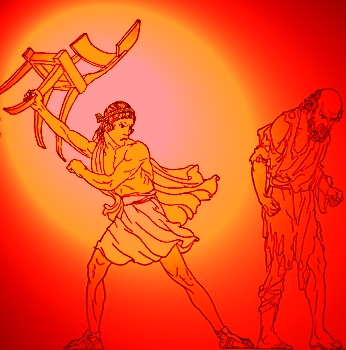
Antinous did not recognize him either and, thinking he was just a homeless street schizo, attacked him with a chair to drive him off.

Later on, during an archery tournament, Odysseus "accidentally" shot Antinous and killed him.

As with much of the Odyssey and the Iliad, it is hard to tell who the "good guys" are and who the "bad guys" are. Homer's Antinous is not exactly a saint, but he in't really guilty of any crime either.

Penelope is the guilty one. As so often in Greek mythology, the women are treacherous and untrustworthy (just think of Pandora). One small detail which you probably did not learn in school was that Penelope had sex with Homer's Antinous and with ALL the other suitors. 


FLAMEN ANTINOALIS ANTONIUS SUBIA explains:
"And the resulting child from that pan-sexual tryst was born a little monstar with horns and hooves. He was called Pan because he was the son of Antinous and ALL the suitors. Penelope couldn't look at him, so she abandoned him, and he was taken in by Mercury, who absolutely adored the little monster.

"Ah yes, Penelope gave birth to Pan in Mantinea!"

Mantinea/Bithynia is the ancestral homeland of our own Antinous. So the name was of regional origin.

But that is not all because, in actual fact, Homer's Antinous was associated with magic. He was something of a wizard. 

According to legend, Homer's Antinous possessed the fabled Mirror of Vulcan/Hephaestus, which enabled him to peer into the past and the future.

So the name Antinous was always associated with myth and magic, even in ancient times. Hadrian, who was fascinated with all things Greek, would have recognized the association between young Antinous and the ancient Greek myth and magic.

As for the fabled Mirror of Vulcan/Hephaestus — that is the stuff of Antinoian myth and magic for a future blog entry ....

Saturday, June 30, 2018

ANTINOUS THE ASTEROID IS A NEIGHBOR
WHO COULD VISIT US WITH A BANG


JUNE 30th is International Asteroid Day ... and if you look hard you can see Antinous ... or rather with Antinous the near-Earth asteroid, which could one day pay us a visit ... with a bang.


The Antinous Asteroid … officially called "1863 Antinous," was discovered in 1948 by an American astronomer named Carl. A. Wirtanen. 

Astronomers had known for some time that asteroids were plentiful between Mars and Jupiter. But no one had expected to find any in the Inner Solar System ... certainly not near Earth.

But Wirtanen turned his Lick Observatory telescope inward and discovered eight asteroids in our own vicinity. 

These Inner Solar System bodies are called "Apollo Asteroids" all named for Classical deities, including of course Antinous.

Apollo Asteroids are collectively named after the first one to be discovered. The asteroid "1862 Apollo" was sighted in 1932 and then lost until 1973. 

Apollo asteroids are so small and faint that they are difficult to see except when close to the Earth.

Astronomers fear 1862 Apollo may one day strike Earth, however, they currently do not expect 1863 Antinous to hit Earth … assuming it does not stray from its current admittedly erratic orbit.

Antinous is about 2 km (1.2 miles) in length and spins on its axis one revolution every seven hours. It takes more than three years to orbit the sun.

Antinous Asteroid is a "Mars Crosser" and also an "Earth Crosser" or even "Earth Grazer" planetoid ... meaning it crosses the orbit of Mars and also the orbit of Earth ... and comes very close to Earth.

Antinous came close to the Earth in 1992 and 1999 ... 18 million miles (30 million km) and it is supposed to come past Earth again in the 21st Century ... but hopefully won't hit us! 

A collision with an "Apollo Group" asteroid 65 million years ago may have been one of the causes of the extinction of the dinosaurs. A closely related group, the "Amor Group" of asteroids, come close to Earth but do not cross its orbit.

The art of Asteroid Astrology is very arcane ... only a minority of astrologers employ "Astrals," as astrologers call these planetoids ... and then usually only a couple of major ones such as Chiron and Lilith. 

Quite honestly, they are so new that astrologers haven't quite agreed on what they mean.

The whole focus on asteroids got a boost when astronomers officially down-graded Pluto from a "planet" to a "minor planet" or "dwarf planet" ... the same category to which Chiron belongs.

So astronomers and astrologers alike are having to take another look at their definitions as humankind's knowledge of the cosmos grows by quantum leaps.