Monday, September 14, 2026

ROMAN SKELETONS BURIED HOLDING HANDS
NOW HAVE BEEN IDENTIFIED AS TWO MALES


TWO ancient Roman skeletons, who mysteriously were buried holding hands, now have been identified as two males, researchers have revealed.

In 2009, archaeologists discovered the remains in the Italian city of Modena. The pair were dubbed the "Lovers of Modena" by the media, the assumption being that they were a heterosexual couple.

The researchers at that time could not determine the gender of the skeletons when they were found in Italy in 2009 because they were badly preserved.

But a new technique, using the protein on tooth enamel, revealed their sex.

The actual relationship between the skeletons from the 4-6th Century AD remains a mystery.

The researchers say the two adult males were intentionally buried hand-in-hand.

Some of the suggestions for the link between the two skeletons are that they are siblings, cousins or soldiers who died together in battle, study author Federico Lugli told Italy's Rai news site (in Italian).

Researchers suggest that their burial site could have been a war cemetery.
The researchers from Italy's University of Bologna said in Scientific Reports that the findings had profound implications for understanding funeral practices at that time in Italy.

Sunday, September 13, 2026

ROME'S GREAT TEMPLE OF JUPITER
DEDICATED ON THIS DAY IN 509 BC


ON the 13th of September the Temple of Jupiter Optimus Maximus atop the Capitoline Hill was dedicated in 509 BC. The ascent of Rome began! 

In the old Roman calendar, September was the seventh month of the year in counting March as the first. Among the festivals observed in September were several honoring Jupiter. 

He was hailed as the chief of the gods and had many epithets as a result.


As Jupiter Optimus Maximus, he occupied the temple of Jupiter Capitolinus on the Capitoline hill with the goddesses Juno and Minerva. With them, he received a Lectisternium (September 13) and the Ludi Romani  (September 5-19). 

Saturday, September 12, 2026

RUN LIKE PHEIDIPPIDES
JUST DON'T DIE LIKE PHEIDIPPIDES


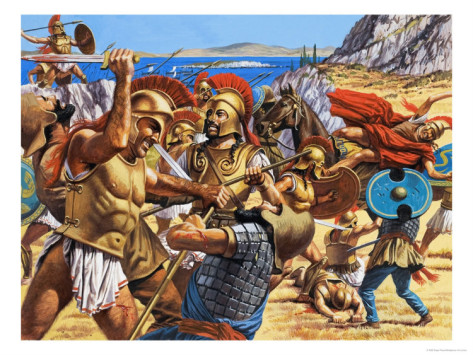
ON September 12, 490 BC, 10,000 Greeks use superior tactics to push 100,000 Persians back into the sea at the Battle of Marathon Bay ... forever changing the course of Western Civilization.

Though outnumbered 10 to 1, the Greeks won thanks to their new tactics.

Instead of individual soldiers fighting one-to-one duels, the Greeks rolled out their "phalanx" battle line of Hoplite soldiers who fought as one impenetrable unit.

The Battle of Marathon was a watershed in the Greco-Persian wars, showing the Greeks that the Persians could be beaten; the eventual Greek triumph in these wars can be seen to begin at Marathon. 

The battle also showed the Greeks that they were able to win battles without the Spartans, as they had heavily relied on Sparta previously. 

This win was largely due to the Athenians, and Marathon raised Greek esteem of them. Since the following two hundred years saw the rise of the Classical Greek civilization, which has been enduringly influential in western society, the Battle of Marathon is a pivotal moment in history.

The battle is perhaps now more famous as the inspiration for the marathon race. 

Although thought to be historically inaccurate, the legend of the Greek messenger Pheidippides running to Athens with news of the victory became the inspiration for this athletic event, introduced at the 1896 Athens Olympics, and originally run between Marathon and Athens.

Pheidippides was a professional "hemerodrome" (foot courier) who was sent to Sparta to request help when the Persians landed at Marathon, Greece. 

He ran 240 km (150 mi) in two days. Thanks to him, the Persians were defeated. 

He then ran the 40 km (26 mi) from the battlefield near Marathon to Athens to announce the Greek victory over Persia in the Battle of Marathon (490 BC) with the words "Chairete, nikomen!" ("Rejoice, we are victorious!") ... before collapsing and dying ... uttering "Cairete" (Rejoice) with his final rasping gasp of breath.

Image at top of entry: "Man Runs First Marathon To Bring News of Greek Victory Over Persia" painting by Tom Lovell (1909–97)

Friday, September 11, 2026

GAY MARTYRS OF TERRORISM


ON September 11th we remember those gay and lesbian men and women who have died in terrorist attacks.

The magnificent Religion of Antinous is not just about beauty and male-on-male sex and it's not just one continuous gay cocktail party. Alas!

The word "alas," by the way is a Latin corruption of the Greek name "Hylas" ... the beloved young companion of Herakles/Hercules. In Mysia, handsome young Hylas was abducted by water nymphs and vanished below the waters of a stream.

Heartbroken Herakles went mad with grief, bellowing "Hylas! Hylas!" and ripping out trees as he frantically searched for his beloved. He never abandoned his search, and his cries of "Hylas! Hylas!" continue to echo through the ages every time we say the word "alas!"

Hadrian and his beloved drowned Antinous have always been associated with Herakles and his beloved drowned Hylas. And so ... alas! ... the Religion of Antinous is profoundly and irrevocably associated with tragedy and with grief. That is the reason why the sculptures of the Beauteous Boy never show him smiling and boyish. He always gazes off to one side, his head tilted slightly downward, with a wistful and slightly melancholy expression on his face.

It's as if he is always whispering, "Alas!"

And so it is fitting that the Ecclesia Antinoi Annals of Saints and Martyrs and Exemplars includes the names of many, many people who have died under tragic circumstances.

Some died of overdoses or suicide. Others, such as the gay college student Matthew Shepard who was bludgeoned to death in Wyoming, were murdered simply because they were gay. 


In Iran, coming out is tantamount to a death sentence. 

Many, many others have been taken by the scourge of AIDS.

And still others on our list, Aula Sancti Ecclesiae Antinoi, have suffered and died because they just happened to be at the wrong place at the wrong time.

On September 11th we remember those gay and lesbian men and women who  have died in terrorist attacks.


They include the gay waiters and pastry chefs in the Windows on the World restaurant on the 110th floor of the World Trade Center, and also the gay and lesbian office workers in the Twin Towers, and the gay passengers and crew aboard the hijacked planes.

They also include the gay victims of the subsequent bombings and atrocities in London, Madrid, Orlando and many other cities.

We don't know the names of most of those people. But one name stands out: Mark "Bear Trap" Bingham.

Mark, 31, was a passenger aboard United Airlines Flight 93 and was flying home to see his mother. 

He made a phone call to his mother. He was so distracted by the chaos on  board the plane that he identified himself by his full name, saying, "Hi, Mom, this is Mark Bingham." 

He just had time to tell her he loved her and that his plane was being hijacked before the phone call abruptly ended.

Mark was a big man at 6 ft 4 in (1.93 m) and 225 pounds (102 kg) and was a rugged rugby athlete. He is believed to have been among the passengers who attempted to storm the cockpit to try to prevent the hijackers from using the plane to kill hundreds or thousands of additional victims.

That assumption is based on the fact that his lover of six years said he had repeatedly fought back against muggers and gay bashers and that Mark definitely would not have surrendered to his fate without first putting up a fight. "Mark was a fighter. He hated to lose ... at anything!"

Mark Bingham may never have even heard of Antinous, and the Ecclesia Antinoi had not been founded yet before he died. He most definitely never expected to be remembered as a gay martyr. And he scarcely could have imagined being memorialized in movies and on websites and in books and TV docu-dramas.

He surely never expected to become a symbol and an icon. But that is what he has become.

And so, on September 11th, we remember Mark "Bear Trap" Bingham as a symbol for all those gay people who happen to be at the wrong place at the wrong time when terrorists strike — as can happen to any of us.

Like Mark (and like Herakles, for that matter), we fight and struggle to do the best we can in our day-to-day lives, but sometimes things just turn out far differently from anything we could ever imagine. Sometimes tragically so ... Alas!

Thursday, September 10, 2026

GAY TEEN MARTYR JOÃO ANTÔNIO DONATI
FIRST BRAZILIAN SAINT OF ANTINOUS


ON September 10th we remember the brutal mutilation murder of a gay teenager on this date in 2014 in Brazil ... the first official saint of Antinous in Brazil.

The death of 18-year-old JOÃO ANTÔNIO DONATI galvanized worshipers of Antinous into proclaiming him the first martyr saint of Antinous in Brazil.

His severely beaten body was found in the city of Inhumas in the state of Goiás with his neck fractured and both legs broken and with his mouth and trachea stuffed with a plastic bag and a paper note, on which had been scrawled an anti-gay hate message saying that this is what should happen to all queers.

His horrific bruises, lacerations and contusions showed that he had put up a desperate struggle against his attackers.

On the same day that João was killed, two other gays were beaten and a transvestite was murdered in the same state. But the images of João's smiling Facebook selfies instantly touched the hearts of millions.


Outrage swept the nation, with protest marches and vigils held in numerous cities.

Brazil has the largest Antinous faith community in the non-English speaking world, and adherents of Antinous have taken the unprecedented move of proclaiming João the first Saint of Antinous in Brazil. 

Brazilian Novitiate Priest DECO RIBEIRO says more than 300 LGBTIU victims of homophobic murders were reported in Brazil in 2015 alone, though the true figure is unknown.

"Hundreds more have died since then," says Deco. "Each and every one of these is a martyr who is symbolized by João Antônio Donati. He was a vibrant young man filled with all the hopes and dreams of so many his age, and who became yet another victim of homophobia in Brazil, and who so deeply touched us that we have been moved to initiate something in our country that has long been in the offing: the Declaration of Apotheosis and canonization of the martyrs of homophobia in Brazil."

Noting that anti-gay hate crimes and murders are frequent in Brazil, Deco says: "This is the first statement and official nomination amid many others that will follow continuously over time honoring the names of many victims who have died in the past and who inevitably will be murdered in the future."


He adds, "We are setting out upon a long and arduous road which will entail hard battles for criminalization of homophobia in a country that has become increasingly Christo-Fascistic, homophobic and intolerant in a grotesque throwback of catastrophic and irreparable proportions. This is a turning point in history."

At the Hollywood Temple of Antinous, the founder of the modern religion of Antinous, ANTONIUS SUBIA, says:

"My prayer goes out to Antinous to take João Donati into his embrace, to give him a place of glory and bliss and show him that the world is not merely a place of hatred and violence, but that love still exists here.  

"May his short beautiful life prove to be a changing point for Brazil, may his violent death awaken his country to the darkness and hatred that has infiltrated their society.  May he be a martyr whose violent death brings an end to such things in the future," Antonius said in the statement issued moments ago.

After João's death, his FACEBOOK page was filled with messages of condolence. 

A month before his murder, he updated his profile image with the accompanying message: "Determination, courage and self-confidence are decisive factors for success.

"No matter what obstacles and difficulties. If we are possessed of an unwavering determination, we will be able to overcome them."

Though Brazil passed same-sex marriage into law in May 2014, homophobic attacks and transphobic attacks are still common.

Wednesday, September 9, 2026

'QUINTILIE VARE, LEGIONES REDDE!'
COINS CONFIRM SITE OF TEUTOBURG BATTLE


WHERE was the Battle of Teutoburg Forest fought in the year 9 AD? That is a trick question which school teachers have loved to spring on their pupils for generations.

The answer, of course, is that the Battle of Teutoburg Forest was fought at Teutoburg Forest, changing the course of Western Civilization. But where is that?

Now, for the first time, archaeologists say they have found eight gold coins which confirm the location was at a place called Kalkriese Hill … which is a short distance from the modern-day Teutoburg Forest.

Such a find is extremely rare, the researchers say, and this recent discovery at Kalkriese Hill expands the number of gold coins collected at the site by more than double the previous amount.

The coins featured images of the Emperor Augustus, with the imperial princes Gaius and Lucius Caesar on the back, and all date back to a period before the ancient battle. Thus they were carried by the legions into the battle.

The defeat of the crack troops, who were led to their deaths by ex-Consul Publius Quinctilius Varus, effectively changed the course of Western Civilization.

Prior to 9 AD, Emperor Augustus Caesar pursued a course of military expansion across the Rhine and into central and northern Europe. After 9 AD, the Rhine became the frontier between the "civilized" Roman world and the "barbaric" lands to the east and north.


Prior to becoming emperor, Hadrian himself had served a stint of duty along the Rhine. As emperor, he consolidated the borders of the empire and his forces never ventured across the Rhine into across-the-Rhine Germania.

Historians have always referred to the Battle of Teutoburg Forest as a defining moment which affected the course of history. 


It has even been cited as a factor in both world wars, especially by the French and British, who considered themselves to have a Roman heritage, as opposed to the Germans, whom war propagandists condemned as the descendants of barbarians.

As a result, Germany was never incorporated into the Roman Empire, leaving that region a breeding ground for barbarian incursions which eventually would bring down the empire and eventually (according to Allied war-time propaganda) result in two world wars.

Arminius, known as Herrmann to the Germans, has indeed come down through German history as a heroic symbol of liberty and German national strength. Herrmann turned back the Roman occupation forces forever, according to the popular interpretation by German nationalists. 


In the late 19th and early 20th Century, unscrupulous German leaders used Hermann as a rallying figure in wars of aggression.

A monument near the site of the Teutoburg Forest battlefield celebrates Herrmann as a national hero. Thousands of German tourists visit the site annually. And the regional soccer team (in Bielefeld) is called Bielefeld Arminia. "Armin" is a popular name for German boys to this day.

Archaeologists in recent years have determined the exact location of the battle near the modern village of Engter north of the city of Osnabrueck. Bones, weapons and armour from the fleeing soldiers of the XVII, XVIII and XIX Legions are strewn along a narrow 17-km-long stretch of marshy woodlands bounded by confining hills to the north and south.


Now the coins definitely confirm that location.

Arminius had been educated in Rome and had become a trusted friend of Varus. The idea was that raising future chieftains in Rome would bond them to Rome when they returned to their families on the frontier.


Arminius was an example of how that policy could backfire and result in knowledge of Roman ways being used against the Romans. Arminius ingratiated himself with Varus, who was one of the most influential men in Rome, a friend of Augustus Caesar himself. 

It was that trust in Arminius which resulted in Varus leading a punitive expedition into an indefensible, boggy forest without sentries or reinforcements ... on advice of his trusted friend Arminius.

In the resulting massacre, Roman soldiers fled for their lives. Most were cut down in the mud. Blue markings in the graphic show where Roman bodies and armament have been found. 


Those who survived were sold into slavery or else were placed in wicker cages and burned alive as sacrifices to the Germanic deities. 

Reports of the battle are sketchy for the simple reason that almost no one survived to report what had happened.

Never before had three entire legions been wiped out in a single battle. The defeat was so devastating that the numbers of the Legions XVII, XVIII and XIX were retired forever, never again to appear in the Roman Army's order of battle. 


Augustus was so traumatized by the loss of three elite legions that he went into a prolonged state of mourning as though for a beloved son ... he tore his clothes, refused to cut his hair for months and, for years afterwards, was heard to moan from time to time, "Quintilie Vare, legiones redde!" ("Quinctilius Varus, give me back my Legions!").

This scene from the epic BBC/PBS mini-series I, Claudius dramatically recreates how Augustus received the news:


Tuesday, September 8, 2026

HOW WOULD YOU RESPOND
IF YOU SAW ANTINOUS TODAY?


FLAMEN Antonius Subia likes to ask new dedicants of Antinous this question:


"If you encountered Antinous right here in your midst today, how would you react? Would you believe it was H.I.M? Or would you say it couldn't be true?"

That is why we love this painting by one of our favorite artists, ANDRÉ DURAND.

He entitles it "The Disciples of Emmaus" from a biblical verse about two men who are so busy talking about the death of Jesus that they fail to recognize him walking towards them on the road to the village of Emmaus.

They "believe in" the promise of eternal life.

But they do not "really believe" that it is possible ... even when they see it with their own eyes.

We are in the midst of the greatest turning point in human history since the discovery of fire … you hold it in the palm of your hand as you scroll your smart phone's apps.

Look around yourself and you see people so engrossed in the the magical world of their smart phones that they are unaware of the magic happening all around them.

It is the same with HOMOTHEOSIS … Gay-Man-Godliness-Becoming-The-Same. Many people "believe in" becoming one with Antinous. But they don't "really believe" it is possible.

Antonius has always believed that a "New Antinous" may already have been born ... or soon will be. He won't be the same "Old Antinous". He will be the Antinous we gay men need in the 21st Century.

Antonius always asks the question to prospective new priests, "Would you recognize Antinous if you were to see him on the street today? And if so, how would you respond?"

Do you "believe in" ... or do you "really believe"? A very good question.

Monday, September 7, 2026

HAPPY BIRTHDAY TO JERMAINE STEWART
WHO TAUGHT US 'THE WORD IS OUT'


Happy birthday, Jermaine Stewart, born September 7th, 1957, who was one of the first gay artists to break out of the clubs and crossover into mainstream just as the music video was being born and kids were clamoring "I want my MTV!"

Jermaine was an out and proud inspiration to gay kids at home in front of their parents' TV sets in the '80s, and to jaded gay grownups in front of theirs as well. 

He always made you smile and want to get up and push the furniture out of the way and dance.

Jermaine began his performing career as a teenager in Chicago, touring with the Chi-Lites and The Staple Singers and appearing on the "American Bandstand" and "Soul Train" TV shows, which were prototypes for all-music broadcasters.

He would go straight from school in the afternoon to the "Soul Train" studios in Chicago where the show was shown locally in black-and-white — who knew that the show would become a nationwide hit within a few years?

By the early '80s he had worked with Shalamar, Millie Jackson, Tavares, the Temptations, and Culture Club as a background vocalist and dancer.

With the help of Culture Club member Mikey Craig, he landed his first solo recording contract with Clive Davis of Arista Records (10 Records in the UK) in 1984. 

His first single, "The Word Is Out," was produced by Peter Collins and was supported by a video shot in Paris. 

The song reached number 41 in the US R&B and Billboard charts, and was followed by an album of the same name in 1985.

Although "The Word Is Out" did much to enhance Stewart's reputation, it did not prove to be the commercial success Arista had expected.

But things changed with his second album, "Frantic Romantic," which included the song that would be Stewart's biggest hit, "We Don't Have To Take Our Clothes Off." It became an international success, reaching the Billboard Top 5 and number 5 in the UK charts.

Jermaine's third album, "Say It Again," was probably his most successful internationally. He was big in the US and Britain, but he was stupendously popular in Europe and Asia. 

He was a veritable superstar in Germany , where "Don't Talk Dirty To Me" was one of the biggest selling records of 1988, making the top 5.

While other mainstream pop stars went for a mainstream look, St. Jermaine went for eye-popping glitz-and-match attire and a glamour-diva image which Asians and Europeans loved.

This was when his career peaked and began a slow but steady decline as '80s radio-friendly pop tunes fell out of favor. In the early '90s he recorded an album entitled "Set Me Free." The album marked a return to the dance funk style of his pre-fame days. The title track was released as a single in the U.S., but sold poorly. The album was never released ….

Meanwhile, his health was beginning to decline. He did however start recording a new album in 1996, but never finished it. St. Jermaine Stewart died of complications of AIDS on March 17, 1997, at the age of 39.

Ironically, his biggest hit "We Don't Have To Take Our Clothes Off," with its safe sex message, was one of the first mainstream pop responses to the AIDS crisis.

We honor Jermaine Stewart for his courage and for his talent and for his audacity at being an in-your-face '80s gay style icon. 

Sunday, September 6, 2026

PORTAL TO ANOTHER DIMENSION
IN THE MIDDLE OF MODERN-DAY ROME


IN a quiet corner of a shady plaza in the middle of Rome stands an ages old portal to another dimension.

The "Magical Doorway" (Porta Alchemica) is all that remains of a 17th Century alchemical laboratory which drew scientists from across Europe ... and which drew the wrath of the Inquisition.

The Alchemy Gate or Magic Portal is a landmark from the Villa Palombara built in 1680 by Massimiliano Palombara marquis of Pietraforte on the Esquiline Hill.

The Porta Alchemica is the only survivor of the five gates of the villa Palombara. 

There was a lost door on the opposite side dating from 1680 and four other lost inscriptions on the walls of the mansion inside the villa. 

The marquis was fascinated by occult and esoteric sciences. His wealth and social position enabled him to act as a patron to a number of  alchemists. 

In his villa he also held meetings, attended by other important personages who shared his interests, such as the Swedish Queen Christina, who lived in Rome after having abdicated, the distinguished astronomer Domenico Cassini, the renowned scholar Father Athanasius Kircher, and others.

Villa Palombara had a small detached outbuilding, probably a laboratory, where the occult meetings and the alchemic experiments were secretly held, and occult rituals were performed.

A young doctor and alchemist from Milan named Giuseppe Borri, who had been expelled from the Jesuit college for delving into the occult, came to Rome and joined the circle of Villa Palombara.

A legend says that Borri, sponsored by the marquis, was successful in transforming lead into gold ... creating the Philosopher's Stone of transformational magic. 

But one night he suddenly fled - this really happened, after being stalked by the pope's Inquisition - and left behind a number of papers inscribed with complicated formulae which nobody was able to decipher. 

So Massimiliano Palombara had them inscribed on the doorways of his laboratory.

Another version of the legend says that an occultist calling himself Antimony (an alchemical element whose symbol adorns the portal lentil) conducted experiments at the villa ... and vanished through the doorway one night ... disappearing into a magical dimension ... leaving behind only a solid-gold apple as proof that he could transform matter into gold.


Unfortunately Villa Palombara was completely demolished in the second half of the 1800s, when the new district was built. 

The other doorways were lost ... along with their alchemical formulae.

On both sides of the surviving portal stand two bearded and bandied-legged  statues ... they are statues of the Egyptian deity BES which once stood at a Temple of Isis and Serapis in Ancient Rome.

Knowledge of the Egyptian hieroglyphs had long since been lost when the portal was built. 

The marquis could not have known that BES was a worshiped by the Egyptians not only as a protective deity ... but also as a protector of Egyptian SEM magician-priests.

Or perhaps the marquis was very well aware of this ....

Saturday, September 5, 2026

ROMULUS SHRINE TO JUPITER LOCATED
AT BASE OF PALATINE IN ROME


IN the old Roman calendar, September was the seventh month of the year in counting March as the first. Among the festivals observed in September were several honoring Jupiter. 

He was hailed as the chief of the gods and had many epithets as a result.


As Jupiter Optimus Maximus, he occupied the temple of Jupiter Capitolinus on the Capitoline hill with the goddesses Juno and Minerva. With them, he received a Lectisternium (September 13) and the Ludi Romani  (September 5-19). 

He was honored with festivals as Jupiter Liber and Jupiter Fulminator (September 1) and as Jupiter Stator (September 5).

Jupiter Stator is the hand of Jupiter giving Roman troops their unstoppable force.

Romulus built a temple to Jupiter Stator at the foot of the Palatine Hill, Italian archaeologists say.


The ruins of the shrine to Jupiter Stator (Jupiter the Stayer), believed to date to 750 BC, were found by a Rome University team led by Andrea Carandini.

"We believe this is the temple that legend says Romulus erected to the king of the gods after the Romans held their ground against the furious Sabines fighting to get their women back after the famous Rape (abduction)," Carandini said in the Archeologia Viva (Living Archaeology) journal.


Historians have always been intrigued by ancient references to the temple, but never knew precisely where it was located or what it looked like. The lithograph above is a fanciful 19th Century idea of its possible appearance.

According to myth, Romulus founded Rome in 753 BC and the wifeless first generation of Roman men raided nearby Sabine tribes for their womenfolk, an event that has been illustrated in art down the centuries.

Carandini added: "It is also noteworthy that the temple appears to be shoring up the Palatine, as if in defence".

Rome's great and good including imperial families lived on the Palatine, overlooking the Forum.

Long after its legendary institution by Romulus, the cult of Jupiter the Stayer fueled Roman troops in battle, forging the irresistible military might that conquered most of the ancient known world.


In the article in Archeologia Viva, Carandini's team said they might also have discovered the ruins of the last Palatine house Julius Caesar lived in - the one he left on the Ides of March, 44BC, on his way to death in the Senate.

Friday, September 4, 2026

DID ANTINOUS AND HADRIAN VISIT
THIS SANCTUARY OF PAN/FAUNUS?


EXPERTS in Israel have discovered what may turn out to be a sanctuary to the god Pan/Faunus which may have been seen by Antinous and Hadrian during their trip through the Eastern Provinces.

Archaeologists unearthed a gateway in the city of Hippos where they discovered a large and rare mask of Greek God Pan. 

The mask is an extraordinary find and suggests the ancient sanctuary was dedicated to the Greek God Pan.

According to experts, bronze masks of this size are extremely rare and usually do not depict Pan or any of the other Greek or Roman mythological images.

University of Haifa archaeologist Michael Eisenberg led a team that unearthed a 1.8-meter-tall (6-foot-tall) Roman gate near a stone building where the mask was found, leading him to speculate that the gate might have led to a sanctuary dedicated to Pan. 

"The mask, and now the gate in which it was embedded, are continuing to fire our imaginations," Eisenberg says. 

"The worship of Pan sometimes included ceremonies involving drinking, sacrifices and ecstatic rituals, including nudity and sex. This worship usually took place outside the city walls, in caves and other natural settings." 

The possible sanctuary was located near the city gates and was constructed sometime during the reign of Hadrian, who was emperor from 117 AD to 138 AD. 

Hadrian and Antinous traveled through the area in 129-130 AD.

Hippos-Sussita is located about 2 km east of the Sea of Galilee in the Sussita National Park of the National Parks Authority.

In recent years, the mysteries of Hippos-Sussita have been revealing their secrets in an extraordinary way.

In 2011, scientists found an ancient sculpture of Hercules. Two years later a basalt tombstone with a sculpture of the deceased’s bust was uncovered. 

Now there is a new surprise: the only finding of a bronze mask of unnatural size, in the form of the god Pan/Faunus.

In Greek mythology, Pan was the god of the wild, hunting and companion of the nymphs. He was depicted as being half human, while having the legs and horns of a goat, just like a faun. 

His Roman counterpart was Faunus and he was in many ways similar to Herne the Hunter, the horned god and lord of the forest in British mythology.

Until now it was thought there were no temples attributed to Pan, but he was rather worshipped in natural settings such as caves.

A more thorough cleaning in the lab, revealed strands of a goat beard, long pointed ears, and other characteristics that led Dr. Eisenberg to identify the mask as depicting a Pan/Faunus/Satyr.

"Now that the whole gate has been exposed, we not only have better information for dating the mask, but also a clue to its function," Eisenberg said in a statement. "Are we looking at a gate that led to the sanctuary of the god Pan or one of the rustic gods?"

Pan is the son of Antinous .. not "our" Antinous, but "Antinous the Suitor" of Homer's Odyssey and Iliad.

At the online Temple of Antinous, our own ANTONIUS SUBIA  explains the esoteric reason for the connection between Antinous and Pan.  He notes that there are two deities named Pan ... the Great Pan who is "all things" ... and the lesser Pan who is the cloven-footed goat-horned god. 

The "Little Pan" is the son of Antinous ... not OUR Antinous, but rather the Antinous of Greek mythology who was slain by Odysseus for having hit on his wife Penelope while Odysseus was off on his Odyssey.

Two different Pans. Two different Antinouses.

It gets a little confusing.

But Antonius suggests there is a clue to the names ... he says it is because they all came from the same place. Antonius points out that it was in August of the year 128 that Hadrian and Antinous traveled through the Peloponnesus and visited the home of Antinous's ancestors in Arcadia, at the city of Mantineia. 

Here is how Antonius explains the Pan-Pan and Antinous-Antinous connection at the online TEMPLE OF ANTINOUS:

"This is an important first event for Antinous as it represents his return to the place of the origin of his blood, which is the source of his mysterious name. Mantineia was to become the fourth most sacred city of the religion of Antinous, honoring Our God with a Temple and Sacred Games. The Queen who founded the city was named Antinoea, she was led to the site of the city by a serpent or dragon. 

"While in the city, Antinous and Hadrian pay homage at the grave of Epaminondas, the great Theban general who defeated the Spartans in the battle of Mantineia, but died after shortly after the victory from his wounds. The battle was won because of the courage of the Sacred Band, also known as the Army of Lovers, a corps of 300 homosexual lovers. Mantineia is the home of the prophetess Diotima, who was the teacher of Socrates, from whom he learned his philosophy of Love, particularly the mysteries of Venus Urania, which is a metaphor for gay love. 

"And Mantineia is the birthplace of the horned god Pan, son of Penelope and 'Antinous the Suitor.' The patron deity of Mantineia, and of all Arcadia is the Great God Pan. There are two gods named Pan, the Great Pan, who is all things, and the Little Pan, who is the son of 'Antinous the Suitor.' 

"We dedicate ourselves to the dual nature of Pan, the most ancient faith of Antinous, the goat-horned god, who follows in the train of Dionysus, and is the King of Satyrs. We seek to understand that within our Antinous is the nature of the Great Cosmic Pan, and also the Little Cloven-hoofed Pan of Mantineia."

Thursday, September 3, 2026

ANCIENT PRIESTS BLESSED TREASURES
BEFORE THROWING THEM AWAY


YOU think you have trouble clearing out accumulated old things to make room for new acquisitions?

The ancient priests of Antinous ... along with priests of many other deities ... couldn't just throw out statues, offerings and other artefacts that worshipers had donated to their temples. The objects had to be ritually blessed, deconsecrated and given burials befitting their sacred nature.

Very often, these caches of "discarded" artefacts survive to the present day ... as has happened at the Temple of Ptah at Karnak in Egypt.

Ironically, treasures which remained in the temple sanctuaries often ended up being looted by invaders, which the "discarded" artefacts remained intact for thousands of years in the "rubbish heap" under the temple.

For example, the photo at left shows the only known portrait of Khufu (or Cheops), the 4th Dynasty pharaoh who (allegedly) built the Great Pyramid at Giza, is a very tiny ivory figurine only 7 centimeters (3 inches) tall.

It was discovered covered in dried feces IN AN ANCIENT CESSPIT next to the temple of Seti at Abydos in Egypt.

We can only assume that, thousands of years ago, some harried novice priest "flushed it away" during routine spring cleaning to clear out old statuary to make room for new items.

After years of being washed, perfumed and fed in ancient Egypt, the statue of the revered Egyptian deity shown at the top of this page was given a proper burial with other "dead" statues more than 2,000 years ago.

Ancient Egyptians buried the statue of the deity Ptah ... the god of craftsmen and sculptors ... with other revered statues, including those of a sphinx, baboon, cat, Osiris and Mut, in a pit next to Ptah's temple.

The statue of Ptah had likely sat in the temple for years, but it and the other sacred objects were respectfully buried after they accumulated damage and were declared useless by the ancient Egyptians, the researchers said.

"We can consider that when a new statue was erected in the temple, this one [of Ptah] was set aside in a pit," said study co-researcher Christophe Thiers, director of the French-Egyptian Center for the Study of the Temples of Karnak. 

"The other artifacts were also previously damaged during their 'lifetime' in the temple, and then they were buried with the Ptah statue."

Archaeologists discovered the pit in December 2014 at Karnak, an Egyptian temple precinct, and spent about a month excavating its rich assemblage. 

The pit held 38 objects, including:


  • Fourteen statuettes and figurines of Osiris.
  • Eleven fragments of inlay from statues. The inlay included that of an iris, a cornea, a false beard, a cap, a strand of hair and an inlay plaque.
  • Three baboon statuettes (representing the god Thoth).
  • Two statuettes of the goddess Mut (one with hieroglyphic inscriptions).
  • Two unidentified statuette bases.
  • One head and one fragmentary statuette of a cat (Bastet).
  • One small fragmentary faience stele (a stone slab) recording the name of the god Ptah.
  • One head of a statuette of a man in gilded limestone.
  • One lower part of a statue of the seated god Ptah, sawn and repaired.
  • One sphinx.
  • One unidentified metal piece.

Wednesday, September 2, 2026

SAINT WILLI NINJA


ON September 2nd, the Religion of Antinous honors St. Willi Ninja, who made the whole world take notice of a gay ghetto dance style called Vogueing.

Vogueing ... with its angular body movements, exaggerated model poses and intricate mime-like choreography ... and the colorful characters who populated Willi Ninja's world were introduced to the public at large by Paris Is Burning, the award-winning 1990 documentary about New York's drag vogue-ball scene. Later in his career, Willi Ninja also performed in works by postmodern choreographers including Doug Elkins, David Neuman and Karole Armitage.

Vogueing had been around for years, but Willi Ninja brought it to a level of visibility and perfection in performance that no one had ever reached before, according to Sally Sommer, a professor of dance at Florida State University.

"He was tall man, about 6-3," she said, "and God gave him the biggest, broadest dance shoulders in the world, so when he would do those things with his arms it was just so impressive."

Willi Ninja is featured in Sommer's 2006 documentary Check Your Body at the Door.

William R. Leake was born in Queens New York on April 12, 1961. He began dancing at 7. By the early 1980s he was vogueing in Washington Square Park in Greenwich Village and at drag balls throughout Harlem. He prided himself on being a clean, sharp dancer, with swiftly moving arms and hands, and he was deeply inspired by the martial arts ... hence his adopted name, Ninja.

As the "mother" of the House of Ninja ... part dance troupe, part surrogate family ... he became a New York celebrity, known as much for his quick wit and sharp tongue as for his darting limbs.

His ensembles ... a coat made of braided synthetic hair, a suit jacket with a skirt and Doc Marten boots ... also turned heads wherever he went: "SEVERE" is the word.

An androgynous, self-described "butch queen," St. Willi Ninja taught vogueing throughout Europe and Japan, modeled in runway shows for the fashion designers Jean Paul Gaultier and Thierry Mugler and danced in music videos such as Madonna's 1990 hit "Vogue".

He also taught models how to strut, giving stars like Naomi Campbell pointers early in their careers. Before his death in 2006, he worked with the socialite Paris Hilton, whose red carpet sashay has since become her signature.

In 2004, he opened a modeling agency, EON (Elements of Ninja), but he never gave up dancing, appearing on televisions series like "America's Next Top Model" and "Jimmy Kimmel Live", and dropping in at local clubs.

"If he saw someone doing something on the dance floor that he loved, he'd walk up to them and say, 'Oooh, child, you are fierce,'" his friend Archie Burnett recalled. "That was one of his highest compliments."

In 2003 he was diagnosed with HIV, but he continued working to support his elderly mother, despite the fact that he could not afford medical health care for himself.

His mother was a wheelchair-bound woman suffering from Parkinson's. One of Ninja's best friends, fellow dancer Archie Burnett, said St. Willi was always grateful that his mother had taken him to the ballet and the Apollo when he was a boy, which inspired him to become a dancer. So he was determined to care for her at the expense of his own seriously declining health.

St. Willi Ninja died September 2, 2006, three years after an HIV diagnosis. In the end, the famous dancer had lost his sight and become paralyzed. But that didn't stop him from being fabulous.

"He was weak, but let me tell you, he was running the show," his friend Archie said, recalling how his acolytes did his hair in the hospital room.

He said, "Child, if I gonna die, then I want to look as fabulous as possible."

The Religion of Antinous honors Willi Ninja as a Saint of Antinous and Blessed Prophet of Homoeros for his courage in overcoming racial discrimination and homophobia. While others of his generation turned to drugs or alcohol or dysfunctional violence to assuage their shattered self-esteem ... St. Willi Ninja turned to the dance floor, where he converted the simple act of walking into a high-art form of sheer FABULOUSNESS.


Tuesday, September 1, 2026

THIS COLORFUL GOBLET REVEALS
ROMANS WERE NANOTECH EXPERTS


THIS colorful 1,600-year-old glass goblet shows the Romans were experts at nanotechnology, according to scientists.

The glass chalice, known as the Lycurgus Cup because it bears a scene involving King Lycurgus of Thrace, appears jade green when lit from the front but blood-red when lit from behind—a property that puzzled scientists for decades after the museum acquired the cup in the 1950s.

The mystery wasn't solved until researchers in England scrutinized broken fragments under a microscope and discovered that the Roman artisans were nanotechnology pioneers, according to a report in SMITHSONIAN MAGAZINE.

They impregnated the glass with particles of silver and gold, ground down until they were as small as 50 nanometers in diameter, less than one-thousandth the size of a grain of table salt.

The exact mixture of the precious metals suggests the Romans knew what they were doing ... "an amazing feat," says one of the researchers, archaeologist Ian Freestone of University College London (UCL).

The ancient nanotech works something like this: When hit with light, electrons belonging to the metal flecks vibrate in ways that alter the color depending on the observer's position.

 Gang Logan Liu, an engineer at the University of Illinois at Urbana-Champaign, who has long focused on using nanotechnology to diagnose disease, and his colleagues realized that this effect offered untapped potential.

"The Romans knew how to make and use nanoparticles for beautiful art," Liu says. "We wanted to see if this could have scientific applications."

When various fluids filled the cup, Liu suspected, they would change how the vibrating electrons in the glass interacted, and thus the color.

The original 4th Century AD Lycurgus Cup, probably taken out only for special occasions, depicts King Lycurgus ensnared in a tangle of grapevines, presumably for evil acts committed against Dionysus, the Greek god of wine.


If inventors manage to develop a new detection tool from this ancient technology, it'll be Lycurgus' turn to do the ensnaring.

Monday, August 31, 2026

ANTINOUS ENABLES YOU TO DISCOVER
THE INTELLIGENCE OF THE HEART


IN ancient times, Antinous was known as a miracle worker. His worshipers prayed to him for miracles, oracles, visions and answers to problems in their daily lives.

The Egyptian hieroglyphs on the OBELISK OF ANTINOUS state clearly that Antinous answers the prayers of all who call upon him through dreams and visions, for example.

The hieroglyphs also make cryptic references to his ability to work magic through his heart. This is a reference to the Ancient Egyptian concept of the "Intelligence of the Heart."

The Egyptians knew that the brain is the center of motor activity and sensory perception. But they believed the heart is the center of a form of intelligence which has baffled most mainstream Egyptologists ... who assume the Egyptians believed the heart was where cognitive thinking occurs.

But the Egyptians had a very different view of the universe from our rational, scientific view of the universe. We dissect facts and analyze them. But while the Egyptians were very good at analyzing facts, they also retained the Zen-like ability to see the whole ... which leads to contemplation ... not analysis.

The Egyptians understood that if you want to find an intelligent solution to a problem, your brain can do the work. You have all the necessary intelligence inside the bone in your skull.

However, most people use their brains the same way they use their muscles. You can strain your head just as if it were a muscle, and work very hard trying to arrive at an answer, but it doesn't really work that way.

When you really want to find an answer to something, what you need to do is contemplate the problem. Visualize your question as well as you can, and then simply wait.

If you don't, and if you instead try to find the solution through brute mental strength, you may be disappointed, because any solution that comes in that way is likely to be wrong.


But when you have waited for a while, the solution will come of itself. That is what the Egyptians called the Intelligence of the Heart ... using your heart instead of your head.

It will work for you in the same way your stomach will digest your food for you without your having to supervise it consciously. Our attempts to supervise everything consciously have all led to consequences that aren't too good for our stomach, and the reason for that is quite simple.

Conscious attention, which employs words, cannot think of very much. We are forced, therefore, to ignore almost everything while we are thinking. We think along a single track, but the world doesn't proceed along a single track.

The world is everything happening altogether everywhere, and you just can't take all that into consideration because there isn't time.

However, the Intelligence of the Heart can take it all into consideration because it is capable of handling innumerable variables at once, even though your conscious attention cannot...


The hieroglyphs on the Obelisk of Antinous promise that Antinous the Gay God enables us to discover the Intelligence of the Heart ... the Intelligence of HIM ... he opens his heart to you .... 

Sunday, August 30, 2026

ANTINOUS WORSHIPERS WORLDWIDE
TAKE PART IN LION HUNT CEREMONIES


ANTINOUS worshipers worldwide participated live online tonight in ceremonies commemorating the SACRED LION HUNT, the final recorded event in the brief life of Antinous ... when he and Hadrian slew a man-eating lion in Egypt in August of the year 130 AD.

Worshipers on both coasts of North America as well as worshipers in South America, Europe and Africa took part in the ceremonies originating at the Hollywood Temple of Antinous.


The skin art image shows Antinous subduing the man-eating Marousian lion in the Egyptian desert in the year 130 AD.

The SACRED LION HUNT was immortalized in poetry and in stone, showing Antinous brashly attacking the lion with his adamantine-tipped spear and wounding it ... so that Hadrian had to gallop to his rescue and dispatch the beast.

Hadrian added medallions to the Arch of Constantine showing him and Antinous with feet on the lion's neck and also making sacrifice to the great lion-killer Hercules.

Soon legend would have it that scarlet-red lotus blossoms had sprung forth from the pool of the lion's blood ... which we honor as the LOTUS MOON, the Pisces Third Quarter Moon in June.

Within a few short weeks after the Sacred Lion Hunt, Antinous himself would be dead. The Sacred Lion Hunt is the last recorded event in His short life.

Flamen ANTONIUS SUBIA celebrated the liturgical ritual in Hollywood.

Antonius noted that the brave may not live forever, but the cautious do not live at all. Tonight's rituals and meditations were aimed at enabling participants to traverse the road between who they think they are and who they can be. The key is to set forth on the journey ... with adamantine-tipped spear in hand ... galloping forward.